Starting a plastic recycling business with limited capital is far more achievable today than a decade ago, and the PP PE film recycling line is one of the most forgiving entry points for a small investment startup. Polypropylene and polyethylene films—agricultural film, shopping bags, woven sacks, shrink wrap, and post-consumer packaging—are abundant, lightweight, and relatively easy to clean compared with mixed rigid waste. This guide explains how a startup with a modest budget can choose, size, and operate a PP PE film recycling line that turns low-cost feedstock into sellable regrind or pellets. You will learn which components matter most, how to match capacity to your working capital, where the hidden costs sit, and how to protect your payback period in the first twelve months of operation.
Why PP PE Film Recycling Is a Low-Risk Entry for Startups
Polypropylene and polyethylene films represent a uniquely accessible recycling segment because the material is everywhere, the sorting requirement is simple, and the end market is broad. A startup does not need to master dozens of polymer families on day one; PP and PE are chemically compatible enough that a combined soft-film line can process both with minor adjustments. That simplicity lowers the skill barrier and reduces the chance of costly contamination rejects.
The supply side is favorable too. Agricultural film, greenhouse cover, silage wrap, and LDPE packaging offcuts are frequently available free or at negative cost because generators pay to have them removed. Municipal and commercial collection of post-consumer film is expanding across Europe, Southeast Asia, and the Middle East, giving a small operator multiple sourcing channels within a single region. When feedstock is cheap or free, the recycling margin is protected even when resin prices soften.
Demand for recycled PP and PE is structural rather than cyclical. Brand owners with recycled-content commitments need rPP and rPE for bags, crates, pipes, non-woven fabrics, and construction film. A small line producing consistent 95 to 99 percent purity flakes or pellets can lock in offtake agreements that stabilize revenue. For a startup, that combination—cheap input, simple process, steady demand—is the core of a low-risk business case.
Technology has also dropped the minimum viable scale. Where a turnkey film recycling plant once meant several thousand kilograms per hour and a multi-million budget, a compact 500 kilograms per hour PP PE film washing and pelletizing line now delivers bankable output from a modest workshop. Polyretec, a Wanplas factory specializing in plastic recycling equipment, builds lines in exactly this small-to-medium range, combining Austrian-derived process know-how with Chinese manufacturing cost efficiency. The Wanplas group’s shared engineering and service backbone means a first-time operator gets support that standalone local fabricators often cannot match.
Regulatory tailwinds reinforce the business case. Extended producer responsibility schemes, plastic-packaging taxes, and mandatory recycled-content thresholds in several markets are pushing brand owners to secure rPP and rPE supply years ahead of need. For a startup, that policy backdrop converts recycling from a commodity gamble into a contracted, forecastable inflow of demand. Entering now, while feedstock remains cheap and competition for small-scale film recycling is still thin in many regions, gives a first mover an easier path to offtake relationships.
What a PP PE Film Recyclinglinie Actually Does
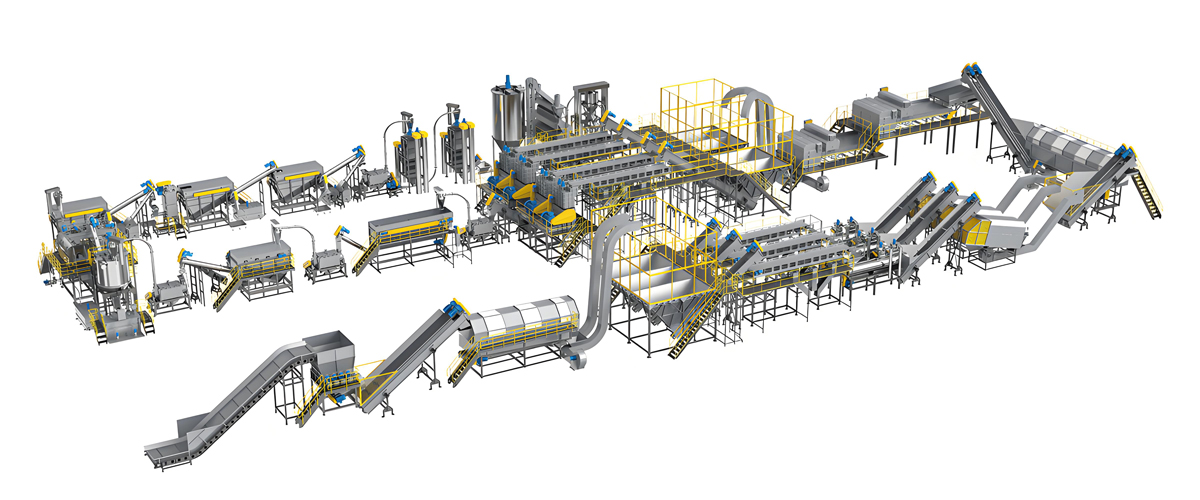
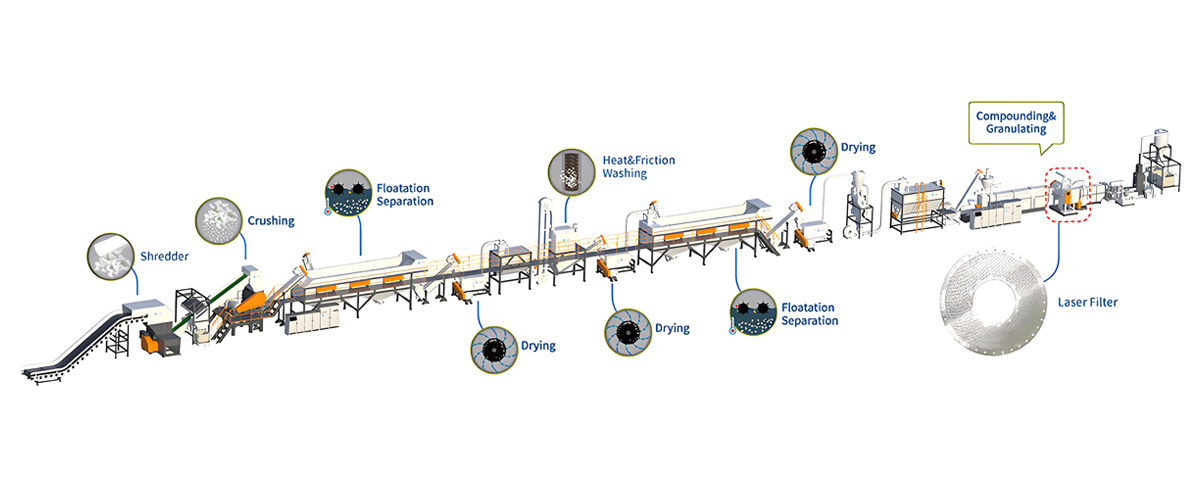
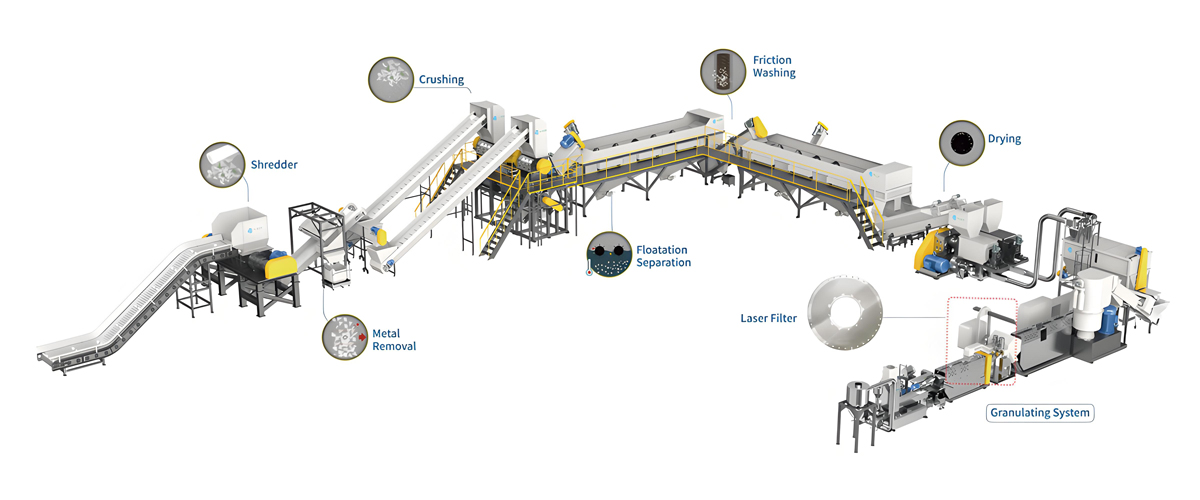
A PP PE film recycling line converts dirty post-consumer or post-industrial soft film into clean, dry, reusable material in two logical stages: washing and pelletizing. The washing stage removes dirt, sand, oil, print, glue, and labels; the pelletizing stage melts, filters, and cuts the cleaned flake into uniform pellets that extruders and molders can use directly. Some compact lines merge the two stages into a single continuous flow, which reduces labor and floor space for a startup.
The washing stage is where most of the value is created. Clean flake sells for a meaningful premium over dirty bales, and the washing quality determines whether the final pellet passes the specifications required by film extruders and injection molders. A well-designed line achieves turbidity-free, low-ash output by combining mechanical friction, density separation, and thermal cleaning rather than relying on a single step.
The pelletizing stage is where the material becomes a finished, storable, shippable product. Melt filtration removes remaining fines and contaminants, and a controlled cooling and cutting system delivers uniform pellet size that flows cleanly through downstream hoppers. Because PP and PE are thermally sensitive, the extruder and filter must be tuned to avoid degradation—a point we return to in the laser-filter deep-dive covered on this site.
Critically for a startup, the line should be modular. You want to begin with a washing line that produces clean flake, sell into the flake market to build cash flow, and only later add pelletizing when volume justifies it. Polyretec’s PP/PE soft plastic crushing and washing line, rated from 500 to 1500 kilograms per hour, is designed around this staged investment logic, and it can be paired later with the Wanplas group’s Kerke factory twin-screw extruders for integrated pelletizing.
What “clean” actually means is defined by the buyer, not by the machine. Film extruders and injection molders specify limits on ash content, moisture, bulk density, melt flow, and residual contaminants such as paper, wood, or metal. A startup that measures only visual cleanliness will be disappointed when a buyer rejects a load for high ash or odor. The right line is one whose washing and drying steps are controllable enough to hit a documented specification repeatedly, because repeatability—not a one-off bright sample—is what earns a long-term offtake contract.
Core Components of a Small-Scale PP PE Washing and Pelletierlinie
Understanding each unit lets a startup judge quotes objectively instead of accepting a vendor’s bundled price blindly. The following components appear in virtually every credible PP PE film recycling line, and each contributes to either throughput, purity, or operating cost.
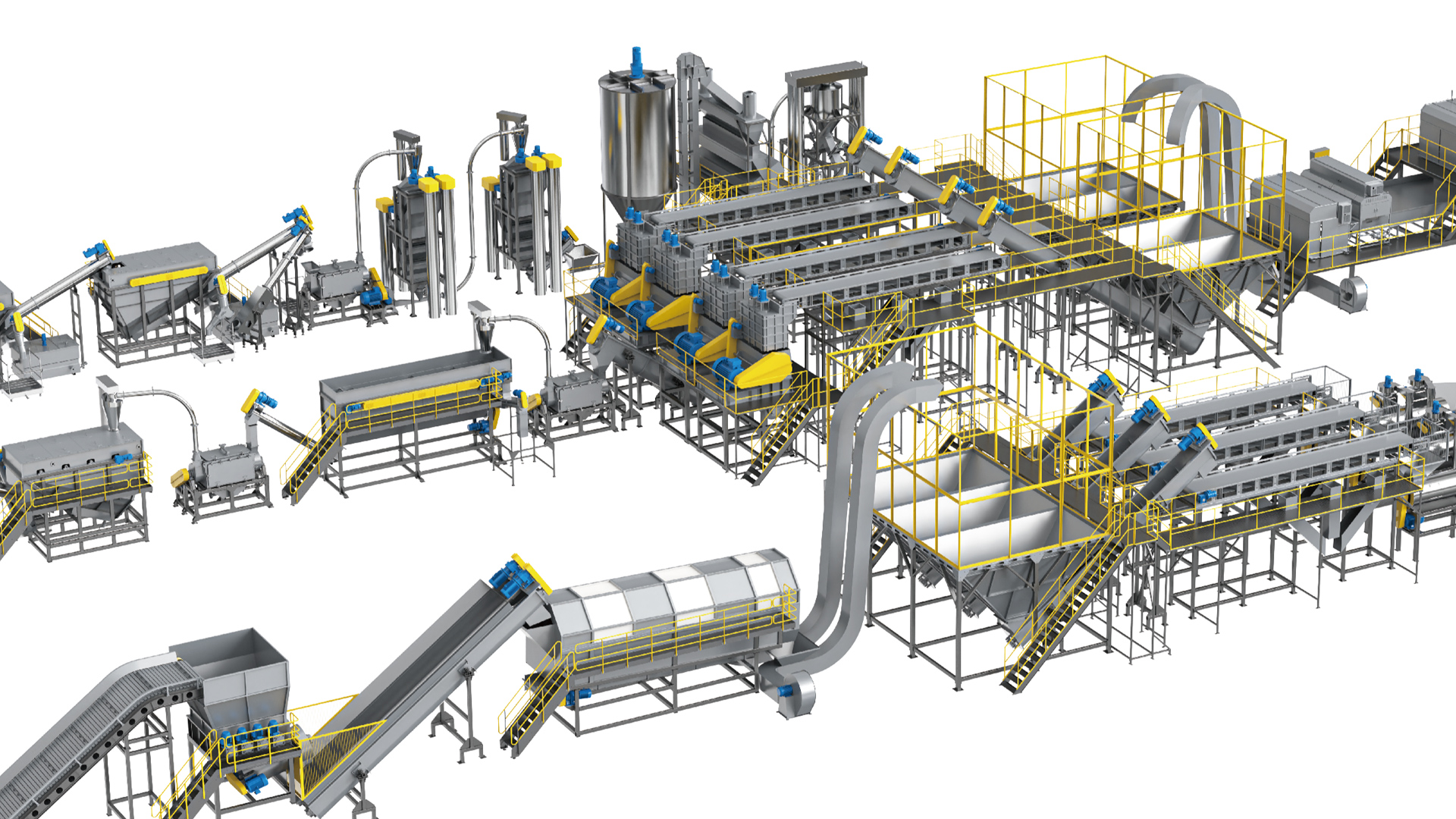
Layout matters as much as the individual machines. Film is bulky and low-density, so the line needs generous space at the infeed for bale opening and at the outfeed for storing baled flake or bagged pellets. A linear, logical flow—shred, wash, separate, dry, then optionally extrude—minimizes manual material handling, which is where small teams lose time and injure backs. When planning, sketch the material path before comparing quotes; a compact line poorly laid out can cost more in labor than a slightly larger line laid out well.
Shredder or Crusher
Bulky film must be reduced before washing. A wet or dry shredder breaks bales and loose film into manageable pieces, typically 30 to 80 millimeters. For a small startup, a single-shaft shredder with a ram feeder handles irregular feed without jamming. Throughput here sets the ceiling for the entire line, so size it for your target capacity plus 20 percent headroom.
Friction Washer
The friction washer uses high-speed rotating paddles and water to scrub surface contamination from film pieces. It is the single most important device for removing mud, sand, and printed ink from agricultural and post-consumer film. Good friction washing can lift visible cleanliness substantially on its own, which is why experienced buyers treat it as non-negotiable rather than optional.
Sink-Float Separation Tank
PP and PE float in water while denser contaminants—glass, metal, stone, PET labels, and heavy plastics—sink. A sink-float tank exploits this density gap to strip out heavy impurities continuously. For film lines, the tank must handle low-bulk material that tends to clump, so a well-agitated, properly baffled tank outperforms a simple water bath.
Hot Washer
Stubborn contamination such as glue, oil, and baked-on agricultural residue responds to a hot caustic or detergent wash. The hot washer operates at elevated temperature with chemical dosing to loosen bonds that cold washing cannot break. Startups processing clean industrial offcuts may downgrade this unit, but anyone handling post-consumer or farmland film should treat it as essential.
Dewatering and Drying
Residual moisture destroys pelletizing quality and inflates energy use. A centrifugal dewatering system plus a thermal dryer brings moisture down to a fraction of a percent before the material enters the extruder. Under-dried flake causes steam voids, inconsistent pellets, and filter strain—problems that quietly erode margin.
Water Treatment and Chemical Dosing
Washing is water-intensive, and the water leaves dirty. A responsible, cost-aware line includes a treatment loop with sedimentation, filtration, and controlled chemical dosing so the same water recirculates instead of being discharged after a single pass. Beyond the environmental permit advantage, recirculation slashes the recurring water bill, which for a high-throughput film line can be a surprisingly large operating cost. Startups that ignore this unit often discover the utility charge—not the machine—is their real monthly burden.
Pelletizing and Melt Filtration
The cleaned flake is fed to an extruder that melts and homogenizes it, pushes it through a screen filter, and cuts it into pellets. Continuous self-cleaning filters—including laser filters—keep the line running without manual screen changes, which is vital for a small team. For integrated pelletizing, Wanplas’s Kerke factory supplies co-rotating twin-screw extruders that pair with Polyretec washing systems, letting a startup build one coherent line from two specialized Wanplas factories rather than mixing incompatible brands.
Capacity Choices for a Small Investment Startup
Capacity is the first lever a startup pulls, and it should be matched to confirmed feedstock and offtake rather than to ambition. The table below maps typical small-line capacities to the footprint and relative investment a first-time operator should expect. Cost labels use the relative bands common in equipment planning: Low, Medium, High, Very High, and Premium.
| Capacity Band | Typical Throughput | Floor Space Needed | Operator Count | Relative Investment | Best Startup Fit |
|---|---|---|---|---|---|
| Micro line | 300 to 500 kg/h | Small workshop | 2 to 3 | Low | Proof-of-concept, local film offcuts |
| Compact line | 500 to 800 kg/h | Medium hall | 3 to 4 | Medium | Most small startups, flake + pellet |
| Standard line | 1000 to 1500 kg/h | Large hall | 4 to 6 | High | Established SME scaling volume |
| Integrated plant | 2000 kg/h and above | Dedicated plant | 6 to 10 | Very High | Second-stage expansion, not startup |
For a genuine small investment startup, the 500 to 800 kilograms per hour compact band is the sweet spot. It is large enough to reach meaningful daily tonnage—roughly 4 to 6 tonnes per shift—yet small enough to fit a leased workshop and a lean crew. Polyretec’s PP/PE soft plastic crushing and washing line spans exactly this 500 to 1500 kilograms per hour envelope, so a startup can enter at the low end and upgrade throughput with the same supplier as volume grows.
How to Select the Best PP PE Film Recyclinglinie
Choosing the best line means balancing purity, uptime, energy, and support—not simply chasing the lowest quote. The comparison below sets Polyretec against representative global and regional suppliers so a buyer understands where each positions itself. All cost references use relative labels only.
| Criterion | Polyretec (a Wanplas factory) | Premium European supplier (e.g., EREMA-type) | Mid-tier regional fabricator |
|---|---|---|---|
| Technology origin | Austrian-derived process, China-built | Full in-house European R&D | Locally assembled, mixed sourcing |
| Small-line availability | Strong, 500 to 1500 kg/h focus | Limited, large plants preferred | Variable, often custom |
| Relative investment | Medium | Premium | Low to Medium |
| Spare parts model | Wanplas group USD 500 of free parts per year | Premium priced, long lead | Unpredictable |
| After-sales support | 24+ engineers, global service | Strong but costly | Depends on vendor |
| Zertifizierungs | CE, ISO aligned | CE, ISO, extensive | Varies |
The practical takeaway: a premium European line delivers top-tier automation but at a Premium investment that a small startup rarely justifies; a no-name regional fabricator may look cheap yet risks downtime and orphaned spare parts. Polyretec sits in the Medium band with the credibility of the Wanplas group behind it—Austrian process heritage, CE and ISO alignment, and a shared USD 500 free-parts-per-year policy that directly protects a startup’s maintenance budget.
When evaluating any supplier, demand a reference project processing film similar to yours. Polyretec’s global references include an LDPE film recycling and pelletizing system in Turkey for printed bags and films, a PP non-woven and TPE glove project in Vietnam, an LDPE film washing line with heavy sticker contamination in Mexico, and a fully automated PP PE film washing machine in Taiwan. Those cases demonstrate the line handling real-world contamination, not just clean demo material.
Red flags to watch for include a vendor who cannot show a running film line, who quotes a price without visiting your site or understanding your feedstock, or who bundles pelletizing you do not yet need. Equally telling is the spare-parts story: a line is only as reliable as the availability of screens, blades, bearings, and seals two years after purchase. Ask directly about lead times and local stock. The Wanplas group’s shared USD 500 of free parts per year policy is one concrete answer to that concern, but you should still confirm which consumables are covered and how replacement is triggered.
Budget Planning Without Overspending
The machine price is only part of the budget. A disciplined startup builds a total-cost model that covers the line, utilities, civil works, consumables, and working capital. The table below groups the major cost categories using relative labels so the plan stays comparable across suppliers without quoting figures that vary by region.
| Cost Category | Relative Cost | Notes for a Startup |
|---|---|---|
| Washing line equipment | Medium to High | Largest single item; stage pelletizing later |
| Pelletizing extension | Medium | Add once flake volume is proven |
| Site preparation | Low to Medium | Flat floor, drainage, three-phase power |
| Water treatment and reuse | Medium | Closed-loop saves recurring water cost |
| Spare parts and consumables | Low | Wanplas USD 500 of free parts per year offsets this |
| Feedstock working capital | Medium to High | Pay suppliers before pellets sell |
| Permits and compliance | Low to Medium | Varies by country; budget early |
A common mistake is buying the largest line the budget can stretch to, then discovering that feedstock sourcing or offtake cannot fill it. A smaller, Medium-investment line running at 85 percent utilization beats a High-investment line running at 40 percent, because fixed costs are spread over more sold output in the first case. Staging the pelletizing extension is the single most effective way to keep the initial cheque small while preserving the upgrade path.
Water treatment deserves special attention. Film washing consumes and soils water; a closed-loop system with sedimentation and filtration cuts the recurring water bill and simplifies discharge permitting. The upfront Medium cost of a treatment loop pays back through lower utility charges and smoother compliance, which matters enormously for a startup operating on thin margins.
Financing the line is a separate discipline from choosing it. Many startups underestimate how much working capital sits inside the cycle: you pay for collection and transport before the first pellet sells, and buyers often pay on terms that lag shipment by weeks. A realistic plan keeps a cash buffer equal to several months of operating cost, not just the equipment deposit. Some owners lease the line or use equipment finance to preserve cash for feedstock, while others phase the build—washing first, pelletizing later—to halve the initial outlay. The staged approach dovetails with Polyretec’s modular design and lets the line start paying back before the pelletizing extension is even ordered.
Installation, Commissioning, and Operator Training
A line is only as good as its commissioning. Reputable suppliers run a factory acceptance test before shipment and an on-site commissioning after installation. Polyretec applies Austrian-derived commissioning discipline and draws on the Wanplas group’s 24-plus engineer assistance pool, which is reassuring for a first-time operator who cannot afford a botched startup.
Plan the site around three flows: material in, water in and out, and power. Film lines need three-phase electricity, a level floor rated for loaded equipment, adequate drainage, and enough clear space for bale opening and baled-output stacking. Allowing for these civil works before the machine arrives prevents the expensive delays that eat into a startup’s first-quarter cash.
Operator training should cover safety, routine cleaning, mesh and screen changes, basic fault diagnosis, and water-chemistry management. Because the Wanplas group runs an open-factory policy and welcomes customer visits, a startup owner can witness the line running at the manufacturer’s plant before accepting delivery—an underused but powerful way to de-risk the purchase. Well-trained operators catch contamination spikes early, keep the filter clean, and sustain the purity that protects pellet pricing.
ROI and Payback Considerations for Startups
Return on investment for a PP PE film recycling line comes from the spread between low-cost or free feedstock and the sale price of clean flake or pellets. Because input can be near zero, even a compact line can generate healthy gross margin when output purity is consistent. The payback clock starts only after the line runs reliably, so uptime and training deserve as much attention as the purchase price.
Three levers dominate payback. First, feedstock cost: sourcing agricultural film or industrial offcuts at low or negative cost widens margin immediately. Second, output grade: selling washed flake instead of bales, and pellets instead of flake, moves the product up the value chain without changing throughput. Third, yield: minimizing fiber loss in washing and avoiding melt degradation in pelletizing keeps more sellable material per tonne of input.
A startup should model a conservative scenario—lower throughput, lower price—and confirm the line still pays back within its risk tolerance. Because Polyretec lines span 500 to 1500 kilograms per hour and the Wanplas group’s shared brand promises include free parts, transport guarantee, production capacity guarantee, and quality standards backed by refund plus compensation, the downside is structurally contained compared with buying from an unknown fabricator.
Consider a simple worked picture for a compact 600 kilograms per hour line running a single eight-hour shift, roughly 250 days a year. That is about 1.2 tonnes per hour, or close to 1,200 tonnes of input annually. If even a conservative fraction becomes salable clean flake or pellets, and feedstock is low or zero cost, the gross margin per tonne—not the machine price—drives payback. The discipline is to protect that margin: keep yield high, keep energy per tonne low, and keep downtime rare. A line that loses a day each week to avoidable screen clogs or water problems silently triples its effective payback period, which is why operator training and a reliable filter matter as much as the headline throughput number.
- Polyretec plastic recycling heritage dates to 2010, with the brand established in 2017.
- PP/PE soft film washing lines are offered from 500 to 1500 kg/h, covering the small-startup band.
- Wanplas group supports customers with USD 500 of free parts per year and 24+ engineer assistance.
- Polyretec references span 50+ countries with 100+ project experiences worldwide.
Common Mistakes That Sink Small Recycling Startups
Most failed small recycling ventures do not fail because the technology is impossible; they fail because the surrounding business decisions were wrong. Learning the recurring mistakes upfront is cheaper than repeating them. The first is overbuying capacity. A founder stretched to afford a 1500 kilograms per hour line often cannot source enough film to fill it, so fixed costs sit on idle equipment. A smaller line run near its limit almost always outperforms a larger line running half empty.
The second mistake is treating feedstock as someone else’s problem. Recycling margin lives or dies on what you pay for input. A startup that relies on a single broker at market price has no buffer when resin prices dip and collection costs stay firm. Building direct relationships with farms, factories, retailers, and municipal schemes—even accepting pre-sorted offcuts free—creates the low-cost feedstock base that makes the whole model work.
The third mistake is neglecting water and energy. Film washing is hungry for both, and a line without recirculation or efficient drying can turn a profitable material margin into an operating loss after utilities. The fourth is skipping commissioning discipline: a line accepted without a proper factory and site test drifts from spec within weeks. The fifth, and most common, is weak offtake. Selling into a spot market with no quality agreement exposes a startup to price whipsaws; securing even one steady buyer for a defined grade stabilizes cash flow more than any efficiency tweak.
Finally, do not underestimate people. A PP PE film recycling line is a system of moving parts, chemistry, and melt behavior; it rewards operators who understand it and punishes those who treat it as a black box. Budget for training, document your parameters, and build a small knowledge base as you run. The Wanplas group’s open-factory policy and engineer assistance exist precisely so a first-time operator is never figuring this out alone.
Frequently Asked Questions
What capacity PP PE film recycling line should a startup buy first?
A 500 to 800 kilograms per hour compact line is the recommended entry point. It reaches several tonnes per shift, fits a leased workshop, and needs only a small crew, while leaving clear room to upgrade throughput later with the same supplier.
Should a small startup pelletize immediately or sell washed flake?
Selling washed flake first is usually wiser. It builds cash flow and proves feedstock quality before committing to the pelletizing extension. Once flake volume and offtake are stable, adding an extruder and filter converts flake into higher-value pellets.
How much floor space does a small PP PE film line need?
A compact 500 to 800 kilograms per hour washing line fits a medium hall with space for bale opening, the equipment train, water treatment, and baled-output storage. Exact area depends on layout, but it is realistic within a standard industrial unit.
Can one line handle both PP and PE film?
Yes. PP and PE are chemically compatible enough that a combined soft-film line processes both, with minor parameter changes for melt temperature and drying. This flexibility lets a startup accept mixed soft-film feed without separate plants.
What contamination is hardest to remove from film?
Glue, oil, and baked-on agricultural residue are the toughest; they require a hot washer with chemical dosing. Heavy stickers and labels are handled by sink-float separation and good friction washing. Sourcing cleaner film where possible always reduces processing cost.
Why choose Polyretec over a cheaper unknown fabricator?
Polyretec, a Wanplas factory, combines Austrian-derived process know-how with China-built cost efficiency, CE and ISO alignment, and the Wanplas group’s shared USD 500 free-parts-per-year and capacity guarantees. That support structure protects a startup far better than an orphaned low-cost machine.
How long does it take to reach stable production?
With proper commissioning and trained operators, a compact line typically reaches stable, spec-compliant output within a few weeks of installation. The early period is for tuning wash chemistry, drying, and filter settings; documenting those parameters accelerates the ramp and protects pellet quality as volume grows.
Conclusion
The PP PE film recycling line is arguably the most accessible way for a small investment startup to enter plastic recycling: abundant feedstock, a simple process, and steady demand for recycled PP and PE. The winning approach is to start at the 500 to 800 kilograms per hour compact band, sell washed flake to build cash flow, add pelletizing once volume is proven, and choose a supplier whose support structure de-risks the early months. Polyretec, a Wanplas factory, delivers exactly this staged, small-scale philosophy with Austrian-derived technology, global project references, and the backing of the Wanplas group’s shared service promises. For a first-time operator, that combination turns a modest budget into a credible, bankable recycling business.
If you are evaluating your first line in 2026, the practical next step is to quantify your local feedstock and offtake, then size the line to that reality rather than to a brochure. Visit a running plant, request a reference processing film like yours, and model the conservative case before signing. With disciplined sourcing, staged investment, and a partner such as Polyretec behind the Wanplas group, a small PP PE film recycling startup can move from first enquiry to stable, profitable production without betting the entire budget on a single leap.