
1. Introduction to Food Grade PET Recycling and Austrian-Grade Recycling Technology
Global plastic circular economy development has pushed food-grade PET recycling into a core position in the packaging and food manufacturing industry. PET plastic, widely used in beverage bottles, food containers, and pharmaceutical packaging, features high transparency, stable chemical properties, and excellent moldability. However, massive post-consumer PET waste has caused severe environmental pressure and resource waste. Professional food-grade PET recycling lines can process waste PET bottles into high-purity food-contact RPET flakes and pellets, which can be reused for new food packaging production, realizing a closed-loop circular economy for plastic resources.
Austrian plastic recycling technology is globally recognized for its high precision, low energy consumption, deep purification performance, and strict safety control standards. Different from ordinary civil-grade plastic recycling equipment that only meets basic waste sorting and cleaning requirements, Austrian standard recycling systems focus on ultra-clean purification, impurity removal precision, and food-grade safety compliance throughout the entire production process. This advanced technical standard has become the benchmark for high-end food-grade plastic recycling worldwide, effectively solving the problems of incomplete impurity removal, excessive chemical residue, and unstable product quality in traditional PET recycling production.
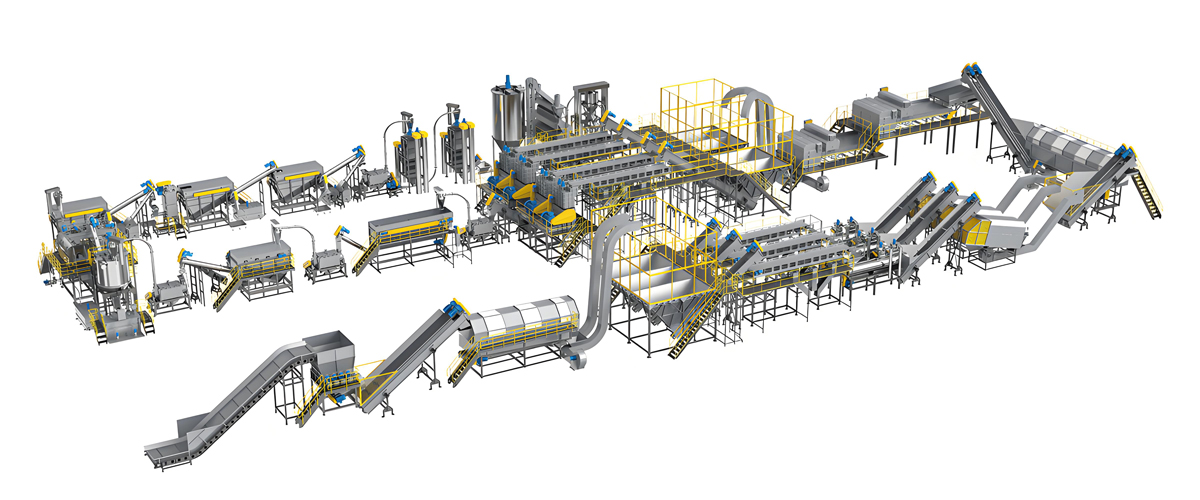
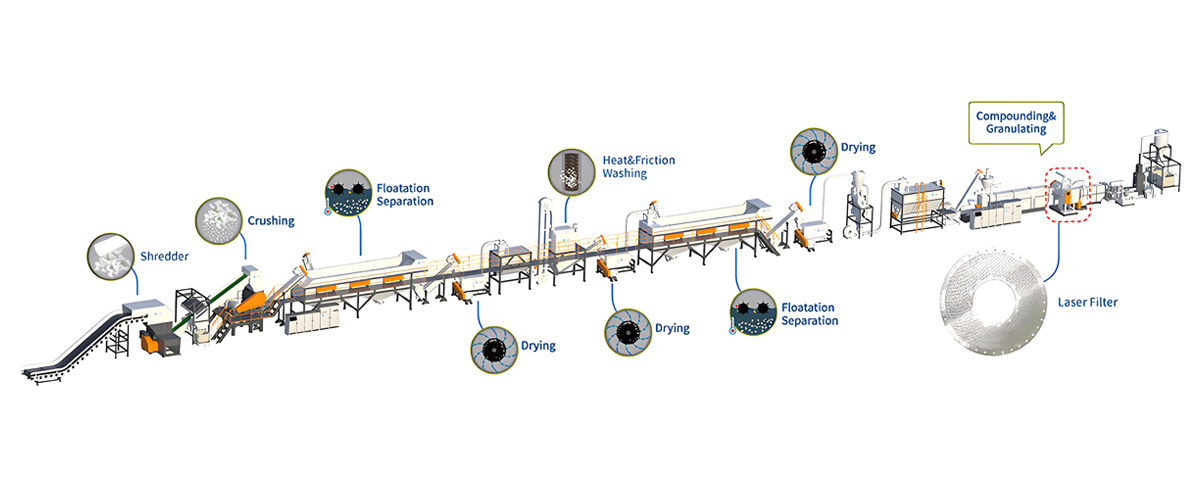
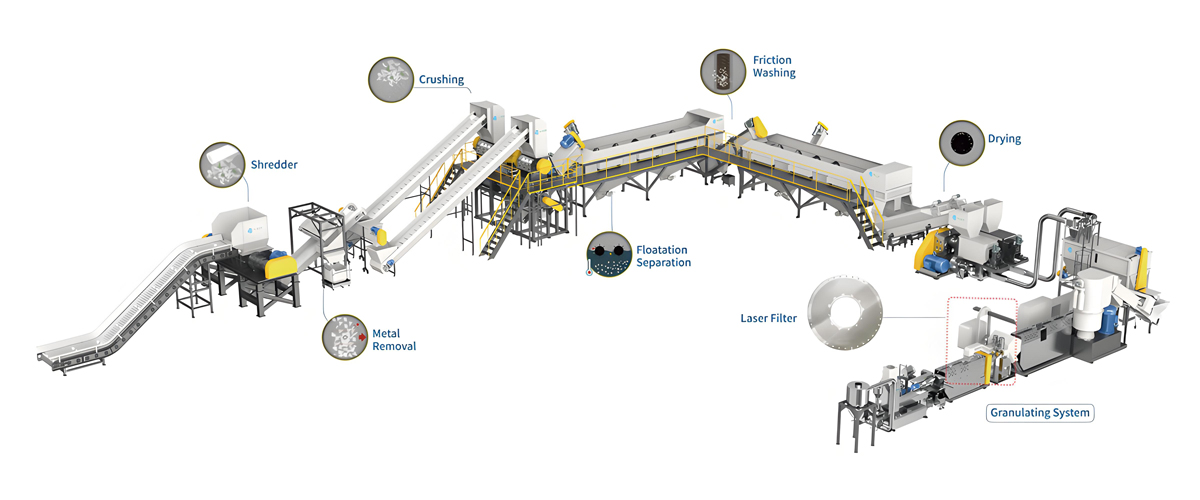
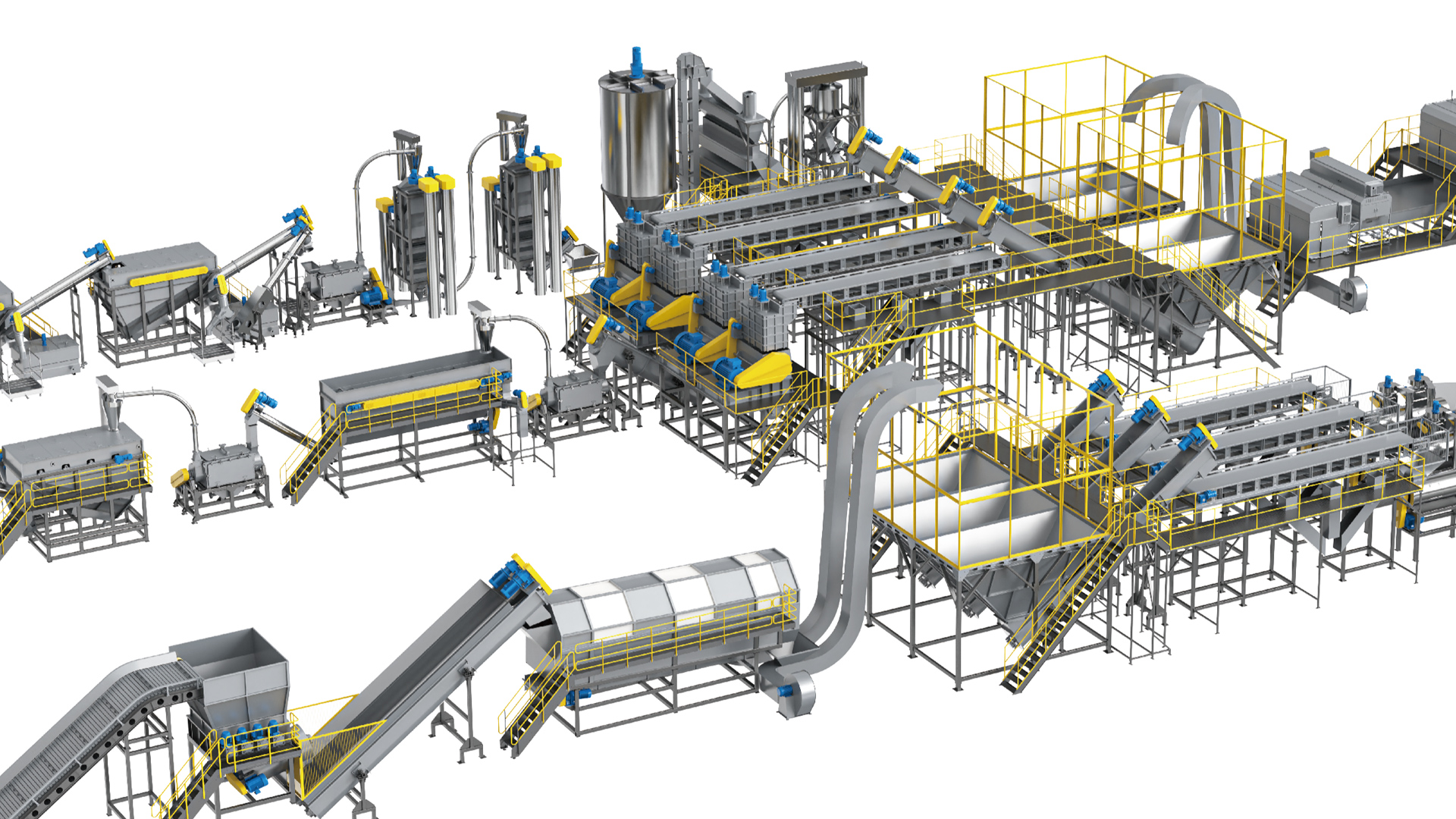
POLYRETEC independently develops and manufactures Austrian tech food-grade PET recycling lines with complete CE certification, fully inheriting core Austrian recycling process principles and intelligent control technology. The production line is specially optimized for food-contact RPET material production, covering full-process procedures from waste PET bottle sorting, de-labeling, crushing, multi-stage deep cleaning, high-temperature sterilization, dehydration, and fine sorting to final food-grade flake molding. All equipment modules comply with European machinery safety standards and food material purification specifications, helping recycling enterprises produce qualified food-grade recycled PET materials and obtain international market access qualifications. This article comprehensively analyzes the technical advantages, complete working process, compliance standards, project cost and price budget, failure troubleshooting, and industry application value of POLYRETEC CE-certified food-grade PET recycling lines, providing systematic commercial and technical guidance for plastic recycling enterprises.
2. Core Definition and Industry Standards of Food-Grade PET Recycling
2.1 Differences Between Food-Grade and Ordinary PET Recycling
Ordinary PET recycling lines are mainly used to produce industrial-grade recycled materials for chemical fibers, plastic accessories, and non-food contact products, with low requirements for impurity content, residual dirt, and chemical pollutants. In contrast, food-grade PET recycling requires recycled RPET materials to directly contact food products, so the whole production process must eliminate all potential safety hazards. Food-grade recycled PET flakes must achieve ultra-low impurity rate, zero harmful chemical residue, zero microbial contamination, and stable physical and chemical properties, which are far higher than industrial recycling standards.
Traditional recycling equipment can only remove surface stains and large particle impurities, unable to eliminate hidden pollutants such as residual beverage liquid, grease, adhesive residue from labels, and micro-molecular chemical precipitates. POLYRETEC Austrian tech recycling line adopts multi-stage deep purification and high-temperature sterile cleaning technology, which completely removes micro-impurities and chemical residues, ensuring that the final RPET products fully meet food-contact safety requirements and can be used for secondary food packaging production.
2.2 International Food-Grade Recycling Zertifizierung Standards
Qualified food-grade RPET materials must comply with multiple international authoritative certification standards. EU food contact material regulations strictly restrict the heavy metal content, volatile organic compounds, and microbial indicators of recycled PET materials. FDA food safety standards in the United States require recycled plastic containers to have no toxic precipitation under long-term food storage conditions. As a core qualification for European market access, CE certification verifies that the equipment’s mechanical safety, electrical performance, production stability, and environmental protection indicators meet EU unified standards.
POLYRETEC food-grade PET recycling line has passed complete CE mechanical safety certification and food-grade production process certification. The whole machine’s structural design, electrical control system, safety protection device, and waste water treatment system all comply with EU standard specifications. Enterprises using POLYRETEC certified lines can smoothly complete food-grade RPET product certification and gain competitive advantages in the high-end recycled plastic market.
2.3 Application Scope of Food-Grade RPET Products
High-purity food-grade RPET materials processed by professional recycling lines can be widely used in high-value food packaging fields, including new beverage bottles, honey jars, food storage containers, cosmetic packaging, and pharmaceutical outer packaging. Unlike low-value industrial recycled plastics, food-grade RPET has high market unit price and stable market demand, bringing higher profit margins for recycling enterprises. With the global ban on single-use plastics and the promotion of circular economy policies, the market demand for certified food-grade recycled PET materials continues to grow, making professional CE-certified recycling lines core competitive equipment for the plastic recycling industry.
3. Core Technical Advantages of POLYRETEC Austrian Tech PET Recyclinglinie
3.1 Inherited Austrian High-Precision Purification Technology
POLYRETEC food-grade PET recycling line fully adopts Austrian advanced layered purification and graded cleaning technology, breaking through the technical bottleneck of single cleaning mode of traditional equipment. The production line sets up multiple independent purification stations for different types of pollutants, realizing targeted removal of surface dirt, label adhesive residue, organic grease, micro-particle impurities, and microbial bacteria. The layered purification process ensures that each cleaning procedure solves specific pollution problems, avoiding incomplete purification caused by mixed cleaning in traditional processes.
Equipped with intelligent precise sorting technology, the line can accurately identify and separate mixed materials such as HDPE, PVC, paper scraps, and metal impurities in waste PET bottles. The sorting precision reaches 99.9%, effectively avoiding mixed material pollution that affects food-grade standards. The whole purification process realizes physical zero-chemical deep cleaning, without adding harmful chemical cleaning agents, ensuring the safety and environmental protection of recycled materials while meeting food-grade requirements.
3.2 Complete CE Zertifizierung and Full Safety Compliance
Every set of POLYRETEC food-grade PET recycling line undergoes strict EU standard testing and obtains complete CE certification, covering mechanical safety, electrical safety, hydraulic system safety, and environmental protection emission indicators. The equipment is equipped with full-cycle safety protection devices, including emergency stop protection, overload automatic shutdown, closed dust removal system, and noise reduction structure, eliminating mechanical safety hazards in the production process.
In terms of production environmental protection, the line supports closed circulating water recycling treatment, with wastewater reuse rate up to 90%, meeting EU environmental emission standards. The low-noise operation design and closed dust collection system avoid workshop environmental pollution, helping enterprises meet international environmental assessment standards and obtain green production qualifications. The standardized certified design enables the equipment to adapt to global market access requirements, suitable for recycling project investment in Europe, America, Southeast Asia, and other regions.
3.3 Intelligent Automated Full-Cycle Production
Different from semi-automatic traditional recycling lines that require a large number of manual operations, POLYRETEC Austrian tech PET recycling line realizes full-process unmanned automated production from raw material feeding to finished product output. The intelligent centralized control system uniformly regulates the operating parameters of each module, including feeding speed, crushing particle size, cleaning temperature, sorting accuracy, and dehydration strength. The system supports real-time parameter monitoring and automatic fault alarm, effectively reducing manual operation errors and improving production stability.
The modular integrated design simplifies equipment structure and improves production efficiency. The whole line can complete continuous feeding, automatic de-labeling, precise crushing, multi-stage floating cleaning, high-temperature sterilization, automatic dehydration, and fine color sorting in one cycle. The hourly processing capacity is stable, and the finished food-grade flake purity is uniform, with batch quality consistency far exceeding traditional equipment.
3.4 Low Energy Consumption and High Raw Material Utilization Rate
Optimized based on Austrian energy-saving technology, POLYRETEC recycling line reduces comprehensive energy consumption by 25% compared with ordinary domestic recycling lines. The frequency conversion speed regulation system adjusts equipment power according to production load, avoiding invalid energy consumption. The efficient circulating water system reduces water resource waste, and the optimized crushing and cleaning structure reduces material loss in the production process.
The raw material utilization rate of the whole line reaches 98%, which is 6% to 10% higher than the industry average. It effectively reduces the waste of waste PET raw materials in the recycling process, greatly improving the economic benefits of the project while realizing resource recycling. The low operating cost and high yield advantage make the equipment have ultra-high cost performance in long-term mass production.
4. Complete Working Process of POLYRETEC Food-Grade PET Recyclinglinie
4.1 Raw Material Pre-Sorting and Debagging Treatment
The first step of food-grade PET recycling is standardized raw material pretreatment. Waste PET bottles recovered from the market are mostly bundled and mixed with impurities such as waste paper, plastic bags, and metal sundries. POLYRETEC supporting automatic debagging machine automatically breaks bundled raw materials, and the preliminary screening system removes large foreign impurities to ensure the uniformity of subsequent feeding materials. This step avoids large impurities entering the crushing system and causing equipment blockage or material pollution.
After debagging, the manual auxiliary sorting platform further removes severely polluted, deteriorated, and non-PET mixed bottles to ensure that the raw material purity meets the pre-production standards of food-grade recycling. Strict raw material screening is the primary guarantee for producing qualified food-grade RPET materials.
4.2 Automatic De-Labeling and Impurity Pre-Removal
Bottle label paper and adhesive residues are the main sources of organic pollutants in PET recycling. POLYRETEC high-efficiency de-labeling machine adopts high-speed friction and air separation technology to completely strip label paper on PET bottle surfaces. The integrated wind selection system automatically separates label paper, dust, and light impurities from PET bottles, realizing efficient pre-purification of raw materials.
Different from traditional single friction de-labeling, the equipment is equipped with secondary residue removal function, which can effectively remove residual adhesive on the bottle surface, reduce organic residue pollution in subsequent cleaning processes, and lay a foundation for deep food-grade purification.
4.3 Precision Crushing and Particle Shaping
The qualified PET bottles after de-labeling enter the high-precision crushing module. POLYRETEC customized crushing cutter head adopts Austrian precision processing technology, with uniform cutting force and stable particle forming. The equipment can crush waste bottles into standard 8mm to 12mm uniform flakes according to production requirements. The uniform flake size ensures consistent cleaning effect in subsequent multi-stage cleaning processes, avoiding incomplete cleaning of oversized flakes and excessive loss of undersized flakes.
The closed crushing structure prevents dust and debris from overflowing, ensuring workshop cleanliness and avoiding secondary pollution of PET flakes during crushing. The high-strength wear-resistant cutter head has long service life and low replacement frequency, reducing equipment maintenance costs.
4.4 Multi-Stage Deep Floating Cleaning and Sterilization
This link is the core process to realize food-grade standards. POLYRETEC recycling line adopts four-stage graded cleaning process, including pre-washing, high-temperature alkali washing, fine floating washing, and sterile pure water rinsing. The pre-washing stage removes surface floating dust and residual beverage stains; the high-temperature alkali washing stage heats up to 85℃ to decompose and remove organic grease, adhesive residue, and bacterial microorganisms on the flake surface; the fine floating washing stage uses the density difference of different plastics to thoroughly separate residual HDPE, PVC and mixed impurities; the final pure water rinsing removes residual cleaning agents and tiny pollutants.
The whole cleaning process adopts physical purification combined with food-grade harmless cleaning agents, which can completely eliminate microbial colonies and chemical residues on PET flakes. After multi-stage cleaning, the flake cleanliness fully meets EU and FDA food-contact material standards, realizing food-grade purification requirements.
4.5 High-Efficiency Dehydration and Drying Treatment
The cleaned wet PET flakes contain a large amount of moisture, which will affect subsequent sorting and storage quality. POLYRETEC high-speed centrifugal dehydration machine removes surface moisture through high-speed rotation, with dehydration rate up to 99%. The low-temperature constant-temperature drying system further removes internal residual moisture of flakes, controlling the final moisture content below 0.03%, avoiding mildew and bacterial growth during material storage, and ensuring the stability of food-grade materials.
4.6 Intelligent Fine Color Sorting and Finished Product Output
The final fine sorting link ensures the uniformity of finished food-grade flakes. The intelligent color sorting system accurately identifies and removes heterochromatic flakes, residual impurity flakes, and unqualified purified flakes, ensuring that the finished products are uniform in color and pure in texture. The qualified food-grade PET flakes are automatically packaged and stored, which can be directly used for food container production or further granulation processing.
5. Project Cost and Detailed Price Analysis of POLYRETEC Food-Grade PET Recyclinglinie
5.1 Complete Equipment Procurement Price Budget
POLYRETEC Austrian tech CE-certified food-grade PET recycling lines are divided into small, medium, and large models according to processing capacity, with standardized and transparent pricing, adapting to different scale investment projects. The small-scale food-grade recycling line with hourly processing capacity of 300kg to 500kg is priced from $52,000 to $60,000. This model is compact in structure, fully automatic in operation, and meets the food-grade purification standard, suitable for small and medium-sized recycling enterprises and start-up food-grade plastic recycling projects.
The medium-sized standard production line with hourly processing capacity of 800kg to 1000kg is priced from $68,000 to $78,000. It is equipped with complete four-stage deep cleaning and intelligent sorting system, with stable batch production quality and high finished product qualification rate, which is the mainstream model for commercial food-grade PET recycling projects.
The large-scale high-efficiency intelligent production line with hourly processing capacity of 1500kg to 2000kg is priced from $85,000 to $98,000. It supports 24-hour uninterrupted continuous production, with intelligent parameter self-optimization and remote monitoring functions, suitable for large-scale circular economy industrial parks and high-end recycled plastic processing enterprises.
5.2 Daily Operation and Raw Material Cost Analysis
In terms of power consumption cost, POLYRETEC frequency conversion energy-saving equipment reduces power consumption significantly. The daily power consumption cost of small-scale lines is about $35 to $45, medium-sized lines about $60 to $75, and large-scale lines about $90 to $110. The supporting circulating water recycling system has a water reuse rate of 90%, and the daily water replenishment cost is controlled within $10 to $20, with extremely low water resource consumption.
The raw material cost of waste PET bottles varies with market fluctuations, with the average market recycling price of waste PET raw materials ranging from $0.28 to $0.35 per kilogram. After processing by POLYRETEC food-grade recycling line, the market selling price of qualified food-grade PET flakes reaches $0.85 to $1.1 per kilogram, with huge profit margins. The equipment’s high raw material utilization rate effectively reduces unit processing loss and further improves project profit space.
5.3 Equipment Maintenance and Labor Cost Budget
POLYRETEC modular equipment design greatly reduces daily maintenance difficulty and cost. The annual comprehensive maintenance cost including wearing part replacement, system calibration, and equipment lubrication is about $1,500 to $2,200, far lower than the maintenance cost of traditional European imported equipment. The core components have long service life, stable performance, and low failure rate, avoiding frequent shutdown maintenance losses.
The fully automated production mode greatly saves labor costs. A single small and medium-sized production line only requires 1 to 2 operators for auxiliary feeding and inspection, and the daily labor cost is controlled within $80 to $120. Compared with semi-automatic traditional lines that require 4 to 6 workers, it saves more than 60% of labor costs annually.
5.4 Project Investment Recovery Cycle Analysis
Benefiting from high product added value and low comprehensive operating costs, the investment recovery cycle of POLYRETEC food-grade PET recycling project is stable and efficient. For small-scale projects, the average investment recovery cycle is 13 to 16 months; for medium-sized standard commercial projects, the recovery cycle is 11 to 14 months; for large-scale mass production projects with stable order resources, the recovery cycle can be shortened to 9 to 12 months.
Compared with ordinary industrial-grade recycling projects with low product profit and long recovery cycle, food-grade RPET recycling projects supported by CE-certified Austrian tech lines have stronger anti-risk ability and more stable long-term income, which is the preferred investment direction for high-value plastic circular economy projects.
5.5 Hidden Loss Comparison of Non-Certified Ordinary Recyclinglinies
Investing in ordinary non-certified PET recycling lines can only produce low-value industrial-grade recycled materials, with low market unit price and fierce homogeneous competition. Such equipment cannot meet food-grade purification standards, cannot pass international safety certification, and cannot enter the high-end food packaging material market. In addition, ordinary lines have high defective rate, high material loss, and high energy consumption, resulting in long-term hidden cost losses.
Taking an annual output of 800 tons of recycled flakes as an example, the annual profit gap between food-grade qualified products and industrial-grade products is as high as $45,000 to $60,000. Adopting POLYRETEC CE-certified Austrian tech recycling lines can completely avoid market threshold limitations and profit losses, realizing high-value utilization of waste PET resources.
6. Common Production Defects and Professional Solutions for Food-Grade PET Recycling
6.1 Unqualified Flake Cleanliness and Residual Impurities
Insufficient cleaning and residual micro-impurities are the most common problems in food-grade PET recycling, mainly caused by incomplete grading cleaning and insufficient sterilization temperature. Unclean flakes cannot pass food-grade safety testing and can only be downgraded to industrial materials, seriously affecting project economic benefits.
POLYRETEC four-stage graded deep cleaning system solves this problem fundamentally. The independent temperature control and flow regulation system of each cleaning stage ensures targeted removal of different pollutants. The high-temperature circulating sterilization process eliminates residual organic substances and microorganisms, ensuring that the flake cleanliness meets food-grade standards stably for a long time.
6.2 Mixed Impurity Residue and Unqualified Purity
Mixed materials such as PVC, HDPE, and metal impurities mixed in raw materials will cause finished product purity failure and affect food safety. Traditional equipment has low sorting accuracy and is prone to mixed material leakage. POLYRETEC multi-stage physical sorting + intelligent color sorting dual system realizes secondary precise screening of impurities, completely removing non-PET mixed materials and ensuring 99.9% purity of finished food-grade flakes.
6.3 Excessive Flake Moisture and Mold Growth
Excessive residual moisture in finished flakes will lead to mildew, bacterial growth, and material deterioration during storage, failing food-grade safety indicators. The high-efficiency centrifugal dehydration and constant-temperature drying system of POLYRETEC equipment precisely controls material moisture content, avoiding moisture residue from the source and ensuring long-term storage stability of food-grade recycled materials.
6.4 Uneven Particle Size and Unstable Batch Quality
Uneven crushing particle size leads to inconsistent cleaning effect of flakes, resulting in unstable batch product quality. POLYRETEC high-precision constant-speed crushing system ensures uniform flake particle size for each batch of materials. The locked intelligent parameter system ensures consistent production standards for each cycle, realizing stable batch quality of food-grade products.
7. CE Zertifizierung and Food-Grade Compliance Advantages
7.1 EU CE Mechanical Safety Zertifizierung Advantages
POLYRETEC food-grade PET recycling line has passed full EU CE machinery safety certification, covering equipment mechanical structure safety, electrical system safety, hydraulic protection, and emergency response functions. All safety indicators comply with EU 2006/42/EC machinery directive standards. The complete certification qualification enables the equipment to be legally sold and operated in all EU member states and European markets, eliminating market access barriers for export projects.
7.2 Food-Grade Production Process Compliance
The whole production process of the equipment meets international food-contact material production specifications. The cleaning water system, production contact materials, and purification process do not produce any harmful substances, ensuring that recycled PET flakes do not have chemical precipitation or microbial pollution. Enterprises using POLYRETEC lines can quickly complete food-grade product certification and obtain high-end market sales qualifications.
7.3 Environmental Protection Emission Compliance Standards
The equipment’s closed circulating water treatment system, dust removal system, and noise reduction structure meet international environmental protection emission standards. No waste water overflow, dust pollution, or excessive noise occurs during production, helping enterprises pass environmental assessment certification smoothly, meet green production requirements, and avoid environmental supervision penalties.
8. Core Application Scenarios and Market Value
8.1 Food and Beverage Packaging Raw Material Production
The food-grade RPET flakes produced by POLYRETEC recycling line can be directly used for the production of new food bottles, beverage packaging containers, and food storage jars, realizing bottle-to-bottle closed-loop recycling. This high-value recycling mode complies with global food plastic circular economy policies and has stable long-term order demand.
8.2 High-End Environmental Protection Plastic Product Manufacturing
Qualified food-grade recycled materials can also be used for high-end daily plastic products, cosmetic packaging, and pharmaceutical auxiliary packaging production, with wide application range and high product added value, helping enterprises expand diversified market business.
8.3 Circular Economy Project Supporting Construction
CE-certified high-standard recycling lines are core supporting equipment for plastic circular economy industrial parks and environmental protection recycling projects. The standardized and certified production mode helps enterprises obtain government environmental protection project subsidies and policy support, improving project comprehensive income.
8.4 Industry Competitive Advantages
Compared with ordinary uncertified recycling equipment on the market, POLYRETEC Austrian tech food-grade PET recycling lines have absolute advantages in safety certification, purification precision, product quality, and market access qualification. The equipment solves the pain points of low recycling value, unqualified safety standards, and narrow market scope of traditional recycling equipment, helping enterprises occupy the high-end food-grade recycled plastic market and build core competitive advantages.
9. Daily Operation and Standard Maintenance Specificationenen
9.1 Daily Standard Operation Procedures
Before equipment startup, operators need to check the tightness of mechanical parts, the stability of electrical system parameters, the water level of circulating water system, and the cleanliness of the crushing and cleaning modules to ensure no abnormal hidden dangers. During production, real-time monitoring of cleaning temperature, sorting accuracy, and material drying status is required, with regular sampling and testing of finished product cleanliness to ensure stable food-grade quality.
After daily shutdown, thoroughly clean the residual materials and dirt inside the equipment, drain and clean the circulating water tank regularly to avoid bacterial growth and residual pollution, ensuring the sanitation and stability of the equipment for subsequent production.
9.2 Regular Equipment Calibration and Maintenance
Regularly calibrate the equipment’s temperature control system, sorting precision system, and crushing particle size parameters every month to maintain long-term production accuracy. Regularly inspect and replace vulnerable parts such as cutter heads, sealing rings, and filter screens to avoid equipment failure affecting production quality. Regularly lubricate mechanical transmission parts to reduce wear and extend equipment service life.
9.3 Seasonal Maintenance and Long-Term Preservation
Carry out comprehensive equipment inspection and maintenance every quarter, including electrical circuit detection, water pipeline cleaning, and system parameter resetting. For long-term shutdown equipment, conduct anti-rust treatment and closed preservation to avoid equipment aging and performance degradation, ensuring that the equipment can quickly restore stable production status after startup.
10. Industry Development Trends of Food-Grade PET Recycling
With the continuous improvement of global plastic pollution control policies and circular economy development requirements, low-value crude plastic recycling is gradually phased out, and high-standard food-grade refined recycling has become the core development trend of the industry. International market supervision on recycled plastic safety and certification is becoming increasingly strict, and only CE-certified, food-grade compliant high-precision recycling lines can meet future market development needs.
Intelligent, energy-saving, and high-purification recycling equipment will become the mainstream configuration of the industry. Relying on Austrian advanced recycling technology and standardized certification system, POLYRETEC continues to optimize equipment purification performance, intelligent control level, and energy-saving efficiency, helping global recycling enterprises realize high-value, standardized, and green plastic recycling production, and promoting the healthy development of the food-grade plastic circular economy industry.
11. Conclusion
Austrian tech food-grade PET recycling lines with complete CE certification are essential core equipment for high-value closed-loop recycling of waste food-grade PET plastics. POLYRETEC professional recycling equipment inherits advanced Austrian purification technology, adopts full-process intelligent automated production, and meets international food safety and mechanical certification standards, perfectly solving the problems of low purification precision, unqualified safety standards, and low product added value of traditional recycling equipment.
The equipment has significant advantages in production precision, safety compliance, energy-saving efficiency, and comprehensive project cost control. It can stably produce high-purity food-grade RPET materials that meet EU and FDA standards, covering high-end fields such as food packaging and environmental protection plastic products. Reasonable project price positioning and short investment recovery cycle make the equipment have ultra-high cost performance and market promotion value.
For plastic recycling enterprises investing in high-standard circular economy projects, selecting POLYRETEC CE-certified Austrian tech food-grade PET recycling line is the key to breaking through low-end homogeneous competition, obtaining international market access qualifications, and realizing high-profit operation. With the continuous upgrading of the recycled plastic industry, professional certified high-precision recycling equipment will become the standard configuration of the industry, leading the standardized and high-quality development of the global food-grade PET recycling field.