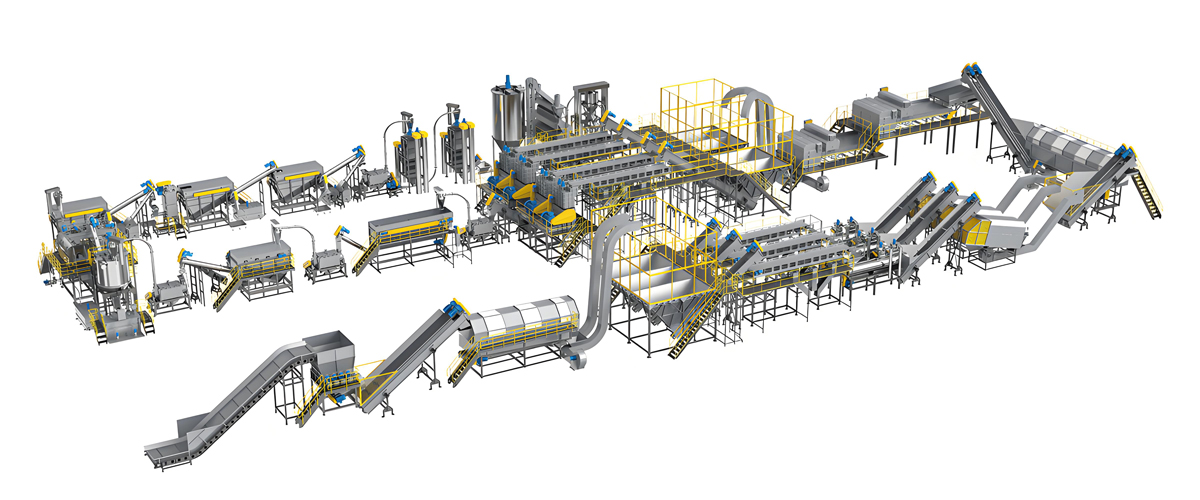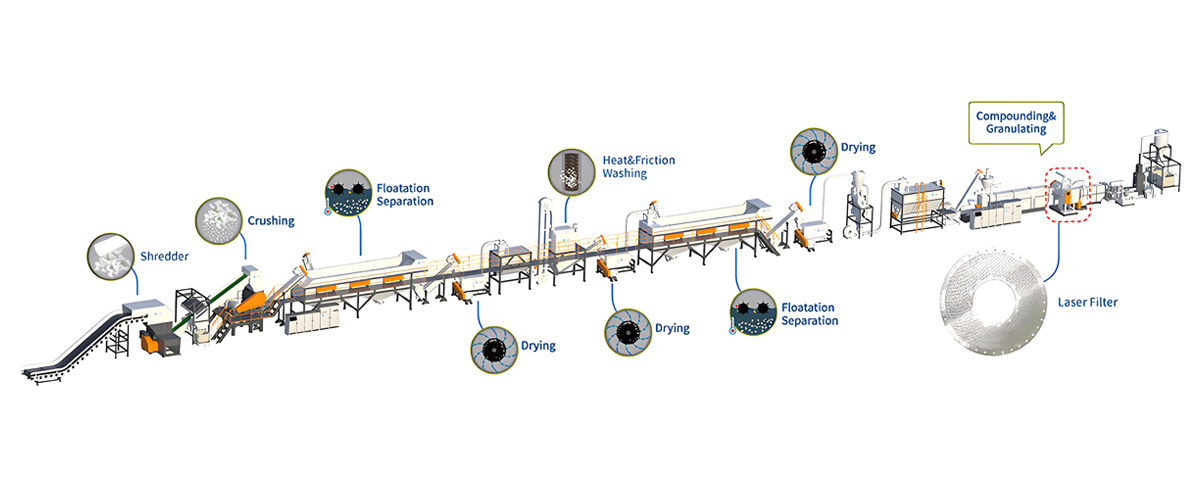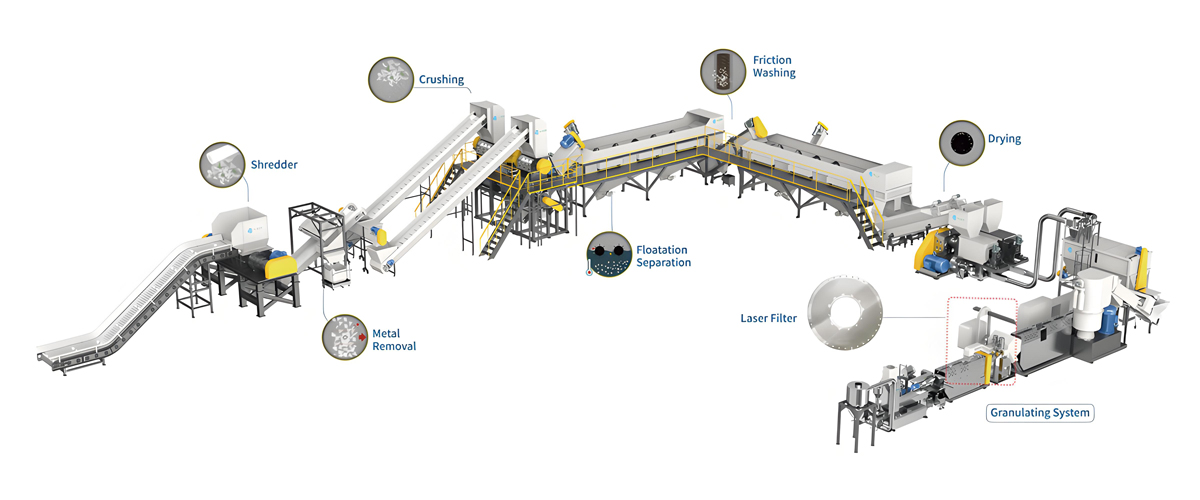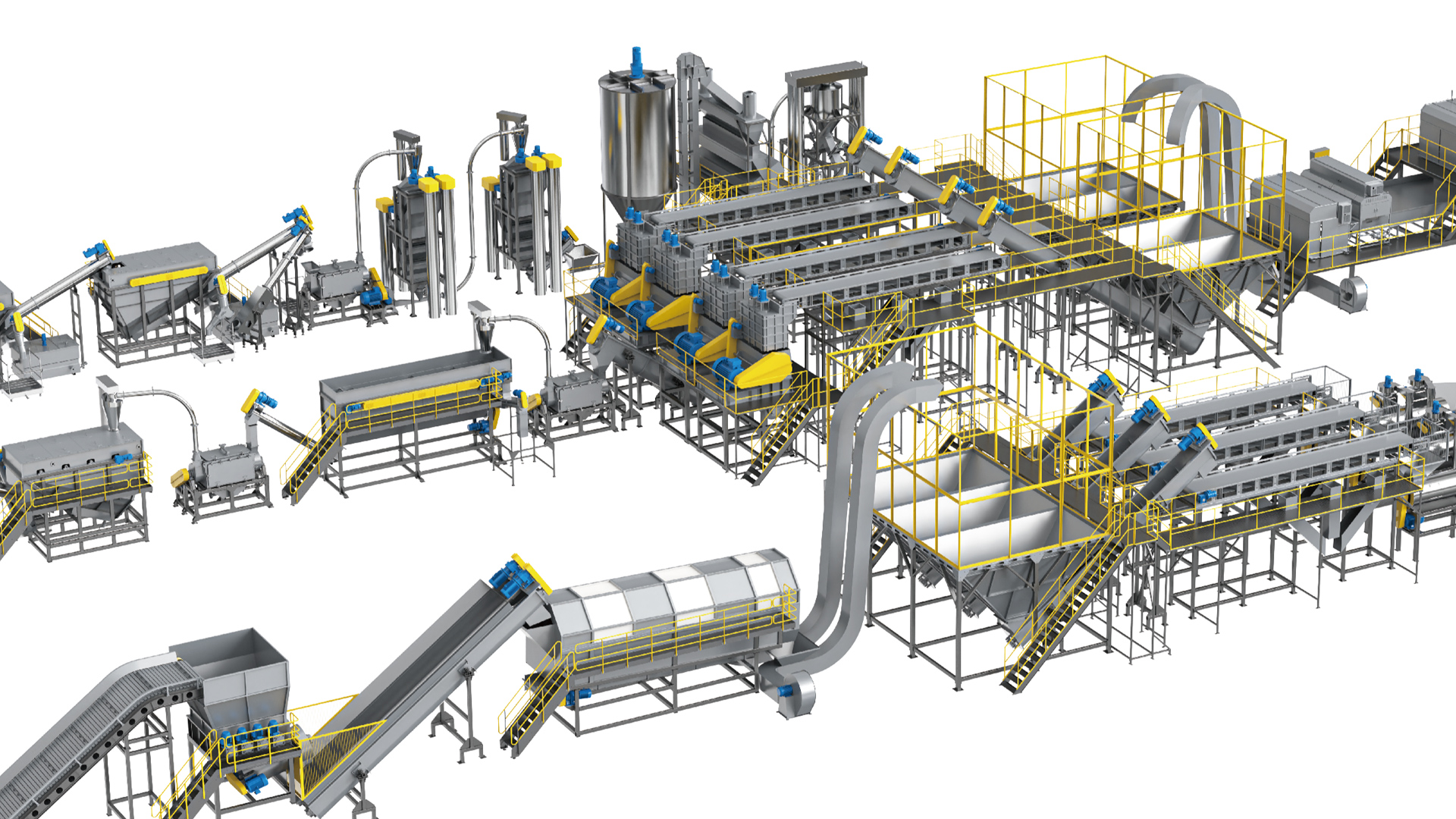

An Austrian tech plastic recycling line is a mechanical recycling plant built around four engineering commitments: gentle material handling that avoids thermal shock, water loops that are closed rather than consumed, melt treatment that removes both particulate and volatile contamination, and a documented decontamination performance that can survive a regulatory audit. Those commitments emerged from a cluster of Austrian equipment builders during the 1980s and 1990s and have since become the reference architecture for high-value post-consumer recycling worldwide. Whether the feedstock is baled PET bottles, agricultural stretch film, post-industrial PP big bags, or mixed rigid HDPE from kerbside collection, the sequence is broadly the same and the differences lie in the details of residence time, wash temperature, screen aperture and vacuum depth.
This guide walks through that sequence stage by stage, with the process parameters an engineering team actually needs when sizing a plant: shredder torque and screen size, friction washer residence time, sink-float density windows, hot wash caustic concentration, centrifuge residual moisture, melt filter aperture, degassing vacuum level, and pelletizer cutting geometry. It also covers the two questions that decide whether a recycling investment succeeds commercially — what the line costs to run in energy per tonne, and whether the output can be sold into food contact, automotive or fibre applications at a premium. Polyretec, a Wanplas factory specialising in plastic recycling equipment, builds lines on the Austrian process model and this article draws on that configuration experience throughout.
Sustainable waste management in 2026 is no longer a voluntary corporate exercise. Extended producer responsibility schemes across the European Union, the United Kingdom, Canada and a growing number of Asian markets now attach a direct financial consequence to packaging that cannot be recycled, and recycled content mandates create a guaranteed demand floor for rPET and rHDPE that meets specification. A recycling line is therefore best understood not as a waste treatment asset but as a polymer production asset whose raw material happens to arrive dirty.
What Defines an Austrian Tech Plastic Linha de Reciclagem
The Austrian approach to plastic recycling is characterised less by any single patented device than by a philosophy of process integration: every stage is designed knowing what the next stage requires, and the line is tuned as one system rather than as a chain of independently optimised machines. Four principles distinguish it from older, harsher recycling architectures.
Preconditioning Before Plasticising
Conventional recycling extruders feed cold, low-bulk-density flake directly into a screw and rely on shear to compact it. The Austrian model interposes a preconditioning unit — a heated, agitated cutter-compactor that simultaneously cuts, warms, dries and densifies the flake before it enters the screw. Typical preconditioner operation holds the material at 60 to 90 degrees Celsius for 40 to 120 seconds with rotor tip speeds of 30 to 45 metres per second. The material enters the extruder at roughly 300 to 450 kilograms per cubic metre bulk density instead of 30 to 80, which stabilises feed, cuts specific energy consumption by 12 to 20 percent, and removes surface moisture before it can hydrolyse polyester chains.
Gentle Single-Screw Plasticising
For washed post-consumer flake the Austrian preference is a single-screw extruder with a length-to-diameter ratio of 30:1 to 36:1 and a moderate compression ratio of 2.5:1 to 3.2:1, rather than an aggressive co-rotating twin screw. The reasoning is that the material has already been mechanically homogenised upstream, so the extruder’s job is thermal homogenisation and pressure generation, not high-intensity dispersive mixing. Lower shear means lower melt temperature, less chain scission and a measurably lower yellowness index in the finished pellet. Where compounding, fibre-loading or reactive modification is required, a twin-screw becomes the right tool — Wanplas’s Kerke factory supplies KTE-series co-rotating twin-screw extruders that integrate downstream of Polyretec washing systems for exactly this case.
Continuous Melt Filtration
Post-consumer streams contain paper fibre, aluminium foil, wood, sand, rubber and cross-linked polymer gels. Austrian lines standardise on continuously self-cleaning filtration — laser-drilled rotary disc filters or backflush piston screen changers — rather than manual screen packs, because uninterrupted operation at stable melt pressure is worth more than the marginal cost of the filter. Filtration fineness of 80 to 150 micrometres is normal for post-consumer film and rigids.
Closed Water and Air Loops
A modern washing line recirculates 90 to 97 percent of its process water through a treatment train of sieve drums, dissolved air flotation, lamella clarifiers and sometimes membrane polishing. Fresh water make-up in a well-engineered plant is 0.6 to 2.5 cubic metres per tonne of input, against 8 to 15 cubic metres per tonne for an unoptimised line. The same logic applies to air: dryer exhaust is heat-recovered, and odour-laden vent streams are routed to a thermal or catalytic oxidiser rather than the atmosphere.
The Complete Process Chain from Bale to Pellet Silo
A full recycling line executes eleven distinct unit operations, each with a defined input specification and output target. Understanding the chain as a whole prevents the most common capital mistake — buying a high-specification pelletizer to compensate for an under-specified wash section, which never works because contamination that survives washing simply becomes contamination in the melt.
Line Sequence and Function
| Stage | Equipment | Primary Function | Key Parameter | Energy Tier |
|---|---|---|---|---|
| 1. Bale opening | Bale breaker, de-baler | Loosen compacted bales, remove wire | Bale density up to 450 kg/m3 | Low |
| 2. Pre-shredding | Single-shaft shredder | Reduce to 40 to 80 mm fraction | Rotor 80 to 130 rpm, screen 50 to 80 mm | Medium |
| 3. Pre-washing | Trommel, pre-wash screw | Remove sand, stones, loose soil | Water 2 to 4 m3 per tonne circulating | Low |
| 4. Wet granulating | Wet granulator | Size-reduce to 12 to 18 mm flake | Screen 12 to 20 mm, rotor 400 to 600 rpm | High |
| 5. Friction washing | High-speed friction washer | Mechanical scrubbing, label removal | Rotor 700 to 1,000 rpm, 8 to 20 s dwell | Medium |
| 6. Sink-float sorting | Float tank with paddle screws | Separate polyolefin from PET, PVC, metal | Dwell 60 to 180 s, water 1.00 g/cm3 | Low |
| 7. Hot washing | Heated caustic reactor | Remove glue, oil, PVA labels, odour bodies | 80 to 95 degrees C, 10 to 20 min | Very High |
| 8. Rinse and dewater | Rinse tank, vertical centrifuge | Neutralise, spin off free water | Centrifuge 800 to 1,200 rpm | Medium |
| 9. Thermal drying | Pipe dryer plus silo | Reduce residual moisture below 1 percent | Air 110 to 150 degrees C | High |
| 10. Melt filtration | Extruder plus laser filter | Remove solid contaminants, degas volatiles | Aperture 80 to 150 micrometres | Very High |
| 11. Pelletizing | Water-ring or underwater cutter | Form uniform 2.5 to 4 mm pellets | Cutter 800 to 2,500 rpm | Medium |
Note the two Very High energy tiers: hot washing and melt filtration. Together they typically account for 55 to 65 percent of the line’s total electrical and thermal demand. Any serious energy optimisation programme starts there, not with the conveyors and pumps that are easier to see.
Shredding, Granulating and Friction Washing
Size reduction determines everything downstream. Flake that is too coarse will not release embedded contamination in the wash section; flake that is too fine generates fines losses, blinds the dewatering screens and increases dryer load. The practical target for most post-consumer streams is 12 to 18 millimetres for rigids and 25 to 40 millimetres for film.
Single-Shaft Pre-Shredding
The pre-shredder is a torque machine, not a speed machine. Rotor speeds of 80 to 130 revolutions per minute with hydraulic ram feeding give the cutting geometry time to bite through baled material without generating heat. Specific energy consumption for pre-shredding runs 18 to 45 kilowatt-hours per tonne depending on feedstock density and screen size. For contaminated agricultural film loaded with 20 to 40 percent soil, an oversized shredder with a replaceable wear-resistant cutting chamber is essential; competitors such as Lindner and Herbold have built their reputations here, and Polyretec specifies equivalent hardened tooling with rotor knives in 1.2379 grade tool steel.
Wet Granulating
Wet granulation performs two jobs at once: it reduces particle size to the final flake dimension and it delivers the first serious washing action, because water injected at 1.5 to 3 cubic metres per tonne carries away liberated dirt as it is generated. Rotor speeds of 400 to 600 revolutions per minute with a knife gap of 0.15 to 0.35 millimetres produce clean cuts rather than tearing. A poorly maintained knife gap above 0.5 millimetres is the single most common cause of excessive fines, and fines above 2 percent by mass materially reduce yield.
High-Speed Friction Washing
The friction washer is where the majority of surface contamination is removed. A vertical or horizontal shaft with paddle elements rotates at 700 to 1,000 revolutions per minute inside a perforated screen basket, forcing flakes to abrade against each other and against the screen. Residence time is short — 8 to 20 seconds per pass — but the shear intensity is high. Two or three friction washers in series are standard for post-consumer material. Key design variables are paddle pitch angle, which controls axial transport speed, and screen perforation, typically 3 to 6 millimetres, which controls the size of the debris that escapes.
For PET bottle flake specifically, friction washing at this stage removes the bulk of the paper and OPP label material, glue residue and residual product. A well-set friction washing train reduces the label content of incoming flake from 3 to 6 percent down to below 0.3 percent before the material even reaches the hot wash.
Sink-Float Separation and Density-Based Sorting
Sink-float separation exploits the fact that the common packaging polymers occupy well-separated density bands and that water sits conveniently between the polyolefins and everything else. It is the cheapest, most robust sorting technology available and remains central to every Austrian-model line despite the availability of near-infrared optical sorters.
Polymer Density Reference
| Material | Density (g/cm3) | Behaviour in Water | Separation Note |
|---|---|---|---|
| PP | 0.90 to 0.91 | Floats strongly | Fastest rise rate, easiest to skim |
| LDPE / LLDPE | 0.915 to 0.935 | Floats | Film traps air, needs de-aeration paddles |
| HDPE | 0.945 to 0.965 | Floats, slower | Requires longer tank dwell, 90 to 180 s |
| PS | 1.04 to 1.06 | Sinks | Reports with PET, needs NIR or froth step |
| PET | 1.33 to 1.40 | Sinks fast | Target fraction in bottle recycling |
| PVC | 1.35 to 1.45 | Sinks with PET | Critical contaminant, must be NIR-sorted out |
| Aluminium | 2.70 | Sinks fast | Removed by eddy current before wet stages |
| Sand and glass | 2.5 to 2.6 | Sinks fast | Collected in tank bottom auger |
Why PVC Is the Critical Contaminant
PVC and PET have overlapping densities, so sink-float cannot separate them. This matters enormously because PVC begins releasing hydrogen chloride above 180 degrees Celsius, well below PET processing temperature of 275 to 290 degrees Celsius. The released acid catalyses hydrolytic chain scission in PET, producing yellowing, black specks and a measurable IV drop. The tolerance is severe: PVC content above roughly 50 parts per million in PET flake is generally considered unacceptable for bottle-grade rPET, and food-grade specifications often demand below 20 parts per million. Achieving that requires near-infrared optical sorting on the flake stream, not just on the bottle stream, plus a metal detector loop.
Tank Design Details That Matter
An effective float tank is not simply a box of water. Counter-current flow, paddle screws set at 8 to 15 revolutions per minute, an air-injection de-aeration zone to release trapped air from film, and a sludge auger on the tank floor all contribute. Tank dwell time should be sized on the slowest-rising fraction, which for HDPE flake at 0.955 grams per cubic centimetre means 90 to 180 seconds. Undersized tanks are a frequent retrofit problem: the line meets throughput on paper but the purity of the float fraction collapses when the operator pushes to nameplate capacity.
Hot Wash Chemistry, Dewatering and Thermal Drying
The hot wash is the decontamination heart of the line and the stage that most directly determines whether the output can claim food-grade status. It combines temperature, alkalinity, surfactant chemistry, mechanical agitation and time — five variables that must be balanced against polymer degradation risk.
Hot Wash Operating Windows
| Parâmetro | PET Bottle Flake | HDPE Rigid | PP / PE Film | Reason for Limit |
|---|---|---|---|---|
| Temperature | 80 to 90 degrees C | 75 to 90 degrees C | 80 to 95 degrees C | PET softens near Tg 78 degrees C, agglomeration risk |
| Caustic (NaOH) | 1.0 to 2.0 percent | 0.5 to 1.5 percent | 1.0 to 2.5 percent | Excess caustic saponifies PET surface, IV loss |
| Surfactant | 0.2 to 0.5 percent | 0.3 to 0.8 percent | 0.4 to 1.0 percent | Higher oil load on film needs more emulsification |
| Residence time | 10 to 15 min | 12 to 20 min | 15 to 25 min | Diffusion-limited removal of absorbed substances |
| Agitation | 30 to 60 rpm paddle | 30 to 60 rpm paddle | 40 to 80 rpm paddle | Film requires more energy to prevent roping |
| Final rinse pH | 6.5 to 8.0 | 6.5 to 8.0 | 6.5 to 8.0 | Residual alkali causes extruder corrosion and odour |
The Diffusion Argument
Surface dirt is removed by mechanical action, but the contaminants that regulators care about — solvents, pesticides, fuel components, personal care chemicals — have diffused into the polymer bulk during the container’s service life. Removing them is a diffusion problem governed by temperature, time and the concentration gradient at the surface. Doubling the wash temperature from 40 to 80 degrees Celsius increases the diffusion coefficient in PET by roughly an order of magnitude. This is precisely why cold-wash-only lines cannot reach food-grade decontamination however long they run, and why the hot wash reactor is non-negotiable in any line intended for regulated applications.
Mechanical Dewatering
A vertical dewatering centrifuge running at 800 to 1,200 revolutions per minute strips free surface water down to 2 to 5 percent residual moisture for rigid flake and 6 to 12 percent for film. Centrifuge screen slot width is typically 0.4 to 0.8 millimetres; narrower slots retain fines but blind faster. Fines recovery from the centrifuge filtrate is worth engineering properly, since 1 to 3 percent of throughput can otherwise be lost to the water treatment plant.
Thermal Drying and Moisture Targets
The pipe dryer, a long duct in which hot air at 110 to 150 degrees Celsius conveys the flake, brings residual moisture down to 0.5 to 1.0 percent. A subsequent buffer silo with continued hot-air purge achieves 0.2 to 0.5 percent. For PET destined for the melt phase, this still is not enough — polyester hydrolyses in the melt, and 0.02 percent moisture at the extruder inlet is the practical ceiling for IV preservation. That requires a dedicated crystalliser and desiccant dryer stage running at 160 to 175 degrees Celsius with dew point below minus 40 degrees Celsius for 4 to 6 hours. Polyolefins are far more forgiving; HDPE and PP tolerate 0.1 percent moisture provided the extruder has effective atmospheric and vacuum vents.
Melt Filtration, Degassing and IV Recovery
Once the flake is clean and dry, the melt phase performs the final three purification functions: removing solid particles too small or too embedded for mechanical separation, stripping volatile organic compounds, and in the case of polyester, restoring the molecular weight lost during processing.
Filtration Fineness Selection
Filter aperture is chosen against the end application, not against a generic quality ideal. Finer is not automatically better, because finer screens raise melt pressure, increase shear heating, shorten screen life and raise melt loss. The practical map is straightforward.
| End Application | Filtration Fineness | Filter Type | Typical Melt Loss | Cost Tier |
|---|---|---|---|---|
| Refuse sacks, drainage pipe | 300 to 500 micrometres | Manual or hydraulic screen changer | Below 0.5 percent | Low |
| Injection moulded crates, pallets | 150 to 250 micrometres | Backflush piston changer | 0.5 to 1.5 percent | Medium |
| Blow moulded bottles, rigid packaging | 100 to 150 micrometres | Laser filter, rotary disc | 1 to 3 percent | High |
| Blown film, thin-wall products | 80 to 120 micrometres | Laser filter plus polishing screen | 2 to 4 percent | High |
| Fibre spinning, food-grade sheet | 25 to 60 micrometres | Candle or disc filter, sintered media | Below 1 percent, high pressure | Premium |
Degassing: The Volatiles Problem
Degassing removes water vapour, monomer, oligomer, solvent residues, decomposition products of adhesives and inks, and the aldehyde and ketone species responsible for odour. A single atmospheric vent handles moisture and light gases; genuine decontamination requires vacuum. The relationship between vacuum depth and stripping efficiency is not linear — the last order of magnitude does most of the useful work.
- Atmospheric vent only: removes free moisture and air. Suitable for clean post-industrial scrap.
- Vacuum 100 to 300 mbar: removes bulk moisture and light volatiles. Adequate for non-food rigids.
- Vacuum 20 to 50 mbar: meaningful odour reduction, standard for quality rHDPE and rPP.
- Vacuum 1 to 5 mbar: deep decontamination, required for food-grade and premium sensory grades.
- Multi-stage vacuum with melt surface renewal: highest efficiency, used where challenge-test performance must be demonstrated.
Stripping efficiency depends as much on melt surface renewal as on absolute pressure. A vacuum vent over a partially filled screw channel with a low-compression melt-conveying element exposes far more surface area than the same vacuum applied over a fully filled channel. This is why degassing screw geometry — decompression zone length, channel depth ratio, presence of a mixing element upstream of the vent — is a specification item in its own right.
IV Recovery for rPET
Intrinsic viscosity is the practical proxy for PET molecular weight and it determines whether the recycled resin can be blown into a bottle, spun into a fibre or only used in low-demand sheet. Virgin bottle-grade PET sits at 0.76 to 0.84 decilitres per gram. Post-consumer washed flake typically arrives at 0.70 to 0.76, and each melt pass costs a further 0.03 to 0.08 unless active countermeasures are used.
| Stage | Typical IV (dL/g) | Change | Controlling Factor |
|---|---|---|---|
| Virgin bottle resin | 0.78 to 0.84 | Baseline | Resin producer specification |
| Bottle after blowing and use | 0.74 to 0.80 | Minus 0.02 to 0.04 | Preform injection thermal history |
| Washed flake after hot wash | 0.70 to 0.76 | Minus 0.02 to 0.05 | Caustic surface saponification, hydrolysis |
| After extrusion without drying | 0.58 to 0.66 | Minus 0.08 to 0.14 | Melt hydrolysis, moisture above 0.05 percent |
| After extrusion with proper drying | 0.66 to 0.72 | Minus 0.03 to 0.05 | Residence time, melt temperature, vacuum |
| After SSP reactor | 0.76 to 0.86 | Plus 0.08 to 0.16 | Reactor temperature 200 to 215 degrees C, 6 to 12 h |
Solid-state polycondensation is the established route: crystallised pellets or flakes are held at 200 to 215 degrees Celsius under nitrogen purge or vacuum for 6 to 12 hours, allowing end-group condensation to proceed while the material remains solid, which avoids the thermal degradation of a melt-phase reaction. The alternative liquid-state route runs the polycondensation directly in a high-vacuum melt reactor in minutes rather than hours; it has a smaller footprint and lower thermal inertia but demands very tight moisture and contamination control upstream. Chain extenders based on multifunctional epoxides offer a third path — a fast, low-capital IV boost of 0.05 to 0.10 — but they modify the branching structure and are not universally accepted for food contact.
Pelletizing: Water-Ring Versus Underwater Cutting
The pelletizer determines pellet geometry, bulk density, fines content and residual moisture — all properties that the downstream converter will judge the material by long before they analyse its polymer chemistry. Three cutting principles dominate recycling applications.
Strand Pelletizing
Melt strands are extruded through a multi-hole die, cooled in a water bath over 1.5 to 3 metres, dried by an air knife, and chopped by a rotating cutter against a fixed bed knife. It is mechanically simple and produces clean cylindrical pellets, but strand breakage limits it in practice to clean, high-melt-strength material at throughputs up to roughly 1,000 kilograms per hour. Contaminated post-consumer melt with variable viscosity tends to break strands and interrupt production.
Water-Ring Die-Face Cutting
Rotating blades cut the melt directly at the die face while a tangential ring of water inside the cutting chamber quenches and transports the pellets. Cutter speeds of 1,200 to 2,500 revolutions per minute produce lens-shaped pellets of 2.5 to 4 millimetres. This is the workhorse of polyolefin recycling: tolerant of viscosity variation, tolerant of the occasional contaminant that slips through, and self-recovering after a brief die-face freeze. Bulk density of the resulting rHDPE pellet typically lands at 500 to 570 kilograms per cubic metre.
Underwater Pelletizing
The die plate is fully submerged in a temperature-controlled water chamber and the cutter runs inside it. Pellets are perfectly spherical, fines content is the lowest of the three methods, and the process handles low-viscosity melts that would break strands or smear on a water-ring die. It is the standard for rPET, for heat-sensitive compounds and for any product where pellet uniformity is contractually specified. The trade-off is complexity: die plate heating, water temperature control at 60 to 85 degrees Celsius, centrifugal dryer sizing and start-up sequencing all require more operator skill.
| Criterion | Strand | Water-Ring | Underwater |
|---|---|---|---|
| Practical throughput ceiling | Up to 1,000 kg/h | Up to 3,000 kg/h | Above 5,000 kg/h |
| Pellet shape | Cylindrical | Lens-shaped | Spherical |
| Fines generation | Medium | Low to medium | Very low |
| Tolerance to viscosity swings | Poor | Good | Excellent |
| Best suited to | Clean post-industrial | rHDPE, rPP, film regrind | rPET, food-grade, compounds |
| Operator skill required | Low | Medium | High |
| Investment tier | Low | Medium | High |
Odour Removal and Sensory Quality Control
Odour is the most frequent single reason a recycled polyolefin is rejected by a brand owner, and it is the property least amenable to a single-machine fix. The odorous species are a mixture of aldehydes, ketones, carboxylic acids, terpenes and sulphur compounds derived from food residues, personal care products, degradation of the polymer itself and, significantly, from the printing inks and adhesives on labels.
The Three-Barrier Approach
No single step removes odour. Effective lines stack three barriers, each targeting a different fraction of the odour load.
| Barrier | Mechanism | Operating Condition | Odour Load Removed |
|---|---|---|---|
| Caustic hot wash | Saponification of fats, dissolution of acids | 80 to 95 degrees C, 1 to 2 percent NaOH | 40 to 55 percent |
| Hot air stripping silo | Solid-state diffusion into purge air | 110 to 140 degrees C, 2 to 8 h dwell | 20 to 35 percent |
| Deep melt degassing | Vacuum stripping from renewed melt surface | 1 to 5 mbar, multi-stage vent | 15 to 30 percent |
| Odour-adsorbing additive | Zeolite or cyclodextrin scavenging | 0.3 to 1.0 percent masterbatch | Residual perception only |
Sensory performance is assessed by trained panels against a six-point scale, commonly following the approach of VDA 270 in automotive supply chains: grade 1 means imperceptible, grade 6 means intolerable. Untreated post-consumer rHDPE from kerbside collection typically scores 4 to 5. A full three-barrier line moves it to 2 to 3, which is acceptable for non-food rigid packaging, detergent bottles and many automotive interior applications. Reaching grade 1 to 2 reliably generally requires clean, source-separated feedstock in addition to the process barriers.
Quantitative Support
Panels are subjective, so production plants supplement them with headspace gas chromatography and mass spectrometry, quantifying total volatile organic compounds in micrograms per gram of polymer. A useful internal benchmark set is: below 50 micrograms per gram for premium sensory grade, 50 to 150 for standard rigid packaging grade, and above 300 indicating that the degassing or wash section is underperforming and should be investigated before shipping.
Energy Consumption Benchmarks and Utility Design
Energy is the largest controllable operating input in mechanical recycling, and it is where Austrian-model lines earn their reputation. The two levers are specific energy consumption in the melt phase and thermal energy recovery in the wash and dry phases.
Stage-by-Stage Electrical Demand
| Process Stage | PET Bottle Line (kWh/t) | PE Film Line (kWh/t) | Optimisation Lever |
|---|---|---|---|
| Shredding and granulating | 35 to 60 | 45 to 85 | Knife gap control, correct screen size |
| Washing and separation | 30 to 50 | 40 to 70 | Variable frequency drives on all pumps |
| Hot wash thermal load | 55 to 95 | 70 to 120 | Plate heat exchanger recovery, steam trap audit |
| Dewatering and drying | 25 to 45 | 45 to 90 | Maximise mechanical dewatering before heat |
| Crystallising and drying (PET) | 60 to 110 | Not applicable | Closed-loop desiccant with heat recovery |
| Extrusion and filtration | 150 to 230 | 180 to 280 | Preconditioner, barrel insulation, screw design |
| Pelletizing and cooling | 30 to 55 | 30 to 60 | Right-size the pellet water circuit |
| Conveying and ancillaries | 20 to 40 | 25 to 50 | Avoid over-long pneumatic runs |
Where the Savings Actually Are
Three interventions consistently deliver the largest returns and all three are design decisions rather than operating adjustments.
Barrel insulation jackets. An uninsulated extruder barrel radiates 25 to 40 percent of its heater energy to the workshop. Ceramic or aramid insulation jackets typically cut heating-zone energy by 20 to 35 percent and simultaneously improve temperature stability, which reduces melt temperature variance and therefore pellet colour variation.
Hot wash heat recovery. The hot wash discharges water at 75 to 90 degrees Celsius, and the incoming fresh and recycled water arrives at ambient. A plate heat exchanger between the two streams recovers 45 to 65 percent of the thermal load. On a 2,000 kilogram per hour line this is one of the shortest-payback modifications available.
Mechanical dewatering before thermal drying. Removing one percentage point of moisture in a centrifuge costs a small fraction of what it costs in a hot air dryer, because evaporating water requires roughly 2,260 kilojoules per kilogram of latent heat. Oversizing the centrifuge and running two in series is almost always cheaper over a plant’s life than oversizing the dryer.
Food-Grade Approval: EFSA and FDA Pathways
The regulatory distinction that matters is this: in the European Union the recycling process is authorised, not the material. An operator cannot buy a food-grade recycling line off the shelf and start selling food-grade rPET. The specific combination of equipment, parameters and input specification must be evaluated and authorised.
The European Route
Regulation EU 2022/1616 on recycled plastic materials intended to come into contact with food replaced the earlier 282/2008 framework and sets out the current process. The operator must:
- Define the input specification precisely — for example, at least 95 percent post-consumer PET food containers by mass, with defined limits on non-food PET and non-PET polymer.
- Run a challenge test in which flake is deliberately contaminated with surrogate substances chosen to represent volatility, polarity and molecular weight classes, then processed through the actual line.
- Measure the residual surrogate concentration in the output and calculate the decontamination efficiency for each surrogate. Efficiencies above 95 to 99 percent are typically needed depending on the surrogate.
- Model the resulting migration into food simulants and demonstrate that estimated dietary exposure remains below the conventionally applied threshold of toxicological concern.
- Submit the dossier via the national competent authority to EFSA for scientific opinion, then obtain authorisation.
- Maintain the process within the authorised parameter window and operate a documented quality management system.
The finished article must additionally comply with EU 10/2011 overall and specific migration limits, and the plant will normally hold ISO 9001 and increasingly ISO 14001 certification alongside a recycled-content chain-of-custody scheme such as EuCertPlast or GRS.
The United States Route
The FDA operates a voluntary but commercially essential letter of no objection system. The applicant submits a description of the recycling process, the source and control of the input material, and challenge test data using a defined surrogate set. The FDA then issues a no-objection letter for a stated end use and a stated maximum recycled content. The technical logic mirrors the European approach; the administrative process is generally faster and the letter is issued to the process operator.
| Requirement | European Union | United States | Engineering Implication |
|---|---|---|---|
| What is approved | The recycling process | The recycling process | Parameters must be locked and logged |
| Governing instrument | EU 2022/1616 plus EU 10/2011 | FDA no-objection letter | Dual submission if exporting both ways |
| Challenge test required | Yes, surrogate contamination | Yes, surrogate contamination | Line must run a spiked trial batch |
| Input traceability | Mandatory, documented | Mandatory, documented | Bale-level records and supplier audits |
| Key process barrier | Hot wash plus SSP or high vacuum | Hot wash plus SSP or high vacuum | SSP residence time is an approval parameter |
| Ongoing obligation | Quality system, periodic verification | Process consistency | SCADA data retention becomes compliance evidence |
Design Consequences
Two practical consequences follow for anyone specifying a line with food-grade ambitions. First, the automation system must log every critical parameter continuously — hot wash temperature and caustic concentration, dryer temperature, SSP reactor temperature and residence time, extruder melt temperature and vacuum level — with tamper-evident retention. Retro-fitting this to an unprepared plant is expensive and disruptive. Second, the process must be designed with headroom: if authorisation is granted at 200 degrees Celsius SSP for 8 hours, running at 195 degrees for 7 hours to chase throughput is outside the authorisation. Build the capacity to run the authorised condition at full commercial rate from the beginning.
Circular Economy Drivers: EPR and Recycled Content Rules
The economics of a recycling line are shaped less by the intrinsic value of recycled polymer than by regulation that creates mandatory demand and penalises non-recyclable packaging. Understanding those drivers is essential to sizing a plant correctly.
Extended Producer Responsibility
EPR schemes make the brand owner financially responsible for the end-of-life management of its packaging, with fees modulated by recyclability. Modulated fees mean a mono-material PE pouch attracts a materially lower fee than a multi-layer PET-aluminium-PE laminate, which changes packaging design decisions upstream and therefore changes the composition of the waste stream a recycler will receive. Recyclers should expect the polyolefin film stream to become progressively more mono-material and the rigid stream progressively more colour-sorted over the coming years — both favourable trends for output quality.
Recycled Content Mandates
The European Single-Use Plastics Directive set a 25 percent recycled content requirement for PET beverage bottles from 2025 and 30 percent for all single-use beverage bottles from 2030. The Packaging and Packaging Waste Regulation extends binding recycled content targets across contact-sensitive and non-contact-sensitive plastic packaging. Several US states have enacted comparable state-level minimum content laws. The practical effect is a demand floor for food-grade rPET that is set by law rather than by price, which substantially de-risks investment in a food-grade line relative to a general-purpose one.
Design for Recycling
Recyclers are increasingly consulted at the packaging design stage, and the guidance that most improves line yield is consistent across the industry: use mono-material structures, avoid PVC and PVDC entirely, avoid carbon black pigments that defeat near-infrared sorting, use floatable polyolefin labels on PET bottles rather than sinking PET or PVC labels, use wash-off adhesives that release at 80 degrees Celsius in caustic, and avoid direct printing on the container body. Each of these changes shifts yield by one to several percentage points, and yield is the dominant driver of a recycling plant’s profitability.
Carbon Accounting
Mechanical recycling of polyolefins typically shows a global warming potential in the range of 0.4 to 1.1 kilograms of carbon dioxide equivalent per kilogram of pellet, against 1.8 to 2.5 for virgin polyethylene produced from naphtha. The comparison is sensitive to electricity grid carbon intensity, transport distance and yield, but the direction is unambiguous and it is why brand owners increasingly write recycled content into supplier scorecards independent of any regulatory requirement. An energy-efficient line configuration therefore delivers a double benefit: lower operating cost and a stronger environmental claim.
Specifying a Line with Polyretec
Polyretec, a Wanplas factory, engineers plastic recycling lines on the Austrian process model with manufacturing carried out in China. The practical value of that combination is access to the process architecture that defines high-value recycling at a cost tier that makes mid-capacity plants viable in markets where European capital equipment is out of reach.
Configuration Guide by Feedstock
| Feedstock | Essential Modules | Typical Yield | Output Application | Investment Tier |
|---|---|---|---|---|
| Post-consumer PET bottles | Full wash, NIR flake sorter, hot wash, SSP | 72 to 82 percent | Food-grade bottle, sheet, fibre | Premium |
| Post-consumer HDPE bottles | Full wash, hot wash, odour silo, laser filter | 78 to 88 percent | Detergent bottles, pipe, crates | High |
| Agricultural PE film | Heavy pre-wash, multi-stage friction, dryer | 55 to 72 percent | Refuse sacks, geomembrane, pipe | High |
| Commercial LDPE stretch film | Light wash, dryer, degassing extruder | 85 to 93 percent | Stretch film, liners | Medium |
| PP big bags and woven | Shredder, wash, sink-float, pelletizer | 80 to 90 percent | Woven bags, injection parts | Medium |
| Post-industrial regrind | Preconditioner, extruder, screen changer | 94 to 98 percent | Direct return to original process | Low |
What to Provide at Enquiry Stage
The quality of a line proposal is limited by the quality of the input data. A useful enquiry package contains the polymer type and expected variability, the contamination profile by mass (soil, moisture, paper, metal, foreign polymer), the bale or bulk density, the target throughput in kilograms per hour of finished product, the intended end application and any certification target, available utilities including electrical supply, steam or hot water availability and water treatment capacity, plus the building footprint and ceiling height. Sending a representative sample of 20 to 50 kilograms allows trial processing, which resolves more specification questions than any amount of correspondence.
Commissioning and Support
Polyretec builds lines under a documented quality system and supplies machines with CE conformity where the destination market requires it. As with all Wanplas factories, the delivery model includes factory acceptance testing before shipment, on-site installation supervision, operator training covering both routine operation and the fault-finding logic behind each subsystem, and the Wanplas brand-level spare parts commitment. The Wanplas mission of warming global customers with China plastic machinery is expressed practically as long-term parts availability and remote diagnostic support rather than a transactional equipment sale. Where a project needs compounding capability beyond simple repelletizing, Wanplas’s Kerke factory contributes twin-screw extrusion technology, and where the recycled pellet feeds directly into container production, the Apollo and YuDa factories supply the blow moulding equipment that closes the loop.
Frequently Asked Questions
What is the difference between a washing line and a full recycling line?
A washing line converts baled waste into clean, dry flake and stops there. A full recycling line adds the melt phase — extrusion, filtration, degassing and pelletizing — to convert that flake into pellets. Many operators start with a washing line because flake has a ready market and the capital requirement is lower, then add pelletizing once feedstock supply and offtake are secured. The two can be procured as separate phases provided the flake specification produced by the wash line matches what the future extruder will require.
How clean does the feedstock need to be before it enters the line?
There is no absolute limit, only an economic one. A line can be engineered for 40 percent contamination if the pre-wash and separation sections are sized accordingly, but yield falls and specific energy consumption rises steeply. For post-consumer bales the practical target is below 8 percent non-target material for rigids and below 15 percent for film. Above roughly 25 percent contamination, an additional dry pre-sorting stage before the wash line usually pays for itself in reduced water treatment load and improved final purity.
Why does recycled PET turn yellow and how is it prevented?
Yellowing in rPET has three main causes: PVC contamination releasing hydrogen chloride, excessive thermal history from over-long residence time or excessive melt temperature, and residual adhesive or ink degradation products. Prevention is a combination of near-infrared flake sorting to remove PVC below 20 to 50 parts per million, keeping melt temperature at or below 285 degrees Celsius, minimising residence time through correct screw and die sizing, and ensuring the hot wash removes glue effectively. Colour is measured as b-value on the CIELAB scale, with values below 3 generally acceptable for clear bottle applications.
Can one line process both PET and polyolefins?
The wash section can be designed for changeover between PET and HDPE with adjustments to hot wash chemistry, float tank operation and dryer settings, though changeover cleaning takes several hours and cross-contamination must be managed carefully. The melt section is much harder to share, because PET requires crystallising, deep drying and a processing temperature around 280 degrees Celsius while polyolefins run at 190 to 230 degrees Celsius with completely different screw geometry. In practice, plants handling both polymers use a shared or convertible wash line and separate dedicated extrusion lines.
What causes black specks in recycled pellets?
Black specks come from four sources in roughly this order of frequency: degraded polymer accumulating in dead spots within the extruder or die, carbonised contamination such as rubber or wood that survived filtration, metal wear debris from worn screws or knives, and carbon black from mis-sorted black packaging. The diagnostic sequence is to check filtration fineness against the speck size, inspect the die and adapter for dead zones, examine screw and barrel clearance, and finally review sorting. A laser filter at 100 micrometres removes the majority of speck-forming particles in polyolefin streams.
How long does a recycling line take to reach stable output quality?
Mechanical commissioning and no-load testing generally take one to two weeks on site. Reaching stable, specification-compliant output typically takes a further four to twelve weeks, because the operating window must be tuned against the actual feedstock rather than the design assumption. Plants processing highly variable post-consumer material should plan for a longer ramp and should establish laboratory testing capability — melt flow rate, moisture, ash content, colour and for polyester, intrinsic viscosity — from the first day of production rather than adding it later.
Is nitrogen purging necessary in the SSP reactor?
Either nitrogen purging or vacuum is necessary, because solid-state polycondensation requires the reaction by-products, principally ethylene glycol and water, to be continuously removed from the pellet surface for the equilibrium to shift towards chain extension. Nitrogen purge systems with a regenerative gas cleaning loop are the more common industrial choice at scale; vacuum SSP is used in smaller reactors. Without either, IV will not build regardless of temperature and time.
What maintenance dominates the operating routine?
Three items account for most planned maintenance hours: cutting tools, screens and water treatment. Granulator and shredder knives require inspection every 200 to 400 operating hours and rotation or regrinding on a defined cycle. Melt filter screens require monitoring of pressure differential with replacement scheduled on that signal rather than on a calendar. Water treatment — sludge removal, dissolved air flotation chemistry, sieve cleaning — is a daily task and is the one most often under-resourced when a plant is first staffed. Screw and barrel wear should be measured annually, with abrasive filled materials accelerating the interval.
How does line capacity relate to shift pattern?
Recycling lines are designed for continuous operation and their economics assume it. A line running two shifts loses more than a third of its nominal annual output not only through the missing hours but through the thermal cycling of the hot wash and extruder, which consumes energy on every start-up and shortens component life. Where market demand does not support continuous running, it is generally better to install a smaller line running around the clock than a larger line running intermittently.
Conclusion
An Austrian tech plastic recycling line is not defined by a single machine but by a process discipline: precondition before you plasticise, filter continuously rather than intermittently, remove volatiles under real vacuum, close the water and air loops, and instrument everything so that the process can be proven as well as operated. Applied consistently, that discipline produces rPET at bottle-grade intrinsic viscosity, rHDPE and rPP with sensory ratings acceptable to demanding brand owners, and a documented decontamination performance that survives EFSA or FDA scrutiny.
The engineering decisions that most determine outcome are also the ones made earliest: hot wash sizing, sink-float tank dwell time, drying capacity, filtration fineness and degassing depth. Errors in these cannot be corrected by anything downstream, whereas most downstream shortcomings can be corrected if the upstream is right. Similarly, the energy profile of a line is fixed largely at design stage through barrel insulation, heat recovery and the balance between mechanical and thermal dewatering — the three interventions that together account for the difference between a line at the top and the bottom of the specific energy benchmark range.
Sustainable waste management has moved from being a compliance obligation to being a polymer supply strategy, driven by extended producer responsibility fees, binding recycled content targets and corporate carbon accounting. That shift rewards recyclers who can produce consistent, certified, low-odour material rather than simply diverting tonnage from landfill. Polyretec, a Wanplas factory, configures lines against that standard, from 300 kilogram per hour washing plants to fully integrated turnkey installations, with the process architecture, instrumentation and support model needed to keep them producing to specification year after year. Operators planning a new plant or an upgrade are encouraged to share their feedstock profile and target application so that the line can be engineered against the material that will actually arrive, not a generic assumption.