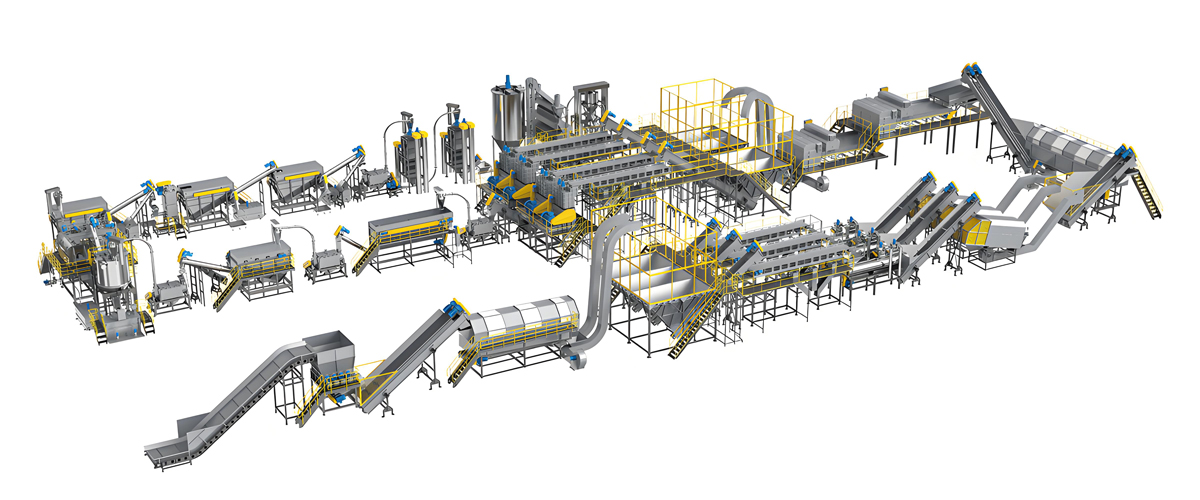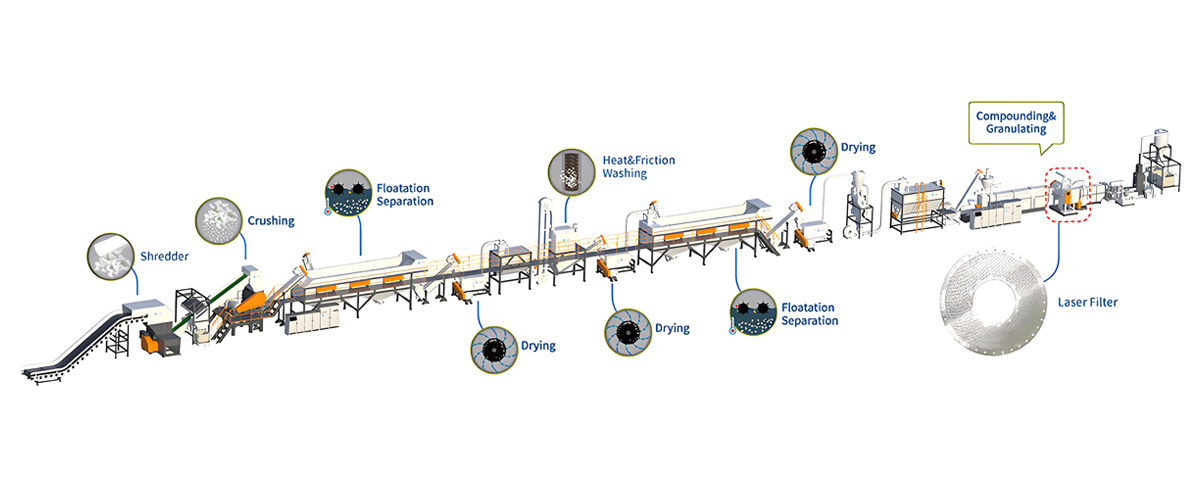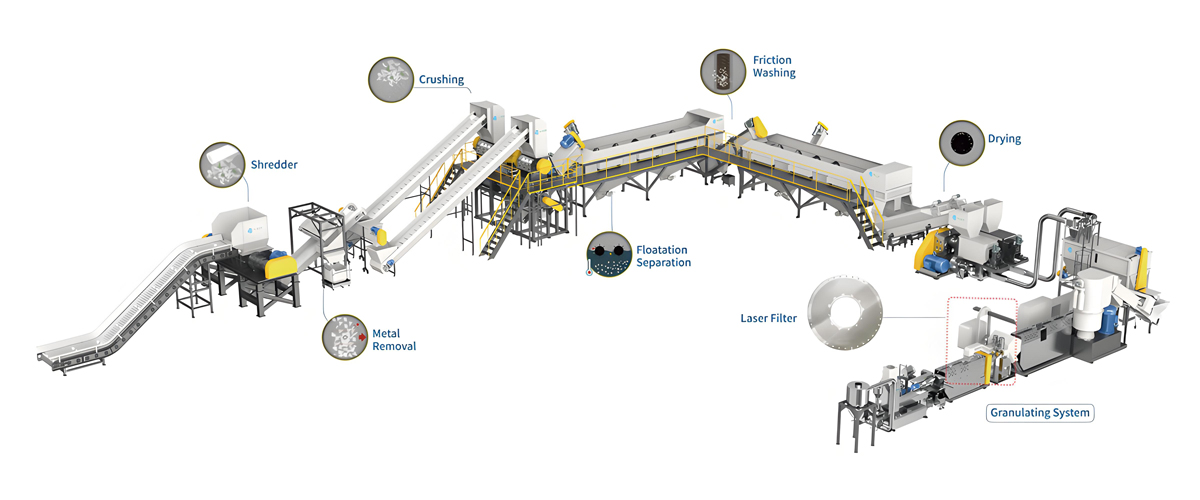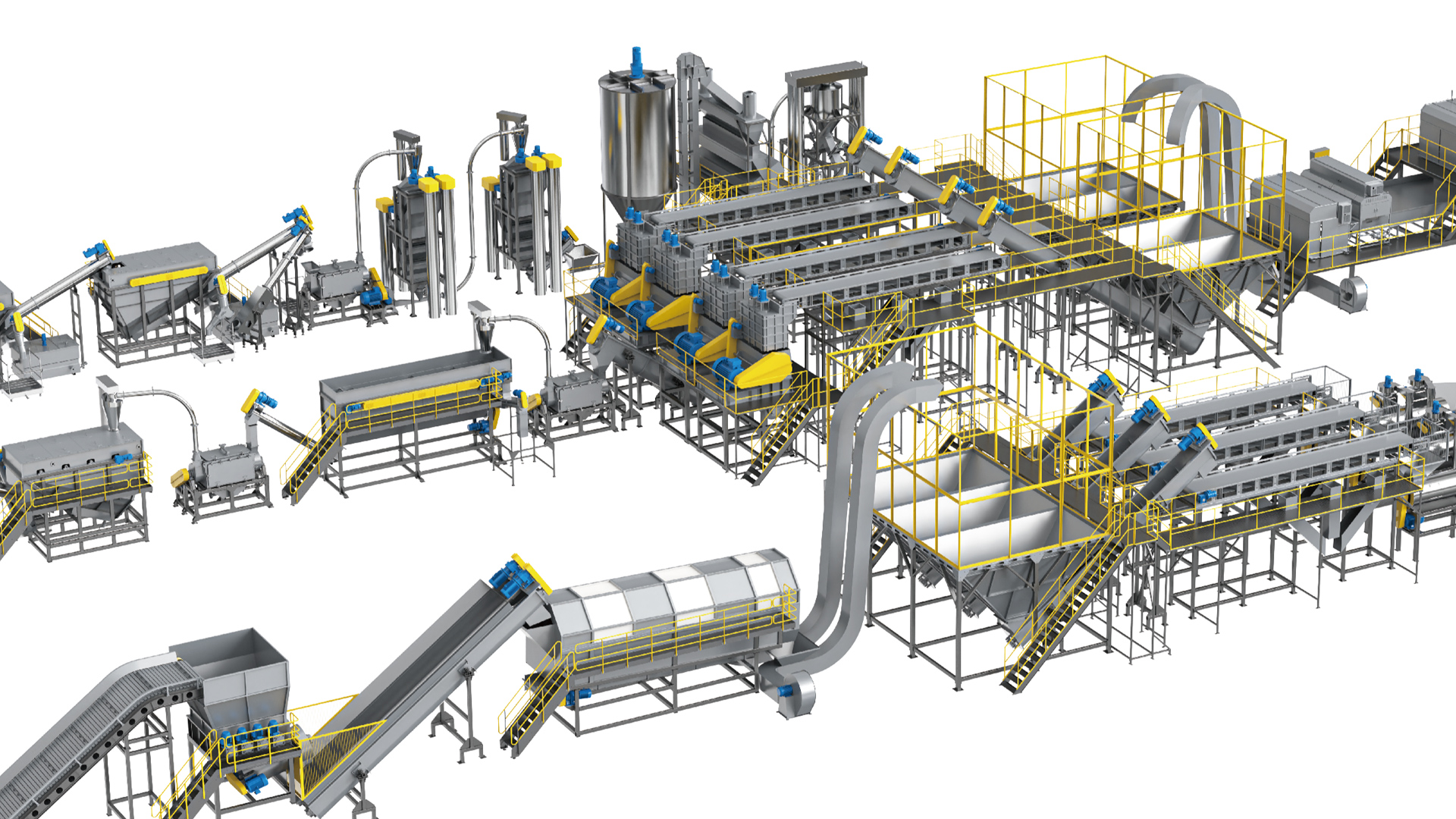

Drying inefficiency is the most common quality bottleneck in a plastic recycling washing line, and it is almost always misdiagnosed. Operators see wet flakes at the extruder throat and blame the hot-air dryer, when in practice the root cause usually sits two stages upstream in mechanical dewatering, or in how the material presents to the dryer. Polyretec, a Wanplas factory with more than 100 recycling projects since 2010, treats drying as a chain: every stage removes water more expensively than the one before it, so the cheapest fix is almost always earlier in the line. This guide gives plant managers a complete root-cause tree, a repeatable diagnostic sequence, target moisture numbers, a comparison of drying technologies, and a maintenance plan that keeps the line at spec.
A plastic recycling washing line that leaves flakes above target moisture forces the extruder to boil water inside the barrel. That steam vents as foaming, causes black specks from thermal degradation, and produces porous pellets that fail buyers. In PP and PE recovery the acceptable window is typically 0.5 percent to 1.5 percent residual moisture; PET before crystallizing wants below 1.5 percent, and below 0.1 percent after. Missing these numbers by even one point erodes margin through rejects and rework, so drying deserves the same engineering attention as the wash itself.
Root Cause Tree of Drying Inefficiency
Drying inefficiency is never a single fault; it is the visible tip of a chain. Working the root-cause tree from cheapest to most expensive correction is the fastest route to a durable fix.
Mechanical dewatering insufficient
The most frequent and cheapest-to-fix cause is a weak centrifuge. If the dewatering centrifuge runs below 1200 rpm, has a worn or enlarged screen, or receives an uneven feed, flakes enter the hot-air dryer at 8 to 12 percent moisture instead of 3 to 5 percent. Every point of water the centrifuge fails to remove must be boiled off by paid thermal energy later. Restoring centrifuge performance is the highest-return action on most lines.
Centrifuge screen clogging
Fine fibrils from UV-embrittled tape, label fibres and settled sludge gradually blind the 0.5 to 1.0 millimeter screen. A partially blinded screen forces water to bypass, and the motor current climbs while throughput falls. Clogging is accelerated by poor upstream de-stoning, because grit abrades the screen and lets fibres lodge. Scheduled screen washing, not wait-until-failure, is the control.
Hot-air temperature or volume insufficient
The dryer needs both temperature and mass flow. A target of 100 to 160 degrees Celsius means little if fan volume is too low; typical lines need 2000 to 6000 cubic meters per hour of hot air per 1000 kg/h of capacity. Failed heating elements, slipped belt drives, or a clogged heat exchanger drop both. Measuring inlet air temperature and volume at the plenum, not at the panel setpoint, exposes this gap.
Material shape and bulk density
Thin film and raffia mat into clumps that trap water in the centre, while dense rigid flakes dry quickly. A line tuned for rigid HDPE flakes will under-dry a film-rich PP mix because the clumps hold moisture. Feed homogeneity, achieved by a pre-agglomerator or by mixing batches, is often the hidden fix.
Ambient humidity
In tropical or rainy seasons, intake air at 80 to 95 percent relative humidity carries little drying capacity. Pre-heating the intake or adding desiccant make-up can cut final moisture by 0.2 to 0.5 percent without raising dryer temperature, and protects the line during monsoon operation.
Capacity beyond design
The silent killer is simply running the line 30 to 50 percent past its nameplate. Residence time in the dryer falls, the centrifuge is overloaded, and moisture creeps up. This is not a fault to repair but a capacity decision to confront, covered in the retrofit section below.
Step-by-Step Diagnostic Procedure
A disciplined diagnostic sequence turns guesswork into a measured fix. Polyretec service engineers use this same order on commissioning and troubleshooting calls.
Step 1: Measure inlet and outlet moisture
Take a representative flake sample after dewatering and after final drying. Weigh, oven-dry at 105 degrees Celsius for 2 hours, and re-weigh. The dewatering-stage target is 3 to 8 percent; the final target is below 1.5 percent for PP/PE. If both are high, the centrifuge is the prime suspect.
Step 2: Verify centrifuge operation
Confirm actual basket speed at 1200 to 1800 rpm via the VFD readout, not the nameplate. Inspect the screen for clogging and measure hole size; replace if worn above 1.2 millimeter. Check motor current against the commissioning baseline to detect imbalance or binding.
Step 3: Check hot-air delivery
Measure plenum temperature with a separate probe; a 15-degree gap versus the setpoint signals heater or sensor failure. Measure fan volume with an anemometer at the duct; compare to the 2000 to 6000 cubic meters per hour per 1000 kg/h design. Clean the heat exchanger fins, which silently foul with dust.
Step 4: Assess feed homogeneity
Look for clumps of film or wet centres in the dried output. A squeeze test on a clump reveals trapped water. If present, add a pre-agglomerator or batch mixer before the dryer and slow the belt to restore residence time.
Step 5: Log ambient conditions
Record intake air relative humidity and temperature. Above 80 percent, enable intake pre-heating or desiccant make-up. This step explains seasonal moisture drift that no machine fault accounts for.
Step 6: Compare to nameplate
If moisture is still high after steps 1 to 5, divide actual throughput by design capacity. If the line runs over 110 percent of nameplate, drying inefficiency is a capacity problem, and the retrofit decision applies.
The cheapest kilogram of water to remove is the one the centrifuge takes out mechanically; the most expensive is the last fraction boiled off by electric heat. Diagnose upstream before touching the dryer heater.
Target Residual Moisture Specifications
Targets differ by polymer and end use, so a line must be specified against the strictest product it will run. The table below gives practical residual moisture windows that protect extrusion quality.
Residual moisture targets by material
| Material / End Use | Target Residual Moisture | Consequence if Exceeded |
|---|---|---|
| PP woven flakes, non-food pelletizing | 0.5-1.5 percent | Steam voids, surface defects |
| PE film pellets | 0.5-1.0 percent | Gel, fisheye defects |
| PET flakes, pre-extrusion | below 1.5 percent | Hydrolysis, IV drop |
| PET flakes, after crystallizing | below 0.1 percent | Sticking in crystallizer |
| PP raffia, extrusion grade | below 1.0 percent | Melt fracture, odour |
Note that these are outlet targets for the washing line. If the plant pelletizes in-house, the extruder’s vacuum vent provides a small final correction, but relying on it to remove more than 0.5 percent moisture risks degradation. The washing line should deliver at or below the target, not hope the extruder compensates.
Drying Solution Comparison
Four drying technologies dominate plastic recycling washing lines, each removing water at a different cost and achieving a different floor. Matching the technology to the material and target is the core of solving inefficiency.
Technology comparison
| Technology | Typical Conditions | Residual Moisture Achieved | Energy (kWh/t) | Best For |
|---|---|---|---|---|
| Centrifugal dewatering | 1200-1800 rpm, 0.5-1.0 mm screen | 3-8 percent | 8-15 | All lines, first stage |
| Hot-air pipeline dryer | 100-140 C, 2000-6000 m3/h | 1.0-2.0 percent | 30-60 | Uniform flakes, compact layout |
| Horizontal hot-air dryer | 120-160 C, 10-20 min residence | 0.3-1.0 percent | 40-90 | Film-rich, mixed feed |
| Crystallizing dryer | 140-180 C, agitated bed | below 0.1 percent | 80-150 | PET, POY, food grade |
Centrifugal dewatering is mandatory on every line and is the lowest-cost water removal. The pipeline dryer is the workhorse for uniform rigid flakes, while the horizontal dryer earns its higher energy and footprint on film and raffia that clump. The crystallizing dryer is reserved for PET and technical polymers where below 0.1 percent is non-negotiable. Leading suppliers such as Starlinger, EREMA and Herbold each favour one architecture, but Polyretec, a Wanplas factory, matches the stage to the actual feed rather than standardising on a single machine.
Energy Optimization for Drying
Drying is the second-largest energy user after the hot wash, so optimization here pays back fast. The principle is to remove water as early and mechanically as possible, then spend heat only on the last stubborn fraction.
Maximize mechanical dewatering
Holding the centrifuge at 1500 rpm with a clean 0.8 millimeter screen removes the most water per kilowatt. Each point of moisture shifted from the thermal dryer to the centrifuge saves roughly 5 to 8 kWh per ton, because boiling water needs about 2260 kJ per kilogram while spinning needs far less.
Recover dryer exhaust heat
Exhaust air leaves at 60 to 90 degrees Celsius carrying most of the input energy. A plate or rotary heat exchanger transferring that heat to incoming make-up air typically recovers 30 to 50 percent of dryer energy. On a 1000 kg/h line this can mean 15 to 30 kWh per ton saved.
Right-size temperature and volume
Running at 160 degrees Celsius when 130 degrees Celsius suffices wastes fuel and risks polymer oxidation. Tune the setpoint to the moisture load and season; in dry climates a lower setpoint holds target. Variable-speed fans that match volume to throughput avoid constant over-blowing.
Pre-treat intake air in humid climates
Desiccant or pre-heated intake in monsoon seasons restores drying capacity without raising temperature, and avoids the energy penalty of simply pushing more humid air through the bed.
Insulate and seal ducts
Uninsulated ducts and leaky transitions lose 5 to 15 percent of thermal energy to the room. Cloth-backed insulation on plenums and sealed flanges is a low-cost, high-return retrofit that also stabilises plenum temperature for diagnosis.
Maintenance Schedule to Prevent Relapse
Drying inefficiency returns unless the line is maintained against the root causes. The schedule below keeps the chain at spec and turns emergency stops into planned service.
Preventive maintenance table
| Component | Task | Frequency | Why It Matters |
|---|---|---|---|
| Centrifuge screen | Wash or replace 0.5-1.0 mm screen | Every shift or weekly | Prevents clogging, keeps dewatering |
| Centrifuge basket | Balance check, wear-ring inspect | Monthly | Avoids vibration, bearing failure |
| Heat exchanger | Clean fins, check delta-T | Monthly | Restores temperature and volume |
| Fan and belts | Tension, alignment, anemometer test | Quarterly | Holds design air volume |
| Sensors and probes | Calibrate temperature, RH, moisture | Quarterly | Keeps diagnosis trustworthy |
| Duct insulation | Seal leaks, renew cladding | Every 6 months | Stops thermal loss |
Operators should log centrifuge current, plenum temperature and outlet moisture daily; a simple trend chart flags drift before it becomes a quality escape. Polyretec commissioning includes this logging routine, and the Wanplas brand’s shared commitment of 500 USD in free spare parts per year helps keep screens, belts and sensors stocked without budget friction.
Retrofit or Replace: A Decision Guide
When diagnosis shows the line is simply over capacity or the dryer architecture is wrong for the feed, the question becomes whether to retrofit or replace. The guide below prevents both premature scrapping and endless patching of a line that has outlived its design.
When to retrofit
Retrofit when a single weak stage is the bottleneck: a clogged or worn centrifuge screen, an undersized fan, a fouled heat exchanger, or missing exhaust heat recovery. Adding a pre-agglomerator for film clumps, upgrading the VFD on the centrifuge, or insulating ducts typically restores target moisture at 10 to 30 percent of replacement cost. Retrofit is also right when the feed mix has shifted slightly but the core line is sound.
When to replace
Replace the dryer or the whole drying train when the line has been pushed more than 30 percent past nameplate for a sustained period, when heat recovery and control upgrades still cannot reach target moisture, or when the material has fundamentally changed, for example from rigid flakes to film-dominant feed that needs a horizontal dryer instead of a pipeline. A full replacement also makes sense when multiple stages fail together and downtime cost exceeds the capital saving of patching.
Sizing the new stage
Specify any new dryer against the strictest product and the peak humidity season, not the annual average. Add 15 to 20 percent capacity headroom so future feed variation does not replay the inefficiency. For integrated plants, Wanplas’s Kerke factory can match a new twin-screw extruder to the dried flake stream, keeping the whole train balanced. When the line is film-heavy, YuanSu, another Wanplas factory, advises on downstream film and sheet use that rewards the driest, cleanest output.
Retrofit the stage, not the symptom. If moisture is high because the centrifuge is weak, fix the centrifuge; buying a bigger dryer only boils water that a 15 USD screen would have spun out.
Frequently Asked Questions
What is the target residual moisture for washed PP flakes before pelletizing?
For non-food PP pelletizing, aim for 0.5 percent to 1.5 percent residual moisture. Above 2 percent, the extruder vents steam, causing voids and surface defects in the pellet.
Why does my centrifuge leave flakes too wet even at full speed?
The usual cause is a clogged or worn screen, or an oversized screen hole letting thin tape bridge. Clean or replace the 0.5 to 1.0 millimeter screen, confirm 1500 rpm, and pre-squeeze very wet film before the centrifuge.
Is a hot-air pipeline dryer or a horizontal dryer better?
A pipeline dryer is compact and cheap for uniform flakes, while a horizontal hot-air dryer gives stable residence time and tighter moisture spread for film-rich or mixed feed. Choose horizontal when quality consistency matters more than footprint.
How much energy does drying add per ton?
Centrifugal dewatering adds 8 to 15 kWh/t, pipeline drying 30 to 60 kWh/t, horizontal drying 40 to 90 kWh/t, and crystallizing drying 80 to 150 kWh/t. Good dewatering is the cheapest moisture removed.
Can ambient humidity really cause drying inefficiency?
Yes in tropical or rainy seasons. Inlet air at 80 to 95 percent relative humidity carries little drying capacity, so pre-heating intake air or adding desiccant make-up cuts final moisture by 0.2 to 0.5 percent without raising temperature.
When should I retrofit rather than replace the dryer?
Retrofit when the bottleneck is a single weak stage, such as a clogged screen or undersized fan. Replace the whole dryer when the line has been pushed 30 percent past design capacity or when heat recovery and control upgrades cannot reach target moisture.
Conclusion
Drying inefficiency in a plastic recycling washing line is solved by treating drying as a chain and attacking the cheapest stage first: mechanical dewatering, then hot-air delivery, then feed homogeneity and ambient control, and only last capacity. Measure inlet and outlet moisture, keep the centrifuge at 1200 to 1800 rpm with a clean 0.5 to 1.0 millimeter screen, verify plenum temperature and fan volume, and lock in a maintenance schedule that stops relapse. Match the dryer technology to the material, target 0.5 to 1.5 percent residual moisture for PP and PE, and recover exhaust heat to hold energy near 40 to 90 kWh per ton. Polyretec, a Wanplas factory, brings Austrian-informed process design and more than 100 global recycling projects to help plants reach and hold these numbers, and the wider Wanplas network lets the same line grow into pelletizing and film production without re-engineering the drying train. For any plant fighting wet flakes in 2026, the fix is almost always earlier and cheaper than the dryer itself.