
1. Introduction to Integrated Plastic Washing and Granulating Production Lines
Plastic waste recycling has evolved from simple single-process processing to fully automated closed-loop production, where seamless connection between washing purification and granulating molding directly determines the final recycled plastic quality, production efficiency, and project profitability. Independent plastic washing lines and separate granulating equipment can no longer meet the large-scale, high-purity, and low-cost production demands of modern plastic recycling factories. Disconnected processing links lead to intermediate material stacking, secondary pollution, manual re-transportation, material loss, and inconsistent particle quality, which greatly restricts the standardized development of plastic recycling projects.
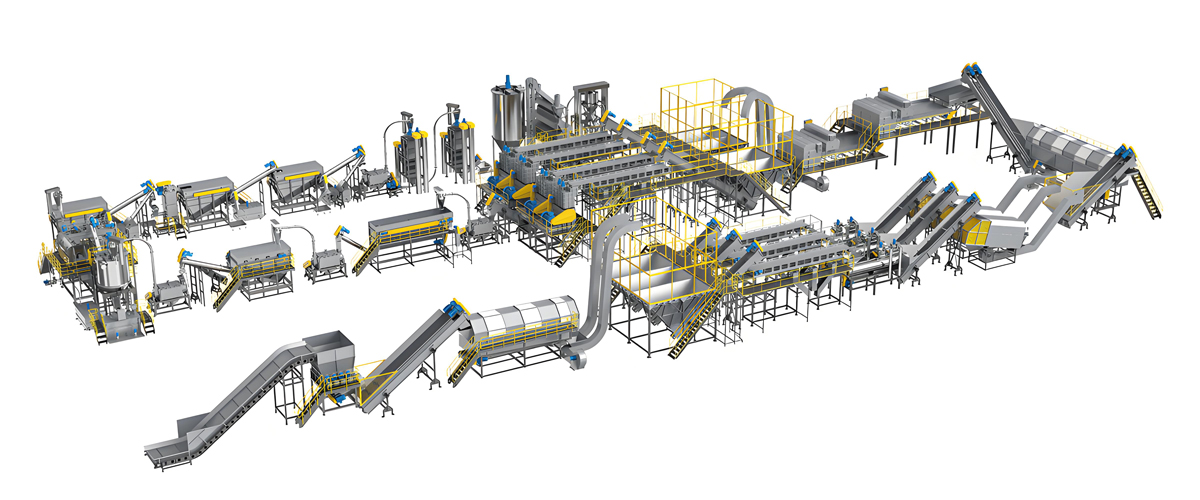
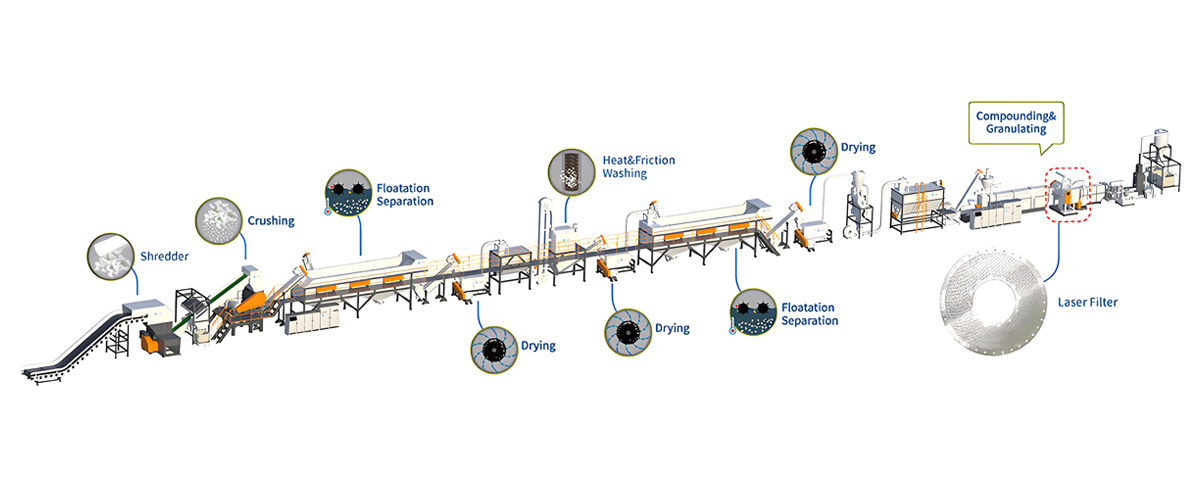
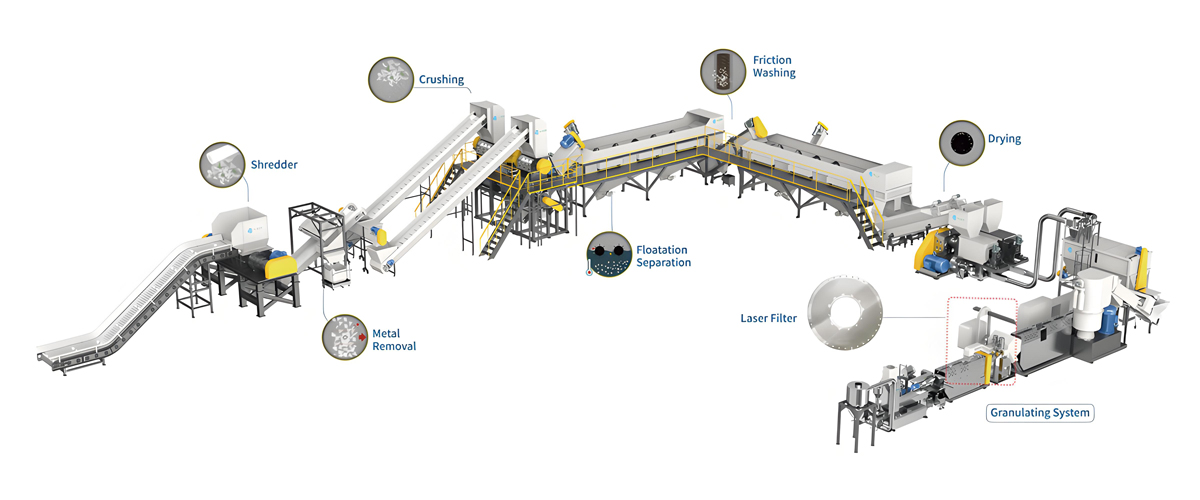
Integrating a professional granulating system with a complete plastic washing line forms an integrated recycling production process that realizes one-stop processing from waste plastic crushing, impurity removal, floating washing, high-temperature cleaning, dehydration, and drying to final granulation molding. This integrated mode eliminates intermediate redundant links, ensures continuous and stable material transmission, improves the purity and uniformity of recycled plastic particles, and effectively reduces comprehensive production and labor costs. As a professional manufacturer of full-set plastic recycling equipment, POLYRETEC has mature integrated technical solutions for washing and granulating line docking, which are widely applied in PET, PE, PP, PVC, and mixed plastic waste recycling projects worldwide.
A scientific and standardized integration scheme can maximize the utilization rate of each piece of equipment, stabilize product quality, shorten the production cycle, and improve the overall automation level of the production line. This article comprehensively elaborates the core integration principles, step-by-step docking processes, equipment matching standards, cost and price analysis, common integration problems and solutions, operational benefits, and application scenarios of plastic washing lines and granulating systems, providing systematic and practical technical guidance and investment reference for global plastic recycling enterprises.
2. Core Functions and Independent Process Characteristics of Waschlinie and Granulating System
2.1 Working Process and Core Functions of POLYRETEC Plastic Waschlinie
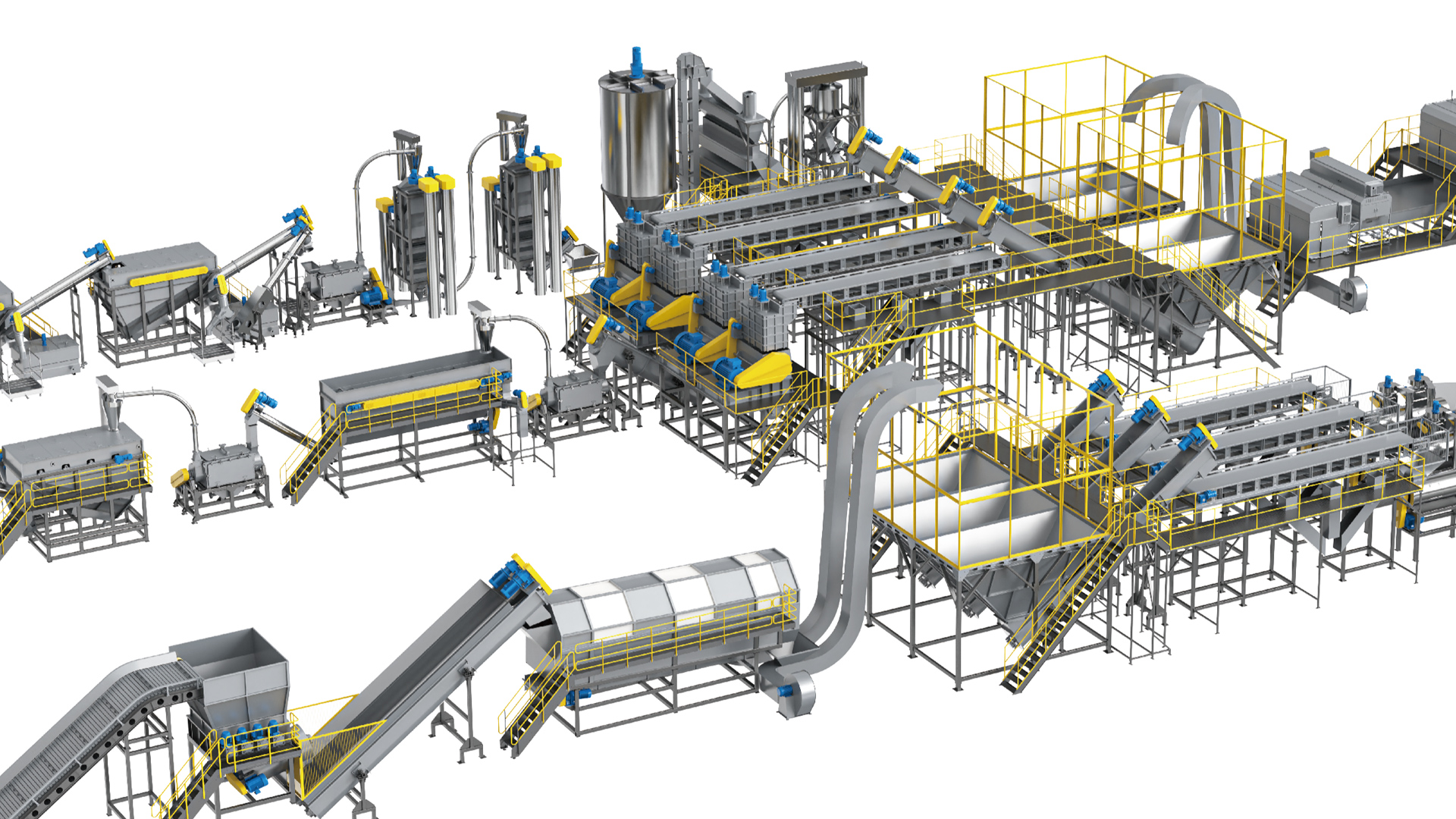
The POLYRETEC full-automatic plastic washing line is the front-end pretreatment core equipment of plastic recycling projects, mainly responsible for removing surface dirt, oil stains, sediment, labels, adhesives, and mixed impurities of waste plastics. The complete washing line covers multiple standardized processing links including coarse crushing, friction washing, hot washing, floating separation, sink-float sorting, high-pressure rinsing, centrifugal dehydration, and hot air drying. Each link is precisely designed for different types of waste plastic pollution characteristics and material densities.
Coarse crushing equipment uniformly crushes bulk, irregular waste plastics into uniform flake or granular materials to facilitate subsequent full contact with cleaning water and improve impurity removal efficiency. The high-speed friction washing unit uses mechanical friction and water flow scouring to remove surface floating dust and loose adhesives. The hot washing tank adds professional environmental cleaning agents and maintains constant high temperature to decompose and remove stubborn oil stains and aged glue layers on plastic surfaces, which is an indispensable link for high-purity recycled plastic production.
The sink-float sorting system separates different types of plastics and light and heavy impurities through density difference, effectively removing stone, metal, glass and other heavy impurities as well as light fiber and paper impurities. The final centrifugal dehydration and hot air drying system reduces the material moisture content to below 3%, meeting the strict drying standard required by subsequent granulating processing. The finished clean dry plastic materials output by the washing line are the core raw materials for high-quality granulation molding, and the drying degree and impurity content directly determine the granulation effect and finished particle quality.
2.2 Working Process and Core Functions of Plastic Granulating System
The plastic granulating system is the terminal molding equipment of the plastic recycling production line, which processes clean dry plastic flakes and particles into uniform solid plastic pellets through melting, extrusion, filtration, and cutting molding. The complete granulating system includes automatic feeding device, screw extrusion host, melt filter, hydraulic screen changer, cooling system, pelletizing machine, and finished particle sorting equipment. It is responsible for converting scattered recycled plastic raw materials into standardized reusable plastic particles, realizing resource regeneration and commercial value upgrading of waste plastics.
The working principle of the granulating system is to heat and melt clean dry plastic materials through the high-temperature screw barrel, extrude the molten plastic through a precise die head, filter out residual tiny impurities through multi-stage filtration, and cool and shape the plastic strips. Finally, the high-speed pelletizing unit cuts the plastic strips into uniform cylindrical particles of fixed specifications. High-quality granulating equipment can ensure uniform particle size, smooth surface, stable density, and no bubble impurities of finished particles, making the recycled plastic particles reach the industrial reuse standard and meet the procurement requirements of plastic product manufacturing enterprises.
2.3 Key Contradictions of Independent Operation and Necessity of Integrated Integration
When the washing line and granulating system operate independently, there are many unavoidable industry pain points. First, the washed wet materials need manual collection, transportation and stacking, which not only consumes a lot of labor costs, but also causes secondary dust pollution and moisture absorption of clean materials, resulting in increased impurity content and unstable moisture content. Second, the discontinuous material supply leads to frequent start-stop of the granulating system, which easily causes equipment temperature fluctuation, uneven melting of materials, and unstable particle quality, and also increases equipment failure rate and energy consumption.
In addition, independent operation requires larger plant area for material stacking, increases site rental and management costs, and cannot form standardized automated assembly line production, limiting the daily processing capacity and production efficiency of the project. The integrated integration of washing and granulating lines perfectly solves the above problems, realizing seamless docking of material output from the washing line to granulating system feeding, full-process closed-loop automated production, no intermediate manual intervention, stable and consistent product quality, and greatly improved project comprehensive benefits.
3. Core Technical Principles of Waschlinie and Granulating System Integration
3.1 Material Continuity Transmission Principle
The core of integrated production line docking is to realize continuous, stable and quantitative material transmission between the washing line discharge port and the granulating system feeding port. POLYRETEC adopts customized sealed conveyor feeding equipment to connect the final drying discharge end of the washing line with the feeding hopper of the granulating host. The fully sealed transmission structure avoids material secondary pollution and moisture regain, and the variable-frequency speed regulation function realizes quantitative and uniform material delivery according to the operating speed of the granulating system.
The system realizes synchronous linkage operation of washing and granulating equipment. When the granulating system operates at high speed, the conveying speed of the washing line supporting conveyor automatically increases to ensure sufficient material supply; when the granulating system is in low-speed operation or standby state, the conveying speed automatically decreases to avoid material accumulation and feeding blockage, realizing dynamic balance of the whole production line material flow.
3.2 Parameter Synchronization and Intelligent Linkage Principle
The integrated production line adopts unified PLC intelligent control system to realize synchronous parameter setting and real-time data monitoring of washing and granulating equipment. The drying temperature, dehydration speed and material output speed of the washing line are automatically matched with the melting temperature, extrusion speed and pelletizing speed of the granulating system. The system can automatically adjust the front-end washing process parameters according to the back-end granulating production status to ensure that the moisture content, impurity content and material dryness of the output materials fully meet the granulating processing standards.
All operating parameters of the whole line are displayed on the centralized control panel in real time, including equipment operating current, temperature, material flow, processing capacity and fault status. The intelligent linkage system can automatically alarm and adjust parameters when abnormal conditions such as excessive material moisture, blockage and equipment overload occur, ensuring long-term stable operation of the integrated production line.
3.3 Closed-Loop Environmental Protection and Energy Saving Principle
The integrated washing and granulating production line realizes closed-loop recycling of water resources and heat energy. The cleaning wastewater generated by the washing line is treated by the circulating water treatment system and reused for production cleaning, reducing water resource waste and production water cost. The hot air waste heat generated by the granulating system cooling and heating links is recycled to the washing line drying unit, improving the thermal utilization rate of the whole line and reducing the energy consumption of heating and drying equipment.
The fully enclosed production structure realizes centralized dust and flue gas collection and treatment, avoiding dust overflow and waste gas pollution in the production process, meeting global industrial environmental protection emission standards, and realizing green and energy-saving integrated production.
4. Complete Step-by-Step Integration Process of Washing and Granulating Production Line
4.1 Pre-Integration Parameter Matching and Equipment Positioning
Before the formal docking of the production line, it is necessary to complete the model matching and parameter debugging of the washing line and granulating system according to the user’s raw material type, processing capacity and finished particle standard. First, confirm the hourly processing capacity of the washing line and granulating system to ensure that the processing parameters of the front and back-end equipment are matched, avoiding the problem of unbalanced material supply caused by mismatched production capacity. POLYRETEC professional technicians provide one-to-one model matching scheme according to user’s production demand, ensuring that the supporting degree of integrated equipment reaches the best state.
Complete the scientific positioning and layout of the production line according to the plant space. The washing line is arranged at the front end of the production line, and the granulating system is closely connected at the rear end. The linear layout reduces the material transmission distance, improves transmission efficiency, and saves plant space. Reserve standardized operation and maintenance channels to facilitate daily equipment inspection, maintenance and cleaning work.
4.2 Intermediate Conveying and Docking Equipment Installation
Install customized sealed screw conveyor or belt conveyor between the washing line drying discharge port and the granulating feeding hopper. The screw conveyor is suitable for small-particle dry materials, with good sealing performance and no material leakage; the belt conveyor is suitable for large-flake plastic materials, with fast conveying speed and high efficiency. According to the material characteristics of different waste plastics, select the matching conveying equipment to realize seamless docking of front and back-end equipment.
Install automatic material buffering device at the docking position to avoid material interruption or accumulation caused by instantaneous speed fluctuation of equipment. The buffering device can store a small amount of qualified dry materials to ensure continuous and stable feeding of the granulating system during short-term parameter adjustment of the washing line.
4.3 Intelligent Control System Integration and Debugging
Integrate the independent control systems of the washing line and granulating system into a unified centralized PLC control cabinet, realize one-key integrated start-stop, synchronous speed regulation and unified fault monitoring of the whole line. Set professional linkage programs for different production processes, and solidify the optimal parameter matching scheme for different plastic materials to ensure stable production effect after formal operation.
Complete no-load test run and load test run of the integrated production line. The no-load test checks whether the equipment transmission and linkage system operates normally without abnormal noise and vibration. The load test uses real waste plastic raw materials for trial production, adjusts process parameters such as washing temperature, drying degree, granulation temperature and extrusion speed according to the trial production effect, and optimizes the whole line process flow to ensure that the finished particle quality meets the standard.
4.4 Post-Integration Production Calibration and Standardization
After the completion of equipment docking and debugging, carry out continuous 24-hour stable operation calibration to verify the continuity and stability of the integrated production line. Detect the impurity content, moisture content, particle size uniformity and surface smoothness of finished particles in batches to ensure that the product quality is stable and consistent in batch production. Form standardized operation procedures for integrated production lines, clarify equipment operation specifications, parameter adjustment standards and daily maintenance guidelines, and lay a foundation for long-term standardized production.
5. POLYRETEC Integrated Production Line Model Matching and Detailed Price Cost Analysis
POLYRETEC supports customized matching of washing lines and granulating systems according to different user production capacities, covering small trial production, medium standardized production and large-scale high-efficiency automated production scenarios. All supporting models are professionally optimized for integrated docking, with perfect parameter matching and stable linkage operation. This chapter provides detailed model parameters, official factory prices and full-project investment cost analysis for three mainstream integrated schemes.
5.1 Small Integrated Production Scheme (300kg/h Processing Capacity)
This scheme is suitable for start-up recycling enterprises and small-scale waste plastic processing stations, mainly used for small-batch recycling of PE, PP daily waste plastics and packaging plastic waste. The supporting equipment includes a small fully automatic plastic washing line and a matching single-screw granulating system, with a stable hourly processing capacity of 300kg.
The small washing line is equipped with coarse crushing unit, friction washing unit, sink-float sorting unit, centrifugal dehydration and hot air drying unit, which can effectively remove conventional impurities and oil stains on waste plastics, with the finished material moisture content controlled below 3%. The matching granulating system adopts energy-saving single-screw extrusion structure, with stable extrusion and uniform pelletizing, meeting the basic industrial reuse standard of recycled particles.
In terms of price cost, the official factory price of the 300kg/h small integrated washing and granulating production line is $32,800 to $36,500, including full-set washing equipment, granulating host, docking conveying equipment and integrated control system. The auxiliary supporting circulating water treatment equipment costs $3,200 to $3,800, and the simple plant transformation and equipment installation and commissioning cost is $1,800 to $2,200. The total one-time fixed investment of the complete small integrated project is $37,800 to $42,500, with low initial investment threshold and suitable for novice project trial operation.
5.2 Medium Standard Integrated Production Scheme (800kg/h Processing Capacity)
The 800kg/h medium integrated production line is the mainstream hot-selling scheme of POLYRETEC, which is widely used in professional medium-sized plastic recycling factories. It is suitable for mass recycling and regeneration of various conventional waste plastics such as PET bottle flakes, PE film, PP woven bags and plastic barrels, with high production efficiency and stable finished product quality.
The medium-sized full-automatic washing line is upgraded with high-efficiency hot washing unit and multi-stage fine sorting structure, which can thoroughly remove stubborn oil stains, colloids and tiny impurities, with the finished material purity reaching more than 99.5%. The supporting dual-stage high-efficiency granulating system is equipped with automatic hydraulic screen changer and multi-stage melt filtration device, which can effectively filter tiny residual impurities, and the finished plastic particles have smooth surface, uniform size and no bubbles, reaching high-standard industrial reuse grade.
The official factory price of the 800kg/h standard integrated production line is $68,500 to $74,200. The supporting environmental protection dust removal, waste gas treatment and circulating water recycling auxiliary equipment costs $5,500 to $6,200. The plant layout transformation, equipment installation, debugging and technical training cost is $2,800 to $3,500. The total fixed investment of the complete medium-sized integrated project is $76,800 to $83,900. This scheme balances investment cost and production efficiency, and is the preferred configuration for most standardized plastic recycling projects.
5.3 Large-Scale High-Efficiency Integrated Production Scheme (1500kg/h Processing Capacity)
The 1500kg/h large-scale integrated production line is a high-end customized scheme for large industrial recycling bases and group enterprises, suitable for long-term large-batch and high-standard waste plastic recycling production. The whole line realizes full unmanned automated operation, with ultra-high production efficiency and stable product quality, and can meet the long-term order supply demand of large plastic product manufacturers.
The large-scale washing line adopts full-process intelligent temperature control and automatic sorting technology, with ultra-high impurity removal accuracy and drying efficiency, and the finished material moisture content is stably controlled below 2%. The supporting high-power twin-screw granulating system has strong melting and plasticizing capacity, fast extrusion speed and high pelletizing uniformity, and is equipped with automatic particle screening and packaging equipment to realize integrated production from raw material processing to finished product packaging.
The official customized factory price of the 1500kg/h high-efficiency integrated production line is $128,000 to $136,500. The full-set high-standard environmental protection auxiliary equipment and intelligent monitoring system cost $9,800 to $11,200. The standardized plant transformation and professional installation and commissioning cost is $4,500 to $5,800. The total fixed investment of the large-scale integrated project is $142,300 to $153,500, with excellent long-term mass production benefits.
6. Daily Operating Cost and Full-Life-Cycle Cost Performance Analysis
Taking the mainstream 800kg/h medium integrated production line as an example, this chapter comprehensively analyzes the daily recurring operating costs of the integrated washing and granulating project, including energy consumption, labor, maintenance and consumable costs, and compares the cost differences with independent split production lines to highlight the economic advantages of integrated integration schemes.
6.1 Energy Consumption Cost Analysis
The integrated production line adopts unified energy-saving control and waste heat recycling technology, which effectively reduces comprehensive energy consumption. The daily operating time is 8 hours, and the monthly total power consumption of the whole line is stably controlled at 8500 to 9500 kWh, with a monthly electricity cost of $920 to $1050. The closed-loop circulating water system reduces water resource consumption, and the monthly water replenishment and water treatment cost is only $120 to $160. Compared with the split independent production line, the integrated scheme saves more than 22% of comprehensive energy consumption every year, with significant energy-saving benefits.
6.2 Labor and Maintenance Cost Analysis
The highly automated integrated production line only requires 2 operators to complete daily production monitoring, raw material feeding and finished product collection work, with a monthly total labor cost of $1800 to $2200. The split production line requires at least 4 to 5 workers to complete intermediate material transportation and equipment operation, and the integrated scheme saves more than 50% of labor cost annually.
The unified integrated control system reduces equipment failure rate, and the monthly routine maintenance, equipment lubrication and parameter calibration cost is $150 to $200. The vulnerable parts of the whole line have unified specifications, which is convenient for centralized replacement and management, reducing the procurement and management cost of spare parts. The annual comprehensive maintenance cost of the integrated production line is more than 30% lower than that of the split production line.
6.3 Consumable and Site Operating Cost Analysis
The integrated production line realizes closed-loop production, reduces material secondary pollution and loss, and the raw material utilization rate is increased from 92% of split production to 98.5%, greatly reducing raw material waste cost. The integrated layout saves plant space, and the monthly site rental and environmental maintenance cost is $380 to $450, lower than the split production mode.
The total monthly comprehensive operating cost of the 800kg/h integrated production line is stably controlled at $3370 to $4060, with controllable cost structure and no hidden consumption. The long-term comprehensive cost performance is far higher than the traditional split production mode.
7. Core Advantages of POLYRETEC Integrated Washing and Granulating Production Line
7.1 Stable and Consistent Finished Product Quality
The seamless integrated docking mode avoids secondary pollution, moisture regain and material damage caused by intermediate manual transportation of materials. The unified intelligent parameter linkage ensures that the moisture content, purity and plasticizing degree of materials in each production batch are consistent, making the finished recycled plastic particles have uniform particle size, smooth surface, stable physical properties and no quality fluctuation. The batch qualification rate of finished products reaches 99.8%, which can stably meet the high-standard procurement requirements of downstream plastic manufacturing enterprises and help users stabilize long-term high-value order cooperation.
7.2 Significant Production Efficiency Improvement
The integrated production line realizes continuous uninterrupted production, eliminating intermediate material stacking, handling and waiting links, and the effective production time of the equipment is increased by more than 30%. The synchronous linkage operation of front and back-end equipment avoids frequent start-stop and idle running of equipment, greatly improving the unit time processing capacity. Under the same equipment configuration, the daily output of the integrated production line is 25% to 35% higher than that of the split production line, effectively improving the production scale and order delivery capacity of the enterprise.
7.3 Low Comprehensive Operating Cost and High Profit Margin
The integrated scheme has obvious advantages in labor cost, energy consumption cost, material loss cost and site cost, and the annual comprehensive operating cost can be saved by 20% to 28% compared with the traditional split production mode. The improvement of product qualification rate and production efficiency further increases the unit product profit margin. Under the same market sales price, the integrated production line has higher net profit space and stronger market competitiveness.
7.4 High Automation and Simple Operation Management
The whole line adopts centralized intelligent control, realizing one-key start-stop, automatic parameter adjustment and real-time fault alarm. The operation threshold is low, and daily production management is simple and efficient. The highly automated production mode reduces manual operation errors, avoids quality problems caused by human factors, and realizes standardized and standardized production management of the workshop.
7.5 Green Environmental Protection and Compliance Production
The fully enclosed integrated production structure realizes centralized collection and treatment of production dust, wastewater and waste gas. The closed-loop water recycling system reduces water resource waste, and the waste heat energy-saving recycling system reduces energy consumption and carbon emissions. The whole production process meets international environmental protection standards, helping enterprises pass environmental protection assessment smoothly and avoid production suspension risks caused by non-compliant environmental protection.
8. Common Integration Problems, Causes and Professional Solutions
8.1 Unmatched Material Supply and Granulation Speed
Many ordinary integrated schemes have the problem of mismatched front and back-end production capacity, resulting in material accumulation or material interruption. Excessive material supply will cause granulating system feeding blockage and overload operation, while insufficient material supply will cause granulation temperature fluctuation and hollow particles. The core cause is unsynchronized parameter setting and lack of intelligent linkage function of front and back-end equipment.
POLYRETEC integrated solution adopts dynamic linkage speed regulation system. The granulating system feeds back the real-time operating speed to the washing line control system, and the washing line automatically adjusts the material output speed and conveying speed to realize real-time matching of material supply and granulation speed, completely solving the problem of unbalanced material flow.
8.2 Unstable Finished Particle Quality
Unstable particle quality such as particle bubbles, uneven size and rough surface is mostly caused by unqualified material drying degree and inconsistent plasticizing temperature. If the washing line drying parameter is unstable and the material moisture content fluctuates, the granulation melting process will produce bubbles; if the front and back-end temperature parameters are not linked, the plasticizing degree will be inconsistent, resulting in uneven particle molding.
POLYRETEC’s exclusive integrated parameter locking system solidifies the optimal matching parameters of drying temperature and granulation temperature. The system automatically compensates temperature difference according to environmental temperature and material changes, ensures stable material drying degree and uniform plasticizing effect, and guarantees stable and excellent finished particle quality in batch production.
8.3 Material Blockage and Equipment Overload Failure
Material blockage often occurs at the docking conveying position of the two systems. Ordinary conveying equipment cannot adapt to material state changes, resulting in material accumulation and blockage. Long-term blockage will cause equipment motor overload and mechanical failure.
POLYRETEC supporting docking conveying equipment is equipped with intelligent anti-blocking monitoring system, which can sense material accumulation in real time and automatically adjust conveying speed or reverse discharge to eliminate blockage. The overload protection device of the whole line can automatically stop and protect the equipment in case of abnormal load, effectively reducing equipment failure rate and maintenance loss.
8.4 Secondary Material Pollution and Moisture Regain
Open conveying and docking structure will lead to clean materials contacting with air, absorbing moisture and adsorbing dust, resulting in reduced finished product purity. POLYRETEC adopts full-sealed negative pressure conveying structure for integrated docking, which completely isolates materials from external air, avoids secondary pollution and moisture regain, and ensures the high purity and dryness of materials entering the granulating system.
9. Project Profit Analysis and Investment Return Cycle
Based on the mainstream 800kg/h POLYRETEC integrated washing and granulating production line, this chapter calculates the project income and investment return cycle accurately, providing intuitive investment benefit reference for recycling project investors.
The integrated production line operates 8 hours a day, with a daily stable processing capacity of 6.4 tons of waste plastics. After integrated washing purification and granulation molding, the finished high-purity recycled plastic particles have a high market sales premium. The net profit of integrated processing and granulation of waste plastics in the global market is $45 to $58 per ton. The daily gross profit of the production line is $288 to $371.
After deducting daily average energy consumption, labor, maintenance and site operating costs, the daily net profit of the project is $195 to $260. Calculated based on 26 working days per month, the monthly net profit of a single integrated production line is $5,070 to $6,760. The total fixed investment of the complete 800kg/h integrated project is $76,800 to $83,900, and the static investment return cycle is 11.5 to 16.5 months.
For projects with sufficient raw material supply and long-term stable orders, the production line can support 12-hour overtime operation, with a daily processing capacity of 9.6 tons and a monthly net profit of more than $9,000, and the investment return cycle can be shortened to less than 9 months. The service life of POLYRETEC integrated production line equipment is more than 15 years, with stable long-term profit output. With the continuous rise of recycled plastic particle market prices, the long-term profit space of the project will continue to expand.
10. Main Application Scenarios of Integrated Washing and Granulating Production Line
10.1 Daily Waste Plastic Recycling and Regeneration
It is suitable for centralized recycling and processing of daily waste plastics such as plastic bottles, plastic films, woven bags, plastic barrels and packaging plastics. The integrated production line efficiently completes impurity removal, cleaning, drying and granulation of daily miscellaneous plastics, turning scattered waste plastics into high-value reusable plastic particles, with wide material adaptability and high comprehensive resource utilization rate.
10.2 Industrial Waste Plastic Professional Processing
For industrial leftover plastics, defective plastic products, industrial plastic profiles and other high-quality waste plastic resources, the integrated production line can achieve high-purity purification and high-standard granulation. The finished particles can be directly used for secondary processing and manufacturing of industrial plastic products, realizing closed-loop recycling of industrial resources and creating higher economic value.
10.3 Large-Scale Environmental Protection Recycling Project
Large-scale environmental protection recycling bases and industrial park centralized waste treatment projects require standardized, automated and large-scale plastic waste processing capacity. POLYRETEC large-scale integrated washing and granulating production line can meet the demand of high-capacity continuous production, help enterprises complete resource recycling indicators, and obtain stable environmental protection project benefits.
11. Market Development Trend of Integrated Plastic Recycling Production Line
With the continuous upgrading of global circular economy policies and the gradual standardization of the plastic recycling industry, the traditional scattered and manual semi-automatic production mode is gradually eliminated by the market. Integrated, automated, energy-saving and environmentally friendly full-process recycling production lines have become the mainstream development trend of the industry.
Downstream plastic product manufacturing enterprises have higher and higher requirements for the purity, uniformity and stability of recycled plastic particles, which puts forward higher standards for the full-process processing technology of plastic recycling. The separate washing and granulating production mode can no longer meet the high-standard product demand, and the integrated seamless docking production mode has become the inevitable choice for industrial upgrading.
As a professional manufacturer of full-set plastic recycling equipment, POLYRETEC continues to optimize the integrated linkage technology of washing lines and granulating systems, improve equipment automation, energy-saving performance and product processing accuracy, and provide high-cost-performance integrated solutions for global plastic recycling enterprises, helping the industry achieve high-quality and sustainable development.
12. Conclusion
The scientific integration of granulating system and plastic washing line is the key to realize high-efficiency, low-cost and high-quality standardized production of plastic recycling projects. Reasonable docking of front-end washing purification and terminal granulation molding processes can completely solve the quality instability, low efficiency, high cost and environmental non-compliance problems existing in traditional split production mode.
POLYRETEC series integrated washing and granulating production lines cover multiple capacity gradients, with mature integration technology, stable equipment performance, reasonable investment cost and short return cycle. The integrated solution has outstanding advantages in product quality control, production efficiency improvement, comprehensive cost saving and environmental protection compliance production. Choosing POLYRETEC professional integrated production line docking scheme can help global plastic recycling enterprises optimize production processes, reduce operating costs, improve product market competitiveness, and realize long-term stable and profitable development of plastic resource recycling business.