
Sticky plastic waste is the recycler’s quiet productivity killer. Films, bags, and flexible packaging that carry adhesives, labels, glues, and residual organics behave nothing like clean rigid flakes on a washing line. Instead of flowing and rinsing cleanly, they ball up, smear contamination across otherwise good material, blind screens, and drag down both throughput and flake quality. For operators running post-consumer PP and PE film, agricultural mulch, or labeled packaging, efficiency losses from stickiness are often the difference between profit and breakeven. Polyretec, a Wanplas factory, builds plastic washing lines that combine Austrian-derived process technology with Chinese manufacturing scale, and its experience across more than 100 recycling projects shows that sticky waste is a solvable engineering problem rather than an unavoidable cost. This guide walks through what makes waste sticky, why efficiency falls, how a purpose-built washing line is staged, which equipment upgrades deliver the largest gains, how cold and hot washing compare, what realistic throughput looks like in 2026, which parameters to tune, how leading manufacturers differ, what standards apply, and how a real Mexico installation handled LDPE film covered in stickers.
The pressure on washing-line efficiency is intensifying in 2026. Brand owners are setting higher recycled-content targets, which pulls more contaminated post-consumer film into the recycling stream just as labor and energy costs rise. A line that was acceptable for clean industrial offcuts a few years ago now fails on the stickier, more printed, more laminated material arriving at the gate. Recyclers who treat efficiency as an engineering discipline, rather than a matter of running harder, are the ones protecting margin. The sections below translate that discipline into concrete, purchasable decisions, and show where to spend capital for the fastest payback on sticky feeds.
What Makes Plastic Waste Sticky
Stickiness in recycled plastic is rarely a single cause. It is the combined effect of surface contaminants and low-melt components that soften under washing-line heat and mechanical action. Understanding the source is the first step to controlling it.
Adhesives, Labels, and Glues
Pressure-sensitive labels, tape residue, and hot-melt glues are the most common culprits on flexible packaging. In water they emulsify poorly and tend to re-deposit on flakes, creating the gray, cloudy appearance buyers reject. Self-adhesive label backing is especially troublesome because it is designed to stick.
Residual Food and Organic Oils
Post-consumer films from food packaging carry oils, sugars, and proteins. These attract dirt and form tenacious films on the polymer surface. Without aggressive pre-rinse, they survive the main wash and lower the perceived cleanliness of the output.
Low-Melt and Contaminant Polymers
EVA, plastisol, and some LDPE fractions soften early, agglomerating with dust and paper into clumps that blind screens and jam conveyors. In a mixed stream, these soft components are the glue that binds contamination to good flake.
Recognizing the dominant sticky agent dictates the remedy. A line dominated by label glue needs mechanical label removal and hot caustic washing, while one dominated by food oil needs a strong pre-rinse and surfactant. Treating both the same wastes energy and still underperforms.
Why Waschlinie Efficiency Drops on Sticky Materials
Efficiency on a washing line is usually measured as clean, dry flake output per hour relative to installed capacity and utility use. Sticky waste attacks every part of that equation. First, it reduces effective throughput because clumps slow the conveyor and force operators to throttle the feed. Second, it raises rework: flakes that fail cleanliness checks must be re-washed or downgraded, doubling handling cost. Third, it increases downtime as screens blind and friction washers load up. Fourth, it raises water and chemical consumption because operators compensate with more aggressive dosing. Finally, it hurts yield, since sticky balls are often discarded as reject rather than recovered.
The hidden cost is consistency. A line that runs clean rigid flakes at nameplate capacity may deliver only a fraction of that on sticky film, and the variance makes production planning unreliable. For a recycler selling to converters on contract, that variability is as damaging as low absolute output. The engineering answer is to design the line so sticky behavior is removed early, before it can propagate through later stages.
Quantifying the loss helps justify the right upgrade. A recycler should track clean, dry output per hour, reject rate, water and chemical use per ton, and unplanned downtime, then compare against the line’s clean-material baseline. The gap between those two numbers is the sticky-waste tax, and it is usually large enough to pay for a beater machine or heavy-duty shredder within a single budget year. Framing efficiency this way turns maintenance and equipment choices into measured investments rather than discretionary spending, which is the mindset that keeps a washing line competitive.
Core Process Stages of a Sticky-Waste Waschlinie
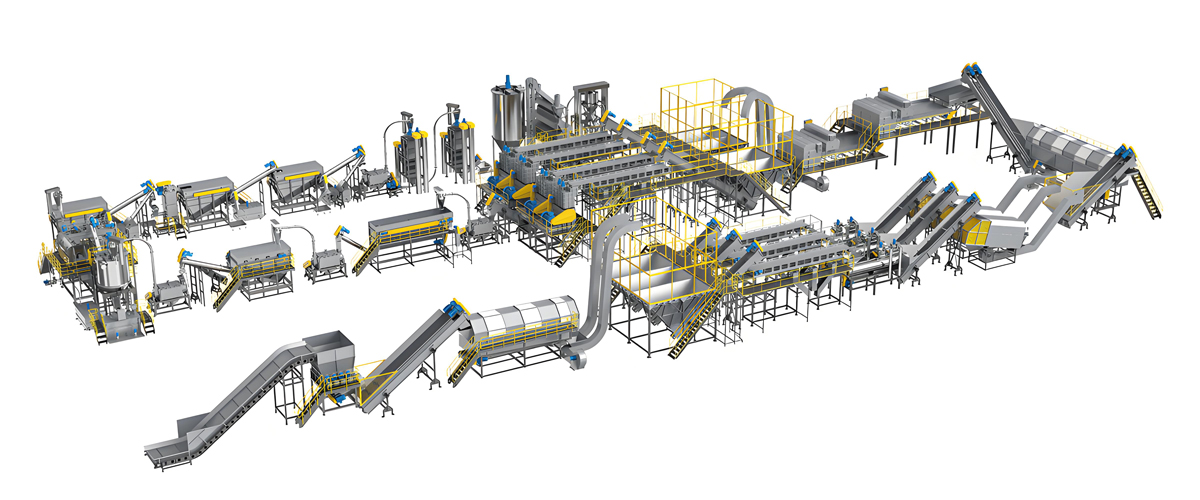
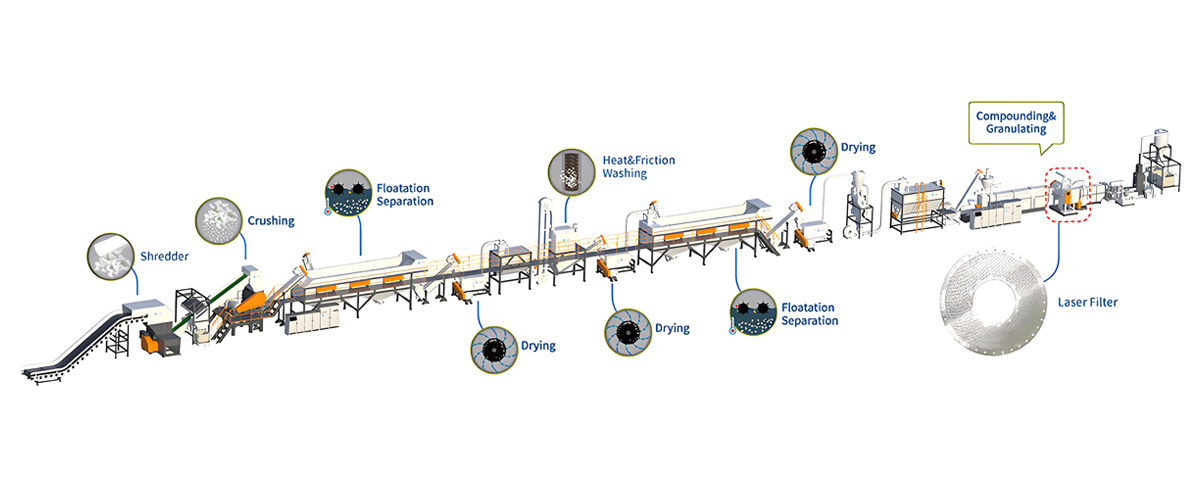
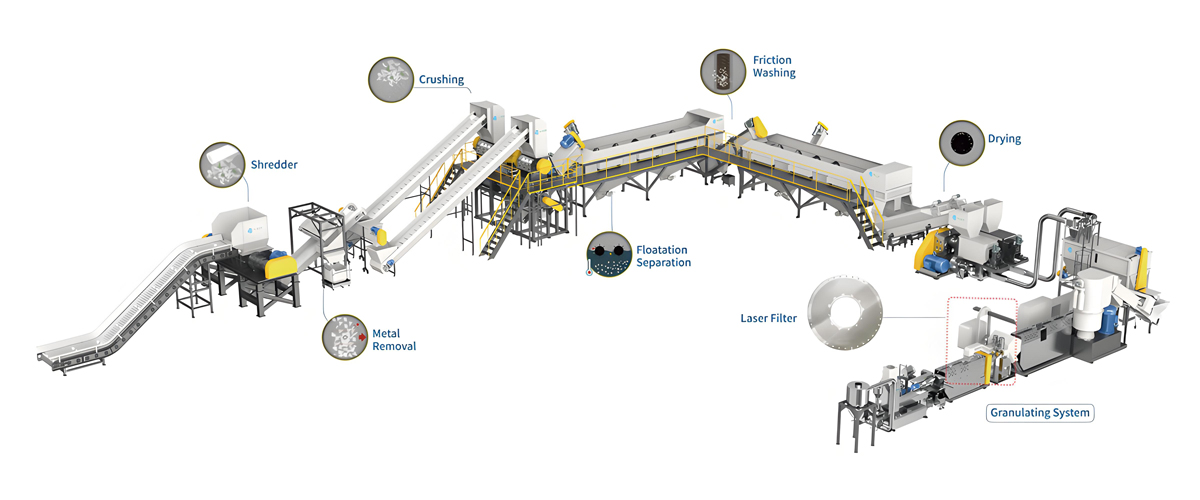
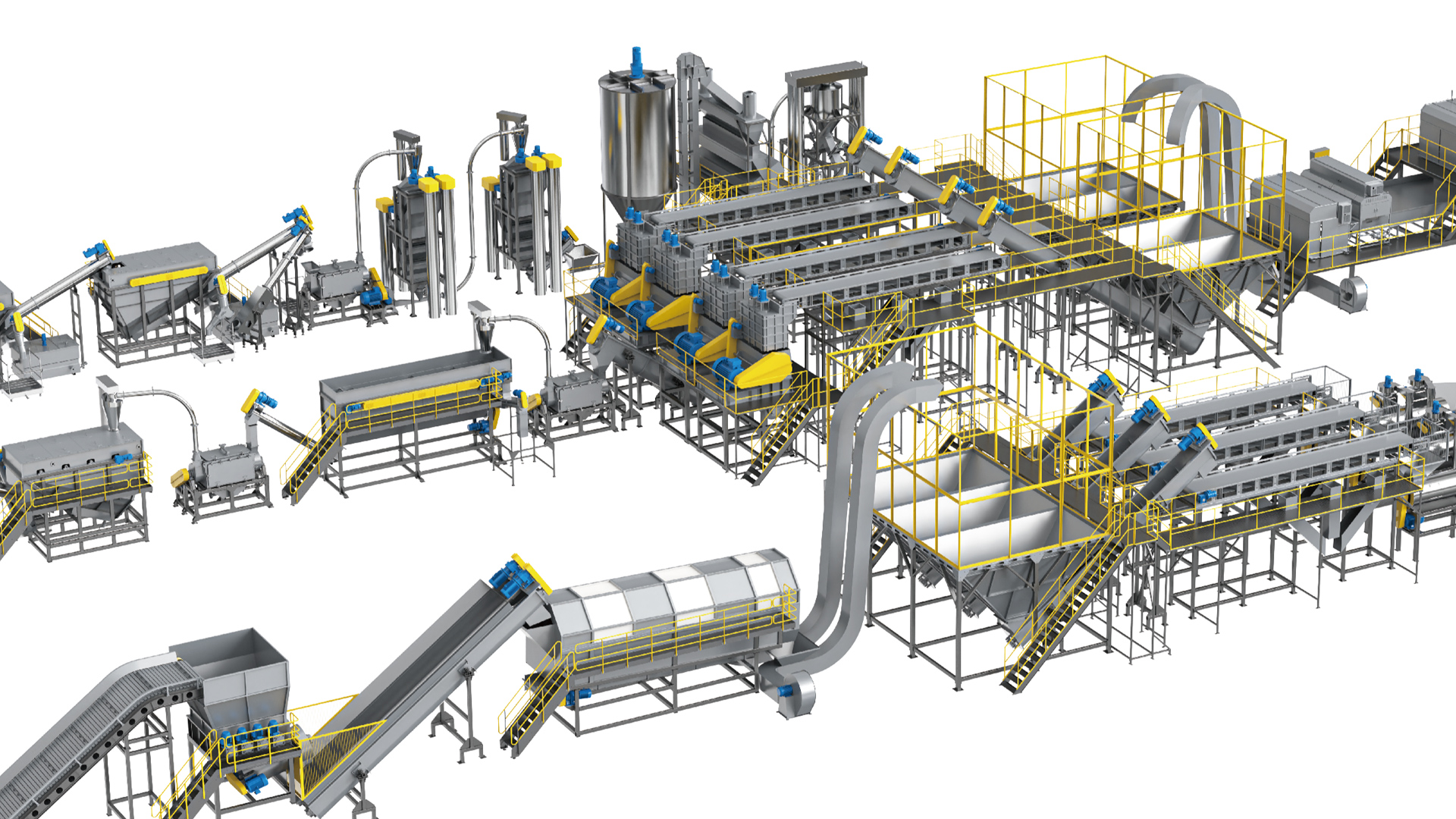
Polyretec washing lines preprocess waste plastics through crushing, cleaning, sorting, and drying. For sticky streams, the sequence below is tuned to strip contaminants before they set.
Stage 1: Pre-Wash and Label Removal
Incoming bales are broken and given a cold pre-rinse that loosens surface dirt and begins lifting labels. A label-removal unit or wet granulator strips backing paper early so it can be floated off rather than ground into the flake.
Stage 2: Shredding and Wet Grinding
Material is shredded, often with a heavy-duty shredder for tough or thick items, then wet-ground into flake. Grinding under water suppresses heat that would otherwise soften sticky components prematurely and helps release trapped contamination.
Stage 3: Friction Washing
A high-speed friction washer or beater machine rubs flake against itself and against the chamber wall, mechanically scrubbing glue and ink from the surface. This stage is the workhorse for sticky waste and the one most worth upgrading.
Stage 4: Float-Sink Separation
In a sink-float tank, PP and PE (density below water) rise while denser contaminants such as PET, glass, and metals sink. Good tank design with controlled turbulence prevents sticky clumps from carrying dense dirt upward with the good fraction.
Stage 5: Hot Wash and Rinse
For label- and glue-heavy streams, a hot caustic or detergent wash dissolves adhesives. Thorough fresh-water rinses then remove chemical residues so the flake meets downstream quality expectations.
Stage 6: Drying and Screening
A centrifugal dryer removes surface moisture, and a screener removes fines and any remaining clumps. Dry, uniform flake is then ready for storage, sale, or one-step pelletizing.
Staging order matters more than the individual machines. Removing labels and loose dirt in the pre-wash, then grinding wet to suppress heat, then scrubbing hard in the friction washer, keeps each later stage working on progressively cleaner material rather than re-contaminating it. A common mistake is to short-change the early stages and expect the hot wash to fix everything, which simply wastes energy and still leaves glue on the flake. The Polyretec sequence is deliberate: contamination is stripped while it is still easy to remove, so the expensive hot-wash and drying stages run on material that is already mostly clean.
Key Equipment Upgrades for Sticky Waste
When a line underperforms on sticky material, the fix is rarely a single part. The upgrades below deliver the largest, most reliable efficiency gains.
Heavy-Duty Shredder
Sticky, thick, or mixed bales stress a standard granulator. A heavy-duty shredder, of the kind Polyretec deployed on its Mexico LDPE film project, tolerates contamination and protects downstream grinders. Lower maintenance and fewer jams translate directly into uptime.
Beater Machine and Friction Washer
A beater machine provides intense mechanical action that detaches glue and label fragments. Pairing it with a high-speed friction washer creates the one-two punch that defines sticky-waste cleaning. Sizing these units to the actual contamination load is more important than nominal capacity.
Upgraded Screen-Changer and Pre-Filter
Sticky lines shed more fines and paper. A robust screening and pre-filtration stage before the friction washer keeps recirculated water cleaner, which protects pumps and improves wash quality.
Water Recirculation and Treatment
Hot washing consumes and fouls water quickly. A recirculation loop with separation and, where needed, basic treatment cuts fresh-water demand and keeps chemistry stable, supporting both cost and consistency.
One-Step Pelletizing Option
For operators who both wash and pelletize, Polyretec offers one-step pelletizing on its soft PP and PE washing line, reducing handling and integrating the process. Downstream, Wanplas’s Kerke factory twin-screw extruders can compound the cleaned flake into value-added pellet.
Cold vs Hot Washing: A Comparison
The decision between cold and hot washing shapes both capital layout and operating cost for sticky waste. The table summarizes the trade-off.
| Criterion | Cold Washing | Hot Washing |
|---|---|---|
| Contaminant removal | Good for loose dirt, weak on glue | Strong on labels, adhesives, oils |
| Energy demand | Low | High |
| Water treatment need | Lower | Higher, chemical laden |
| Capital cost | Low | Medium to High |
| Best use case | Clean post-industrial film | Labeled, glued post-consumer film |
| Cycle time impact | Fast | Longer, needs rinse stages |
For genuinely sticky post-consumer waste, hot washing is usually unavoidable, but it should be reserved for the contaminated fraction. A staged design that cold-pre-washes and only hot-washes the dirty stream saves energy versus heating the entire flow. That selective approach is a core efficiency tactic in 2026, when energy cost and carbon reporting weigh on every recycling business case.
Throughput and Utility Benchmarks
Capacity planning should use Polyretec’s published ranges rather than generic vendor claims. The table below sets a defensible envelope for sticky and related streams.
| Polyretec Washing Product | Capacity Range | Target Input | Sticky-Waste Relevance |
|---|---|---|---|
| Soft PP and PE Crushing and Waschlinie | 500 to 1500 kg/h | Film, woven bags, agriculture film | Primary line for sticky films |
| Food-Grade-PET-Flaschen-Waschanlage | 500 to 6000 kg/h | PET bottles, flake grades | Reference for scale-up |
On sticky film, realized throughput typically sits below the upper end of the range because friction washing and drying become the limiting stages, not the shredder. Utility use scales with contamination: hot washing and recirculated-water treatment add both energy and chemical cost. Recyclers should model water and steam demand explicitly, since these often dominate operating expense on a sticky-waste line more than electricity. Wanplas group services, including factory-layout and utility-design support, help operators size these systems before installation rather than discovering shortfalls after commissioning.
Optimizing Parameters: Friction, Temperature, Detergent
Three process levers dominate sticky-waste cleaning. Tuning them systematically beats simply buying a bigger machine.
| Parameter | Effect | Optimization Tip |
|---|---|---|
| Friction washer speed | Higher speed scrubs more, raises power | Set to just remove glue; excess wastes energy |
| Wash temperature | Higher heat loosens adhesives | Use hot only on contaminated fraction |
| Detergent dose | More surfactant lifts oil and ink | Dose against soil load, verify rinse |
| Water exchange rate | Cleaner water improves flake | Recirculate with separation, top up |
| Residence time | Longer contact cleans better | Balance against throughput target |
The optimization mindset is to remove stickiness as early and as cheaply as possible. A strong cold pre-rinse and mechanical label removal reduce how much hot washing and chemical the later stages need. Continuous monitoring of turbidity and flake cleanliness lets operators hold quality while trimming dose and temperature, which is where real efficiency is won in 2026.
Waschlinie Manufacturer Comparison
Buyers comparing washing lines for sticky waste will meet a few globally active suppliers. The table frames their positioning.
| Manufacturer | Origin | Strength | Price Tier |
|---|---|---|---|
| Polyretec (a Wanplas factory) | China, Austrian-derived technology | Washing and pelletizing for PP, PE, PET | Medium to High |
| SOREMA | Italy | Washing and sorting lines for film and bottles | High to Premium |
| EREMA / Starlinger | Austria | Integrated wash and recycle, Premium engineering | Premium |
SOREMA and the Austrian makers are respected for sophisticated washing and sorting, often at a Premium price. Polyretec competes by applying the same Austrian-derived process principles through Chinese manufacturing, keeping the investment in the Medium to High range while retaining the engineering discipline sticky waste demands. Wanplas group backing, including an open-factory policy that welcomes visits, shared quality promises, and an annual free spare parts allowance, adds service assurance that narrows the gap with higher-priced European brands for many operators.
Standards and Compliance for Recycled Output
Clean flake is only salable if it meets the buyer’s specification and the relevant compliance frame. CE machinery directives and ISO quality management are the baseline for the line itself, covering safety and documented process control. For the material, EN 15347 describes the characteristics to be determined in feeding of plastics wastes for recycling, a useful reference for classifying incoming sticky waste consistently so the line can be tuned to it.
Where washed flake or pellet enters food-contact or regulated applications, additional decontamination and traceability are required under frameworks such as EU 10/2011 for food-grade recycled content. Most sticky post-consumer film is recycled into non-food uses such as garbage bags, construction film, and composite lumber, where the bar is cleanliness and consistency rather than super-clean decontamination. Defining the end use up front prevents both over-engineering and failed audits.
For sticky post-consumer film in particular, most output is destined for non-food recycled content such as refuse sacks, agricultural film, and composite profiles, where the commercial specification is cleanliness, low odor, and consistent moisture rather than super-clean decontamination. Holding the line to that specification, documented under ISO discipline and CE-compliant machinery, is usually enough to satisfy buyers and brand-owner audits alike. Recyclers who attempt food-grade status on stickered film face a far heavier validation burden and rarely recover the cost, so matching the standard to the realistic end market is itself an efficiency decision.
Case Study: Mexico LDPE Film with Stickers Project
Polyretec’s documented Mexico installation is a clear example of engineering for sticky waste. The project was a washing line for LDPE film contaminated with stickers, a classic sticky scenario where label adhesive resists ordinary cold washing. The chosen configuration included a heavy-duty shredder and a beater machine, the two upgrades most responsible for breaking up sticker-backed film and scrubbing adhesive from the LDPE surface.
The result was a line able to handle a contamination profile that defeats basic film washers, turning stickered LDPE into clean flake suitable for re-extrusion. For the operator, the efficiency gain came not from a larger line but from matching the right aggressive stages to the specific sticky contaminant. The lesson generalizes: diagnose the sticky agent, then specify the stage that removes it, rather than assuming a standard line will cope.
Troubleshooting Common Sticky-Waste Defects
Sticky waste produces a predictable set of defects when a stage is undersized or a parameter drifts. Recognizing them quickly keeps a washing line efficient and protects flake salability.
| Defect | Likely Cause | Corrective Action |
|---|---|---|
| Residual glue on flake | Weak friction wash, cold-only washing | Add or speed up beater; introduce hot wash stage |
| Clumps and balls | Low-melt polymer softening, overheat | Control temperature; pre-sort EVA and soft fractions |
| High flake moisture | Dryer or screener fault | Inspect centrifugal dryer, verify screener sizing |
| Contamination in good fraction | Excess tank turbulence | Tune float-sink flow and baffles |
| Rising water turbidity | Poor recirculation separation | Upgrade separation; increase exchange rate |
Residual glue is the signature sticky-waste defect, and the fix is mechanical, not chemical alone. A beater machine or faster friction washer physically lifts adhesive from the surface; hot washing then dissolves what remains. Operators sometimes over-dose detergent to compensate for a weak friction stage, which raises cost and water-treatment load without fixing the root cause. Clumps form when low-melt components such as EVA soften in a hot wash that is too aggressive for the mix, so the remedy is to moderate temperature and pre-sort the soft fraction rather than push heat higher.
Moisture and turbidity are efficiency signals rather than quality defects. Wet flake costs more to pelletize or ship and can fail buyer specs, so a slipping centrifugal dryer should be caught early. Turbidity that climbs despite dosing means the recirculation loop is not separating fines, and the wash water is effectively re-contaminating the flake. Addressing separation protects both quality and chemical consumption, which is where sticky-waste lines quietly lose money.
Maintenance and Operating Best Practices for Waschlinies
A washing line for sticky waste works hard on its mechanical and water systems, so maintenance discipline decides whether efficiency holds over years rather than months.
Shredder and Beater Wear
The heavy-duty shredder and beater machine do the abrasive work on stickered and glued film. Blade and rotor inspection on a fixed schedule prevents the gradual loss of scrubbing power that operators often mistake for a feed problem. Keeping sharpened blade sets and beater liners in stock turns a potential week-long outage into an afternoon changeover.
Screen, Filter, and Water Systems
Screens and pre-filters blind faster on sticky streams, so clean them on a trend basis using turbidity and pressure data. The water recirculation and treatment loop deserves its own care plan: separator media, chemical dosing pumps, and heat exchangers should be checked so the hot-wash chemistry stays stable. Stable water quality is the quiet foundation of consistent flake cleanliness.
Dryer and Conveyor Care
Centrifugal dryers and conveyors take mechanical load and vibration. Bearing condition, belt tension, and screen integrity should be on the weekly list. A failing dryer shows up first as moisture variance, which then travels downstream and is expensive to discover at the pelletizer.
Spare Parts and Service Strategy
As with pelletizing lines, lifetime cost is governed by parts readiness. Wanplas group shared service policy provides an annual free spare parts allowance and replacement of damaged parts within warranty, which absorbs much of the routine upkeep cost on sticky-waste lines. Recyclers should maintain a critical-parts list led by shredder blades, beater liners, screens, seals, and dryer bearings.
Training and Data Discipline
Standardize the pre-rinse, label-removal, friction-wash, and hot-wash setpoints for each waste profile, and log them per shift. Reviewing trends weekly catches drift before it becomes scrap. Wanplas open-factory policy lets customer teams observe running lines and train against real equipment, building the operator competence that sustains efficiency long after commissioning.
Frequently Asked Questions
What makes plastic waste sticky in a washing line?
Stickiness comes from adhesives, labels, glues, residual food oils, and low-melt plastics such as EVA or LDPE that soften and clump during washing, causing material to ball up and carry contamination through the line.
Which equipment upgrades help the most with sticky waste?
A heavy-duty shredder, a high-speed friction washer or beater machine, an effective label-removal pre-wash, and a well-tuned float-sink tank deliver the biggest efficiency gains for sticky PP and PE film waste.
Is hot washing better than cold washing for sticky contaminants?
Hot washing with caustic or detergent loosens glues and labels far more effectively than cold washing, at the cost of higher energy and water treatment demand, so the choice depends on contamination severity and utility budget.
What capacity should a sticky-waste washing line target?
Polyretec’s soft PP and PE crushing and washing line family spans roughly 500 to 1500 kg/h, while its food-grade PET washing line reaches 500 to 6000 kg/h, giving a planning envelope for sticky film and rigid streams.
Which standards apply to washing lines?
CE machinery directives and ISO quality management are the core references, and EN 15347 describes characteristics to be determined in feeding of plastics wastes for recycling, supporting consistent incoming-material classification.
Can a washing line and pelletizing line be combined?
Yes. Polyretec offers one-step pelletizing on its soft PP and PE washing line, and Wanplas’s Kerke factory twin-screw extruders can be integrated downstream for compounded recycled pellet production.
How did the Mexico stickered-film project solve stickiness?
The Mexico line for LDPE film with stickers used a heavy-duty shredder and a beater machine to break up sticker-backed film and scrub adhesive, converting a difficult sticky stream into clean re-extrusion flake.
Conclusion
Improving washing line efficiency for sticky plastic waste is an engineering discipline, not a matter of running a standard line harder. The path is to diagnose the sticky agent, stage the line so contamination is removed early through pre-rinse and label removal, invest in the friction washer and beater machine that do the real scrubbing, reserve energy-hungry hot washing for the contaminated fraction, and tune friction, temperature, and detergent against measured flake quality. Polyretec, a Wanplas factory, applies Austrian-derived process technology to exactly these challenges, backed by more than 100 recycling projects and Wanplas group services including an annual free spare parts allowance. Whether the feed is stickered LDPE film as in Mexico or labeled post-consumer PP packaging, the right combination of equipment and parameters turns a notorious productivity killer into a stable, profitable stream in 2026.
For recyclers planning a purchase or a retrofit in 2026, the practical sequence is to sample the real incoming waste, measure its glue and label load, and specify the line from the friction and hot-wash stages outward rather than from a nominal capacity. Combine that with a water-treatment loop sized to the contamination, a spare-parts plan built on the annual free spare parts allowance, and operator training supported by the Wanplas open-factory policy, and efficiency stops being a mystery and becomes a controlled, improvable number. Sticky waste will keep arriving at the gate, but with the right line it no longer has to dictate the bottom line.