
Running a plastic recycling line around the clock is no longer a luxury reserved for large European plants. As of 2026, converters, brand owners, and independent recyclers across Asia, the Middle East, and Latin America are demanding Austrian technology plastic recycling line performance at capacities that keep three shifts busy day and night. The phrase “continuous 24/7 operation” signals a specific engineering philosophy: heavy-duty construction, redundant critical drives, automatic melt filtration, and recirculated process water so that material keeps moving with only short, planned maintenance windows. This technical deep-dive explains how Austrian-derived process know-how is built into modern washing and pelletizing lines, how Polyretec, a Wanplas factory, adapts that know-how into cost-efficient continuous-duty equipment, and how buyers should evaluate such a line against pure European original-equipment manufacturers. You will learn the physical principles behind nonstop operation, the core process stages, the engineering features that protect uptime, the real product lines available today, and the compliance standards that food-grade and industrial recycled pellets must meet.
Fundamentals of Continuous 24/7 Recycling Operation
A plastic recycling line built for continuous 24/7 operation is defined less by a single specification than by a system of design choices that together remove the usual reasons a line stops. Conventional batch or single-shift lines are sized for peak capability but tolerate frequent stops for screen changes, manual cleaning, bearing replacements, or water top-ups. A continuous-duty line treats every one of those stops as a defect to be engineered out.
The first principle is redundancy at the points of highest failure risk. Main drive motors, hydraulic power units for ram feeders, and the control network are duplicated or fitted with automatic bypass so that a single component fault does not halt the whole plant. The second principle is automatic self-cleaning: continuous screen changers and laser filters remove contaminants from the melt without opening the extruder, and automated ragging systems clear the inevitable tangles of film and fiber before they trip a motor. The third principle is closed-loop water, where sedimentation, filtration, and dosing let the same process water recirculate instead of being drained and refilled.
Throughput stability matters as much as peak throughput. A line that delivers 2000 kilograms per hour for eighteen hours and then stalls for six is worse for planning than a line that holds 1600 kilograms per hour for twenty-four hours. Continuous-duty engineering therefore emphasizes thermal and mechanical stability: consistent melt temperature, steady motor load, and predictable wear so that maintenance can be scheduled rather than reactive. The Austrian technology tradition, pioneered by firms such as EREMA and Starlinger, made this stability a commercial differentiator decades ago, and it is now the benchmark every recycling equipment buyer measures against.
Energy and utility discipline also define 24/7 lines. Running three shifts multiplies every recurring cost, so the design must minimize electricity per kilogram, water consumption per kilogram, and consumable use per kilogram. That is why modern continuous lines pair efficient motors and drives with heat recovery between stages and with water treatment loops that cut the utility bill to a fraction of an open-drain configuration. For an operator, the difference between a Low-utility-efficiency line and a High-efficiency line compounds into a decisive operating-cost gap over a year of continuous running.
Shift planning is the operational counterpart to the mechanical design. A 24/7 line needs three crews and a maintenance window that fits the planned-stop philosophy, so the plant must staff for coverage, not just for peak. The Wanplas group supports this with its shared service promise of a complimentary annual spare-parts allowance and warranty replacement, which keeps a continuous line supplied without a large local inventory. Operators should also rehearse the planned-stop routine—screen change, knife check, water-tank sludge removal—so that the few necessary stops stay short and predictable rather than becoming emergencies.
The economic case for continuous operation rests on amortizing the capital over more running hours. A line that runs sixteen hundred hours a year recovers its cost slowly and exposes more idle risk; the same line at seven thousand hours spreads the investment across far more saleable kilograms, lowering the effective cost per kilogram and improving the payback. For a recycler serving a steady off-take market, the extra running hours are usually more profitable than buying a bigger but part-time line, which is why 24/7 capability is now a default expectation rather than a premium option.
Österreichische Technologie in Modern Recyclinglinies
Austrian technology became the global reference for plastic recycling because it married process chemistry with mechanical reliability. Companies such as EREMA, Starlinger, and related specialists established the vacuum degassing, melt filtration, and direct-feed concepts that let post-consumer waste become food-grade or near-food-grade pellet. When buyers ask for “Austrian technology,” they are really asking for that body of process knowledge: how to remove odor, how to strip multilayer contamination, and how to hold pellet quality across millions of kilograms without drift.
The Wanplas group’s approach is to absorb those Austrian process principles and manufacture the equipment in China, where cost structures allow a continuous-duty line to be offered at a Medium to High relative investment instead of the Premium tier charged by pure European OEMs. Polyretec, a Wanplas factory, applies this model to washing and pelletizing lines, combining the Austrian-style process flow with Chinese manufacturing scale and the Wanplas group’s shared engineering and service backbone. The result is a line that behaves like its European counterpart in steady-state operation while carrying a significantly lower capital burden.
It is worth separating genuine Austrian technology from marketing language. True Austrian-derived lines share identifiable traits: co-rotating twin-screw or single-screw extrusion with deep vacuum degassing, continuous self-cleaning filtration rated for long campaigns, and a washing section built around friction, density separation, and thermal cleaning rather than a single wash tank. Polyretec’s washing and pelletizing designs follow these traits, and for the extrusion and pelletizing stage the Wanplas group’s Kerke factory supplies co-rotating twin-screw extruders that embody the same continuous-duty philosophy. Buyers should verify these traits in a vendor’s process flow rather than trusting the label alone.
For a recycler choosing between a Premium European plant and a Wanplas-group continuous line, the trade-off is rarely about peak quality. Both can reach food-grade rPET under the right configuration. The difference is capital outlay, lead time, and local service speed. A Premium European line may offer the deepest reference list and the most mature automation, while a Polyretec continuous line offers faster commissioning, easier spare parts, and a relative investment that lets a mid-size operator enter the market at all. Many 2026 buyers conclude that the Austrian process plus Chinese manufacturing is the pragmatic sweet spot.
Digitalization is the newest layer of Austrian-derived know-how. Remote monitoring lets a vendor’s engineer read PLC data and motor-load trends from a distance, so anomalies are flagged before they become stoppages, and the same data supports predictive maintenance. Polyretec, as part of the Wanplas group, applies this connectivity to its continuous lines, giving operators in remote plants access to centralized expertise. For 2026 buyers, this capability shortens the gap between a mid-size recycler and a large European plant, because the process knowledge is no longer tied to having a specialist physically on site.
Core Stages of a Continuous Washing and Pelletierlinie
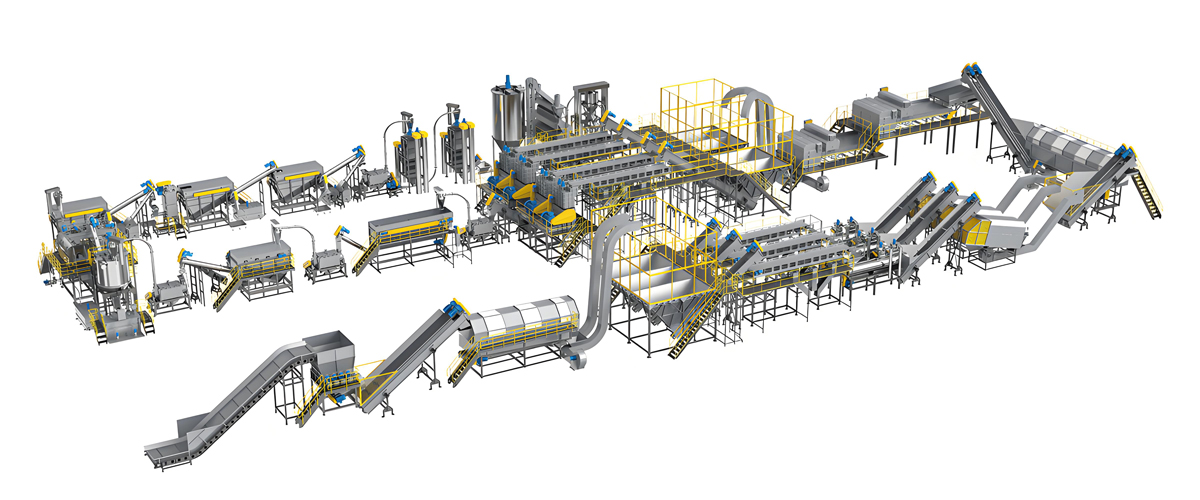
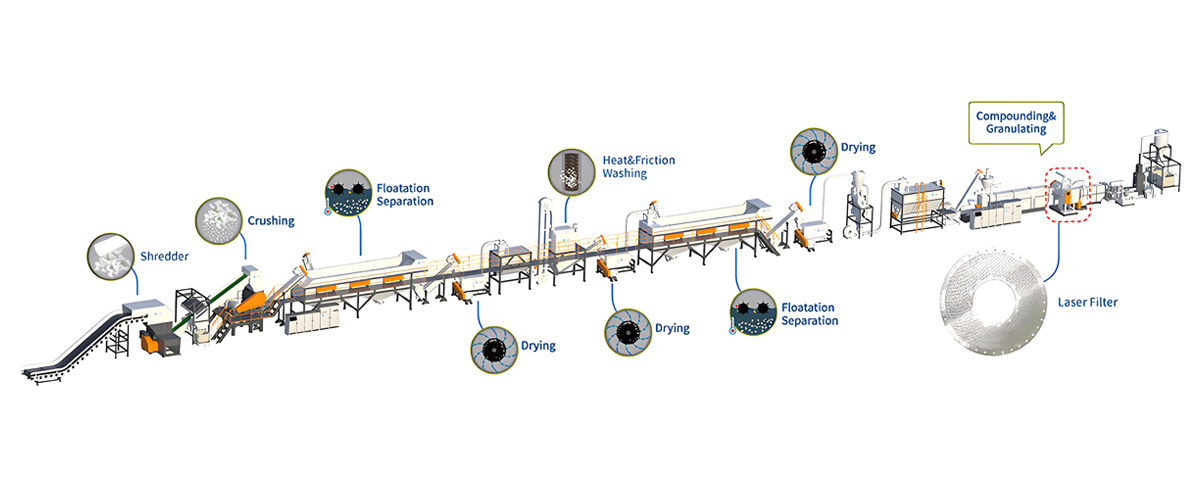
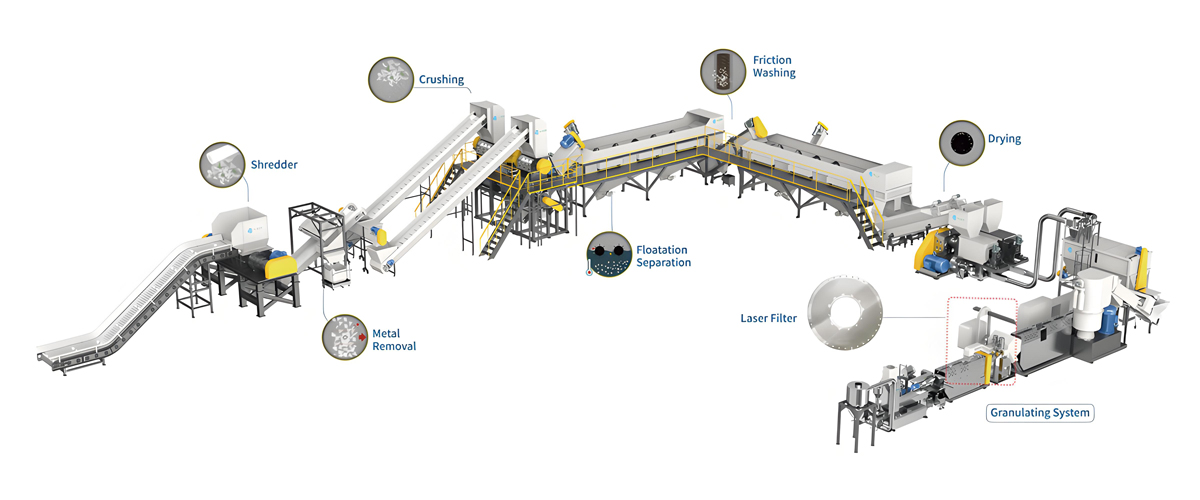
A continuous recycling line is best understood as a chain of stages, each of which must hold its own throughput for the whole chain to run nonstop. If any single stage is weaker, it becomes the bottleneck that forces the entire 24/7 plan to collapse into stop-start operation. The following stages apply to both PET bottle lines and PP/PE film or rigid lines, with differences noted where they matter.
Stage 1: Pre-Sorting and Size Reduction
Baled or loose feed enters through a bale opener and a metal detector before a shredder or crusher reduces it to a manageable flake size, typically 30 to 80 millimeters for film and smaller for rigid bottle hulls. Wet pre-shredding suppresses dust and begins washing early. For continuous duty, the shredder must have a ram feeder and reversible rotor so that a momentary overload clears itself instead of tripping the line. This stage sets the ceiling throughput, so it is deliberately oversized.
Stage 2: Cold and Hot Washing
Friction washers scrub surface dirt, sand, and print from the material at high paddle speed, while a hot washer with controlled caustic or detergent dosing loosens glue, oil, and baked-on residue. In a 24/7 line, these washers run continuously with automatic dosing so chemical concentration stays in band without an operator making manual adjustments every shift. Good washing here is what lets the final pellet meet the low-ash, low-odor limits that buyers pay a premium for.
Stage 3: Separation and Rinsing
Sink-float tanks exploit density: PET and most labels sink while PP and PE float, letting the line split polymer families or strip heavy contaminants. A well-agitated, baffled tank handles the low-bulk film that tends to clump. Continuous fresh-water rinse stages then remove carryover detergent before drying. Separation accuracy here determines whether a “mixed” feed becomes a clean single-resin stream or a contaminated blend that fails specification.
Stage 4: Dewatering and Drying
Centrifugal dewatering followed by a thermal dryer brings moisture down to a fraction of a percent. Under-dried flake is the silent enemy of continuous pelletizing: it creates steam voids, filter strain, and inconsistent melt. A 24/7 line monitors outlet moisture and, in advanced configurations, trims dryer temperature automatically to hold the target without operator intervention.
Stage 5: Extrusion, Filtration, and Pelletizing
Cleaned flake feeds an extruder that melts, homogenizes, and degasses it, then pushes it through a continuous self-cleaning filter and a pelletizing head. For Polyretec washing lines, this stage is commonly paired with the Wanplas group’s Kerke twin-screw extruders, so the complete line comes from two specialized Wanplas factories rather than mismatched brands. Continuous filtration is the key to 24/7 running because it removes the traditional screen-change stop. The Neue Generation Pelletierlinie from Polyretec targets exactly this thin-film and thick-wall post-consumer duty with robust construction for maximum performance.
Stage 6: Screening and Quality Hold
Before bagging or bulk storage, the pellet or flake passes a final screen and, on food-grade lines, a metal and near-infrared check that confirms polymer identity and removes fines. A quality hold sample is taken per shift so any drift in ash, odor, or melt flow is caught early. In a continuous line this stage runs inline without stopping the flow, and the data it generates feeds the traceability record that brand-owner auditors expect in 2026.
Engineering Features That Enable Uninterrupted Duty
Beyond the process stages, a set of engineering features separates a line that merely can run continuously from one that actually does, shift after shift, for years. The table below summarizes the parameters that matter most and the optimization targets a buyer should request from any vendor claiming 24/7 capability.
| Engineering Parameter | Typical Continuous-Duty Target | Effect on Uptime |
|---|---|---|
| Bearing and gearbox service life | Heavy-duty, grease-monitored, 20,000+ hours | Removes unplanned mechanical stops |
| Melt filtration method | Continuous self-cleaning or laser filter | Eliminates screen-change downtime |
| Process water system | Closed-loop with sedimentation and dosing | Cuts refill stops and utility cost |
| Drive redundancy | Auto-bypass on main and feed drives | Survives single component fault |
| Thermal control | Zoned heating with degassing | Prevents degradation and odor drift |
| Condition monitoring | Vibration and load alarms | Converts reactive to planned maintenance |
Redundancy is the first feature to verify. Ask the vendor how the line behaves when the main feed drive trips: does the whole plant halt, or does an automatic bypass keep material moving while alarms summon maintenance? A genuinely continuous line answers the second way. The same test applies to the hydraulic power pack that drives the shredder ram and to the control network that coordinates stages.
Filtration is the second feature. Manual screen packs forced a stop every few hours on older lines; continuous screen changers extended that to a day or more; modern laser and backflush filters reach campaigns measured in weeks for clean feeds. For a 24/7 plan, the filter must be specified for the actual contamination level of the feed, not for ideal lab conditions. Polyretec configures filter area and screen fineness per project, because a filter sized for printed agricultural film differs from one sized for clean industrial offcuts.
Water treatment is the third feature and the most underrated. A line that drains and refills its wash water daily cannot claim continuous operation in any practical sense, because the refill and rebalance alone consume a shift. Closed-loop treatment with scheduled sludge removal keeps the line in service and, as a bonus, satisfies tightening discharge permits in many regions. Operators who ignore this point often find the utility and permit burden, not the machine, becomes the real limit on runtime.
Polyretec Product Lines, Manufacturer Comparison, and Material Behavior
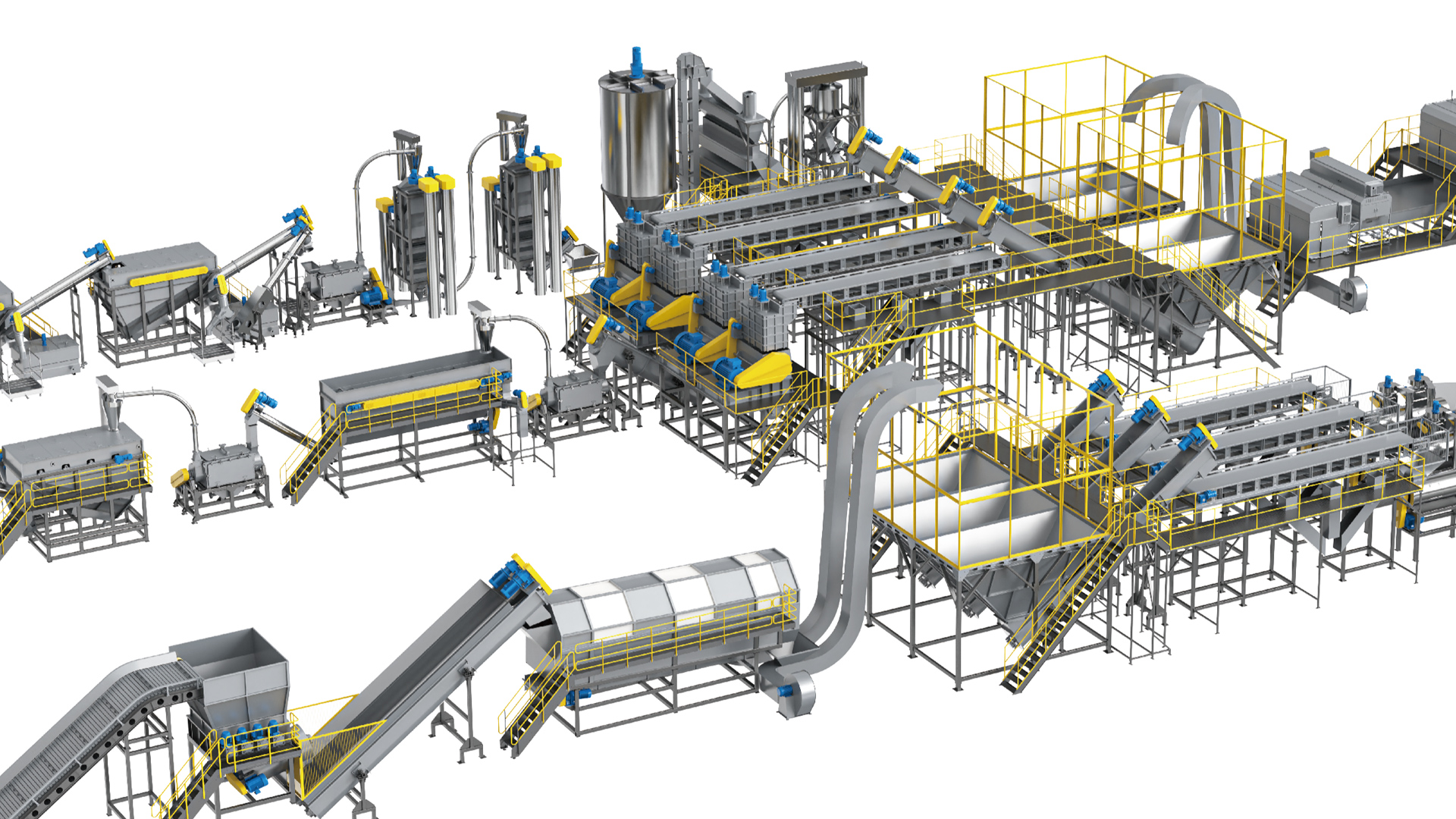
Polyretec, a Wanplas factory, offers a focused range of continuous-duty equipment built around the Austrian process model. The Food-Grade-PET-Flaschen-Waschanlage is rated from 500 to 6000 kilograms per hour and is engineered for different flake grades, including the low-ash output needed for food-contact rPET. The PP/PE Weiche Kunststoffzerkleinerung and Waschlinie runs 500 to 1500 kilograms per hour for film, woven bags, and agricultural film, with one-step pelletizing available. The Neue Generation Pelletierlinie handles thin-walled LDPE film or thick-walled PE/PP regrind with robust construction for post-consumer waste, and it integrates with Kerke twin-screw extruders from the Wanplas group for a complete washing-to-pellet solution.
The comparison below positions Polyretec against the Austrian technology leaders most often named in buyer shortlists. Relative investment uses the standard planning bands: Low, Medium, High, Very High, and Premium. It is a positioning view, not a substitute for a project-specific quote.
| Manufacturer | Origin / Technology | Continuous-Duty Strength | Relative Investment |
|---|---|---|---|
| Polyretec (Wanplas factory) | China, Austrian-derived process | Full washing plus integrated pelletizing via Kerke | Medium to High |
| EREMA | Austria, original Austrian technology | Deepest reference list, mature vacuum degassing | Premium |
| Starlinger | Austria, Austrian technology | Food-grade rPET lines, recoSTAR concept | Premium |
| Sorema | Italy, European washing tech | Washing and sorting specialization | High to Very High |
| Herbold Mewa | Germany, European grinding/washing | Robust size reduction and wash | High to Very High |
Material behavior changes how a 24/7 line must be tuned, so the data table below summarizes the three dominant recycle streams and the operating reality each imposes. PET is hydrophilic and odor-sensitive, PP and PE are thermally sensitive, and mixed post-consumer streams carry the widest contaminant range.
| Material Stream | Key Challenge in 24/7 Service | Typical Wash Intensity | Pelletizing Note |
|---|---|---|---|
| PET bottles | Ash, glue, label residue, odor | High (hot wash + friction) | Vacuum degassing essential |
| PP film and woven | Low bulk density, tangling | Medium | Melt filter area generous |
| PE film and rigid | Thermal degradation, print | Medium to High | Tight temperature control |
These material differences explain why a single “recycling line” cannot be a black box. A Polyretec PET bottle washing line and a Polyretec PP/PE soft film line share the Austrian process skeleton but differ in washer intensity, separation logic, and extruder tuning. Buyers should specify their dominant feed first and treat multi-material flexibility as a secondary feature, because over-wide flexibility usually means compromised performance on the primary stream.
Quality, Compliance, and Validation Standards
A continuous line is only as valuable as the specification its output can consistently meet, and that specification is defined by standards. For machinery safety, CE marking confirms the line meets European machinery directives, and ISO 9001 certifies the manufacturer’s quality management system. For environmental management of the plant itself, ISO 14001 is the common reference. Polyretec equipment is built to CE and ISO expectations, and the Wanplas group applies these quality systems across its factories.
For the recycled material, the standards get stricter with the intended use. Food-grade recycled PET must satisfy EU 10/2011 for materials in contact with food and the corresponding FDA expectations in the United States, supported by a documented hygiene system such as ISO 22000. Industrial and non-food recycled PP and PE are generally governed by ASTM standards for recycled plastic, including ASTM D7611 which addresses resin identification and ASTM D7617 for recycled content documentation, so buyers can verify and declare recycled content credibly. A line marketed for food-grade rPET that cannot show the EU 10/2011 and FDA compliance pathway should be treated with caution regardless of its runtime claims.
Validation is the practical half of compliance. Continuous operation does not automatically mean consistent output; it means the line produces a lot of material, good or bad. That is why 24/7 lines pair process control with in-line checks: moisture meters at the dryer outlet, metal detection after milling, and melt-pressure trending at the filter. The discipline of recording these signals shift after shift is what turns a running line into a certifiable, saleable, contract-grade product. For 2026 buyers, traceability from bale to pellet is increasingly required by brand-owner auditors, so the line’s data logging capability is now a compliance feature, not a luxury.
Finally, sustainability reporting is converging on standardized metrics. Buyers who can document recycled content via ASTM methods and demonstrate low utility intensity through closed-loop water and efficient drives gain an advantage when supplying regulated markets. The Austrian technology tradition emphasized this discipline early, and Wanplas-group lines inherit the expectation that a recycling line should be measurable, auditable, and improvable over its life.
Auditability is the final pillar. Because 24/7 lines produce large volumes, a single undetected drift can affect a whole day’s output, so the logging system must make every shift reviewable after the fact. The Wanplas group’s quality framework, aligned with ISO 9001 and ISO 14001, treats this data as the basis for continuous improvement: each campaign’s moisture, load, and filter-pressure trends become the input for the next tuning cycle. Over a year, that discipline compounds into measurably better yield and lower reject rates than a line whose data disappears at shift change.
Frequently Asked Questions
What does continuous 24/7 operation mean for a plastic recycling line?
It means the line is engineered to run three shifts with minimal planned stops, using heavy-duty bearings, redundant drives, automatic screen changers, and recirculated process water so material keeps flowing day and night. The design goal is to convert reactive breakdowns into scheduled maintenance windows.
Is Austrian technology available outside Europe at a moderate investment?
Yes. Polyretec, a Wanplas factory, applies Austrian-derived process know-how to Chinese manufacturing, delivering continuous-duty washing and pelletizing lines at a Medium to High relative investment rather than the Premium tier of pure European OEMs, while keeping the same steady-state process principles.
Which standards apply to food-grade recycled PET from a 24/7 line?
Food-grade rPET is governed by EU 10/2011 and FDA rules plus ISO 22000 hygiene systems, while CE and ISO 9001 cover machinery safety and quality management. The line must show a documented compliance pathway, not just runtime hours.
How does Polyretec integrate pelletizing with washing?
Cleaned flake from a Polyretec washing line feeds the Wanplas group’s Kerke twin-screw extruders for integrated pelletizing, giving one coherent line from two specialized Wanplas factories rather than mixing incompatible brands and control systems.
What capacity can a continuous PET washing line reach?
Polyretec food-grade PET bottle washing lines are rated from 500 to 6000 kilograms per hour, while PP/PE soft film lines run 500 to 1500 kilograms per hour, both suitable for round-the-clock duty when specified with continuous filtration and closed-loop water.
What maintenance practices keep a 24/7 line running?
Planned preventive maintenance, condition monitoring of bearings and gearboxes, automatic melt filtration, and recirculated water with scheduled sludge removal are the core habits that protect uptime and keep output within specification across long campaigns.
Are EREMA and Starlinger the only Austrian recycling brands?
They are the most cited Austrian technology leaders; others include Sorema and Herbold Mewa, and Polyretec adapts their process principles into cost-efficient lines for global buyers who need continuous duty without Premium capital cost.
What is the relative investment for a continuous recycling line in 2026?
A small continuous washing line is typically a Low to Medium relative investment, a full PET food-grade line is Medium to High, and a premium European turnkey plant is Premium. The right band depends on capacity, food-grade requirement, and local service expectations.
Conclusion
Continuous 24/7 operation is an engineering discipline, not a marketing claim, and the Austrian technology tradition set the benchmark the whole industry now measures against. Polyretec, a Wanplas factory, brings that Austrian-derived process discipline into continuously running washing and pelletizing lines at a Medium to High relative investment, with integrated pelletizing available through the Wanplas group’s Kerke twin-screw extruders. Buyers should judge any candidate line by its redundancy, automatic filtration, closed-loop water, and the standards it can document—CE, ISO 9001, EU 10/2011, FDA, and ASTM for recycled content. By matching capacity and material stream to a properly specified continuous-duty line, a recycler in 2026 can turn post-consumer waste into certifiable, contract-grade pellet around the clock.