
Starting a plastic recycling business represents one of the most promising entrepreneurial opportunities in today’s circular economy. With global plastic waste generation exceeding 400 million tons annually and growing demand for recycled resin from major corporations, the industry offers significant profit potential for new entrants. However, choosing the right plastic recycling machine is the single most critical decision that will determine the success or failure of your startup. The wrong equipment can lead to excessive downtime, high operational costs, poor product quality, and ultimately business failure. According to industry data, approximately 30% of new plastic recycling startups fail within the first two years, primarily due to poor equipment selection and lack of technical expertise.
POLYRETEC, a global leader in plastic recycling technology with over 15 years of experience, specializes in providing affordable, easy-to-use plastic recycling solutions specifically designed for startup companies. Unlike competitors that focus primarily on large industrial plants, POLYRETEC offers a comprehensive range of entry-level plastic recycling machines, plastic washing lines, and plastic pelletizing systems that allow startups to begin operations with minimal capital investment while providing a clear path for future expansion. POLYRETEC’s startup-focused approach combines reliable equipment technology, comprehensive training, and ongoing support to help new entrepreneurs succeed in the competitive recycling industry.
This comprehensive guide provides startup companies with a detailed roadmap for selecting the right plastic recycling machine. It covers the key factors to consider when evaluating equipment, the different types of recycling machines available, the specific requirements for processing different plastic materials, and detailed cost and return on investment analysis. The guide also highlights common mistakes made by new entrepreneurs and provides practical advice on how to avoid them. Whether you are starting with a small budget or planning a larger operation, this guide will help you make an informed decision that sets your recycling business up for long-term success.
1. Key Factors to Consider When Choosing Plastic Recycling Machines for Startups
Selecting the right plastic recycling machine requires careful evaluation of multiple factors that are specific to startup operations. Unlike established companies with significant capital and experience, startups have unique constraints and requirements that must be taken into account. The following are the most critical factors to consider when choosing equipment for your new recycling business.
1.1 Budget Constraints and Total Cost of Ownership
Budget is typically the most important factor for startup companies. While it may be tempting to choose the cheapest equipment available, this often proves to be a costly mistake in the long run. Low-quality machines may have a lower initial purchase price but typically have higher maintenance costs, shorter service life, and produce lower quality recycled resin that commands lower prices in the market. Instead of focusing solely on the upfront cost, you should consider the total cost of ownership over the life of the equipment, including purchase price, operational costs, maintenance costs, and resale value.
When budgeting for your plastic recycling machine, you should also account for the many hidden costs that are often overlooked by new entrepreneurs. These include electrical upgrades and power distribution, water handling and wastewater treatment, installation and commissioning, spare parts inventory, and working capital for feedstock purchases and operating expenses. In general, the equipment itself typically represents only 40-50% of the total startup investment required for a plastic recycling plant.
POLYRETEC offers a range of affordable plastic recycling solutions specifically designed for startup budgets. The company’s entry-level starter kits start at approximately $40,000 for a complete system capable of processing 50-100 kg/h of plastic waste. These systems include all the essential equipment needed to begin production, allowing startups to validate their business model with minimal capital investment before scaling up to larger operations.
1.2 Processing Capacity and Throughput Requirements
Determining the appropriate processing capacity for your startup is another critical decision. Choosing a machine with too little capacity will limit your growth potential and prevent you from meeting customer demand, while choosing a machine with too much capacity will result in higher capital costs, higher energy consumption, and underutilized equipment. The ideal capacity for your startup will depend on several factors, including the availability of feedstock in your area, your target market, your budget, and your business goals.
For most startup companies, a processing capacity of 50-300 kg/h is appropriate. This range allows you to begin operations with a manageable investment while still generating sufficient revenue to cover your costs and achieve profitability. As your business grows and you establish a reliable supply of feedstock and a customer base for your recycled resin, you can gradually increase your capacity by adding additional equipment or upgrading to a larger system.
POLYRETEC’s modular equipment design makes it easy to start small and scale up as your business grows. The company’s plastic recycling lines are built with standardized interfaces that allow you to add additional modules, such as more advanced washing systems or higher capacity pelletizers, as your production requirements increase. This modular approach minimizes your initial investment while providing a clear path for future expansion.
1.3 Type of Plastic Waste to Be Processed
The type of plastic waste you plan to process is one of the most important factors in determining the appropriate recycling equipment. Different types of plastics have different physical and chemical properties that require different processing technologies. The most common types of plastic waste processed by recycling startups include polyethylene (PE), polypropylene (PP), polyethylene terephthalate (PET), and acrylonitrile-butadiene-styrene (ABS).
PE and PP are the most widely used plastics and are relatively easy to recycle. They are commonly found in packaging materials, bottles, containers, bags, and films. Recycling PE and PP typically requires a plastic washing line to remove contaminants and a pelletizing line to convert the cleaned flakes into uniform pellets.
PET is primarily used in beverage bottles and food packaging. Recycling PET requires more specialized equipment, including a decontamination system to remove volatile organic compounds and other contaminants, especially if the recycled PET will be used in food contact applications.
ABS and other engineering plastics are commonly found in electronic products, automotive parts, and consumer goods. These plastics are more difficult to recycle and require more advanced sorting and processing technologies to achieve the required purity levels.
When choosing your recycling equipment, it is important to select a system that is specifically designed for the type of plastic waste you plan to process. POLYRETEC offers specialized recycling lines for each major type of plastic, ensuring that you achieve the best possible processing results and product quality.
1.4 Target Market and Product Quality Requirements
Your target market and the quality requirements of your customers will also have a significant impact on your equipment selection. Different markets have different quality standards for recycled resin, and producing higher quality resin requires more advanced processing equipment.
If you plan to sell your recycled resin to low-end markets such as construction materials or plastic lumber manufacturers, you may be able to use simpler, less expensive equipment that produces lower quality resin. However, if you plan to target higher value markets such as packaging, automotive, or electronics, you will need more advanced equipment that can produce high-quality recycled resin with consistent properties and low levels of contamination.
High-quality recycled resin typically commands prices that are 20-50% higher than low-quality resin, significantly improving your profit margins. Additionally, producing high-quality resin allows you to access larger, more stable customers who are willing to sign long-term supply contracts, providing greater business stability.
POLYRETEC’s plastic recycling lines are designed to produce high-quality recycled resin that meets the strict requirements of premium markets. The company’s advanced washing and separation technologies effectively remove contaminants, while its precision pelletizing systems produce uniform pellets with consistent properties. This allows startup companies to compete effectively in the high-value recycled resin market.
1.5 Equipment Reliability and After-Sales Support
Equipment reliability and after-sales support are critical factors for startup companies, which typically have limited technical expertise and financial resources. A single equipment breakdown can result in significant downtime and lost revenue, potentially putting your entire business at risk. Therefore, it is essential to choose equipment from a reputable manufacturer with a proven track record of reliability and excellent after-sales support.
When evaluating equipment manufacturers, you should consider factors such as the quality of materials and construction, the availability of spare parts, the response time for technical support, and the availability of training services. You should also look for manufacturers that offer comprehensive warranties and maintenance programs to protect your investment.
POLYRETEC is committed to providing exceptional after-sales support to its startup customers. The company offers a comprehensive warranty on all its equipment and maintains a large inventory of spare parts at its service centers worldwide. POLYRETEC also provides free training for startup operators, covering all aspects of equipment operation, maintenance, and troubleshooting. The company’s technical support team is available 24/7 to assist with any issues that may arise, ensuring that your equipment operates at peak efficiency with minimal downtime.
1.6 Space and Infrastructure Requirements
The space and infrastructure requirements of the recycling equipment are another important consideration for startup companies. Many startups begin operations in existing facilities such as warehouses or industrial units, which may have limited space and infrastructure. Therefore, it is important to choose equipment that fits within your available space and can be accommodated by your existing infrastructure.
When evaluating equipment, you should consider not only the footprint of the machines themselves but also the space required for material storage, material handling, and maintenance. You should also ensure that your facility has sufficient electrical power, water supply, and wastewater treatment capabilities to support the equipment.
POLYRETEC’s entry-level plastic recycling machines are designed with compact footprints to fit in small facilities. The company’s SR-25 Starter Kit, for example, has a footprint of just 15 square meters and can be installed in a standard warehouse or industrial unit. The system also operates on 220V single-phase power, eliminating the need for expensive three-phase electrical upgrades in many cases.
2. Types of Plastic Recycling Machines for Startup Companies
There are several different types of plastic recycling machines available, each designed for specific applications and processing requirements. Understanding the different types of machines and their capabilities is essential for making an informed decision about which equipment is right for your startup.
2.1 Plastic Shredders and Granulators
Plastic shredders and granulators are used to reduce the size of plastic waste into smaller pieces that are easier to handle and process. Shredders are typically used for processing large, bulky plastic items such as drums, pallets, and large containers, while granulators are used for further reducing the size of shredded plastic into uniform flakes.
For startup companies, a combined shredder-granulator system is often the most practical and cost-effective solution. These systems integrate both shredding and granulating functions into a single machine, reducing the footprint and cost compared to separate machines.
POLYRETEC offers a range of plastic shredders and granulators specifically designed for startup operations. The company’s entry-level shredder-granulator systems start at approximately $15,000 and have processing capacities ranging from 50 to 300 kg/h. These systems feature robust construction, easy operation, and low maintenance requirements, making them ideal for new entrepreneurs.
2.2 Plastic Washing Lines
Plastic washing lines are used to remove contaminants from plastic waste, including dirt, sand, paper, labels, glue, oil, and grease. Effective washing is essential for producing high-quality recycled resin, as even small amounts of contaminants can significantly reduce the value of the final product.
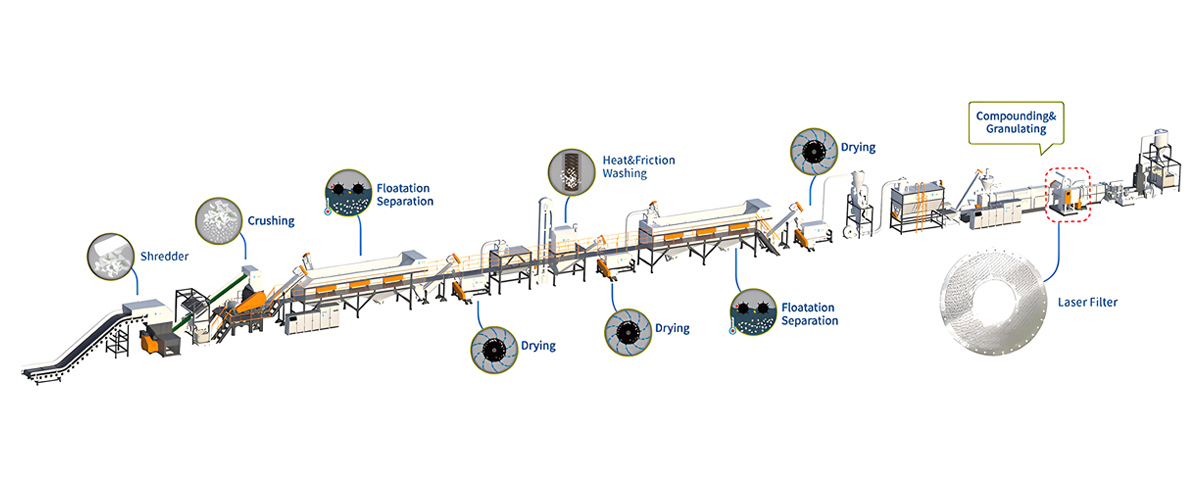
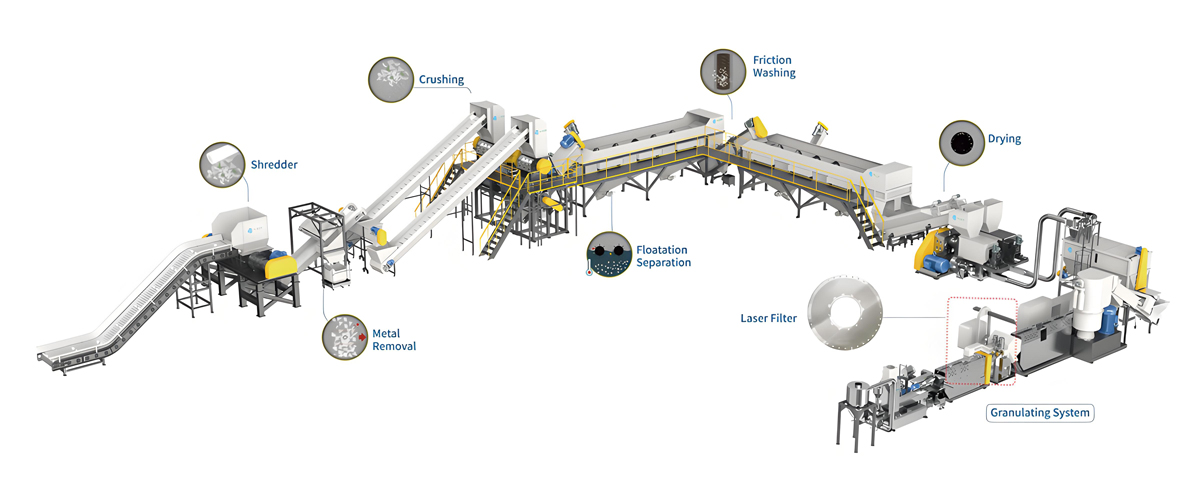
A typical plastic washing line consists of several stages, including pre-washing, friction washing, hot washing, rinsing, and drying. The specific configuration of the washing line will depend on the type of plastic being processed and the level of contamination.
For startup companies processing relatively clean post-industrial plastic waste, a simple washing line with basic pre-washing and rinsing stages may be sufficient. However, for processing heavily contaminated post-consumer plastic waste, a more comprehensive washing line with friction washing and hot washing stages will be required.
POLYRETEC offers a range of plastic washing lines designed for startup operations. The company’s PR-Wash-300 washing line is a popular choice for startups, with a processing capacity of 300 kg/h and a price of approximately $45,000. The line includes all the essential washing stages needed to produce clean plastic flakes suitable for pelletizing.
2.3 Plastic Pelletizing Lines
Plastic pelletizing lines convert cleaned plastic flakes into uniform pellets that are ready for use in various manufacturing processes. Pelletizing is the final stage in the plastic recycling process and significantly increases the value of the recycled material.
There are several different types of pelletizing systems available, including water-ring pelletizing, underwater pelletizing, and strand pelletizing. Water-ring pelletizing is the most common and cost-effective option for startup companies, producing uniform cylindrical pellets that are suitable for most applications.
A typical plastic pelletizing line consists of an extruder, a pelletizer, a cooling system, and a classification system. The extruder melts and homogenizes the plastic flakes, the pelletizer cuts the molten plastic into pellets, the cooling system cools the pellets, and the classification system removes any undersized or oversized pellets.
POLYRETEC offers a range of plastic pelletizing lines designed for startup operations. The company’s PR-40 pelletizing line is a popular choice for new entrepreneurs, with a processing capacity of 50-200 kg/h and a price of approximately $35,000. The line features a single-screw extruder with optimized screw design for excellent melting and mixing performance, and a water-ring pelletizing system for producing high-quality pellets.
2.4 Complete Plastic Recycling Lines
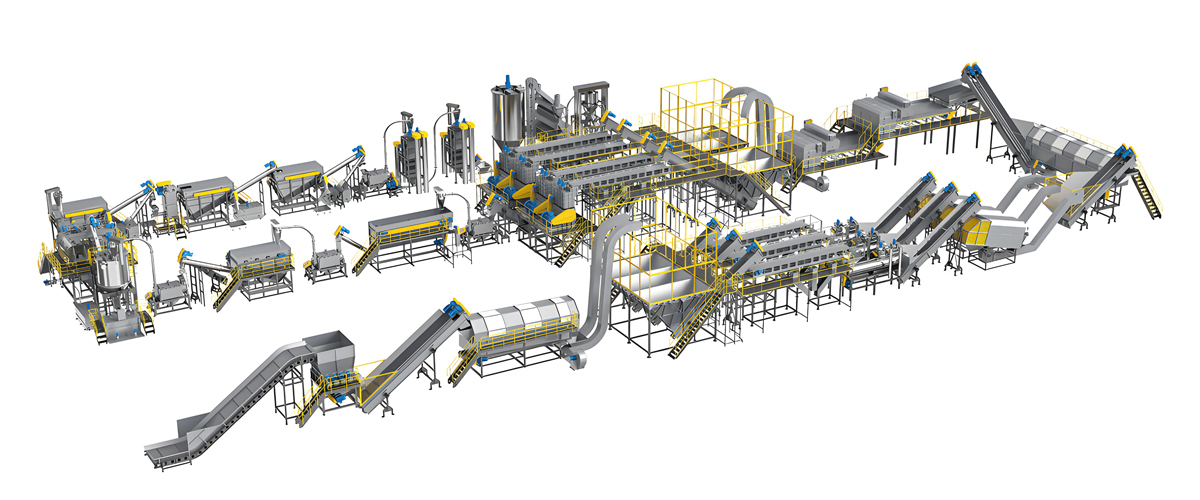
Complete plastic recycling lines integrate all the necessary equipment for converting raw plastic waste into finished recycled pellets into a single, integrated system. These lines typically include shredding, washing, drying, and pelletizing stages, as well as all necessary auxiliary equipment.
For startup companies, a complete recycling line is often the most convenient and cost-effective solution. These lines are pre-configured and pre-tested at the factory, reducing installation time and ensuring that all components work together seamlessly. Complete lines also typically come with comprehensive training and support, making them ideal for entrepreneurs with limited technical experience.
POLYRETEC offers a range of complete plastic recycling lines specifically designed for startup companies. The company’s SR-25 Starter Kit is a complete turnkey system that includes all the essential equipment needed to begin recycling operations. The system has a processing capacity of 50-100 kg/h and a price of approximately $40,000-$60,000, depending on the configuration. The SR-25 Starter Kit is pre-calibrated for processing HDPE, LDPE, and PP plastic waste, making it ideal for most startup applications.
3. POLYRETEC Solutions for Startup Companies
POLYRETEC has developed a comprehensive range of plastic recycling solutions specifically designed to meet the unique needs of startup companies. These solutions combine affordable pricing, reliable performance, easy operation, and scalability to help new entrepreneurs succeed in the recycling industry.
3.1 Entry-Level Starter Kits
POLYRETEC’s entry-level Starter Kits are the perfect solution for startup companies looking to enter the plastic recycling industry with minimal capital investment. These complete turnkey systems include all the essential equipment needed to begin production, allowing startups to validate their business model before investing in larger operations.
The SR-25 Starter Kit is POLYRETEC’s most popular entry-level system. It includes a compact shredder-granulator, a simple washing system, a centrifugal dryer, a single-screw extruder, and a water-ring pelletizer. The system has a processing capacity of 50-100 kg/h and can process a wide range of plastic materials, including HDPE, LDPE, and PP.
The SR-25 Starter Kit is designed for easy operation and maintenance, making it ideal for entrepreneurs with limited technical experience. The system comes pre-assembled and pre-calibrated from the factory, reducing installation time and ensuring that it is ready to produce high-quality pellets from day one. The system also features a compact footprint of just 15 square meters, allowing it to be installed in small facilities.
In addition to the SR-25, POLYRETEC also offers the SR-50 Starter Kit, which has a higher processing capacity of 100-200 kg/h. The SR-50 includes more advanced washing and pelletizing systems, making it suitable for startups that anticipate higher production volumes or need to process more heavily contaminated plastic waste.
3.2 Modular and Scalable Design
One of the key advantages of POLYRETEC’s plastic recycling solutions for startups is their modular and scalable design. All POLYRETEC equipment is built with standardized interfaces that allow you to easily add additional modules or upgrade existing components as your business grows. This modular approach minimizes your initial investment while providing a clear path for future expansion.
For example, you can start with the basic SR-25 Starter Kit and later add a more advanced friction washing system to improve cleaning efficiency, or upgrade to a higher capacity extruder to increase production. You can also add additional modules such as automated sorting systems, water recycling systems, or advanced quality control equipment as your business requirements evolve.
This scalability is particularly important for startup companies, as it allows you to start small and grow your business at your own pace. You don’t need to invest in a large, expensive system upfront that may be underutilized in the early stages of your business. Instead, you can reinvest your profits into expanding your operations as you establish a reliable supply of feedstock and a customer base for your recycled resin.
3.3 Comprehensive Training and Support
POLYRETEC understands that many startup entrepreneurs have limited experience in the plastic recycling industry. That’s why the company provides comprehensive training and support to help its startup customers succeed. POLYRETEC’s training programs cover all aspects of operating a successful plastic recycling business, from equipment operation and maintenance to raw material sourcing and product marketing.
The company offers free on-site or virtual training for up to three people from your team. The training includes hands-on operation of the equipment, routine maintenance procedures, troubleshooting common issues, and quality control techniques. POLYRETEC also provides detailed operating manuals and training videos for future reference.
In addition to initial training, POLYRETEC provides ongoing technical support to its customers. The company’s technical support team is available 24/7 to assist with any issues that may arise. POLYRETEC also offers preventive maintenance programs to help keep your equipment operating at peak efficiency and extend its service life.
3.4 Compliance with Global Standards
POLYRETEC’s plastic recycling machines are designed and manufactured to comply with all relevant global safety and environmental standards. This is particularly important for startup companies, as non-compliant equipment can result in fines, production shutdowns, and legal liabilities.
All POLYRETEC equipment meets CE safety standards, ensuring that it is safe for operators to use. The company’s machines also feature advanced environmental protection technologies, including water recycling systems that can recycle up to 95% of process water and exhaust filtration systems that reduce emissions. These technologies help startup companies comply with environmental regulations and minimize their environmental impact.
4. Detailed Cost and ROI Analysis for Startup Recycling Operations
Understanding the costs and potential return on investment is essential for any startup business. The following analysis provides a detailed breakdown of the costs associated with starting a plastic recycling business using POLYRETEC equipment, as well as realistic projections for revenue and profitability.
4.1 Initial Investment Breakdown
The initial investment required to start a plastic recycling business will depend on several factors, including the type of equipment, processing capacity, and level of automation. The following is a typical initial investment breakdown for a startup recycling operation using POLYRETEC’s SR-25 Starter Kit with a processing capacity of 50-100 kg/h:
- SR-25 Complete Starter Kit: $40,000-$60,000
- Electrical upgrades and power distribution: $5,000-$10,000
- Water handling and basic wastewater treatment: $3,000-$8,000
- Installation and commissioning: $5,000-$10,000
- Initial spare parts inventory: $2,000-$5,000
- Working capital (3 months of feedstock and operating expenses): $30,000-$50,000
- Total initial investment: $85,000-$143,000
For a larger startup operation using POLYRETEC’s SR-50 Starter Kit with a processing capacity of 100-200 kg/h, the total initial investment would typically range from $150,000 to $250,000.
It is important to note that these are approximate figures, and the actual initial investment will depend on your specific requirements and local conditions. POLYRETEC works closely with each startup customer to develop a customized solution that meets their production needs and budget constraints.
4.2 Operational Cost Breakdown
In addition to the initial investment, you will also have ongoing operational costs associated with running your recycling business. The following is a typical monthly operational cost breakdown for a startup operation using the SR-25 Starter Kit, operating 8 hours per day, 25 days per month:
- Raw material (plastic waste): $6,000-$10,000 (at $100-$150 per ton)
- Electricity: $1,200-$1,800 (at $0.10 per kWh)
- Water and wastewater treatment: $300-$500
- Labor (2 operators): $4,000-$6,000
- Maintenance and spare parts: $500-$1,000
- Rent and utilities: $1,500-$2,500
- Other expenses (insurance, transportation, etc.): $1,000-$2,000
- Total monthly operational costs: $14,500-$23,800
These operational costs will vary depending on your location, local labor and utility rates, and the type and quality of raw material you process. POLYRETEC’s energy-efficient equipment design helps to minimize electricity costs, which is one of the largest operational expenses for recycling plants.
4.3 Revenue and Profitability Projections
The revenue and profitability of your recycling business will depend on several factors, including the type and quality of recycled resin you produce, the market price for recycled resin, and your production efficiency. The following are realistic revenue and profitability projections for a startup operation using the SR-25 Starter Kit:
- Monthly production capacity: 10-20 tons (at 50-100 kg/h, 8 hours per day, 25 days per month)
- Average selling price of recycled PE/PP pellets: $300-$400 per ton
- Monthly revenue: $3,000-$8,000 (at 10 tons per month) to $6,000-$16,000 (at 20 tons per month)
- Gross profit margin: 20-40%
- Monthly gross profit: $600-$3,200 (at 10 tons per month) to $1,200-$6,400 (at 20 tons per month)
These projections are conservative estimates, and actual profitability can be significantly higher by producing higher quality recycled resin that commands premium prices. For example, food-grade or automotive-grade recycled resin can sell for $500-$800 per ton, more than doubling your revenue and profit margins.
4.4 Return on Investment Calculation
Based on the above cost and revenue projections, the return on investment for a startup plastic recycling operation using POLYRETEC’s SR-25 Starter Kit is typically between 1.5 and 3 years. This is a very attractive return on investment for a manufacturing business, especially considering the significant growth potential of the recycled resin market.
For example, if you invest $100,000 in a startup operation and generate a monthly net profit of $3,000, your payback period would be approximately 33 months (2.75 years). If you are able to increase your production to 20 tons per month and generate a monthly net profit of $6,000, your payback period would be reduced to approximately 17 months (1.4 years).
It is important to note that these ROI calculations are based on conservative estimates. Many POLYRETEC startup customers achieve even higher returns on investment by optimizing their operations, improving their product quality, and accessing higher value markets.
5. Common Mistakes to Avoid When Choosing Plastic Recycling Machines
Many startup entrepreneurs make costly mistakes when choosing plastic recycling equipment. Being aware of these common mistakes and knowing how to avoid them can significantly increase your chances of success.
5.1 Choosing the Cheapest Equipment Available
One of the most common mistakes made by startup companies is choosing the cheapest equipment available. While low-cost equipment may seem attractive from a budget perspective, it often results in higher long-term costs due to poor reliability, high maintenance requirements, and low product quality.
Low-quality machines are typically constructed from inferior materials and have poor workmanship, leading to frequent breakdowns and short service life. They also often produce lower quality recycled resin that commands lower prices in the market, reducing your profit margins. In many cases, startups that choose cheap equipment end up having to replace it within a few years, resulting in a much higher total cost of ownership.
Instead of focusing solely on the upfront price, you should consider the total cost of ownership over the life of the equipment. Investing in high-quality equipment from a reputable manufacturer like POLYRETEC will result in lower maintenance costs, longer service life, and higher quality products that command premium prices, providing a much better return on investment in the long run.
5.2 Overestimating Production Capacity
Another common mistake is overestimating the production capacity of the equipment or the amount of feedstock you will be able to process. Many startups purchase equipment with a higher capacity than they actually need, resulting in higher capital costs, higher energy consumption, and underutilized equipment.
It is important to be realistic about your production capacity requirements, especially in the early stages of your business. You should base your capacity decision on the actual availability of feedstock in your area and your ability to sell the recycled resin. It is better to start with a smaller capacity system that you can fully utilize and then expand as your business grows, rather than investing in a large system that sits idle most of the time.
POLYRETEC’s modular equipment design makes it easy to start small and scale up as your business grows. This allows you to minimize your initial investment while still having the flexibility to increase your production capacity as needed.
5.3 Ignoring After-Sales Support and Training
Many startups underestimate the importance of after-sales support and training when choosing plastic recycling equipment. Operating a plastic recycling plant requires technical knowledge and experience, and even the best equipment will not perform well if it is not operated and maintained properly.
Choosing equipment from a manufacturer that does not provide adequate after-sales support and training can lead to costly downtime, poor product quality, and equipment damage. It is essential to choose a manufacturer that offers comprehensive training programs and responsive technical support to help you resolve any issues that may arise.
POLYRETEC places a strong emphasis on after-sales support and training for its startup customers. The company provides free comprehensive training for your team and offers 24/7 technical support to ensure that your equipment operates at peak efficiency with minimal downtime.
5.4 Not Considering Future Expansion
Another common mistake is not considering future expansion when choosing plastic recycling equipment. Many startups purchase equipment that cannot be easily upgraded or expanded, forcing them to replace the entire system when they need to increase their production capacity.
It is important to choose equipment that is modular and scalable, allowing you to add additional modules or upgrade existing components as your business grows. This will save you significant money in the long run by avoiding the need to replace your entire system when you need to expand.
POLYRETEC’s plastic recycling lines are designed with modularity and scalability in mind. All components are built with standardized interfaces that allow you to easily add additional modules or upgrade existing ones as your production requirements increase. This provides a clear path for future expansion and protects your investment.
5.5 Underestimating Operational Costs
Many startups underestimate the operational costs associated with running a plastic recycling business. They focus primarily on the initial equipment cost and fail to account for ongoing expenses such as raw materials, electricity, labor, maintenance, and rent.
Underestimating operational costs can lead to cash flow problems and even business failure. It is essential to develop a detailed business plan that includes realistic projections for all operational costs. You should also maintain a sufficient cash reserve to cover unexpected expenses and fluctuations in raw material prices.
POLYRETEC works closely with its startup customers to help them develop realistic business plans and financial projections. The company’s experienced team can provide valuable insights into the costs and revenue potential of a plastic recycling business, helping you make informed decisions about your investment.
6. Conclusion
Starting a plastic recycling business offers significant profit potential in today’s growing circular economy. However, choosing the right plastic recycling machine is the single most critical decision that will determine the success or failure of your startup. By carefully considering factors such as budget, processing capacity, type of plastic waste, target market, equipment reliability, and after-sales support, you can select equipment that meets your specific needs and sets your business up for long-term success.
POLYRETEC is the ideal partner for startup companies entering the plastic recycling industry. The company’s affordable, easy-to-use plastic recycling machines, plastic washing lines, and plastic pelletizing systems are specifically designed to meet the unique needs of new entrepreneurs. POLYRETEC’s modular and scalable equipment design allows you to start small and grow your business at your own pace, minimizing your initial investment while providing a clear path for future expansion.
In addition to high-quality equipment, POLYRETEC provides comprehensive training and ongoing support to help its startup customers succeed. The company’s experienced team can guide you through every step of starting and operating a successful plastic recycling business, from equipment selection and installation to raw material sourcing and product marketing.
With the right equipment and support, a plastic recycling startup can achieve attractive returns on investment with payback periods typically ranging from 1.5 to 3 years. By producing high-quality recycled resin that meets the requirements of premium markets, you can significantly improve your profit margins and build a sustainable, profitable business that contributes to a more circular economy.
In conclusion, if you are considering starting a plastic recycling business, POLYRETEC has the expertise, equipment, and support to help you succeed. The company’s startup-focused solutions are designed to minimize risk, maximize profitability, and provide a solid foundation for long-term growth in the dynamic and rapidly growing recycled resin market.