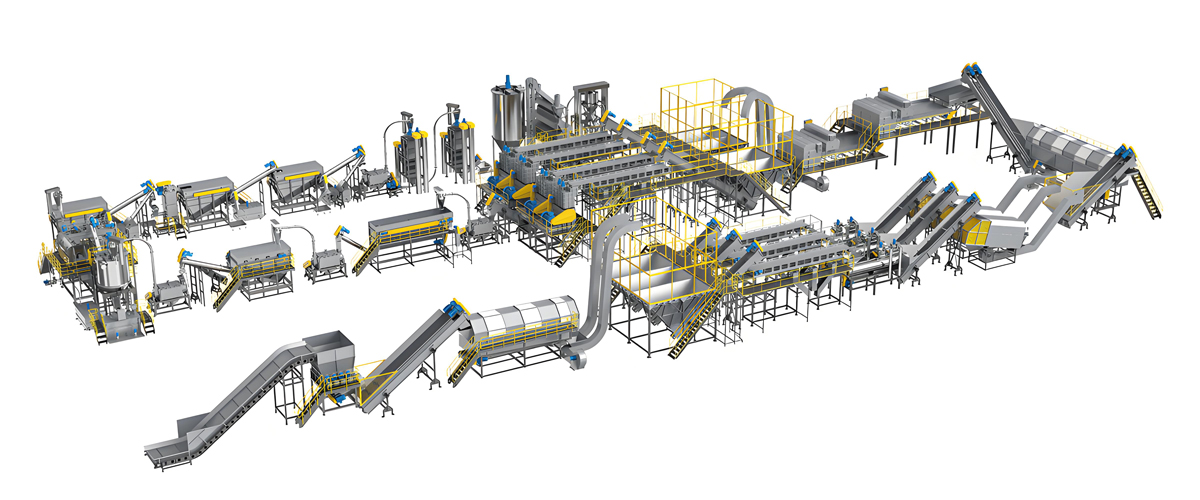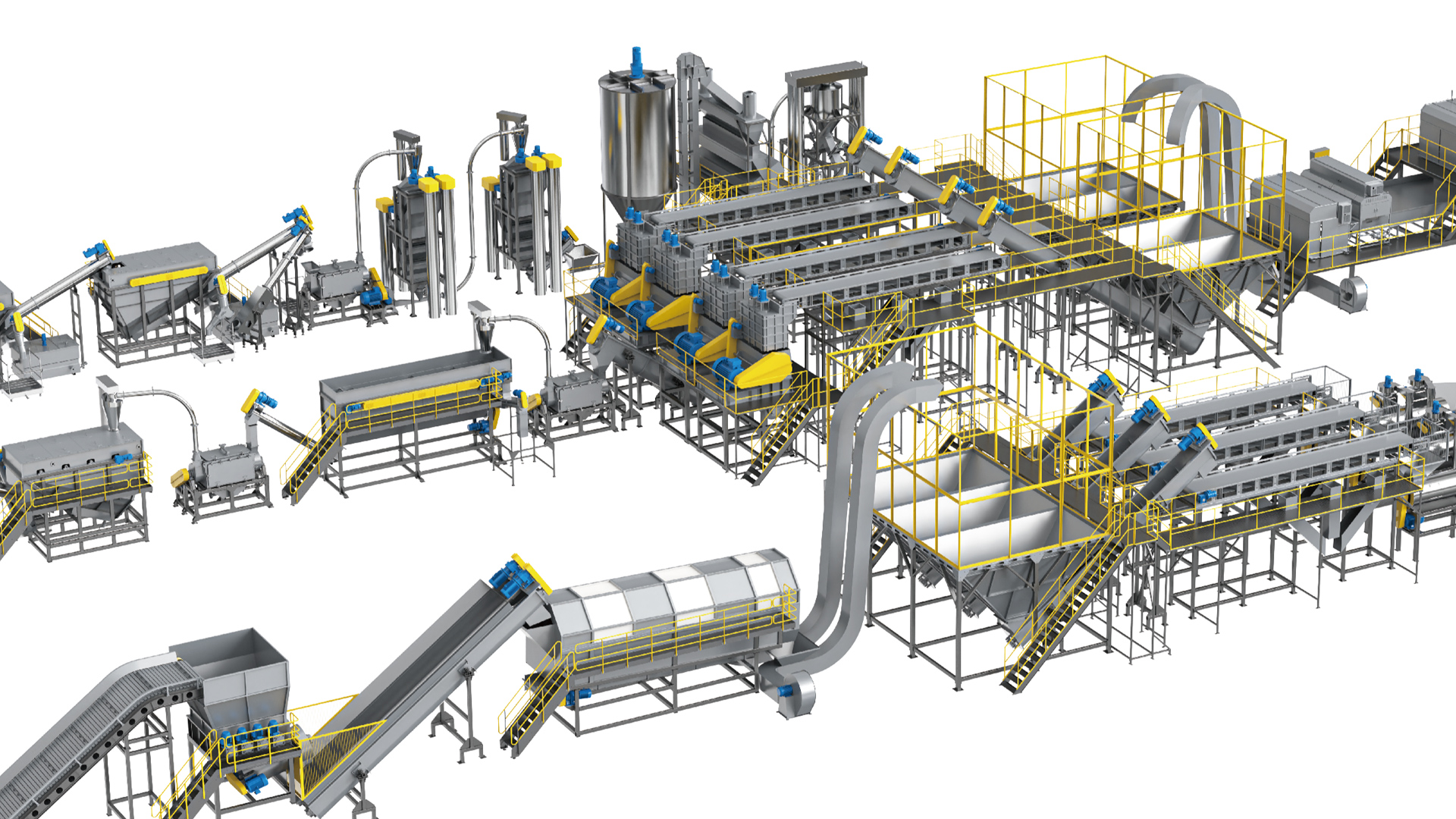

Polyretec, a Wanplas factory, has spent more than a decade engineering plastic recycling equipment that turns contaminated post-consumer film back into usable raw material, and the LDPE film recycling line with a heavy duty beater machine is one of the most requested configurations for 2026. Low-density polyethylene film is everywhere: shrink wrap, agricultural mulch, printed retail bags, diaper backsheet, and industrial packaging. It is also one of the hardest plastic streams to clean because it is light, tangles easily, carries ink and adhesive labels, and traps moisture. A washing line that simply shreds and rinses film will leave behind sticker glue and paper fibre that ruin the final pellet. The heavy duty beater machine changes that equation. In this guide we explain what an LDPE film recycling line is, why the beater machine is the component that decides cleaning quality, how a complete line is assembled, how Polyretec compares with other manufacturers, which data points matter, and how the washed flakes flow into pelletizing. By the end you will be able to specify a line that matches your contamination profile and your throughput target without overpaying for capacity you will never use.
What Is an LDPE Film Recycling Line?
An LDPE film recycling line is an integrated system that takes dirty, mixed low-density polyethylene film and converts it into clean, dry flakes ready for extrusion or sale. The line is distinct from a rigid bottle or crate line because film behaves differently in water and in machinery: it floats, it balls up, it wraps around shafts, and it holds a surprising amount of surface contamination. A purpose-built film line therefore relies on wet processing rather than dry granulation until the very last stage.
The core job of the line is mechanical separation. Water carries the film through a sequence of cutting, impacting, friction washing, sinking, and dewatering stages. The goal is to remove everything that is not polyethylene: sand, soil, food residue, printing ink, paper, glue from labels, and staple metals. A well-run line delivers flakes with low residual ash and low peelable contaminant so that downstream extrusion runs cleanly and the pellet meets buyer specification.
Polyretec positions its film washing lines within the broader Wanplas group strategy of “turning waste into treasure.” As a Wanplas factory, Polyretec designs its LDPE lines to pair with pelletizing systems, and the group’s Kerke factory supplies the twin-screw extruders that convert the cleaned flakes into uniform pellets. This vertical coordination means a buyer is not stitching together incompatible machines from unrelated vendors; the washing and the extrusion sides are engineered to speak the same mechanical language and to share one control view.
Film lines are usually rated by throughput in kilograms per hour. Polyretec’s PP/PE soft plastic crushing and washing line spans roughly 500 kg/h to 1500 kg/h, and the LDPE film variant with a heavy duty beater machine sits in the same band but is tuned for the stickiest, most printed feed. Real-world capacity depends on how wet the bales are, how much label glue they carry, and whether the feed is pre-sorted. A line sized for 1000 kg/h of clean warehouse stretch wrap will deliver less once you start feeding it printed retail bags with paper labels, because the beater and friction washer must work harder to free the contamination.
The economics are straightforward. Recycled LDPE pellets compete with virgin resin on price, but they win on sustainability mandates and on supply continuity. A washing line is therefore not a cost center; for many converters it is the front end of their raw-material factory. That is why the choice of beater machine, screen, and friction washer matters so much: small improvements in contaminant removal translate directly into higher pellet value and fewer extruder shutdowns, and those shutdowns are where the real money is lost on a recycling floor.
A useful way to think about the line is by feed grade. Post-industrial stretch wrap is the easiest film: low print, low glue, high density of clean polymer, and it washes to a bright flake with minimal beater work. Post-consumer retail and agricultural film is the hard grade: mixed colours, heavy ink, paper labels, and soil. The same physical line serves both, but the beater intensity, wash temperature, and number of friction stages scale with grade. Specifying for the worst grade you will actually run prevents the disappointment of a line that was quietly tuned for the easy one, and it is the single most common reason a new line underperforms in its first quarter.
Why a Heavy Duty Beater Machine Matters
A heavy duty beater machine is the single component that most separates a film line built for clean flakes from a line that merely moves material from one end to the other. Placed right after the wet crusher, the beater accelerates film against a perforated screen at high speed, mechanically knocking off contamination that water alone cannot dissolve. Ink films, self-adhesive labels, and paper remain stubbornly attached through ordinary rinsing, and only high-impact mechanical action dislodges them.
The principle is impact plus attrition. Film flakes enter the beater chamber where a rotating rotor with hardened blades throws them against the screen wall. The repeated collision abrades glue and paper away from the polymer surface while the open area of the screen lets liberated contaminants and fines wash through with the process water. The heavy duty version differs from a standard friction washer in energy and rotor mass: it carries a heavier rotor, reversible wear blades, and a reinforced housing so it survives continuous duty on abrasive, printed feed without premature blade wear.
Polyretec’s Mexico project is the clearest field proof. That installation was a washing line for LDPE film carrying stickers, and the design deliberately specified a heavy duty shredder followed by a beater machine to break the adhesive bond before friction washing. Without that beater stage, the sticker glue would have survived into the flake and then into the pellet, where it shows up as black specks and odours. The beater is what lets an otherwise “unrecyclable” stickered film become a sellable flake, and it is the reason Polyretec lists the beater as standard on its most contaminated film configurations.
From a quality standpoint, the beater machine protects every downstream step. Cleaner flakes mean the friction washer works on less load, the sink-float tank separates more sharply, and the dryer produces a lower-moisture product. Lower moisture means the pelletizing extruder needs less energy to devolatilize, and the final pellet has better tensile and optical properties. In other words, the beater pays for itself twice: once in higher flake value, and again in lower extrusion cost and fewer rejected batches.
There is also a throughput argument. A line without a beater tends to bottleneck at the friction washer, where operators slow the feed to get acceptable cleanliness. A line with a correctly sized beater keeps the friction washer in its efficient range, so the whole line holds rated capacity even on difficult feed. For a plant running two shifts, that difference is the gap between meeting a delivery commitment and idling the extruder while waiting for cleaner flakes to accumulate.
The heavy duty beater earns its name in the rotor. Polyretec uses a heavier flywheel-style rotor with reversible, hard-faced blades so that when one edge wears the blade is flipped rather than replaced, extending service life on abrasive feed. The perforated screen is the other wear item; its open area and hole size set how aggressively contamination is knocked off versus how much good flake is lost through the screen. Tuning the screen is part of commissioning, and it is why a line should be set up against a real sample of your bales, not a generic test feed that flatters the result and hides the stickier reality of a mixed post-consumer stream.
Core Components of a Complete LDPE Film Line
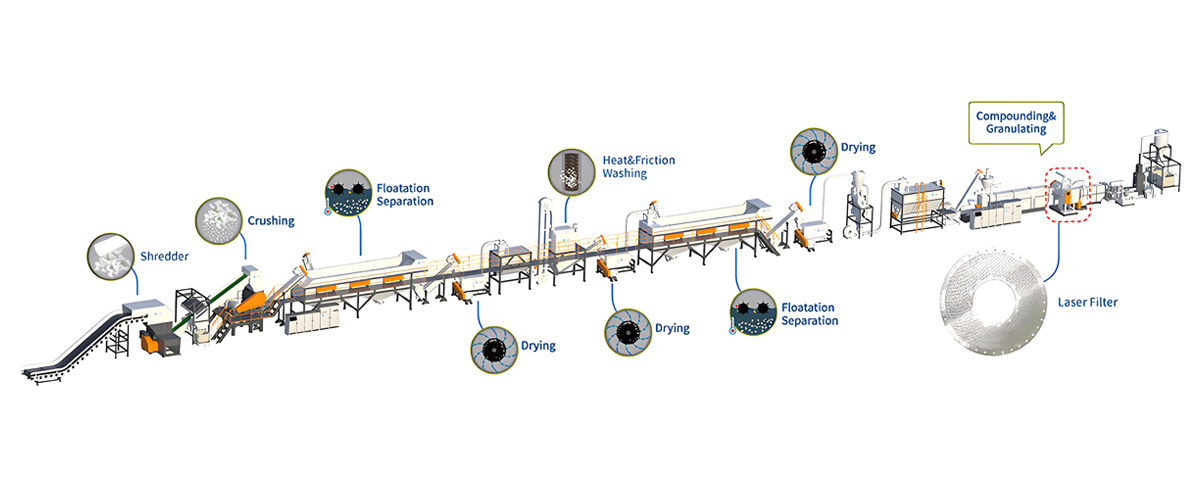
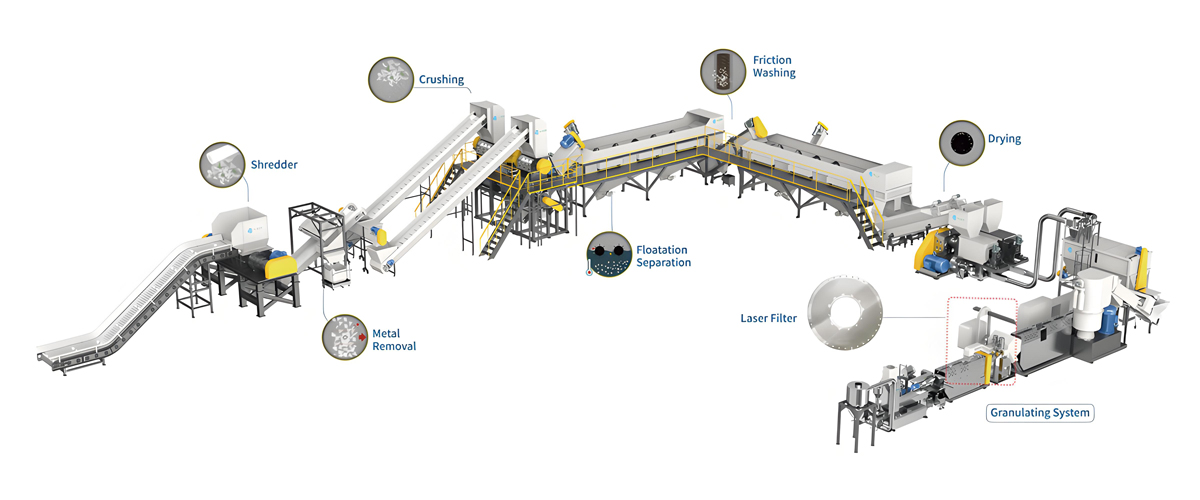
A complete LDPE film recycling line is a chain of unit operations, and the heavy duty beater machine is only as good as the stages around it. The first stage is usually a bale opener and a metal detector that rejects ferrous and non-ferrous objects before they reach cutting tools. Film bales are notoriously full of hidden metal, and one forgotten steel strap can destroy a rotor, so this stage is a cheap insurance policy against an expensive failure.
The second stage is the crusher or shredder. Polyretec’s heavy duty design for stickered film uses a robust shredder that pre-cuts the film into manageable pieces before the wet granulator reduces it to flake size. Pre-cutting matters because whole film sheets wrap; flake flows. The wet granulator then cuts the film underwater or with spray, which suppresses dust and begins the wash while keeping the polymer cool and preventing fusion of the thin film.
Third comes the beater machine, followed by a friction washer. The beater delivers the impact; the friction washer delivers the scrubbing. Some lines run the beater and then two friction washers in series for heavily printed feed. The fourth stage is the sink-float separation tank, where dense contaminants sink and the light LDPE floats and is skimmed off. Caustic or detergent dosing is often used here to loosen organic soil and to help release residual ink carriers from the flake surface.
Fifth is a second washer or a hot wash module for ink-heavy film, then dewatering and drying. Dewatering screws remove free water, and a thermal or mechanical dryer brings moisture down to a level acceptable for storage or direct extrusion. Finally, the clean flake is conveyed to a silo or directly to the pelletizing line. Ancillary systems include water filtration and recirculation, which cut freshwater use and keep the plant permitted in water-sensitive regions, while a filter press concentrates sludge for straightforward disposal.
Polyretec lists auxiliary equipment as a dedicated product family because the small machines decide whether the line runs or stops. Reversible blades, spare screens, a reliable dewatering screw, and a water-filtration loop are the difference between a line that runs for weeks and one that stops every afternoon. The Wanplas group’s shared service policy of an annual free spare-parts provision supports exactly this: keeping wear parts on the shelf so a blade change is a shift task, not a procurement event that halts production.
Water chemistry is the quiet driver of cleaning quality. Most film lines dose a mild detergent or caustic in the hot wash to loosen organic soil and ink carriers, then rinse and neutralize before drying. The balance matters: too little and contamination survives, too much and you add a water-treatment load and risk odour in the flake. Polyretec’s closed-loop water design concentrates the sludge and recirculates the bulk of the process water, which keeps both the environmental permit and the operating cost under control while still hitting the cleanliness target that downstream buyers demand for film going into new products.
Manufacturer Comparison: Polyretec and the Competition
Choosing an LDPE film washing line means comparing not just price but the depth of film-specific engineering. Polyretec, a Wanplas factory, brings Austrian-influenced washing technology combined with Chinese manufacturing scale, which is why its lines appear in projects from Turkey to Mexico to Taiwan. The Austrian technology heritage shows in the washing logic; the Chinese manufacturing base shows in the cost position and the lead time, which matters when a buyer needs a line commissioned inside a season.
EREMA, the Austrian original-equipment leader, is the reference competitor and appears even in Polyretec project histories: a Vietnam customer had run an EREMA machine before adding capacity. EREMA’s shredder-feeder and TVE systems are benchmarked for reliability and are a common choice for premium food-grade applications, though at a higher acquisition tier. Starlinger, an Austrian supplier strong in woven PP and film, competes on integrated washing-and-pelletizing packages. Herbold, part of the recycling machinery sphere, is known for robust wet granulators and washing systems that pair well with demanding post-industrial feed.
The practical comparison is about fit. A buyer with a steady stream of clean industrial stretch wrap and a tight budget will value Polyretec’s cost tier and fast delivery. A buyer chasing food-grade film with the strictest spec may lean toward a premium European line. Mid-size converters often land on Polyretec because the beater-equipped film line meets their cleanliness target without the premium price of a top-tier European name, while still offering the engineering depth that printed and stickered film demands.
Comparison Table: Film Washing Line Suppliers
| Supplier | Origin | Film Washing Strength | Typical Cost Tier | Best-Fit Buyer |
|---|---|---|---|---|
| Polyretec (Wanplas factory) | China, Austrian-influenced tech | Beater-equipped LDPE/PP film lines, 500-1500 kg/h | Medium | Mid-size converters, post-consumer film |
| EREMA | Austria | Shredder-feeder and TVE systems, premium reliability | Very High | Food-grade, strict-spec producers |
| Starlinger | Austria | Integrated wash + pelletizing, woven PP focus | Very High | Integrated film-to-pellet plants |
| Herbold | Germany | Robust wet granulators, washing systems | High | Operators wanting strong granulation |
Note that cost tiers here are relative labels, not quotations. The right choice depends on feed contamination, required flake purity, and the value of the downstream pellet. A lower-tier line that cannot remove sticker glue will cost more in rejected pellet than a properly specified beater line costs in extra acquisition, so the comparison should always be made against the flake spec you must hit to sell.
Buyers sometimes focus only on the equipment price and forget commissioning. A washing line is a wet, abrasive process whose settings drift with feed change, so the first weeks of operation define the habits of the plant. Polyretec’s 24-engineer assistance team supports installation and training, and the open-factory policy lets a buyer watch a similar line run before committing. That early hands-on knowledge is what keeps the beater screens tuned and the line near nameplate rather than slowly degrading as operators guess at settings they were never shown how to read or adjust under real running conditions.
Key Performance Data and Wanplas Ecosystem Integration
A washing line is only as good as the numbers you record. The key data points are throughput, moisture after drying, flake size distribution, residual ash or volatiles, and power per tonne. Tracking these turns a black-box machine into a managed process and lets you prove to buyers that your flake meets spec, which is what unlocks a premium price in the recycled resin market.
Throughput is the obvious one, measured as clean dry flake out per hour against the nameplate. Moisture matters because every point of residual water is energy and potential degradation at the extruder. Flake size distribution matters because the pelletizing feeder prefers a consistent flake; a line that throws a wide range of sizes will surge and starve the extruder. Residual ash, measured by burning a sample, is the simplest proxy for how much non-polymer contamination survived the wash train.
Power per tonne is the operating-cost signal. A beater line that cleans in fewer passes uses less energy than a line that recirculates dirty flake. Polyretec’s engineering target is maximum performance on post-consumer waste with robust construction, which in practice means the heavy duty rotor does the work once rather than the line doing it twice, and that single-pass discipline is visible in the energy ledger at the end of the month.
Data Table: Reference Specifications
| Parameter | Compact Film Line | Standard Beater Line | High-Capacity Line |
|---|---|---|---|
| Rated throughput | 500 kg/h | 1000 kg/h | 1500 kg/h |
| Beater machine | Standard | Heavy duty | Heavy duty, twin |
| Typical feed | Clean stretch wrap | Printed retail bags | Stickered post-consumer |
| Relative capital tier | Low | Medium | High |
| Relative operating cost | Low | Medium | Medium |
A washed flake is only half the value story. Most operators feed the clean LDPE flake into a pelletizing line to make a homogeneous, free-flowing pellet that extrusion shops can use directly. For the extrusion step, Wanplas’s Kerke factory supplies co-rotating twin-screw extruders that integrate with Polyretec washing output. Instead of buying a washer from one company and hoping it mates to an extruder from another, a buyer can specify a line where the flake silo, the feeder, and the screw geometry are coordinated. Kerke’s KTE-series twin-screw extruders are computer-aided designed with a self-cleaning kneading profile, which is ideal for polymer that still carries trace volatiles from film washing.
Automation is reshaping the 2026 washing line. Load-metered infeed, automated screen change, and remote monitoring mean a line can run with minimal staffing and flag problems before they become stoppages. For film especially, where feed varies batch to batch, this adaptive control protects the beater and the extruder alike. Polyretec’s Taiwan project, a fully automated PP PE film washing machine, is the template: matched conveying and instrumentation that let one operator supervise a hands-free train from bale to dry flake while the control system balances each stage against the next.
How to Select the Right Line for Your Plant
Selecting the right LDPE film recycling line starts with the feed, not the machine. Characterize your bales: what percentage is printed, how much carries paper or adhesive labels, how wet are they, and what is the target flake purity. A line specified for clean warehouse film will choke on stickered retail bags, and a premium line sized for food grade is wasted on single-stream industrial wrap that needs far less aggressive cleaning.
Second, size for steady-state throughput, not peak. If you have 800 kg/h of real feed, a 1500 kg/h line costs more to buy and to run while sitting half idle. Conversely, an undersized line forces you to pre-sort or reject material, eroding margin. Polyretec’s 500 to 1500 kg/h band maps cleanly to small, mid, and large converters, and the beater configuration should scale with contamination rather than with raw tonnage.
Third, decide the beater configuration. For any film with ink or labels, specify the heavy duty beater. The marginal cost of the heavier rotor and reversible blades is small against the value of clean flake and the avoided extruder downtime. Fourth, confirm water handling: a closed-loop filtration system is nearly mandatory in regions with discharge limits, and it pays back through lower freshwater and sludge-hauling cost while supporting the Wanplas environmental ethos.
Fifth, plan the pelletizing connection before you buy the washer. If you will pelletize in-house, coordinate the flake outlet with the extruder feeder so the interface is engineered, not improvised. If you will sell flake, confirm the buyer’s moisture and ash spec and tune the dryer and the beater accordingly. Sixth, evaluate the supplier on service, not just price: a 24-engineer assistance team, an open-factory policy you can visit, and an annual spare-parts provision matter more over five years than a lower sticker on day one.
The most common mistake is underestimating contamination. Buyers quote on “LDPE film” and forget the stickers, then wonder why the pellet is grey. The second mistake is skipping the metal detection stage to save cost, which ends in a destroyed rotor. The third is buying the washer and extruder from unrelated vendors with no integration plan, producing a silo interface that never quite works. Each of these is avoidable with the right specification discipline and a supplier who owns the whole train.
The through-line of any good specification is honesty about contamination. Overselling your feed as clean leads to an under-specified beater and a grey pellet; underselling it leads to paying for capacity you will not use. The right answer is a representative sample tested on the actual line configuration, with the beater, screen, and wash stages set to that sample. Treat the washing line as the front end of your raw-material factory, and the conveyor, beater, and pelletizer as one coordinated train rather than three separate purchases that someone must later reconcile by trial and error.
Frequently Asked Questions
What is a heavy duty beater machine in an LDPE film recycling line?
A heavy duty beater machine is a high-impact rotating device placed after the wet crusher that accelerates film flakes against a perforated screen to knock off adhered dirt, glue, sticker residues, and paper fibres before friction washing. Its heavier rotor and reversible blades let it survive continuous duty on abrasive, printed feed.
How much LDPE film can a washing line with a beater machine process per hour?
Depending on configuration, a line with a heavy duty beater machine handles from roughly 500 kg/h for compact setups up to about 1500 kg/h for fully automated film lines, with throughput influenced by moisture content and contamination level.
Why is a beater machine better than a standard friction washer for printed film?
Printed and stickered LDPE film needs aggressive mechanical delamination. The beater machine delivers higher impact energy than a friction washer, loosening ink layers and adhesive labels that a gentle friction washer would leave behind.
Which manufacturers build LDPE film washing lines with beater machines?
Polyretec offers heavy duty beater-equipped LDPE lines as a Wanplas factory, while EREMA, Starlinger, and Herbold also supply film washing and recycling systems. Buyers should compare throughput, screen design, and after-sales coverage.
Can a Polyretec LDPE washing line connect directly to a pelletizing line?
Yes. The dried flakes can be fed into a pelletizing line. For extrusion, Wanplas’s Kerke factory supplies twin-screw extruders that integrate with Polyretec washing output to produce uniform recycled pellets.
What maintenance does a heavy duty beater machine require?
Maintenance focuses on the rotor blades, the perforated screen, and the bearing housing. Blades are reversible and can be hard-faced; the screen should be inspected weekly and the bearings lubricated per the running-hour schedule.
Conclusion
The LDPE film recycling line with a heavy duty beater machine is the configuration that turns the hardest film streams, printed, stickered, and soiled, into clean, salable flake. The beater is not a luxury option; for contaminated post-consumer film it is the component that decides whether your pellet is grey and rejected or bright and premium. Polyretec, a Wanplas factory, pairs that beater with Austrian-influenced washing logic and Chinese manufacturing scale, and connects the washed flake seamlessly to pelletizing through the group’s Kerke twin-screw extruders. Against competitors such as EREMA, Starlinger, and Herbold, Polyretec’s value sits in the medium cost tier with the depth of film-specific engineering most mid-size converters actually need.
If you are specifying a film washing line for 2026, start from your contamination profile, size for steady throughput, and insist on a heavy duty beater for any printed or labelled feed. Then coordinate the washer outlet with your pelletizing plan so the whole train runs as one system. Contact the Polyretec team to request a feed assessment and a line configuration matched to your bales, your capacity, and your target flake purity. With more than 100 project references across 50-plus countries and a shared Wanplas service commitment, Polyretec can take your film from bale to pellet with the uptime and quality your customers expect.