
Table of Contents
- What Is a Soft Plastic Pelletizing Extruder?
- Why Pelletize Washed Film and Flexible Plastic?
- How a Soft Plastic Pelletizing Extruder Works: The Process Stages
- Key Components of a Film Pelletizing Line
- Model Range and Technical Specifications
- Raw Material Requirements for Stable Pelletizing
- Final Pellet Quality and Specifications
- Applications by Material Type
- How to Choose the Right Pelletizing Capacity
- Cost and Energy Analysis
- Installation, Training, and After-Sales Support
- Pelletizing vs Selling Flakes: A Comparison
- Market Trends for Flexible Plastic Recycling in 2026
- Frequently Asked Questions
- Conclusion
What Is a Soft Plastic Pelletizing Extruder?
A plastic recycling machine built for the downstream step of recovery is, in practical terms, a soft plastic pelletizing extruder that takes clean washed flakes of PE, PP, OPP, and BOPP film, woven and nonwoven bags, and composite film and melts, filters, and cuts them into uniform reusable pellets. It sits at the end of the recycling chain, after a washing line has done the dirty work of removing labels, glue, sand, and organic residue. Where a washing line produces loose, fluffy flakes with a low bulk density, a pelletizing extruder converts that same material into dense, free-flowing granules that a film-blower, pipe extruder, or injection molder can swallow without pre-treatment.
The machine family described here is the soft plastic pelletizing extruder, built around a cutting-compaction system and a single-screw extruder with a hot die-face cutter and water-ring cooling. Polyretec markets this equipment as the PTCS series, with models spanning screw diameters from 80 millimeters to 185 millimeters and output rated from about 150 kilograms per hour up to 1200 kilograms per hour depending on the model and the condition of the feedstock. It is explicitly engineered for flexible plastics: clean PE and PP film bags, PP woven and nonwoven bags, OPP and BOPP film, and composite film, with or without residual paint or ink.
What separates a true pelletizing extruder from a bare granulator is integration. A loose granulator only chops material; it does not melt, filter, degas, or form a consistent pellet. A dedicated soft plastic pelletizing extruder carries the material through compaction, plasticizing, double degassing, screen filtration, and die-face pelletizing in one continuous, controlled line, so the operator gets a specification pellet with documented size, moisture, and bulk density rather than an uncontrolled regrind. That integration is exactly what lets the output go straight back into a film-blowing line or a pipe extruder at 100 percent loading, which is the economic argument for owning the machine.
The pellets a plastic recycling machine like this produces are a finished, tradeable commodity. Natural PE pellets become new film and bags; PP pellets become woven sacks, nonwoven fabric, and injection-molded parts; and mixed polyolefin pellets become pipe and profile. Mechanical pelletizing covers the vast majority of flexible polyolefin volume because it is energy-efficient and proven, while chemical recycling remains a niche reserved for streams too contaminated or too multilayer for melt processing. For a buyer, the question is not whether to pelletize flexible plastic, but how much capacity, how clean the feed, and how consistent the pellet must be for the intended market.
Key statistic: Global plastic production sits near 400 million tons per year, and polyolefins, PE and PP together, account for roughly half of that volume. Flexible packaging and film are the fastest-growing slice of polyolefin demand, which is why film pelletizing capacity is one of the most actively installed segments of the plastics recycling machinery market.
Why Pelletize Washed Film and Flexible Plastic?
Washed film flakes are among the most valuable recyclable streams, yet in loose flake form they are awkward to handle, store, and ship. A single batch of clean PE film flakes can have a bulk density as low as 0.08 to 0.3 grams per cubic centimeter, which means a truckload is mostly air. Pelletizing raises that stacking density to 0.5 to 0.8 grams per cubic centimeter, more than doubling the material a container can carry and cutting freight cost per ton dramatically. For any processor who sells recovered plastic beyond the local gate, density is money, and a soft plastic pelletizing extruder is the machine that captures it.
The demand side is strengthening. Recycled polyolefin pellets are now written into packaging and film targets across the European Union, and many global brands have public commitments to include recycled content in bags, sacks, and flexible packaging. RPE and RPP pellets carry a premium over virgin resin when supply is tight and quality is certified, and that premium is the payback engine for a pelletizing line. Because the output is a uniform granule, it blends predictably into virgin resin and passes through downstream equipment without jamming or starving the screw, which keeps the converter’s own line running at rated speed.
Processing resilience is the second driver. Virgin resin prices swing with oil and gas markets, while a captive pellet stream insulates a converter from those swings. A film producer who can pelletize their own offcuts, rejects, and purchased washed flakes is less exposed to resin volatility and more able to promise recycled content to customers on a long-term basis. That stability is exactly what justifies the capital outlay for a plastic recycling machine dedicated to flexible polyolefins.
The final argument is circularity. Post-industrial film, conversion scrap, printed roll ends, and collected post-consumer bags are all feedstock a pelletizing extruder can convert into sellable or reusable pellets. Instead of landfilling or downcycling this material, a processor closes the loop locally: film collected and washed in a region becomes pellets used by film-blowers and pipe makers in the same region, cutting transport and import dependence on virgin plastic. A well-run pelletizing line turns what was once a disposal cost into a margin source.
How a Soft Plastic Pelletizing Extruder Works: The Process Stages
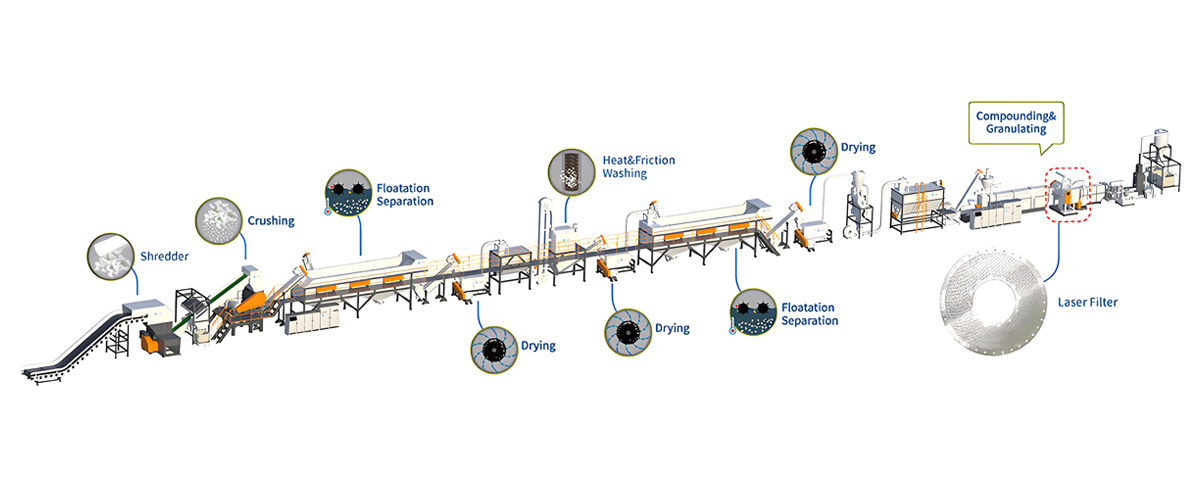
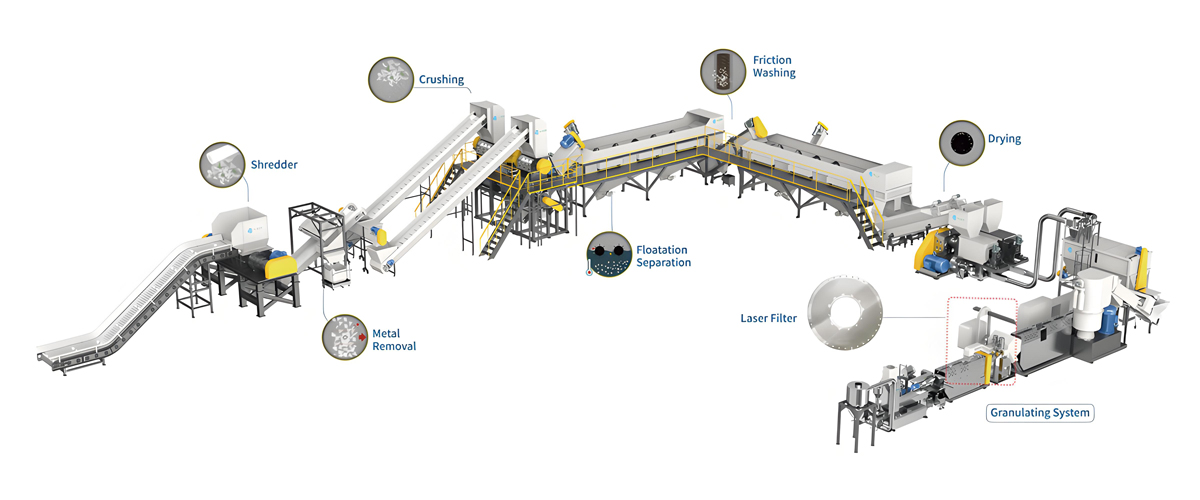
A modern soft plastic pelletizing extruder is a continuous, melt-based process built around a cutting-compaction unit and a single-screw extruder. Each stage removes a specific problem: air and bulk, moisture and ink vapors, gels and contamination, and finally size inconsistency. The goal is a uniform pellet with controlled moisture and stable bulk density that a downstream extruder can use at full loading. Below are the stages a well-designed plastic recycling machine for flexible PE and PP typically includes, in the order material flows through the plant.
Stage 1: Feeding by Belt Conveyor and Clamping Wheelset
Recycled waste film, bags, and rolls are placed directly on a belt conveyor that meters the feed by amperage quantification, so the screw is never overloaded or starved. A clamping wheelset can be paired with the conveyor to feed an entire roll of film on a rack at once, holding tension so the roll unwinds steadily into the cutter. This staged feeding logic is what protects the compaction and extrusion modules downstream and keeps the whole line stable across a long campaign.
Stage 2: Cutting and Compaction
The cutting-compaction system uses precise temperature control and a rotating cutter to bring semi-molten plastic quickly and stably into the extrusion system for mixing and fusion. Rather than dropping cold fluff into the screw, the compactor pre-conditions the film so it melts fast and uniformly, which raises throughput and reduces the risk of bridging or burning. This is the stage that makes a low-bulk-density film feed behave like a manageable, controllable raw material.
Stage 3: Extrusion and Double Degassing
Once plasticized, the melt passes through the extruder barrel where the double-degassing hole design releases more ink and water vapor trapped in the recycled material, improving the quality of the final product. Printed and washed film often carries residual moisture and volatile ink components; the two venting zones pull these out before the melt reaches the die, preventing bubbles, weak pellets, and surface defects in the finished granule.
Stage 4: Double-Column Screen Changing
The double-column screen changer has a filtration area twice that of a standard slide-plate screen changer. This design improves filtration efficiency and reduces the frequency of screen changes, and because the dual-channel layout lets the machine keep running during a screen change, overall capacity is protected and material waste is reduced. For a line running printed or dirty-edge film, fewer stops means more salable pellets per shift.
Stage 5: Hot Die-Face Pelletizing and Water-Ring Cooling
The hot die-face pelletizing system cuts the melted plastic immediately after extrusion, and the cut pellets enter a water ring for cooling right away. The result is a pellet with average shape and size that is easy to handle, store, and re-process in film-blowing, pipe, and injection equipment. The recycled pellets can be loaded 100 percent directly into a film-blowing machine or pipe extruder production line for reuse, which is the whole point of the machine.
Key Components of a Film Pelletizing Line
The reliability of a soft plastic pelletizing extruder comes from how its components are specified for flexible, low-density feed. The feeding unit combines a belt conveyor and an optional clamping wheelset so rolls and loose film both feed cleanly. The cutting-compaction system is the heart of the machine: it bridges the gap between fluffy flake and a stable melt, using controlled temperature and a cutter to avoid thermal degradation while maximizing intake. Without a proper compactor, a single-screw extruder fed loose film will surge, overheat, and stall.
The extruder barrel and screw are sized by model, with screw diameters from 80 to 185 millimeters and an L-to-D ratio adjustable between 18 and 42 depending on the material and the degassing requirement. A longer L/D gives more residence time for mixing and venting, which matters for printed or contaminated film. The double-degassing zone and the double-column screen changer are the two features that most separate an industrial pelletizing extruder from a hobby granulator, because they protect melt quality and uptime at the same time.
The pelletizing head itself uses a hot die-face cutter followed by a water-ring cooling tunnel. Die-face cutting keeps the pellet length consistent and avoids the strand-breaking problems of strand pelletizing when processing low-viscosity polyolefins. The water ring quenches the pellet the instant it is cut, yielding a round, uniform granule rather than an irregular, dusty one. Downstream, a dewatering and conveying system moves the cooled pellets to a silo or bagging station without re-introducing moisture.
Control and safety round out the package. Modern lines run on a centralized control panel that monitors amperage, temperature zones, melt pressure, and screen-changer differential so the operator can react before a stoppage. Because the feed is metered by amperage, the line is largely self-regulating against surges, which reduces the skill burden on staff and protects the screw and drive from overload.
Model Range and Technical Specifications
The PTCS series covers five models so a buyer can match capacity to available feedstock rather than over- or under-buying. Output ratings assume clean, low-moisture feed; printed or wet material will sit toward the low end of each range. The table below summarizes the published specifications for the soft plastic pelletizing extruder family.
| Model | Screw Diameter (mm) | L/D Ratio | Rotating Speed (rpm) | Output (kg/h) | Power (kW) | Operators |
|---|---|---|---|---|---|---|
| PTCS80 | 80 | 18 to 42 | 10 to 150 | 150 to 250 | 90 | 1 to 2 |
| PTCS100 | 100 | 18 to 42 | 10 to 150 | 200 to 350 | 130 | 1 to 2 |
| PTCS130 | 130 | 18 to 42 | 10 to 150 | 450 to 600 | 220 | 2 to 3 |
| PTCS150 | 150 | 18 to 42 | 10 to 150 | 600 to 700 | 270 | 2 to 3 |
| PTCS185 | 185 | 18 to 42 | 10 to 150 | 800 to 1200 | 366 | 2 to 4 |
For a small converter handling in-house film scrap, the PTCS80 or PTCS100 is typically enough and can be run by one or two operators. A regional recycler aggregating washed flakes from many sources will gravitate to the PTCS130 or PTCS150, while a large compounder or exporter targeting export-grade pellets will specify the PTCS185 for its 800 to 1200 kilograms per hour rating. The step between models is not just throughput; it is also the power, footprint, and labor the buyer is committing to, so the choice should follow a realistic feedstock volume rather than a hopeful one.
Raw Material Requirements for Stable Pelletizing
A soft plastic pelletizing extruder is forgiving compared with rigid lines, but it still has limits that determine whether the line runs at rated capacity. The published raw material window is clear: film thickness up to 500 micrometers, bulk density between 0.08 and 0.3 grams per cubic centimeter, and residual moisture no more than 7 percent by weight. Staying inside this window keeps the compactor and screw stable and avoids the surging and burning that wreck pellet quality.
Thickness matters because very heavy or multi-layer film behaves more like sheet than film and can overload the cutter. Bulk density matters because the compactor is what converts fluffy feed into a controllable melt; outside the 0.08 to 0.3 range the metering becomes erratic. Moisture matters most at the degassing stage: above 7 percent, the double-venting zone may not remove enough vapor, and the pellet will carry bubbles or surface porosity that a film-blower will reject. Pre-drying washed flakes or pairing the extruder with a proper dewatering step protects throughput.
Ink and paint are manageable thanks to the double-degassing and double-column filtration, but heavily printed or laminated film should be blended with clean material rather than run pure, because the contaminant load drives screen changes and can tint the pellet. A buyer who knows their feedstock mix, and who can sort or blend to stay inside the window, will see the published output figures; a buyer who feeds everything indiscriminately will see lower, more variable results. The plastic recycling machine rewards feed discipline.
Final Pellet Quality and Specifications
The output of a soft plastic pelletizing extruder is a PE or PP pellet with a granule size of about 3 millimeters by 3 millimeters, a moisture content of 1 to 2 percent, and a stacking density of 0.5 to 0.8 grams per cubic centimeter. These three numbers are what make the pellet tradeable: the size is compatible with standard downstream feeders, the moisture is low enough to avoid steam defects in re-extrusion, and the density is high enough to ship economically.
Moisture of 1 to 2 percent is achieved by the water-ring cooling followed by a dewatering and drying step, which is critical because residual water becomes steam in the next extruder and causes bubbles or splay. The 0.5 to 0.8 stacking density is the payoff for pelletizing in the first place, more than doubling the density of the loose flake and cutting freight cost per ton. A buyer receiving this pellet can load it 100 percent into a film-blowing or pipe line without pre-drying, which is the operational convenience that commands the recycled pellet premium.
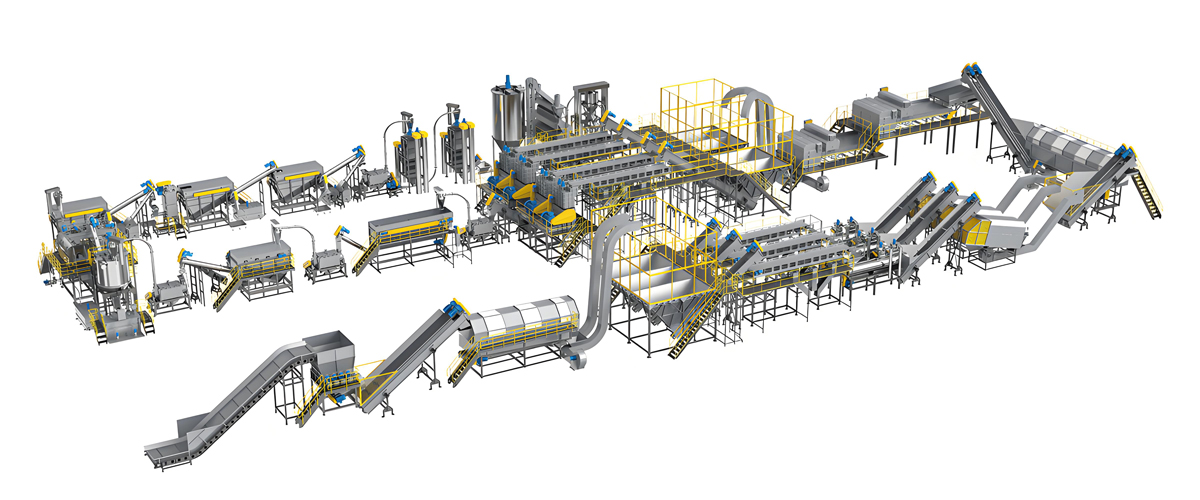
Color and contamination are controlled by the screen changer and degassing rather than by washing, so the pellet quality is only as good as the washed flake that enters the line. This is why pelletizing follows, and does not replace, a washing line for post-consumer film. For post-industrial conversion scrap that is already clean, the extruder alone is enough; for post-consumer film, the washing line upstream is what guarantees the pellet meets spec. The two machines are partners in the recycling chain.
Applications by Material Type
The soft plastic pelletizing extruder is specified for a defined set of flexible polyolefin streams, and matching the material to the machine is the first step in a good specification. Clean PE and PP film bags, whether post-industrial or post-consumer, are the core feed and run at the top of the published output range when washed and dewatered. PP woven and nonwoven bags, including raffia and FIBC offcuts, also process well and produce a stiff, high-value PP pellet used in sacks and nonwoven fabric.
OPP and BOPP film, common in packaging and laminates, pelletize into a clear-to-hazy PP pellet used in tape, film, and injection parts. Composite film, with or without residual paint or ink, is handled by the double degassing and double-column filtration, though heavy laminates should be blended to protect screen life. The machine is explicitly rated for material with or without paint or ink, which is what makes it suitable for printed roll ends and converted scrap that a simpler granulator would choke on.
What the line is not built for is rigid plastic, PET, or highly filled compounds; those need different screw geometry and feeding. For the flexible polyolefin streams it targets, the extruder turns material that would otherwise be downcycled or landfilled into a uniform pellet that re-enters film, pipe, and molding lines at full value. The application list is broad within polyolefins and deliberately narrow outside them, which is the sign of a machine designed for a job rather than a generic claim.
How to Choose the Right Pelletizing Capacity
Choosing a soft plastic pelletizing extruder starts with a realistic feedstock volume, not a sales pitch. A buyer should total the clean, low-moisture flexible polyolefin they can reliably secure per month, convert that to an hourly figure at their planned shifts, and pick the smallest model that meets it with headroom. Specifying the PTCS185 when real feed is 400 kilograms per hour wastes capital and floor space; specifying the PTCS80 when real feed is 700 kilograms per hour forces overtime and rejects jobs.
Feed quality is the second variable. A buyer whose film is mostly clean post-industrial scrap can expect output near the top of each model’s range and can choose a smaller model for the same daily tonnage. A buyer processing printed, wet, or mixed post-consumer film should derate expectations and may need the next model up to hit the same daily volume. Knowing the moisture and contamination profile before purchase is what prevents a capacity surprise after commissioning.
Labor and power round out the decision. The PTCS80 and PTCS100 run with one or two operators and 90 to 130 kilowatts, suiting a small shop; the PTCS130 through PTCS185 need two to four operators and 220 to 366 kilowatts, suiting a dedicated recycling plant. A buyer should price the line together with its power connection, ventilation, and upstream dewatering, because the extruder is only one part of a working plastic recycling machine cell. The right choice balances feed, quality, labor, and power into a line that runs at rated speed on real material.
Cost and Energy Analysis
The purchase price of a soft plastic pelletizing extruder scales with model, from the compact PTCS80 to the high-output PTCS185, and is quoted ex-works with payment by telegraphic transfer or letter of credit, shipped from the port of Shanghai. Beyond the machine, a buyer should budget for power, labor, screens and consumables, and the upstream washing or dewatering equipment if it is not already in place. Treating the extruder as a standalone purchase without its support systems is the most common way to misjudge total cost.
Energy is the largest recurring cost and is published per model: 90 kilowatts for the PTCS80 up to 366 kilowatts for the PTCS185. At typical industrial electricity rates, power per ton of pellet drops as model size rises because larger screws are more efficient per unit of output, so a high-volume buyer often saves energy per ton by choosing a bigger line rather than running a small line around the clock. Labor is one to four operators depending on model and automation, and screen consumption depends on how printed or dirty the feed is.
The payback case rests on the pellet premium and the freight saving from densification. By raising bulk density from roughly 0.1 to 0.6 grams per cubic centimeter, pelletizing can cut transport cost per ton by more than half versus shipping loose flake, and certified recycled pellets command a margin over both virgin resin and dirty flake. For a converter with captive film scrap, the line can pay for itself by displacing purchased virgin resin at full plant utilization, which is why the plastic recycling machine is treated as a strategic asset rather than a cost center.
Installation, Training, and After-Sales Support
Buying a soft plastic pelletizing extruder is the start of a relationship, not a one-time transaction. The supplier backs the equipment with seven-day, twenty-four-hour after-sales support, which matters because a line that stops costs the operator money every hour it is down. Commissioning typically includes mechanical and electrical installation guidance, control-panel training, and a trial run on the buyer’s actual feedstock so the settings are tuned to real material rather than a generic sample.
Certifications matter for export and for buyer qualification. The PTCS series carries CE, SGS, BV, TUV, and ISO certifications, which smooth customs and reassure downstream customers that the equipment and its output meet recognized standards. For a recycler selling pellets across borders, these certificates are often a prerequisite for the contract, not a nice-to-have, and they should be confirmed on the specific model and destination before order.
Training is the quiet multiplier on return. A line run by staff who understand amperage metering, screen-change timing, and degassing behavior will hit rated output and keep pellets on spec; the same line run by untrained staff will surprise, stall, and produce off-grade material. The supplier’s engineer assistance, cited at more than ten years of credible commitment in the product literature, is the resource a buyer should use during the first campaigns to lock in stable operation before scaling volume.
Pelletizing vs Selling Flakes: A Comparison
A recycler with washed film flakes faces three realistic options: sell loose flakes, pelletize in-house, or pay someone else to pelletize. Each has a different risk and return profile, and the right choice depends on volume, freight distance, and access to pellet buyers. The table below contrasts the three paths for a flexible polyolefin recycler.
| Option | Bulk Density | Freight Cost per Ton | Value per Ton | Capital Needed | Best For |
|---|---|---|---|---|---|
| Sell loose flakes | 0.08 to 0.3 g/cm3 | High | Lowest | None | Small volume, local buyer |
| Pelletize in-house | 0.5 to 0.8 g/cm3 | Low | Highest | Extruder + support | Mid to large volume |
| Contract pelletizing | 0.5 to 0.8 g/cm3 | Low | Medium | None | Variable volume |
For a recycler below roughly a few hundred kilograms per hour, selling flakes or using contract pelletizing is rational because the capital and labor of an in-house line are not yet justified. Above that threshold, in-house pelletizing captures both the freight saving from densification and the pellet premium, and the soft plastic pelletizing extruder becomes the obvious economic choice. The comparison is not ideological; it is a function of volume and logistics, and the crossing point is where the line pays for itself.
Market Trends for Flexible Plastic Recycling in 2026
Flexible plastic, film, and bags are the fastest-growing segment of polyolefin demand and, historically, the hardest to collect and recycle at scale. That is changing in 2026 as extended-producer-responsibility schemes and brand recycled-content commitments push film collection and sorting infrastructure into more regions. More collected film means more washed flake available to pelletize, which directly expands the addressable market for a soft plastic pelletizing extruder.
At the same time, mechanical pelletizing is being paired with, not replaced by, advanced recycling. Multilayer and heavily printed film that melt processing cannot clean sufficiently is routed to chemical recycling, while the clean polyolefin fraction is pelletized mechanically at a fraction of the energy and cost. A recycler who understands this split can spec a plastic recycling machine cell that maximizes mechanical yield and only diverts the truly unrecyclable fraction, which is the most profitable and lowest-carbon operating model available today.
Quality certification is the third trend. Buyers of recycled pellets increasingly demand documented moisture, density, and contamination data, and the consistency a die-face pelletizer and water-ring cooler deliver is exactly what those specifications require. Equipment that produces a uniform, low-moisture, high-density pellet is therefore better positioned than loose flakes or inconsistently cut regrind, and the PTCS series’ emphasis on uniform pellet shape and size aligns directly with where the market is heading.
Frequently Asked Questions
What is the difference between a washing line and a pelletizing extruder?
A washing line removes dirt, labels, and contaminants from dirty plastic and outputs clean flakes. A soft plastic pelletizing extruder takes those clean flakes and melts, filters, and cuts them into dense pellets. They are sequential steps; one does not replace the other for post-consumer film.
Can the extruder handle printed or inked film?
Yes. The double-degassing zone and double-column screen changer are designed to release ink and moisture vapors and to filter gel and contamination. Heavily printed film should be blended with clean material to protect screen life and pellet color, but the machine is rated for material with or without paint or ink.
What capacity should I choose?
Base the choice on realistic, clean, low-moisture feed volume per shift. The PTCS80 and PTCS100 suit small shops at 150 to 350 kilograms per hour; the PTCS130 and PTCS150 suit regional recyclers at 450 to 700 kilograms per hour; the PTCS185 suits large plants at 800 to 1200 kilograms per hour. Derating applies for wet or heavily printed feed.
What pellet size and quality can I expect?
The output is a PE or PP pellet of about 3 by 3 millimeters, with moisture of 1 to 2 percent and a stacking density of 0.5 to 0.8 grams per cubic centimeter. The pellet can be loaded 100 percent into a film-blowing or pipe line without pre-drying.
What are the power and labor requirements?
Power ranges from 90 kilowatts on the PTCS80 to 366 kilowatts on the PTCS185. Operators range from one or two on the small models to two to four on the large models, depending on automation and shift layout.
Do I need a washing line upstream?
For post-industrial conversion scrap that is already clean, the extruder alone is sufficient. For post-consumer film, a washing line upstream is required to guarantee the pellet meets spec, because the extruder filters and degasses but does not wash.
Which certifications does the equipment carry?
The PTCS series carries CE, SGS, BV, TUV, and ISO certifications, which support export and buyer qualification. Confirm the specific certificates for your model and destination before ordering.
Conclusion
A soft plastic pelletizing extruder is the downstream plastic recycling machine that turns clean washed PE, PP, OPP, and BOPP film, woven and nonwoven bags, and composite film into uniform, dense, reusable pellets. With the PTCS series spanning 150 to 1200 kilograms per hour across five models, double degassing, double-column filtration, and hot die-face pelletizing with water-ring cooling, it converts low-density flake into a 0.5 to 0.8 grams per cubic centimeter pellet that ships cheaply and re-processes at 100 percent loading. For a recycler or converter with reliable flexible polyolefin feed, in-house pelletizing captures both the freight saving from densification and the recycled pellet premium, making the line a strategic asset rather than a cost. As film collection expands under extended-producer-responsibility schemes in 2026, the economics of owning a soft plastic pelletizing extruder only improve, provided the buyer matches model capacity to real, clean feed and pairs the machine with the washing or dewatering support it needs to run at rated speed.