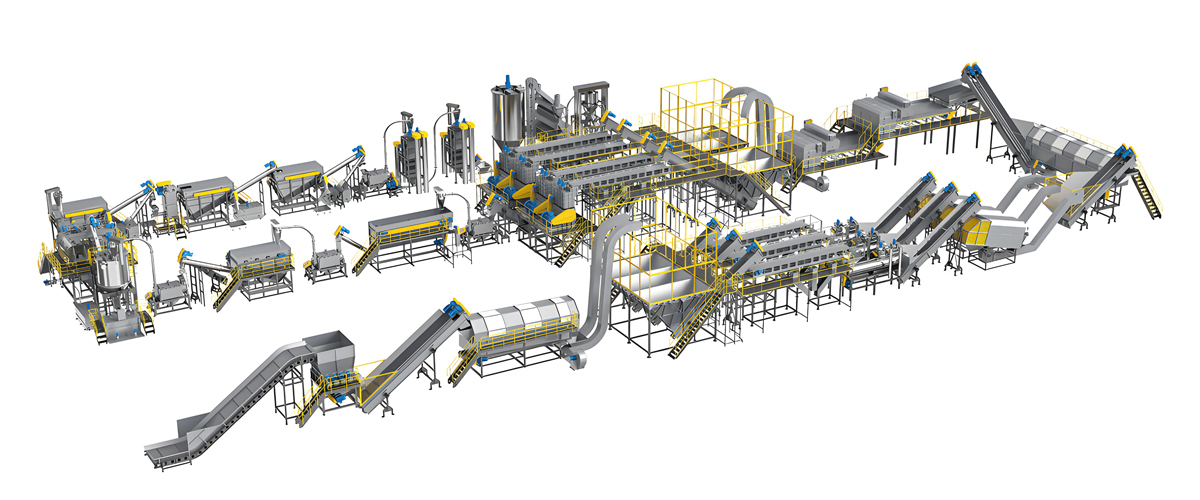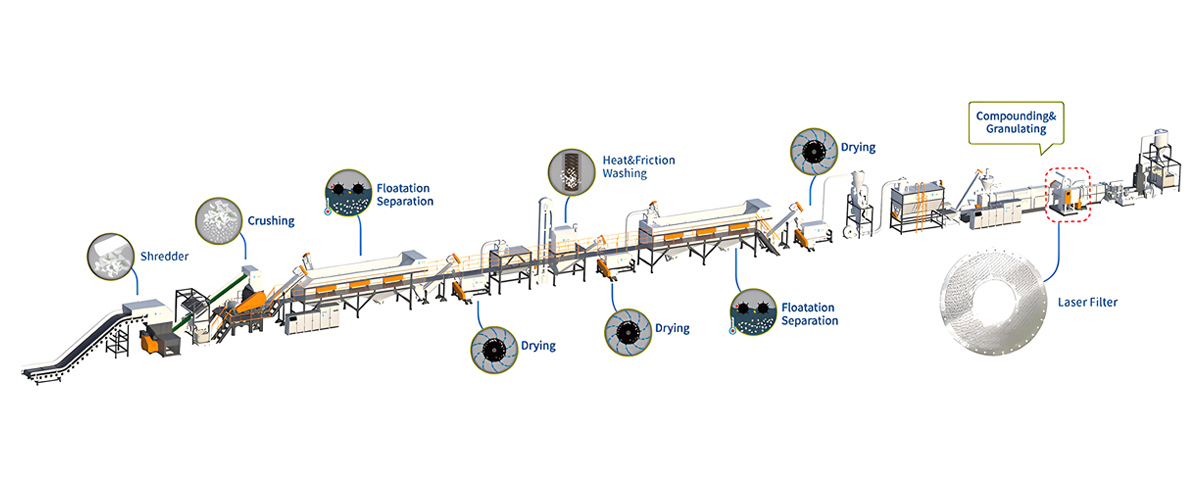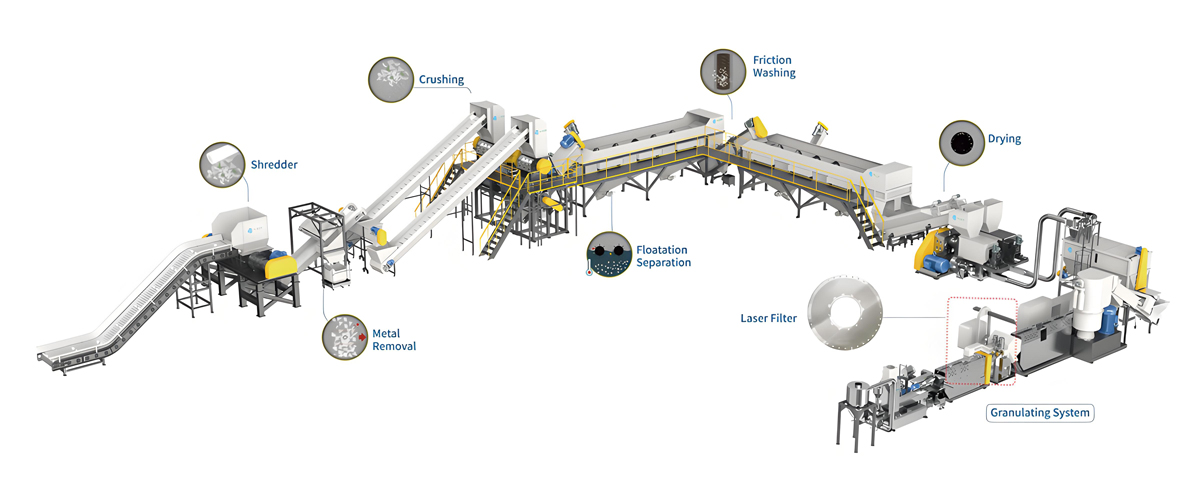

Plastic shredders are the foundational core equipment of every plastic waste recycling line, undertaking the primary crushing, volume reduction and material homogenization work for all types of rigid and flexible plastic waste. Whether for small-scale workshop recycling or large-scale industrial plastic waste processing plants, the correct selection of shredder size directly determines production efficiency, operating cost, finished material quality and overall project profitability. Many recycling project operators face common problems such as insufficient shredding capacity, frequent equipment jamming, excessive energy consumption or idle equipment redundancy due to unreasonable shredder size matching, which seriously restricts long-term stable operation of recycling lines.
Different sizes of plastic shredders correspond to matched processing capacity, motor power, blade specification, feeding size and application scenarios. Small-sized shredders are suitable for low-output, flexible small-batch recycling, while large industrial shredders are tailored for high-load, continuous large-scale waste plastic treatment. As a professional manufacturer focusing on full-series plastic recycling and washing equipment, POLYRETEC provides complete small, medium and large-sized plastic shredding equipment, covering all scenario demands from personal workshop small recycling projects to factory-level large-scale centralized plastic waste treatment. This article comprehensively explains the core indicators, selection standards, size classification, cost budget and scenario matching skills of plastic shredder size selection, providing systematic and practical guidance for global recycling enterprises to configure reasonable shredding equipment.
1. Basic Classification of Plastic Shredder Sizes and Core Parameter Standards
1.1 Small-Scale Plastic Shredder Basic Specifications
Small-sized plastic shredders are defined as low-power, low-output compact shredding equipment, mainly designed for small-batch, scattered plastic waste recycling scenarios. The core parameter indicators of small shredders include motor power ranging from 7.5kW to 22kW, effective blade length of 300mm to 600mm, maximum feeding particle size of 400mm, and hourly processing capacity stably maintained at 50kg/h to 300kg/h. The equipment adopts single-axis low-speed high-torque structural design, with lightweight fuselage, small floor area and flexible operation, which is convenient for mobile and decentralized recycling work.
In terms of discharging effect, small shredders are equipped with standard 10mm-30mm adjustable screen meshes, which can uniformly crush waste plastics into small granular flakes that meet the requirements of subsequent washing and pelletizing. The equipment is suitable for flexible plastics such as waste plastic films, packaging bags, and small rigid plastics including daily cosmetic bottles, small toy plastic parts and thin-walled plastic containers. The structural design features simple operation, low failure rate and extremely low threshold of factory infrastructure matching.
1.2 Medium-Scale Plastic Shredder Basic Specifications
Medium-sized plastic shredders are transition models connecting small and large equipment, with motor power concentrated in 30kW to 55kW, blade length of 600mm to 1000mm, maximum feeding size of 800mm, and hourly processing capacity of 300kg/h to 800kg/h. This type of equipment adopts optimized dual-axis shear shredding structure, which balances crushing efficiency and energy-saving performance, and can adapt to mixed crushing of flexible and rigid plastics.
Medium-sized shredders can stably process thick-walled HDPE bottles, plastic pipes, plastic crates and mixed waste plastic materials, with adjustable discharging particle size of 8mm-40mm. They are the most widely applicable equipment type for small and medium-sized standardized recycling factories, solving the problems of insufficient capacity of small shredders and excessive energy waste of large equipment.
1.3 Large-Scale Industrial Plastic Shredder Basic Specifications
Large industrial plastic shredders are high-power and high-output core equipment for factory-level large-scale recycling projects, with motor power above 75kW, mainstream configuration of 75kW-160kW, blade length exceeding 1000mm, and maximum feeding size up to 1500mm. The hourly processing capacity can reach 800kg/h to 3000kg/h, supporting 24-hour full-load continuous industrial operation.
Large shredders adopt heavy-duty dual-axis high-torque shear structure, equipped with thickened alloy steel blades and reinforced fuselage, which can crush large-volume and high-hardness plastic waste such as large plastic buckets, plastic pallets, thick plastic plates and whole rolls of plastic films. The discharging particle size is adjustable from 15mm to 50mm, meeting the high-volume feeding demand of large-scale washing lines and pelletizing production lines, and is the essential supporting equipment for centralized plastic waste recycling bases.
2. Core Factors Determining Plastic Shredder Size Selection
2.1 Daily and Annual Processing Capacity Demand
Production capacity is the primary factor for shredder size selection. Operators need to calculate the average daily waste plastic processing volume and reserve 20%-30% capacity redundancy to avoid equipment overload operation. For small workshop projects with daily processing volume below 3 tons, small shredders with 50-300kg/h output can fully meet the demand, with no redundant energy consumption and low operating cost. For projects with daily processing volume of 3-8 tons, medium-sized shredders are the best choice to balance efficiency and cost.
Large-scale industrial recycling projects with daily processing volume exceeding 10 tons must be equipped with large industrial shredders. If small and medium-sized equipment is forcibly used for high-volume processing, it will cause long-term overload operation, frequent blade jamming, motor heating and shutdown failures, seriously shortening equipment service life and restricting production progress. Reasonable size matching based on capacity demand is the premise of stable project operation.
2.2 Types and Hardness of Processed Plastic Waste
Different plastic materials have different hardness, thickness and structural characteristics, putting forward different requirements for shredder size, torque and blade configuration. Flexible plastics such as plastic films, woven bags and packaging materials have low hardness but are easy to wind blades, suitable for small and medium-sized single-axis shredders with low-speed and high-torque design, which can effectively avoid winding and blockage.
Rigid plastics such as HDPE oil bottles, PET bottles, plastic crates, thick plastic pipes and plastic pallets have high hardness and strong impact resistance, requiring medium and large dual-axis shredders with high shear force. Large-volume thick-walled rigid plastics must be matched with large-sized heavy-duty shredders. Small shredders have insufficient shear torque and blade strength, which cannot crush thick rigid plastics, and are prone to blade cracking and equipment damage.
2.3 Feeding Size and Discharging Particle Size Requirements
The maximum feeding size of the shredder determines whether the raw materials can be directly fed without pre-cutting. Small shredders are only suitable for small-size waste plastics below 400mm. For large plastic raw materials such as whole plastic buckets and long plastic pipes, pre-cutting is required before feeding, increasing manual operation costs. Large shredders support direct feeding of 1.5m large materials, eliminating pre-processing links and improving production efficiency.
The discharging particle size is matched with subsequent processing equipment such as washing lines and pelletizers. Small shredders have fine crushing accuracy and are suitable for projects requiring fine particle finished materials. Large shredders focus on high-volume volume reduction, with relatively larger discharging particle size, which is more suitable for primary crushing of large waste materials and secondary fine crushing matching. Operators need to select shredder size according to the particle size standards required by subsequent production links.
2.4 Factory Space and Infrastructure Conditions
Small shredders have compact structure, small floor area and low requirements for factory space and foundation, which can adapt to small workshops and decentralized production sites with limited space. The equipment has low power load, and ordinary industrial power supply can meet the operating demand without additional power distribution transformation.
Large industrial shredders have large fuselage size, heavy weight and large floor area, requiring standardized factory foundation fixing and stable bearing space. The equipment has high power load, and enterprises need to complete high-power power distribution transformation and circuit safety configuration in advance. Before selecting large-sized equipment, it is necessary to confirm whether the factory space, power supply and infrastructure meet the installation and operation standards.
2.5 Automation Configuration and Production Line Matching
Small-scale manual semi-automatic recycling lines are suitable for supporting small shredders, with flexible start-stop and low linkage requirements. Large-scale fully automatic assembly line production needs to be matched with large shredders with automatic feeding, intelligent frequency conversion and linkage control functions, realizing synchronous operation with conveyor belts, washing equipment and sorting equipment, and improving the overall automation level of the production line.
3. Size Selection Schemes for Small-Scale Plastic Recycling Projects
3.1 Applicable Scenarios of Small Shredders
Small plastic recycling projects mainly include individual workshop recycling, small community waste plastic centralized processing, small-batch special plastic material recycling and experimental trial production of new projects. The daily processing capacity of such scenarios is below 3 tons, with scattered raw material sources, mixed material types and flexible production time, and does not need 24-hour continuous operation. Small shredders can fully meet the production demand and avoid equipment redundancy and cost waste.
3.2 Recommended POLYRETEC Small Shredder Size and Parameters
POLYRETEC customized small-sized plastic shredder for small-scale recycling adopts 7.5kW-22kW power configuration, with blade length of 300mm-600mm and hourly output of 50-300kg/h. The equipment is specially optimized for small-batch flexible and thin-walled rigid plastics, with low-speed high-torque operation, effectively avoiding material winding and blockage. The lightweight integrated fuselage is easy to install and move, with low noise and low energy consumption during operation.
The equipment is equipped with an adjustable 10-30mm screen mesh, realizing uniform crushing of waste plastic films, small bottles and plastic accessories. The failure rate is extremely low, and daily maintenance is simple, basically realizing unattended stable operation.
3.3 Small Shredder Price and Investment Cost Analysis
The ex-factory price of POLYRETEC small plastic shredders is 3,200-6,800 US dollars. The price of 7.5kW basic model is 3,200-4,200 US dollars, and the price of 22kW high-power small model with higher output is 5,800-6,800 US dollars. The equipment has low one-time investment, no need for special foundation transformation and high-power power distribution supporting, and the auxiliary investment cost is less than 500 US dollars.
In terms of daily operating cost, the hourly power consumption of small shredders is only 5-18kWh, with annual electricity cost of 1,800-6,500 US dollars based on 8-hour daily production and 300-day annual work. The annual maintenance cost of vulnerable parts such as blades and screen meshes is only 300-800 US dollars, with extremely low comprehensive operating cost, which is very suitable for small-budget and small-scale recycling projects.
3.4 Advantages and Limitations of Small Shredders
The core advantages of small shredders are low investment threshold, flexible operation, low energy consumption and low maintenance cost. They can quickly start small-scale recycling projects with short investment cycle and almost no risk of equipment idle loss. The equipment is suitable for flexible switching of multiple material types and scattered production scenarios.
The main limitation is the low single-machine output, which cannot support large-volume continuous production. It is unable to crush high-hardness and large-size thick-walled plastic waste, and is only suitable for conventional thin-walled and flexible plastic materials. With the expansion of project scale, small shredders will face capacity bottlenecks and need equipment upgrading and replacement.
4. Size Selection Schemes for Large-Scale Plastic Recycling Projects
4.1 Applicable Scenarios of Large Industrial Shredders
Large-scale plastic recycling projects refer to standardized factory-level production lines with daily processing capacity of more than 10 tons, including urban centralized plastic waste recycling bases, large waste plastic washing and pelletizing factories, industrial plastic residue treatment projects and export-oriented recycled material processing enterprises. Such projects require 24-hour continuous full-load operation, with large raw material volume, complex material types and high requirements for production efficiency and material uniformity, which must be matched with large industrial shredders.
4.2 Recommended POLYRETEC Large Shredder Size and Parameters
POLYRETEC large industrial plastic shredders are divided into multiple specifications of 75kW, 90kW, 110kW and 160kW, with blade length ranging from 1000mm to 1800mm and hourly output of 800kg/h to 3000kg/h. The equipment adopts heavy-duty dual-axis shear structure and thickened alloy steel blades, with ultra-high shear torque, which can easily crush large-volume and high-hardness plastics such as plastic pallets, thick plastic plates, large oil drums and whole rolls of plastic films.
Equipped with intelligent frequency conversion speed regulation, automatic feeding matching and overload protection system, the large shredder can realize 24-hour uninterrupted stable operation. The adjustable screen mesh range is 15-50mm, which can meet the primary crushing and homogenization requirements of large-scale production lines, and perfectly match the feeding rhythm of subsequent high-efficiency washing lines and pelletizing equipment.
4.3 Large Shredder Price and Full Project Cost Analysis
The ex-factory price of POLYRETEC large industrial plastic shredders ranges from 18,000 to 45,000 US dollars. The 75kW basic large model with hourly output of 800-1200kg is priced at 18,000-22,000 US dollars. The 90kW-110kW medium-large model with output of 1500-2000kg/h is priced at 25,000-32,000 US dollars. The 160kW ultra-large high-power model with output up to 3000kg/h is priced at 38,000-45,000 US dollars.
In terms of auxiliary investment, large shredders need standardized foundation fixing, high-power power distribution transformation and safety protection configuration, with a one-time auxiliary supporting cost of 3,000-6,000 US dollars. The hourly power consumption of large equipment is 60-160kWh. Calculated based on 20-hour daily production and 300-day annual work, the annual electricity cost is 36,000-96,000 US dollars. The annual maintenance cost of blade wear, lubrication and electrical inspection is 2,500-5,000 US dollars.
4.4 Advantages and Precautions of Large Shredders
Large industrial shredders have ultra-high production efficiency and strong material adaptability, supporting full-type plastic waste crushing and 24-hour continuous operation. The crushed materials have uniform particle size and stable quality, which can significantly improve the overall operating efficiency of the large-scale recycling line and reduce manual intervention costs. Long-term large-volume processing has prominent scale benefits and low unit material processing costs.
The selection precautions are high initial investment cost, high requirements for factory infrastructure and professional operation and maintenance. Large equipment is not suitable for small-batch and discontinuous production, and long-term low-load operation will cause serious energy waste and increase unit production costs. It is necessary to reasonably match the model according to the actual stable processing volume of the project to avoid over-investment.
5. Medium-Sized Shredder: The Most Cost-Effective Universal Choice
For most small and medium-sized standardized recycling enterprises with daily processing volume of 3-10 tons, medium-sized plastic shredders are the most balanced and cost-effective choice, avoiding the capacity bottleneck of small equipment and the over-investment risk of large equipment. POLYRETEC medium-sized shredders adopt 30kW-55kW power configuration, with hourly output of 300-800kg/h, which can adapt to mixed crushing of flexible and rigid plastics, and can meet the production demand of 8-16 hours of daily continuous operation.
The market price of medium-sized shredders is 9,800-15,800 US dollars, with moderate one-time investment. The hourly power consumption is 25-45kWh, and the annual comprehensive operating cost of electricity and maintenance is 12,000-20,000 US dollars, which has significant cost advantages compared with large equipment. The equipment has strong universality and can be compatible with multiple production scenarios, and can be upgraded and matched with automated feeding and sorting systems with the expansion of project scale, with low later transformation cost and high long-term investment value.
6. Common Mistakes in Shredder Size Selection and Avoidance Skills
6.1 Blind Pursuit of Large-Sized Equipment
Many project operators blindly purchase large high-power shredders in the early stage of investment to reserve production capacity, resulting in long-term low-load operation of equipment. The unit energy consumption of low-load operation of large equipment is far higher than that of medium and small equipment, resulting in serious waste of electricity cost and equipment resources, and lengthening the investment payback cycle. The correct selection principle is to match the model according to the actual stable daily output, and reserve 20% redundancy appropriately, instead of excessive pursuit of high configuration.
6.2 Excessive Pursuit of Small Equipment for Cost Saving
In order to save initial investment cost, some enterprises use undersized shredders to bear high-volume production tasks, resulting in long-term overload operation of equipment. The equipment is prone to frequent jamming, motor burnout and blade damage, with extremely high failure rate, frequent production shutdowns and increased maintenance costs. The production efficiency is low, which cannot meet the order demand, resulting in greater economic losses. It is necessary to comprehensively balance initial investment and long-term operating cost, and avoid low-quality and low-price selection.
6.3 Ignoring Material Adaptability and Only Focusing on Output Parameters
Some operators only refer to the hourly output parameters when selecting models, ignoring the matching degree between equipment size and material hardness and size. Small and medium-sized equipment cannot adapt to high-hardness thick-walled plastic crushing. Even if the output meets the standard, the equipment will be severely worn and frequently faulty. It is necessary to prioritize material adaptability, select blade torque and fuselage structure matching the waste plastic type, and then confirm the output size.
6.4 Ignoring Subsequent Production Line Matching
The shredder is the front-end processing equipment of the recycling line. If the shredder size is too large and the subsequent washing, sorting and pelletizing equipment has low capacity, it will cause material accumulation and production line congestion. If the shredder size is too small, the front-end crushing capacity is insufficient, restricting the overall output of the subsequent high-efficiency production line. The shredder size must be matched with the processing capacity of the whole production line to ensure synchronous and balanced operation of each link.
7. Comprehensive Cost-Benefit Comparison of Different Shredder Sizes
7.1 Initial Investment Cost Comparison
The average initial investment of small shredders is 3,200-6,800 US dollars, medium-sized shredders is 9,800-15,800 US dollars, and large industrial shredders is 18,000-45,000 US dollars. Small equipment has the lowest entry threshold, medium equipment has moderate investment, and large equipment has high one-time investment, which is suitable for projects with sufficient capital budget and stable large-volume raw material supply.
7.2 Long-Term Operating Cost Comparison
In terms of unit material processing energy consumption, small shredders have high unit energy consumption, medium shredders have the lowest comprehensive energy consumption, and large shredders have low unit energy consumption under full-load operation but high energy consumption under low-load operation. In terms of maintenance cost, small equipment has low maintenance cost but easy loss of vulnerable parts under overload; medium equipment has stable loss and low maintenance cost; large equipment has high single maintenance cost but long maintenance cycle.
7.3 Investment Payback Period Comparison
Small shredder projects have a payback period of 3-6 months, suitable for short-term small-batch trial production. Medium shredder projects have a payback period of 8-12 months, with stable profit and low risk, suitable for long-term standardized operation. Large shredder projects have a payback period of 12-18 months, with large profit space after stable production and prominent scale advantages, suitable for large-scale factory operation.
8. Professional Size Selection Suggestions Based on Different Project Stages
8.1 New Project Trial Stage
For new plastic recycling projects with unstable raw material sources and uncertain order volume, it is recommended to choose small or medium-sized shredders. Low initial investment can avoid blind investment risk. After verifying the project profitability and stable raw material supply, gradually upgrade the equipment model to expand production scale, which is the safest investment strategy for new projects.
8.2 Stable Mass Production Stage
For standardized recycling factories with stable daily processing volume of more than 5 tons, medium and large-sized shredders are recommended. According to the daily processing capacity of 5-10 tons, choose medium-sized 55kW shredders; for daily processing capacity of more than 10 tons, choose large 75kW and above industrial shredders, giving full play to scale production advantages and reducing unit comprehensive processing cost.
8.3 Project Expansion and Upgrading Stage
When the existing production capacity is insufficient and the project needs to be expanded, it is necessary to recheck the overall production line capacity, select a shredder size matching the upgraded production line, and eliminate mismatched old equipment. Priority should be given to medium and large equipment with strong scalability, which can be matched with automated feeding and intelligent control systems to realize intelligent upgrading of the production line.
9. POLYRETEC Professional Customization and After-Sales Service Support
POLYRETEC provides full-series customized plastic shredder size selection services for global recycling enterprises. Professional engineers conduct one-on-one project evaluation according to customers’ raw material types, daily processing volume, factory conditions, budget and subsequent production line configuration, avoiding model mismatching and blind investment. All equipment sizes, power parameters and blade configurations can be personalized adjusted according to customer actual working conditions.
All POLYRETEC shredders undergo strict factory debugging and full-load testing before delivery to ensure stable equipment performance and qualified crushing effect. The company provides free on-site installation, commissioning and operation training services, helping customers quickly master equipment operation and daily maintenance skills. The whole machine enjoys a 2-year free warranty and lifelong technical support services, with long-term stable supply of original vulnerable parts, effectively reducing customer later operation and maintenance risks and costs.
Conclusion
The scientific selection of plastic shredder size is the key foundation to ensure efficient, stable and low-cost operation of plastic recycling lines. Small-sized shredders are suitable for small-batch, flexible and low-budget recycling projects with low investment and flexible operation. Medium-sized shredders have the best comprehensive cost performance, covering most standardized small and medium-sized recycling scenarios, and are the mainstream choice of the current recycling market. Large industrial shredders are tailored for large-scale high-volume industrial recycling projects, with prominent scale benefits and high long-term return on investment.
In actual project selection, operators must comprehensively consider multiple factors such as production capacity demand, plastic material characteristics, factory infrastructure, project budget and subsequent production line matching, and avoid selection mistakes such as blind pursuit of high configuration and excessive cost saving. With reliable equipment quality, reasonable size classification and perfect full-cycle service, POLYRETEC provides targeted shredder configuration solutions for global small and large-scale plastic recycling projects, helping enterprises reduce operating costs, improve production efficiency and enhance project comprehensive profitability.