
With the continuous expansion of the global plastic recycling industry, labor cost has become one of the largest operating expenditures for recycling enterprises, especially in regions with rising labor prices. Traditional semi-automatic plastic washing lines rely heavily on manual work in links such as sorting, feeding, process adjustment, quality inspection and finished product packaging, which not only pushes up operating costs, but also leads to problems such as unstable production efficiency, large quality fluctuations and high safety risks. For many small and medium-sized recycling enterprises, the annual growth of labor cost has gradually eroded profit margins, making it urgent to find a feasible cost reduction path.
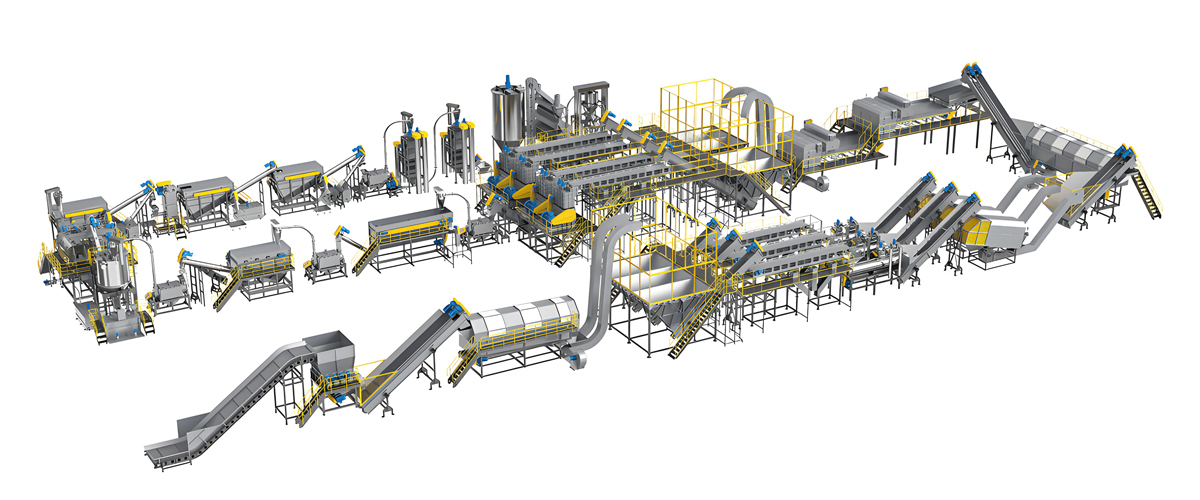
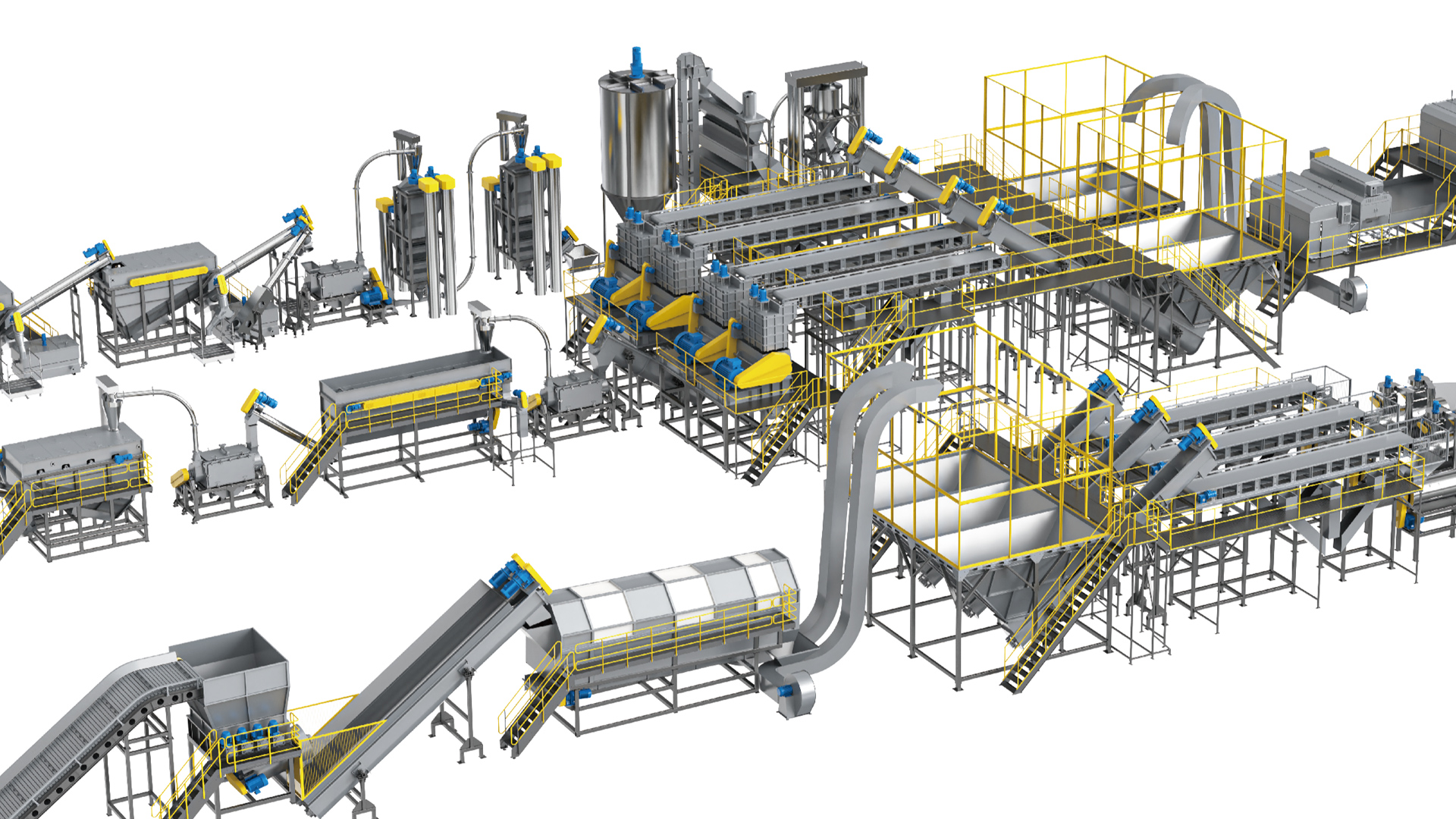
The fully automated plastic washing line realizes unmanned operation of the whole production process through intelligent control system, automatic sorting equipment, closed-loop cleaning process and automatic packaging device, which is the core solution to reduce labor cost in the plastic recycling industry. As a professional manufacturer of plastic recycling equipment, POLYRETEC has launched a series of fully automatic plastic washing lines with independent intellectual property rights. While ensuring high cleaning quality and stable operation, the equipment greatly reduces the demand for on-site operators, helping global recycling enterprises achieve significant labor cost reduction while improving production efficiency and product quality. This article will systematically analyze the labor pain points of traditional plastic washing lines, explain how fully automated lines realize labor substitution, carry out detailed cost-benefit calculation, and provide practical landing suggestions for enterprises.
1. Labor Cost Pain Points of Traditional Semi-Automatic Plastic Washing Lines
Most traditional plastic washing lines adopt a semi-automatic mode, in which core equipment such as crushers and cleaning machines operate automatically, but a large number of auxiliary links still depend on manual operation. With the increase of global labor cost and the improvement of production safety standards, the disadvantages of this mode become more and more obvious, restricting the profitability and development space of enterprises.
1.1 High Labor Demand in Multiple Production Links
Traditional washing lines need to be equipped with a large number of operators in all production links. In the raw material pretreatment stage, manual feeding and primary sorting are required. Workers need to pick out large pieces of non-plastic impurities such as wood, metal and glass from mixed waste plastics, and simply classify different types of plastics. A medium-sized production line with a capacity of 1000 kg per hour usually needs 3 to 4 workers to be responsible for feeding and sorting alone, and the labor intensity is very high. In the cleaning process, special personnel are required to patrol each equipment, adjust process parameters such as water temperature and cleaning agent concentration according to the pollution degree of materials, and deal with faults such as material blockage and equipment jamming in time.
In the finished product processing stage, manual work is also required to be responsible for material transfer, quality sampling inspection, finished product packaging and warehousing. For lines without automatic conveying devices, workers also need to use trolleys to transfer materials between different processes, which further increases labor demand. Generally speaking, a traditional 1000 kg/h semi-automatic washing line needs to be equipped with 8 to 10 operators per shift to maintain normal operation. If three-shift continuous production is adopted, at least 24 to 30 workers are needed, and the annual labor expenditure is very considerable.
1.2 Low Work Efficiency and Large Quality Fluctuation Caused by Manual Operation
In addition to the direct labor cost, the efficiency and quality problems caused by manual operation also bring a lot of hidden costs. Manual sorting is limited by energy and attention, and the efficiency will decrease significantly with the extension of working time. The sorting accuracy is also unstable. It is difficult to accurately distinguish similar plastics such as PP and PE by naked eyes, and it is easy to miss small impurities, resulting in low purity of finished products and affecting selling prices. According to industry statistics, the accuracy of manual plastic sorting is usually between 75% and 85%, and the misjudgment rate will rise significantly during night shift and fatigue period, leading to an increase in defective rate.
At the same time, manual parameter adjustment and quality inspection are highly dependent on the experience of operators. Workers with different levels will get different production effects. Even the same worker will have operational errors due to emotional and physical state, resulting in fluctuations in cleaning quality. Unstable product quality will not only increase the cost of rework and secondary treatment, but also affect the reputation of enterprises, leading to customer loss and order reduction. In addition, problems such as low work efficiency and irregular rest time of manual production will also lead to low overall equipment utilization, usually only 60% to 70%, and a lot of production capacity is wasted.
1.3 High Hidden Costs of Labor Management and Safety
The cost of employing people is far more than wages. Enterprises also need to bear a series of additional costs such as social security, welfare, training, accommodation and management. For recycling enterprises, the working environment of the production workshop is relatively poor, with high dust, high noise and certain safety risks, so it is difficult to recruit workers, and the turnover rate is high. Enterprises need to invest a lot of energy and funds in recruitment and training, and the cost of personnel training and loss is very high. New workers usually need 1 to 3 months of training to be competent for their jobs, and there will be higher error rate and lower efficiency during the training period, which further increases the invisible cost.
Safety cost is another expenditure that cannot be ignored. The plastic washing workshop has many mechanical equipment, and there are safety risks such as mechanical injury and electric shock. Manual operation is prone to safety accidents due to irregular operation or fatigue. Once an industrial injury occurs, enterprises need to bear medical expenses, compensation expenses, work delay losses and other expenses, and may also face penalties from regulatory authorities. In addition, more and more countries and regions have strict requirements on production safety and labor protection, and enterprises need to invest more funds to improve working conditions and provide labor protection supplies, which further pushes up labor-related costs.
2. How Fully Automated Plastic Washing Lines Realize Labor Substitution
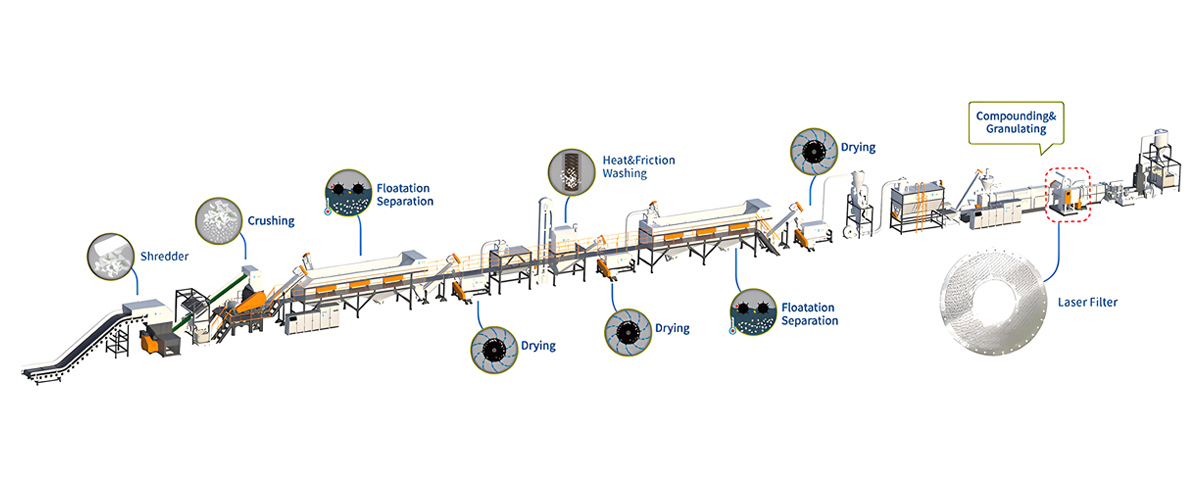
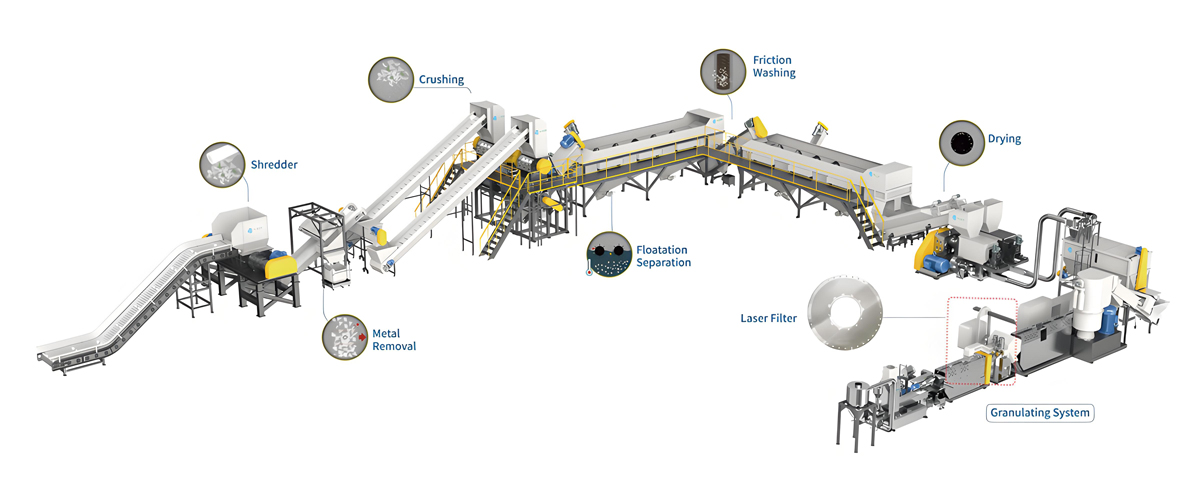
The fully automatic plastic washing line replaces manual work with automated equipment and intelligent systems in all production links, minimizing the demand for on-site operators. From raw material feeding to finished product packaging, the whole production process runs automatically under the control of the central control system, and only a small number of managers and maintenance personnel are needed to ensure normal production. POLYRETEC’s fully automatic washing line has carried out targeted automation transformation for each labor-intensive link, realizing comprehensive labor replacement.
2.1 Automatic Feeding and Pretreatment System
The first link of the automatic line is the automatic feeding system, which replaces manual feeding and primary impurity removal. The raw materials are transported to the production line by the belt conveyor with automatic feeding device, and the feeding speed can be automatically adjusted according to the load of the subsequent equipment to maintain uniform feeding without manual shovel feeding and on-site guard. Before entering the crushing process, the materials pass through the automatic metal separator, which can automatically identify and remove iron, aluminum, copper and other metal impurities mixed in the waste plastics, and the removal accuracy is much higher than manual picking. For large non-plastic impurities, the optical primary sorting device can also be configured to automatically identify and eliminate large pieces of wood, glass and other impurities through visual recognition technology, replacing manual primary sorting.
This set of automatic feeding and pretreatment system can save 2 to 3 front-line feeding and sorting workers per shift, and the processing efficiency and impurity removal effect are better than manual work. The equipment can run continuously for 24 hours without fatigue, and the feeding volume and impurity removal efficiency remain stable, which fundamentally solves the problem of low efficiency of manual feeding and sorting.
2.2 Intelligent Sorting System Replaces Manual Sorting
Sorting is the link with the largest labor demand in traditional production lines, and it is also the core link of cost reduction for fully automatic lines. POLYRETEC’s automatic washing line is equipped with a variety of intelligent sorting equipment, including density separation tank, electrostatic separator and optical sorting machine, which can realize high-precision automatic classification of different types of plastics without manual participation.
The density separation tank uses the buoyancy of water to automatically separate polyolefin plastics such as PP and PE from heavy plastics such as ABS and PS. The materials are automatically conveyed and discharged without manual fishing and classification. For mixed plastics with similar density, the electrostatic sorting system can accurately separate different polymer materials according to the different electrical properties of plastics, with a sorting accuracy of more than 99%, which is far higher than the manual level. For high-demand sorting scenarios, an optical sorting machine can also be added to identify and sort plastics of different colors and materials through spectral identification technology, further improving the sorting accuracy and automation degree.
The intelligent sorting system can completely replace 4 to 6 sorting workers per shift, and the sorting efficiency and accuracy are much higher than manual work. While saving labor costs, it also improves the purity of finished products, increases the selling price of products, and creates additional benefits for enterprises.
2.3 Closed-Loop Automatic Cleaning Process Without Manual Patrol
In the cleaning stage, the fully automatic line adopts a closed multi-stage cleaning process, including pre-washing tank, friction washing machine, hot washing tank and rinsing tank. All equipment operates continuously and automatically, and materials are automatically transmitted between different processes through conveyor belts and screw conveyors without manual transfer. The whole cleaning process is closed, which reduces dust overflow and does not require manual on-site operation and cleaning.
The system is equipped with a variety of sensors, which can automatically monitor parameters such as water temperature, water level, cleaning agent concentration and cleaning effect in real time, and automatically adjust according to the set parameters. For example, when the water temperature is lower than the set value, the heating system will start automatically; when the cleaning agent concentration is insufficient, the automatic dosing device will add quantitatively; when the material volume changes, the conveying speed and cleaning intensity will be adjusted automatically. The automatic control system can replace the manual patrol and parameter adjustment work, and the whole cleaning process does not need special personnel to guard. Only regular inspection is enough, which greatly reduces the workload of operators.
2.4 Automatic Dewatering, Quality Inspection and Packaging System
After cleaning, the materials are automatically dewatered by a centrifugal dewatering machine, and then transported to the finished product silo through a closed pneumatic conveying system, without manual transfer and transportation. The production line is equipped with an online automatic quality inspection device, which can automatically detect the cleanliness, particle size and impurity content of finished materials through visual recognition and sensor technology. Unqualified products will be automatically eliminated and returned to the previous process for reprocessing, replacing manual sampling inspection with higher efficiency and more comprehensive coverage.
At the end of the production line, there is an automatic packaging system, which can automatically weigh, bag, seal and stack according to the set weight. The packaged finished products are automatically transported to the warehouse area through the conveyor line, and even can be automatically stored with the stereoscopic warehouse system, completely eliminating the need for manual packaging and handling. The whole process from finished product output to warehousing is fully automated, which can save 2 to 3 packaging and handling workers per shift, and greatly reduce the labor intensity of workers.
2.5 Central Control System Realizes Unattended Production
The core of the whole fully automatic washing line is the PLC central control system, which integrates the control of all equipment in the whole line. Operators only need to set production parameters and start the equipment on the touch screen of the central control room, and the whole production line will run automatically according to the set program. The system can monitor the operation status, fault information and production data of each equipment in real time, and display them on the large screen of the central control room intuitively. When the equipment fails, the system will automatically send out an acousto-optic alarm, display the cause of the failure and the solution, and even automatically troubleshoot simple failures, without manual inspection of each equipment one by one.
With the remote diagnosis function, the management and technical personnel can also check the operation of the production line remotely through mobile phones or computers, and adjust parameters remotely without being on site all the time. For large production bases, a set of central control system can manage multiple production lines at the same time, and only 1 to 2 operators are needed to take charge of the operation of the whole workshop, which greatly reduces the demand for management and operation personnel and improves the overall management efficiency.
3. Quantitative Analysis of Labor Cost Reduction and Return on Investment
For recycling enterprises, the most concerned issue is how much labor cost can be saved by the fully automatic washing line and how long it takes to recover the investment. This chapter takes three common capacity specifications as examples to carry out detailed cost-benefit calculation, so that enterprises can intuitively understand the economic value of automated transformation.
3.1 Comparison of Initial Investment and Labor Demand
First of all, compare the initial investment and personnel allocation of traditional semi-automatic lines and fully automatic lines with different capacities. All prices are standard configuration FOB prices for reference only, and the actual quotation will be adjusted according to configuration requirements.
For small production lines with a capacity of 500 kg per hour, the initial investment of traditional semi-automatic lines is about 90,000 US dollars, including crusher, cleaning tank, friction washer, dewatering machine and simple conveying device. This configuration requires 6 operators per shift, including 2 feeding and sorting workers, 2 equipment operation and patrol workers, and 2 packaging and handling workers. For three-shift production, 18 workers are needed. The initial investment of POLYRETEC 500 kg/h fully automatic washing line is about 160,000 US dollars. On the basis of the traditional line, automatic feeding system, metal separator, automatic sorting device, central control system and automatic packaging machine are added. This configuration only needs 2 operators per shift, 1 central control operator and 1 equipment patrol maintenance worker. Only 6 workers are needed for three-shift production.
For medium-sized production lines with a capacity of 1000 kg per hour, the initial investment of traditional semi-automatic lines is about 180,000 US dollars, requiring 9 operators per shift and 27 workers for three shifts. The initial investment of POLYRETEC 1000 kg/h fully automatic washing line is about 290,000 US dollars, with 3 operators per shift and 9 workers for three shifts.
For large production lines with a capacity of 2000 kg per hour, the initial investment of traditional semi-automatic lines is about 350,000 US dollars, requiring 15 operators per shift and 45 workers for three shifts. The initial investment of POLYRETEC 2000 kg/h fully automatic washing line is about 520,000 US dollars, with 5 operators per shift and 15 workers for three shifts.
3.2 Calculation of Annual Labor Cost Savings
Next, calculate the annual labor cost savings. Since labor prices vary greatly in different regions, we calculate according to three different wage levels: low labor cost regions (annual salary of 6,000 US dollars per person), medium labor cost regions (annual salary of 12,000 US dollars per person) and high labor cost regions (annual salary of 30,000 US dollars per person), including wages, social security, welfare and other comprehensive employment costs.
Taking the most widely used 1000 kg/h production line as an example, the traditional line needs 27 workers for three shifts. In low labor cost areas, the annual labor cost is 27 * 6,000 = 162,000 US dollars. The fully automatic line needs 9 workers, and the annual labor cost is 9 * 6,000 = 54,000 US dollars, saving 108,000 US dollars every year. In medium labor cost areas, the annual labor cost of traditional lines is 27 * 12,000 = 324,000 US dollars, and that of fully automatic lines is 9 * 12,000 = 108,000 US dollars, saving 216,000 US dollars every year. In high labor cost areas such as Europe and North America, the annual labor cost of traditional lines is 27 * 30,000 = 810,000 US dollars, and that of fully automatic lines is 9 * 30,000 = 270,000 US dollars, saving 540,000 US dollars every year.
Even for small 500 kg/h production lines, the annual labor cost savings are very considerable. In low labor cost areas, 12 workers can be reduced, saving 72,000 US dollars every year; in high labor cost areas, 540,000 US dollars can be saved every year. For large 2000 kg/h production lines, 30 workers can be reduced, and the annual labor cost savings in high-cost areas can reach 900,000 US dollars, which is very significant.
3.3 Comprehensive Benefit Calculation and Investment Payback Period
In addition to direct labor cost savings, fully automatic washing lines can also bring other economic benefits, which together constitute the return on investment. First of all, the improvement of sorting accuracy reduces the impurity content of finished products, and the selling price of finished materials can be increased by 5% to 10%. Taking 1000 kg/h production line as an example, with an annual output of 6000 tons and an average selling price of 500 US dollars per ton, the annual income can be increased by 150,000 to 300,000 US dollars. Secondly, the improvement of automation reduces the scrap rate and raw material loss. The material loss of traditional lines is about 8% to 10%, while that of fully automatic lines is only 3% to 5%, which can save about 300 tons of raw materials every year, equivalent to 90,000 US dollars. In addition, the equipment utilization rate is increased from 70% to more than 90%, and the actual annual output is higher, which can create more profits.
Taking the 1000 kg/h production line in medium labor cost areas as an example, the annual comprehensive income brought by automation transformation includes 216,000 US dollars of labor cost savings, 180,000 US dollars of income increase from quality improvement, and 90,000 US dollars of raw material loss savings, totaling 486,000 US dollars of annual comprehensive benefits. The additional investment of the fully automatic line compared with the traditional line is 290,000 – 180,000 = 110,000 US dollars. Calculated in this way, the additional investment can be recovered in only 0.23 years, that is, about 2.8 months. Even if the total investment of 290,000 US dollars is calculated, the static investment payback period is only about 0.6 years, that is, 7.2 months.
Even in low labor cost areas, the annual comprehensive benefit is about 288,000 US dollars, and the investment payback period is about 1 year. In high labor cost areas, the payback period is shorter, usually only 3 to 4 months. It can be seen that investing in fully automatic plastic washing lines has a very high return on investment, and the higher the labor cost, the more obvious the cost reduction effect and the shorter the payback period. With the continuous rise of global labor costs, the economic advantages of automated production lines will become more and more prominent.
4. Additional Operation Value Brought by Fully Automated Washing Lines
In addition to directly reducing labor costs, fully automated plastic washing lines can also bring many additional operation values, help enterprises improve management level and market competitiveness, and create long-term value for enterprise development.
4.1 More Stable Production Quality and Stronger Market Competitiveness
The fully automatic production line adopts standardized process flow and precise parameter control, which eliminates the quality fluctuation caused by manual operation errors. The cleaning quality and sorting purity of each batch of products are kept consistent, and the product qualification rate can reach more than 99%, which is much higher than the 85% to 90% of manual production. Stable and reliable product quality can help enterprises win more high-end customers and long-term orders, increase product added value and selling price, and establish a good brand image in the market.
At the same time, the automated production line has stronger production capacity guarantee. The equipment can run continuously 24 hours a day without being limited by working hours and labor intensity, and can flexibly adjust production plans according to order demand, improving the ability of enterprises to respond to market changes. When encountering urgent large orders, enterprises can quickly increase production capacity without temporary recruitment and training of workers, which helps to seize market opportunities and gain competitive advantages.
4.2 Lower Safety Risks and Compliance Costs
Automated production reduces the number of on-site operators and also reduces the probability of safety accidents. Most dangerous operation links are completed automatically by equipment, and workers only need to operate in the safe central control room, which greatly reduces the risk of mechanical injury, electric shock and occupational diseases. The reduction of safety accidents not only saves the direct economic losses such as medical expenses and compensation, but also avoids the indirect losses such as production stoppage and reputation damage caused by accidents.
In addition, more and more countries and regions have strict requirements on environmental protection and production safety of the recycling industry. Fully automatic closed production lines can better meet the regulatory requirements, reduce the risk of environmental protection and safety penalties, and save the cost of compliance governance. For enterprises that need to pass various system certifications such as ISO and environmental protection certification, automated production lines are also easier to meet the certification standards, reducing the difficulty and cost of certification.
4.3 Digital Management Improves Operation Efficiency
The fully automatic plastic washing line is equipped with a complete data acquisition and statistics system, which can automatically record production data such as daily output, energy consumption, raw material consumption, equipment operation status and fault information, and generate statistical reports automatically. Enterprise managers can understand the production situation in real time through the data system, find problems in time and optimize them, without manual statistics and summary, which reduces the workload of management personnel and improves management efficiency and accuracy.
Digital production data also provides data support for enterprise operation decision-making. Managers can optimize production plans, adjust raw material procurement and control production costs based on data, so as to improve the overall operation level of the enterprise. For large recycling groups, the data of multiple production lines can be integrated into the unified management platform to realize centralized management and scheduling of multiple factories, improving the overall operation efficiency of the group.
5. POLYRETEC Fully Automatic Plastic Washing Line: Technical Advantages and Service Support
As a professional supplier of plastic recycling equipment, POLYRETEC has many years of technology accumulation and project experience in the field of fully automatic washing lines. Its equipment has been verified by hundreds of projects at home and abroad, and can stably help enterprises achieve the goal of reducing labor costs and improving efficiency.
5.1 Modular Design and Customized Scheme
POLYRETEC’s fully automatic plastic washing line adopts modular design, and customers can freely choose and match functional modules according to their own raw material types, processing capacity, finished product quality requirements and budget. For example, for waste plastics with heavy oil pollution, you can choose to add a hot washing module; for mixed waste plastics with complex components, you can add an electrostatic sorting or optical sorting module; for enterprises with high requirements for automation, you can add automatic packaging and stereoscopic warehouse modules. The modular design can not only meet the personalized needs of different customers, but also facilitate the subsequent upgrading and transformation of the production line. Enterprises can gradually increase functional modules according to development needs to avoid repeated investment.
POLYRETEC will provide exclusive customized solutions according to the actual situation of each customer. Before the scheme design, professional engineers will conduct on-site investigation, understand the customer’s plant conditions, raw material characteristics and production needs, and then design the most appropriate process flow and equipment configuration to ensure that the scheme can maximize benefits for customers. Whether it is a small recycling station or a large industrial recycling base, you can find a suitable automated solution.
5.2 Intelligent Control System Reduces Operation Difficulty
Many enterprises worry that automated equipment is too complex to operate and requires high technical level of workers. POLYRETEC’s control system adopts humanized design, with simple and intuitive touch screen operation interface, which is very easy to learn and use. Ordinary workers can master the basic operation after short-term training, and do not need professional technical background, which solves the problem of difficult recruitment of high-tech talents for enterprises. The system has a one-key start function. After selecting the corresponding production formula, the equipment can automatically adjust all parameters and start production automatically, which is very convenient to operate.
The system has a perfect fault self-diagnosis function, which can automatically find and prompt faults, and give solutions. Most simple faults can be solved by operators according to the prompts, without waiting for professional after-sales personnel to come to the site, reducing downtime loss. For complex problems, POLYRETEC also provides remote diagnosis service. After-sales engineers can remotely connect to the equipment control system to troubleshoot and solve problems online, which greatly improves the after-sales response speed and reduces the cost of on-site service.
5.3 Full-Cycle After-Sales Service and Technical Support
POLYRETEC provides customers with full-cycle after-sales service covering the whole process from installation and commissioning to later operation and maintenance. After the equipment arrives at the site, professional engineers will be sent to guide the installation and commissioning, be responsible for the normal operation of the whole line, and conduct systematic operation and maintenance training for the customer’s staff to ensure that the workers can skillfully operate the equipment and carry out daily maintenance. All equipment enjoys a one-year free warranty, and core components enjoy a longer warranty period. During the warranty period, all quality problems are repaired free of charge.
After the warranty period, POLYRETEC still provides lifelong technical support and preferential supply of spare parts. Customers can contact the after-sales team at any time if they encounter any problems in the production process. The global after-sales service network can respond quickly and provide on-site service when necessary. In addition, POLYRETEC will regularly return visit to customers, understand the operation of the equipment, put forward optimization suggestions, help customers do a good job in equipment maintenance, extend the service life of the equipment, and ensure long-term stable return on investment.
6. Suggestions on Implementing Automated Transformation for Recycling Enterprises
For enterprises that are still using traditional semi-automatic production lines, automated transformation is an inevitable trend to reduce costs and increase efficiency. However, in the process of transformation, we should proceed step by step according to our own actual situation to avoid blind investment.
First of all, comprehensively evaluate the own production situation and demand. Enterprises should count their current labor cost, production capacity, product quality status and existing equipment conditions, calculate the potential space for cost reduction and efficiency increase after automation, and combine their own development planning and financial situation to determine the appropriate scale of transformation. For start-ups or enterprises with small production scale, they can choose a small fully automatic production line first, and then expand the scale after the operation is stable and the benefits are realized. For large enterprises, they can carry out step-by-step transformation, first transform the links with the highest labor cost and the most obvious effect, and then gradually promote the whole line automation.
Secondly, choose a reliable equipment supplier. The effect of automated transformation depends largely on the technical level and service ability of suppliers. Enterprises should choose suppliers with rich project experience, mature technology and perfect after-sales service, and do not blindly choose low-price products. Low-quality automated equipment will have frequent failures, but will increase maintenance costs and downtime losses. When selecting suppliers, we should focus on investigating their past project cases, customer word-of-mouth, technical team size and after-sales service network, and ensure that we can get timely and effective support after purchasing equipment.
Finally, do a good job in personnel training and management system matching. After the automation transformation, the demand for ordinary operators is reduced, but the requirements for the quality of management and technical personnel are improved. Enterprises should do a good job in personnel training in advance, so that employees can master the operation and maintenance skills of automated equipment, and adapt to the new production mode as soon as possible. At the same time, we should adjust the corresponding management system, establish a set of management specifications suitable for automated production, give full play to the advantages of automated equipment, and achieve the maximum effect of cost reduction and efficiency increase.
Conclusion
Against the background of rising global labor costs and increasingly fierce industry competition, replacing manual production with fully automated plastic washing lines is the only way for the transformation and upgrading of the plastic recycling industry. The fully automatic production line can not only greatly reduce the number of operators and directly save labor costs, but also bring comprehensive value improvements such as stable product quality, improved production efficiency, reduced safety risks and digital management, helping enterprises enhance their core competitiveness and achieve higher returns on investment.
As a professional manufacturer of plastic recycling equipment, POLYRETEC is committed to providing customers with high-performance fully automatic plastic washing solutions. With advanced technology, reliable quality and perfect service, it helps global recycling enterprises realize automated and intelligent production. Whether you are a small recycling enterprise seeking cost reduction or a large group planning capacity upgrading, you can find a suitable automated solution in POLYRETEC. Investing in fully automatic plastic washing lines will bring long-term and stable economic benefits to enterprises and help them take the initiative in the future industry competition.