
Food grade recycled PET flakes are the core raw materials for producing new food packaging bottles, beverage containers, and edible plastic products. Unlike ordinary industrial-grade recycled PET materials, food grade PET flakes require ultra-high purity, zero harmful residue, and strict control of foreign contaminants to meet global food safety production standards. In commercial PET bottle washing and recycling production lines, flake contamination is the most common and influential quality defect, which directly leads to unqualified food grade certification, reduced product market value, and even batch product scrapping.
Flake contamination in food grade PET washing lines mainly includes organic residue contamination, adhesive pollution, ink staining, microbial contamination, mixed non-PET plastic impurities, and inorganic dust sediment pollution. These hidden contaminants cannot be completely removed by ordinary simple washing processes, and long-term accumulation will cause continuous quality fluctuations of finished flakes, failing to meet FDA, EU food grade and international food packaging material safety standards. As a professional manufacturer of high-standard food grade PET bottle washing lines, POLYRETEC focuses on solving flake contamination problems in the whole recycling process. This article comprehensively analyzes the contamination sources, hazard characteristics, targeted prevention processes, equipment optimization schemes, operating standard specifications, project cost control and daily maintenance strategies, providing systematic and operable guidance for food grade PET recycling enterprises to achieve zero-contamination flake production.
1. Overview and Hazards of Flake Contamination in Food Grade PET Production
1.1 Definition of Qualified Food Grade PET Flakes
Qualified food grade PET flakes must undergo strict impurity removal, deep cleaning, high-temperature disinfection and sterile drying treatment. The finished products need to achieve zero visible stains, zero residual adhesives, zero microbial colonies, and non-PET impurity content lower than 0.01%. The moisture content must be controlled below 0.05%, and the surface residue of organic pollutants and chemical detergents must meet international food contact material standards. Only flakes that meet the above indicators can be used for secondary granulation and blow molding of food packaging containers, and obtain food grade market access qualifications.
Ordinary recycled PET flakes only meet industrial-grade usage standards and contain a variety of trace contaminants, which cannot be used in food packaging scenarios. The core difference between food grade and industrial-grade PET flake production lies in the full-process contamination prevention and deep purification system of the washing line.
1.2 Main Types of Flake Contamination in Washing Lines
The contamination of PET flakes in food grade washing lines is divided into six major categories, covering all pollution links from raw material feeding to finished product output. The first category is organic residue contamination, including beverage residues, oil stains, sugar stains, and food residues remaining in waste PET bottles. The second category is adhesive contamination, referring to label glue, bottom glue and sealing glue residues that are difficult to remove. The third category is ink contamination, formed by long-term adhesion of printing ink on the bottle surface, resulting in flake discoloration and dot stains. The fourth category is microbial contamination, including bacteria, mold and microbial spores bred in residual liquid and humid stacked waste bottles. The fifth category is mixed plastic contamination, such as HDPE bottle caps, PVC labels, PP gaskets and other heterogeneous plastic impurities. The sixth category is inorganic contamination, including dust, sediment, metal debris and mineral particles mixed in raw materials.
1.3 Core Hazards of Uncontrolled Flake Contamination
Flake contamination will cause multi-dimensional losses to food grade PET recycling projects. In terms of product quality, trace impurities and residues will lead to black spots, bubbles, color difference and brittle cracking of finished food packaging products, directly causing batch unqualified products. In terms of market qualification, excessive microbial and chemical residues will make flakes fail food grade testing, lose high-value food packaging market qualifications, and can only be sold as low-priced industrial-grade materials, resulting in a 30% to 50% drop in product profit margin.
In terms of enterprise operation, long-term contamination problems will increase the scrap rate of finished products, waste high-quality raw materials and production energy consumption, and greatly reduce production efficiency. In severe cases, unqualified food grade plastic products will trigger market supervision penalties, affecting enterprise brand reputation and long-term market development. Therefore, building a complete flake contamination prevention system is the core premise of stable and profitable operation of food grade PET bottle washing projects.
2. Root Causes of Flake Contamination in Traditional PET Washing Lines
2.1 Raw Material Pre-Treatment Screening Defects
Most traditional PET washing lines lack refined pre-treatment processes. Waste PET bottles recovered from the market are mixed with a large number of heavily polluted bottles, special-shaped bottles, non-food grade waste plastic bottles and seriously aged bottles. Traditional equipment only adopts simple manual rough sorting, which cannot accurately remove heavily polluted raw materials containing a large amount of residual dirt, mold and stubborn oil stains. These unqualified raw materials enter the crushing and washing link, resulting in large-area contamination of subsequent flakes, and the pollution source spreads to the entire batch of products.
2.2 Incomplete Label and Adhesive Removal Process
Bottle labels and bonding glue are the primary sources of persistent contamination. Traditional washing lines adopt single hot water soaking and simple friction washing, which can only remove loose surface labels but cannot completely decompose and peel off stubborn aged glue layers and residual ink. After crushing, the residual fine glue and ink particles adhere to the surface of PET flakes, forming invisible micro-contamination. This kind of micro-pollution cannot be identified by naked eyes, but will lead to unqualified food grade detection and hidden quality risks of downstream products.
2.3 Insufficient Multi-Stage Deep Cleaning Capacity
Traditional PET washing equipment has a single cleaning process, lacking targeted graded cleaning for different pollutants. Ordinary cold water friction washing can only remove surface dust and loose residues, but has no removal effect on stubborn oil stains, aged sugar stains and cured glue residues. The cleaning water lacks circulating filtration and purification functions, resulting in repeated use of turbid water quality, secondary adhesion of pollutants to flakes, and continuous accumulation of contamination in the production line.
2.4 Lack of High-Temperature Sterilization and Microbial Removal Links
Waste PET bottles stacked for a long time in a humid environment are easy to breed a variety of microorganisms. Traditional washing lines do not support high-temperature disinfection and sterile treatment processes. Conventional normal-temperature washing cannot kill bacteria and mold spores on the bottle body and inner wall. After crushing, microorganisms remain on the surface of flakes, resulting in excessive microbial colonies in finished products, which is the key reason why ordinary washing lines cannot produce food grade qualified flakes.
2.5 Defective Fine Screening and Impurity Removal System
Traditional equipment has low precision of flake screening and sorting. After crushing and washing, fine non-PET plastic debris, fiber impurities, metal particles and residual glue scraps cannot be completely separated. These tiny impurities are mixed in qualified PET flakes, forming physical contamination. In addition, the traditional drying system has uneven drying effect, local moisture residue on flakes leads to secondary mildew and microbial reproduction, forming new contamination.
2.6 Unreasonable Water Circulation and Environmental Protection Configuration
The cleaning wastewater of traditional washing lines contains a large amount of organic residues, glue impurities and suspended pollutants. Without professional wastewater purification and filtration equipment, the circulating water remains turbid for a long time. In the continuous production process, pollutants in the water body repeatedly adhere to the surface of flakes, forming cyclic secondary pollution, which makes it impossible to fundamentally solve the flake contamination problem.
3. POLYRETEC Full-Process Flake Contamination Prevention Technology & Advantages
3.1 Precision Raw Material Pre-Sorting and Pre-Cleaning System
Aiming at the raw material pollution source, POLYRETEC food grade PET bottle washing line is equipped with a professional pre-treatment contamination interception system. The automatic sorting machine first removes non-PET impurities, heavily polluted rotten bottles, colored miscellaneous bottles and non-food grade plastic bottles, and strictly controls the pollution source from entering the production line. The pre-washing spray device is matched to perform high-pressure preliminary cleaning on the surface and inner wall of qualified raw material bottles, removing surface floating dust, residual liquid and loose dirt, greatly reducing the subsequent deep cleaning pressure and avoiding batch contamination of flakes caused by individual polluted raw materials.
3.2 Efficient Label Stripping and Glue Residue Decomposition Technology
Different from traditional single cleaning mode, POLYRETEC adopts physical high-temperature softening + high-strength friction composite glue removal technology. The special label remover realizes full peeling of paper labels, plastic labels and adhesive layers. The high-temperature hot water tank with constant temperature control softens the aged residual glue, and the high-speed friction washing unit thoroughly strips tiny glue residues and ink particles. The whole process avoids residual micro-pollutants, completely solves the core contamination problem of glue and ink residue, and ensures the surface cleanliness of PET flakes meets food grade standards.
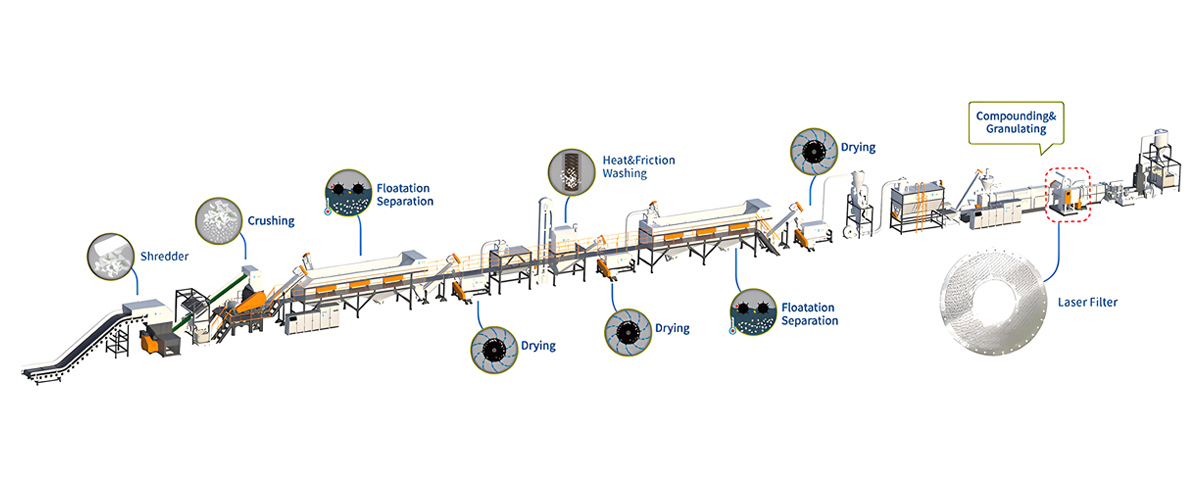
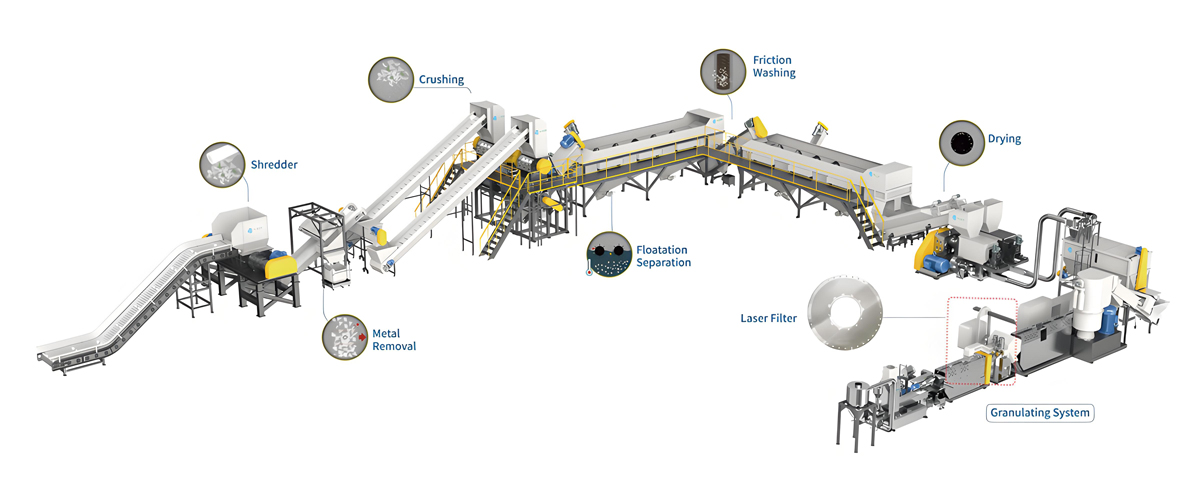
3.3 Graded Multi-Stage Deep Purification Washing Process
The production line adopts five-stage progressive deep cleaning process, including pre-washing rough cleaning, high-temperature degreasing cleaning, strong friction decontamination, floating impurity removal fine cleaning and sterile water final rinsing. Each cleaning link is targeted at different types of pollutants. The high-temperature degreasing link completely decomposes oil stains and sugar residues; the strong friction link removes stubborn aged dirt; the final sterile water rinsing eliminates residual cleaning agent and trace impurities. The graded cleaning mode ensures no dead angle of flake purification, and completely removes all organic and inorganic contaminants.
3.4 High-Temperature Sterilization and Microbial Inactivation Configuration
To solve microbial contamination, POLYRETEC food grade washing line is equipped with a professional high-temperature constant-temperature sterilization module. The 85℃ constant-temperature hot water circulating system kills bacteria, mold and microbial spores on the surface and gaps of PET flakes. Combined with the sterile drying process, it completely inactivates microorganisms and inhibits secondary bacterial reproduction. After treatment, the microbial colony index of finished flakes fully meets FDA and EU food contact material safety standards, which is the key configuration to distinguish food grade production lines from ordinary industrial lines.
3.5 High-Precision Fine Screening and Heterogeneous Impurity Removal System
The equipment is equipped with multi-dimensional fine sorting equipment, including floating and sinking sorting tank, color sorting machine and precise vibrating screen. The floating and sinking sorting automatically separates light impurities such as label debris and fiber and heavy impurities such as metal and sediment. The high-precision color sorting machine identifies and removes discolored flakes, contaminated individual flakes and residual heterogeneous plastic particles. The vibrating screen filters fine powder and tiny impurities, realizing full covered fine impurity removal of flakes and ensuring zero physical contamination of finished products.
3.6 Closed-Loop Water Circulation Purification and Secondary Pollution Prevention
POLYRETEC supporting wastewater recycling and purification system realizes closed-loop circulation of cleaning water. The multi-stage filtration and precipitation device intercepts organic residues, suspended particles and glue impurities in the wastewater in real time. The purified clean water is reused for production, and the polluted sludge and impurities are discharged and treated uniformly. The whole process avoids turbidity of circulating water and secondary adhesion pollution of flakes, fundamentally eliminating the cyclic contamination problem existing in traditional production lines.
3.7 Full-Automatic Sterile Drying and Finished Product Protection
After deep cleaning and impurity removal, the flakes enter the constant-temperature sterile drying system. The hot air circulating drying equipment realizes uniform dehumidification and drying of flakes, with the final moisture content strictly controlled below 0.05%. The closed drying structure avoids external dust and microbial pollution. The finished product conveying and storage links adopt fully sealed design to prevent secondary contamination of qualified flakes in the final stage, ensuring the long-term stability of food grade quality of finished products.
4. Standard Operation Process for Zero-Contamination Food Grade PET Flakes
4.1 Raw Material Inspection and Pre-Processing Standard
Before production, all waste PET bottle raw materials must pass manual and mechanical double inspection. Strictly reject moldy, deteriorated, heavily polluted raw materials and non-food grade plastic bottles. The qualified raw materials are sorted by color to avoid mixed color contamination. After sorting, the surface pre-washing is carried out to remove surface floating dirt, and the raw materials are stored in a closed and dust-free workshop to prevent secondary pollution before production.
4.2 Online Real-Time Pollution Monitoring in Production Process
The POLYRETEC intelligent control system supports real-time monitoring of production water quality, cleaning temperature, flake impurity content and microbial indicators. The system automatically records production data of each link. Once abnormal water quality turbidity, insufficient cleaning temperature or excessive impurity content is detected, the equipment will automatically alarm and adjust operating parameters in real time to avoid batch contamination of flakes.
4.3 Regular Equipment Cleaning and Pollution Discharge Specifications
Enterprises need to formulate standardized daily, weekly and monthly equipment cleaning systems. Clean the residual impurities and dirt in the washing tank, pipeline and screening equipment every day to prevent pollutant accumulation. Conduct deep disinfection and sterilization of the whole line every week to eliminate microbial residues. Replace the filter screen and purify the circulating water system regularly every month to ensure the long-term cleanliness and stability of the production line and avoid old pollutant accumulation causing new flake contamination.
4.4 Finished Product Sampling and Contamination Detection Standards
After production, finished PET flakes must be sampled and inspected in strict accordance with food grade standards. Detect surface residue, impurity content, moisture content and microbial colonies of flakes. Only products that meet all indicators can be put into storage and sold. Unqualified products need to be re-cleaned and screened to ensure that no contaminated flakes flow into the market.
5. Food Grade PET Washing Line Equipment Configuration & Price Cost Analysis
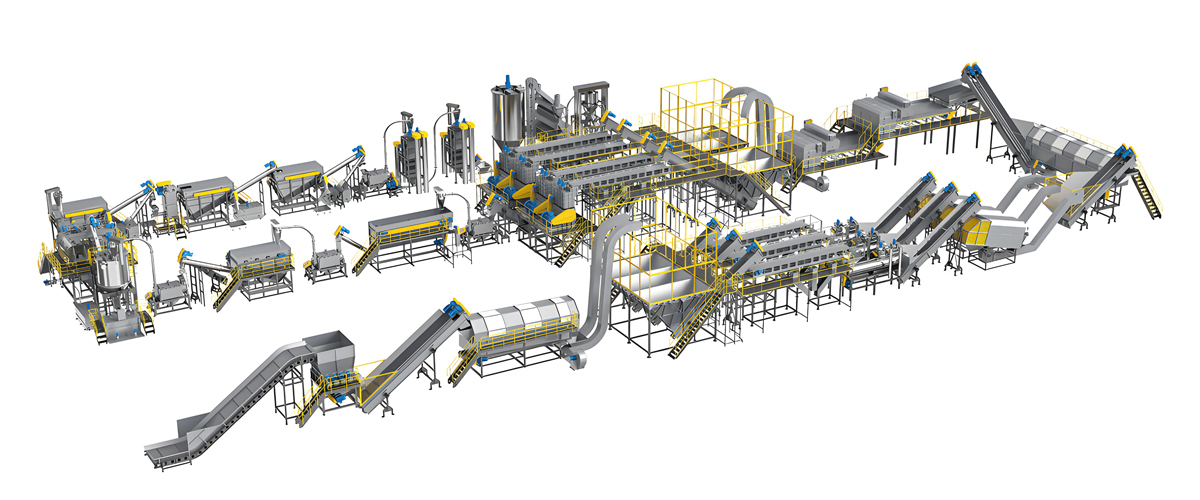
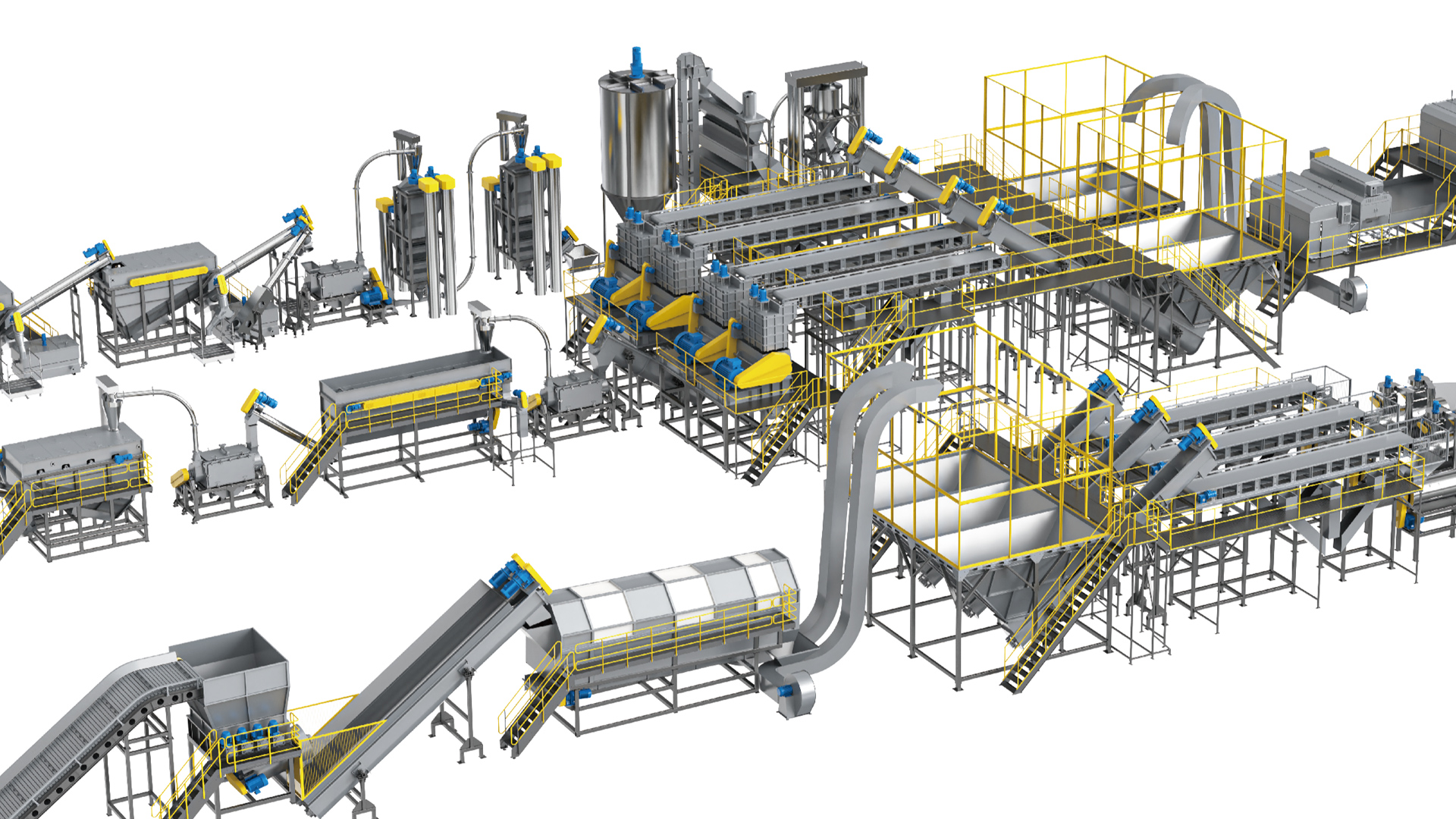
POLYRETEC provides two complete sets of food grade PET bottle washing line configurations for different production scales, both equipped with full-process contamination prevention systems, which can stably produce zero-contamination food grade PET flakes. The equipment configuration is complete, the price is transparent, and the investment cost is fully analyzed for enterprise reference.
5.1 Standard Food Grade PET Washing Line (300kg/h)
This configuration is suitable for small and medium-sized food grade PET recycling enterprises, with stable hourly output of 280 to 320kg/h, meeting the daily production demand of conventional food grade flakes. The core contamination prevention equipment configuration and unit price are as follows: automatic raw material sorting and pre-cleaning system priced at 5,800 to 7,200 US dollars, high-efficiency label removing and pre-washing machine priced at 8,500 to 10,200 US dollars, five-stage deep cleaning and constant-temperature degreasing system priced at 18,000 to 22,500 US dollars, high-temperature sterilization and microbial inactivation device priced at 9,200 to 11,800 US dollars, floating-sinking sorting and high-precision color sorting impurity removal system priced at 16,500 to 19,800 US dollars, closed-loop water circulation purification system priced at 7,800 to 9,500 US dollars, and sterile constant-temperature drying and finished product sealing system priced at 10,200 to 12,600 US dollars.
The total ex-factory price of the standard food grade washing line is 76,000 to 93,600 US dollars. The equipment covers all contamination prevention links, with low one-time investment and stable operation, which is the most cost-effective choice for small-scale food grade PET recycling projects.
5.2 High-Efficiency Food Grade Enhanced Washing Line (500kg/h)
This enhanced configuration is upgraded for large-scale standardized food grade production factories, with hourly output of 480 to 520kg/h. On the basis of standard configuration, it upgrades high-power automatic sorting system, intelligent constant-temperature precise sterilization system, higher-precision color sorting impurity removal equipment and full-intelligent water quality real-time monitoring system. It realizes fully automatic unattended anti-contamination production, with more thorough impurity removal and sterilization effect and more stable finished product quality. The total ex-factory price of the complete enhanced production line is 118,000 to 135,000 US dollars, suitable for large-scale high-standard food grade PET recycling projects pursuing high output and ultra-high purity flakes.
6. Full Project Investment and Operating Cost Analysis
6.1 One-Time Fixed Investment Cost
The one-time fixed investment of the project is mainly the complete equipment cost. The total equipment investment of the standard 300kg/h food grade washing line is 76,000 to 93,600 US dollars, and the total investment of the high-efficiency 500kg/h enhanced line is 118,000 to 135,000 US dollars. All prices include factory assembly, full-load debugging, food grade process parameter optimization and equipment quality inspection, with no hidden charges.
6.2 Auxiliary Facility Investment
Food grade production requires dust-free closed workshops, finished product sterile warehouses, professional power distribution facilities and water circulation treatment rooms. The auxiliary facility investment of standard production line is 8,000 to 11,000 US dollars, and the auxiliary investment of high-efficiency enhanced line is 11,000 to 14,500 US dollars. Enterprises with existing standardized workshops can appropriately reduce this part of the investment by 30%.
6.3 Installation, Debugging and Training Costs
POLYRETEC provides free on-site installation, full-line food grade process debugging, equipment parameter calibration and professional operator training for all customers. Professional engineers complete trial production and quality testing on site to ensure that the finished flakes meet food grade zero-contamination standards. Customers do not need to bear additional service fees, effectively saving project launch costs.
6.4 Total Project Investment Summary
The total one-time investment of the standard food grade PET washing project is 84,000 to 104,600 US dollars. The total investment of the high-efficiency enhanced project is 129,000 to 149,500 US dollars. The investment covers all links required for formal food grade production, realizing one-stop project delivery and rapid mass production.
6.5 Daily Operating and Maintenance Costs
In terms of power consumption, the standard production line consumes 85 to 100kWh per hour, with an annual electricity cost of 45,900 to 54,000 US dollars. The high-efficiency line consumes 130 to 150kWh per hour, with an annual electricity cost of 70,200 to 81,000 US dollars. In terms of auxiliary materials, the consumption of food grade cleaning agents and filter materials is 0.015 US dollars per kilogram of flakes. The highly automated equipment only needs 2 operators for daily management, with annual labor cost of 76,800 US dollars. The annual equipment maintenance and vulnerable parts replacement cost is 3,000 to 4,200 US dollars, with controllable long-term operating costs.
7. Profit Advantage of Zero-Contamination Food Grade PET Flake Production
7.1 Product Premium Advantage
Zero-contamination food grade PET flakes have a huge market premium compared with ordinary industrial-grade flakes. The market price of qualified food grade flakes is 1.2 to 1.5 US dollars per kilogram, while the price of ordinary contaminated industrial flakes is only 0.6 to 0.8 US dollars per kilogram. The high-purity and zero-contamination quality enables enterprises to obtain double profit margins and stable high-end customer orders.
7.2 High Yield and Low Scrap Rate Benefit
POLYRETEC full-process anti-contamination system controls the finished product scrap rate below 0.8%, while the scrap rate of traditional washing lines due to flake contamination is as high as 8% to 12%. The ultra-low scrap rate saves a lot of raw material waste and production energy consumption, greatly improving the comprehensive production benefit of the project.
7.3 Stable Long-Term Project Return
The standard 300kg/h production line has an annual output of 840 to 960 tons of food grade flakes, with an annual net profit of 110,000 to 160,000 US dollars and an investment payback period of 8 to 11 months. The high-efficiency 500kg/h line has an annual output of 1,440 to 1,560 tons of qualified flakes, with an annual net profit of 240,000 to 300,000 US dollars and a payback period of 7 to 9 months. The equipment has a service life of more than 15 years, with long-term stable high-profit output.
8. Daily Maintenance and Anti-Contamination Management Guidelines
8.1 Daily Equipment Cleaning Management
After daily production, thoroughly clean all washing tanks, conveying pipelines, sorting screens and drying equipment to remove residual flakes, dirt and impurities. Keep the production workshop and finished product warehouse closed and dust-free to prevent external pollution. Regularly replace the filter screen of the circulating water system to ensure clean water quality and avoid secondary contamination.
8.2 Regular Equipment Parameter Calibration
Regularly calibrate the cleaning temperature, water circulation flow rate, sorting precision and drying parameters of the production line to ensure that all anti-contamination links operate in a standard state. Avoid quality fluctuation caused by parameter drift, and maintain the long-term stability of food grade flake quality.
8.3 Raw Material and Finished Product Closed Management
Raw material stacking area and finished product storage area are strictly separated and closed. Strictly implement raw material inspection system to prevent polluted raw materials from entering the line. Finished food grade flakes are sealed and stored in sterile environment to avoid moisture absorption, dust pollution and microbial reproduction, maintaining zero-contamination state of finished products.
9. POLYRETEC Professional Service Guarantee for Food Grade Projects
POLYRETEC has rich practical experience in global food grade PET bottle washing and zero-contamination flake production projects. For all food grade recycling customers, the company provides full-cycle professional services including pre-sales project scheme customization, equipment production and debugging, on-site installation and training, and after-sales lifelong maintenance.
In the pre-sales stage, professional technical teams formulate targeted anti-contamination production schemes according to customer raw material conditions, production scale and food grade certification requirements, and provide accurate investment and profit analysis. Before delivery, all equipment undergoes strict food grade standard testing and full-load trial production to ensure that the anti-contamination performance meets international food safety standards.
After on-site installation, professional engineers complete full-line process debugging and operator training to help customers master standardized anti-contamination production operations. The company provides 24-hour remote technical support, regular equipment maintenance and precision calibration services. The whole machine enjoys a 2-year free warranty and lifelong technical upgrade services, helping customers maintain long-term stable zero-contamination production of food grade PET flakes and maximize project economic benefits.
Conclusion
Flake contamination is the core bottleneck restricting food grade PET bottle washing production and high-value market profit. Traditional washing lines have many defects in raw material pretreatment, glue removal and cleaning, sterilization and impurity removal, which cannot avoid multi-source flake pollution and cannot meet food safety production standards. POLYRETEC food grade PET bottle washing line solves various contamination problems through full-process source interception, graded deep cleaning, high-temperature sterilization, precise impurity removal and closed-loop water purification technology.
The equipment has stable zero-contamination production capacity, low project investment cost, low operating loss and high product premium, which can help recycling enterprises stably produce qualified food grade PET flakes, obtain high-end market access qualifications, and create sustainable and high-profit green recycling benefits. For global enterprises engaged in food grade PET plastic recycling, POLYRETEC professional anti-contamination washing line is the most reliable equipment solution to solve flake pollution problems and improve project competitiveness.