
In the global plastic recycling industry, improving production efficiency and reducing unit processing cost have become the core demands of recycling enterprises to cope with increasingly fierce market competition. As the first core process of the plastic bottle washing line, the crushing link directly determines the upper limit of the entire production line capacity, and is also the most common bottleneck restricting the improvement of production efficiency. Many washing lines have backward crushing equipment and unreasonable process matching, resulting in low crushing efficiency, frequent material jams and shutdowns, which make the subsequent cleaning units run under insufficient load for a long time, resulting in serious waste of equipment capacity and labor cost. Simply increasing the motor power to pursue crushing speed will also bring a series of problems such as accelerated blade wear, increased energy consumption, and unqualified flake quality, which will affect the cleaning effect and finished product value in the subsequent process.
Optimizing the crushing speed of the plastic bottle washing line is a systematic project, which requires comprehensive optimization from raw material pretreatment, equipment structure design, process parameter matching, automatic control to daily operation and maintenance, so as to achieve the balance of high speed, high quality, low energy consumption and long service life. As a professional manufacturer of plastic recycling equipment, POLYRETEC has accumulated rich technical experience in the research and development and application of crushing equipment for many years. Its PR-C series heavy-duty plastic crushers are optimized for the characteristics of plastic bottle recycling, which can effectively improve the crushing speed and stability while ensuring the quality of crushed flakes, and help customers maximize the production capacity and economic benefits of the entire washing line. This article will systematically analyze the core factors affecting the crushing speed of plastic bottle washing lines, explain the practical optimization methods and strategies from multiple dimensions, carry out detailed cost-benefit analysis for speed upgrading, and share the best practices of daily operation and maintenance, providing a comprehensive reference for recycling enterprises to improve production efficiency.
1. The Core Position of Crushing Process in Plastic Bottle Washing Line
1.1 Crushing Speed Determines the Upper Limit of Whole Line Capacity
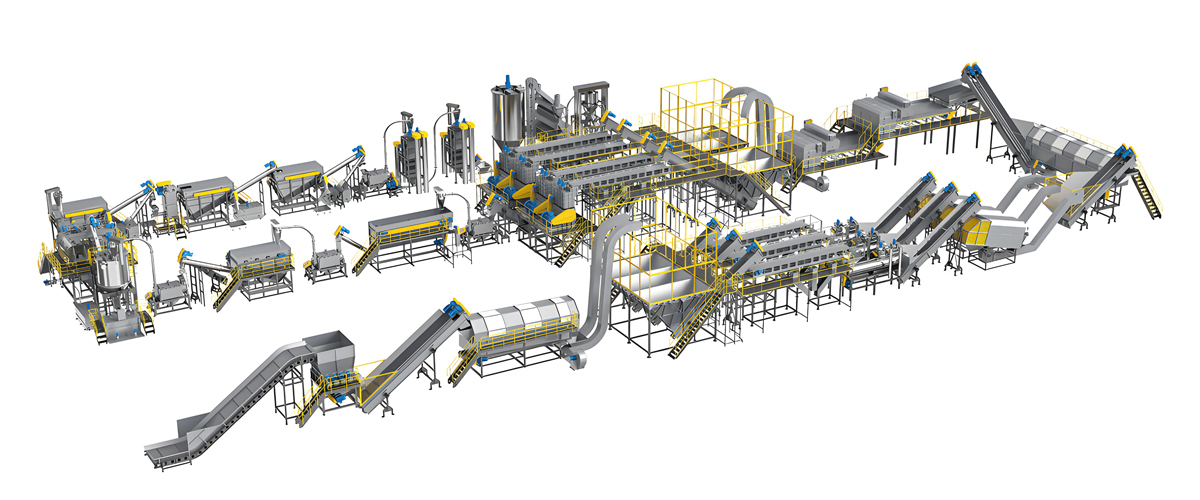
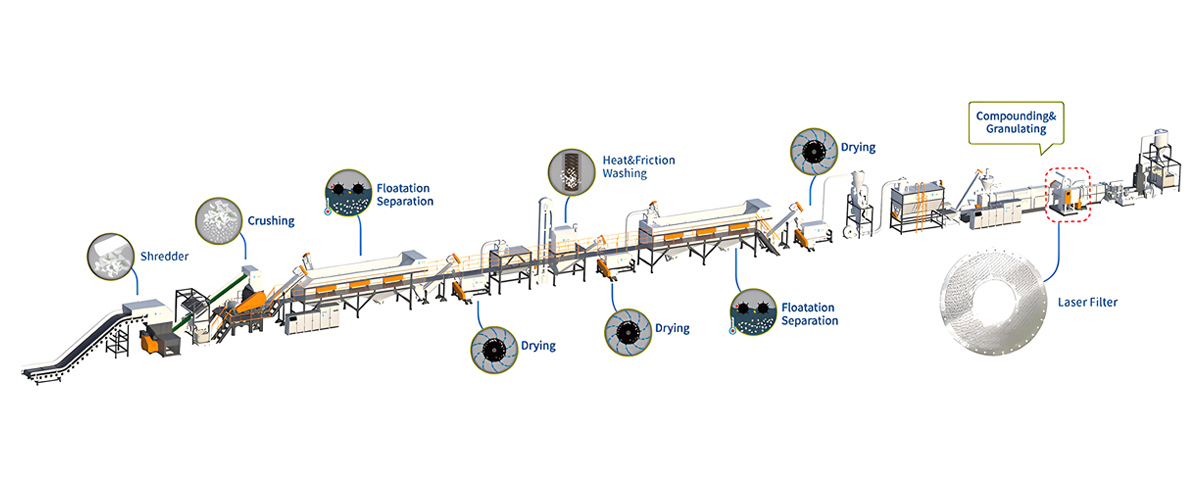
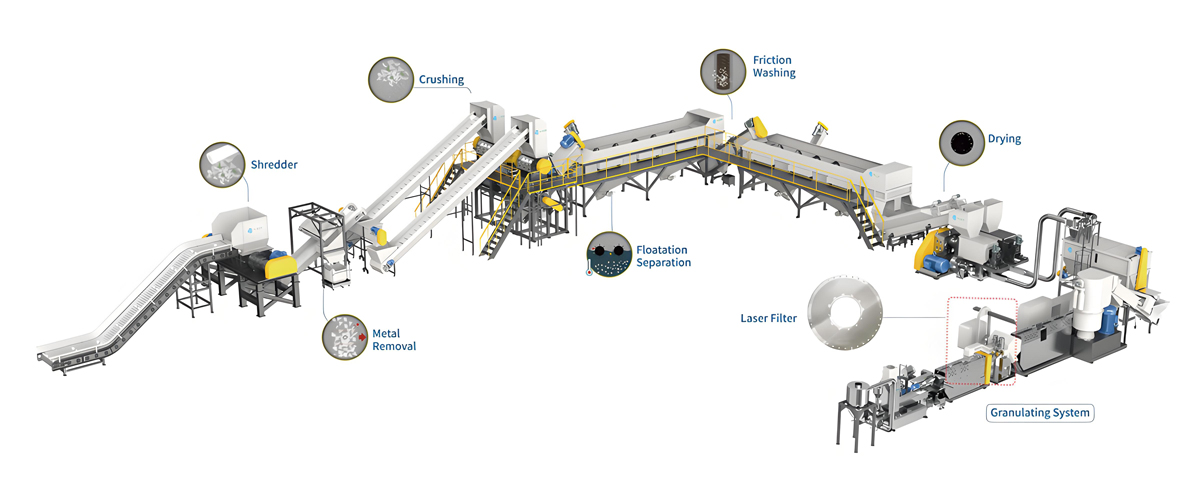
The plastic bottle washing line is a continuous production system composed of pretreatment sorting, crushing, pre-washing, hot washing, friction washing, rinsing, dehydration and other processes. The production capacity of each process must be reasonably matched to ensure the efficient operation of the entire line. As the first forming process of the whole line, the crushing link is responsible for crushing whole plastic bottles of different sizes and shapes into uniform flakes of a specific size, providing suitable raw materials for the subsequent cleaning process. If the crushing speed is too low, the subsequent cleaning equipment will be in a state of insufficient material supply for a long time, and the equipment and labor cannot operate at full load, resulting in a waste of production capacity. In actual production, many washing lines have a design capacity of 1000 kg per hour, but limited by the crushing speed, the actual operating capacity is only 600 to 700 kg per hour, and the equipment utilization rate is less than 70%, which greatly increases the unit production cost.
Improving the crushing speed reasonably can release the production potential of the subsequent process, improve the overall operating efficiency of the whole line, and reduce the unit energy consumption and labor cost of unit output. For most small and medium-sized recycling enterprises, optimizing the crushing process is the most cost-effective way to increase production capacity, which does not require large-scale transformation of the entire production line, and can achieve significant capacity improvement with less investment.
1.2 Balance Between Crushing Speed and Flake Quality
Optimizing crushing speed does not mean blindly pursuing high output while ignoring product quality. The quality of crushed flakes, including particle size uniformity, flake shape, powder content and impurity content, directly affects the cleaning effect, dehydration efficiency and final finished product value of the subsequent process. If the crushing speed is increased by simply expanding the screen aperture, the particle size of the flakes will be too large and uneven, which will make it difficult to fully clean the pollutants inside the flakes in the subsequent cleaning process, resulting in a decline in the cleanliness of finished products. If the rotor speed is blindly increased, it will lead to excessive fragmentation of materials, increased fine powder content, increased material loss in the cleaning process, and also aggravate the wear of blades and equipment, increasing maintenance costs.
A scientific speed optimization scheme should achieve the best balance between crushing efficiency and flake quality. While increasing the processing speed per unit time, it should ensure that the flake particle size meets the process requirements, with uniform shape, low powder rate and low impurity increment, so as not to increase the burden of the subsequent cleaning process and affect the quality of final finished products. High-quality crushing can also improve the efficiency of subsequent sorting, cleaning and dehydration, and improve the overall operation quality of the whole washing line.
1.3 Common Crushing Bottlenecks in Traditional Washing Lines
Most traditional plastic bottle washing lines have various crushing bottlenecks, which restrict the improvement of production efficiency. The first is the backward design of the crusher structure, the unreasonable rotor and blade configuration, resulting in low crushing efficiency and easy material jamming. The second is the simple manual feeding method, with uneven feeding speed, which often causes overload blockage or idle waste of the crusher. The third is the mismatch of the feeding and discharging conveying system, which leads to slow discharging and material accumulation in the crushing chamber, reducing the crushing efficiency. The fourth is the lack of perfect overload protection and automatic fault handling functions. In case of material jamming, it requires manual shutdown for cleaning, which takes a long time and seriously affects the continuous operation efficiency. The fifth is the extensive daily maintenance, serious blade wear and tear without timely treatment, resulting in a significant decline in crushing efficiency and increased energy consumption. These problems are common in small and medium-sized recycling enterprises, and are also the key direction of crushing speed optimization.
2. Core Factors Affecting Crushing Speed of Plastic Bottles
To optimize the crushing speed scientifically, we must first clarify the core factors that affect the crushing efficiency. These factors involve raw material characteristics, equipment structure, process configuration and operation management. Only by starting from all dimensions can we achieve systematic and efficient optimization.
2.1 Raw Material Characteristics and Pretreatment Status
The characteristics of raw materials have the most direct impact on the crushing speed. First of all, the material type and hardness of plastic bottles are different. PET beverage bottles have thin wall and high brittleness, which are easy to crush and have high processing speed; while HDPE chemical barrels and detergent bottles have thick wall and high toughness, which require greater crushing force and have relatively slow speed. Secondly, the size and shape of raw materials are different. Whole large barrels and flattened bottles have great differences in feeding difficulty and crushing time. If the raw materials are mixed with large pieces of metal, stone, glass and other hard impurities, they will easily cause blade damage and material jamming, resulting in forced shutdown, which seriously affects the average crushing speed.
In addition, the pretreatment status of raw materials is also very important. If the raw materials are mixed with a large number of labels, adhesive tapes and rope impurities, they are easy to wrap around the rotor and shaft during the crushing process, resulting in increased running resistance and even material jamming. Raw materials with high water content and high viscosity are also easy to adhere to the inner wall of the crushing chamber and the screen, blocking the screen holes, resulting in unsmooth discharging and reduced crushing efficiency. Good raw material pretreatment can effectively reduce the failure rate of the crusher and maintain a stable and efficient crushing speed.
2.2 Structural Design of the Crusher
The structural design of the crusher itself is the decisive factor determining the crushing speed. The rotor structure is the core. Different rotor types such as claw type, sheet type and hammer type have different crushing efficiency and applicable materials. The number, arrangement angle and cutting mode of blades directly affect the cutting efficiency. Reasonable blade angle and arrangement can form continuous and efficient shearing, improve the crushing speed per unit time, and reduce energy consumption. The material and hardness of the blade also affect the stability of the crushing efficiency. The blade with high hardness and good wear resistance can maintain sharpness for a long time, avoid the rapid decline of efficiency after short-term use.
The design of the crushing chamber also has an important impact. The reasonable cavity shape can make the materials form an effective circulation in the cavity, improve the crushing probability, and avoid the material rotating with the rotor without effective crushing. The aperture size, opening rate and shape of the screen directly affect the discharging speed. Too small aperture will lead to slow discharging and material accumulation, while too large aperture will lead to unqualified flake particle size. In addition, the sealing and lubrication design of the transmission system will also affect the operating efficiency and stability of the equipment. Poor transmission efficiency will cause a lot of energy loss and reduce the actual output efficiency.
2.3 Feeding and Discharging Conveying System
The matching degree of feeding and discharging conveying system is an important external factor affecting the crushing speed. If the feeding speed is too slow, the crusher will run under load for a long time, and the actual output per hour is low; if the feeding speed is too fast, it is easy to cause overload blockage of the crusher, but lead to shutdown and reduce the average efficiency. The traditional manual feeding method has great randomness, which is very easy to cause the problem of uneven feeding, and the crusher often switches between overload and idle load, which not only reduces the average crushing speed, but also increases the failure rate and energy consumption.
The discharging system is equally important. If the discharging conveying capacity is insufficient, the crushed flakes cannot be transported away in time, which will cause material accumulation at the bottom of the crusher, block the screen holes, and prevent the materials that meet the particle size requirements from being discharged in time, resulting in repeated crushing in the cavity, increasing power consumption and powder rate, and reducing the overall crushing speed. The unsmooth discharging of materials is a common but easily ignored bottleneck in many production lines.
2.4 Automation Control and Protection System
The level of automation control directly affects the continuous operation time and average efficiency of the crusher. Traditional simple control systems lack real-time monitoring of load and operating status, and cannot automatically adjust the feeding speed according to the actual load of the crusher. It is easy to cause overload operation when there are many materials, and idle waste when there are few materials. At the same time, the lack of perfect automatic protection functions, such as overload protection, anti-jam reverse function, etc., when material jamming occurs, it is necessary to manually shut down and clean up, which takes a long time to handle, seriously affecting the continuous operation efficiency of the equipment.
High-level automation control system can monitor parameters such as motor current and bearing temperature in real time, automatically adjust the feeding speed according to the actual load, keep the crusher running near the optimal load state, maximize the crushing efficiency, and automatically troubleshoot simple faults, reduce the frequency and handling time of shutdown failures, and improve the effective operation time of the equipment.
2.5 Equipment Maintenance and Operation Management
Good daily maintenance and standardized operation are the prerequisites for the crusher to maintain high-speed operation for a long time. The blade will gradually wear during use. After the blade passivation, the cutting efficiency will decrease significantly, the crushing time of the same amount of materials will be longer, and the energy consumption will increase. If the blade is not polished or replaced in time, the crushing speed may drop by 30% to 50%, and even cause serious problems such as material jamming and motor overload. In addition, the screen is worn or blocked by impurities, the transmission belt is loose, the lubrication of bearing is poor, etc., will lead to the decline of equipment operation efficiency.
At the same time, the operation level of operators also has a great impact. Irregular operations such as feeding a large number of materials at one time and putting hard impurities into the machine will increase the probability of equipment failure and reduce the average crushing speed. Establishing standardized operation and maintenance procedures is an important guarantee for long-term stable and efficient operation of the crusher.
3. Systematic Strategies to Optimize Crushing Speed
Aiming at the above influencing factors, we can systematically optimize the crushing speed from five dimensions: pretreatment feeding, equipment structure, process matching, automatic control and operation maintenance, so as to achieve efficient, stable and low-cost crushing production.
3.1 Optimize Raw Material Pretreatment and Automatic Feeding Control
Good raw material pretreatment is the basis for improving crushing speed. First of all, strengthen the sorting work before crushing, remove large pieces of metal, stone, glass and other hard impurities mixed in the waste bottles, avoid damage to the blade and material jamming caused by hard objects. Configure the magnetic separator before the feeding port to automatically remove ferromagnetic metal impurities, which can effectively protect the blade and reduce the failure rate. For raw materials mixed with a large number of ropes and adhesive tapes, manual pre-picking or special de-bundling equipment should be configured to reduce the situation of impurities winding the rotor.
Replace manual feeding with an automatic uniform feeding system. Use a belt conveyor with speed regulation function to transport materials evenly and continuously to the crushing chamber. Match the feeding speed with the actual load of the crusher to avoid the impact of uneven feeding on efficiency. For medium and large production lines, a weightless feeding system can be configured to accurately control the feeding amount per unit time, so that the crusher always maintains a stable load state, maximizing the crushing efficiency. Practice shows that reasonable automatic feeding can increase the average crushing speed by 20% to 30%, and at the same time reduce the energy consumption per unit output.
3.2 Optimize the Core Structure of the Crusher to Improve Crushing Efficiency
Optimizing the core structure of the crusher is the most direct means to improve the crushing speed. First of all, choose the appropriate rotor type and blade configuration according to the material type. For brittle materials such as PET bottles, claw rotor can be used for high-efficiency crushing; for tough materials such as HDPE barrels, heavy-duty sheet rotor with higher shear force should be selected. Reasonably increase the number of blades and optimize the installation angle of the blades to improve the cutting frequency and effect. The blade is made of high-chromium alloy tool steel, which is treated by special heat treatment, with high hardness and good toughness, maintaining sharpness for a longer time and avoiding rapid decline in efficiency due to wear.
Optimize the design of the crushing chamber, adopt a V-shaped or stepped cavity structure to improve the effective crushing times of materials in the cavity, avoid the material rotating with the rotor and idling. Optimize the screen configuration, select the appropriate aperture according to the requirements of the subsequent cleaning process for flake size, and use a screen with high opening rate to improve the discharging speed. For materials that are easy to block the screen, a screen with a tapered hole structure can be used to reduce the probability of hole blocking. Regularly check the wear of the screen, and replace it in time when the wear is serious or the hole blocking is difficult to clean, so as to ensure smooth discharging.
Optimize the transmission system, adopt high-efficiency motor and precision reducer, improve transmission efficiency, reduce energy loss in the transmission process. Configure the appropriate transmission ratio to match the motor power with the rotor speed, so that the crusher can operate in the high-efficiency working range of the motor, reducing energy consumption while ensuring crushing capacity.
3.3 Improve the Discharging System to Eliminate Discharging Bottlenecks
Ensure that the discharging capacity of the crushing unit is greater than the crushing capacity, avoid the bottleneck of discharging restricting the crushing speed. Configure a screw conveyor or negative pressure pneumatic conveying system with sufficient conveying capacity at the discharge port to transport the crushed flakes away from the crusher in time to avoid material accumulation at the bottom of the crushing chamber. The conveying capacity of the discharging system should be reserved for 30% to 50% margin to adapt to the short-term peak output of the crusher and ensure smooth discharging under any working conditions.
For materials with light specific gravity and easy to float, a negative pressure suction discharging device can be configured to suck out the flakes in the crushing chamber in time through negative pressure air flow, which not only improves the discharging speed, but also can separate part of the label paper and dust at the same time, killing two birds with one stone. Regularly check the discharging pipeline and conveyor to avoid material blockage caused by material accumulation, and ensure the continuous and smooth discharging process.
3.4 Upgrade Automatic Control System to Reduce Shutdown Time
Upgrade the electrical control system of the crusher to achieve intelligent and refined control. Install a current sensor on the main motor to monitor the motor load in real time. The control system automatically adjusts the feeding speed according to the current value. When the load is too high, reduce the feeding speed appropriately, and when the load is too low, increase the feeding speed, so that the crusher always runs near the optimal load point, maximizing the crushing efficiency per unit time.
Add an automatic anti-jam protection function. When the system detects that the motor current continues to be too high and material jamming occurs, it will automatically control the rotor to reverse for a short time to loosen the blocked materials, and then automatically switch to forward rotation for normal crushing. Most slight material jams can be eliminated automatically without manual shutdown processing, which greatly reduces the shutdown time caused by material jamming. Configure over-temperature, over-load, leakage and other protection functions to ensure the safe operation of the equipment. For large production lines, the crushing unit can be connected to the central control system of the whole washing line to realize linkage control with the front and rear processes, improve the overall operation coordination of the whole line, and reduce the efficiency loss caused by process mismatch.
3.5 Optimize Process Parameters for Different Materials
Different types of plastic bottles have different physical properties, and the corresponding optimal crushing parameters are also different. Operators should adjust the process parameters in time according to the actual raw material types to obtain the best crushing effect and speed. For brittle PET bottles, appropriately increasing the rotor speed can improve the crushing efficiency; for tough HDPE and PP materials, appropriately reducing the speed and increasing the cutting force can avoid the problem of tough materials being difficult to break due to too fast speed. For raw materials with different pollution degrees and wall thicknesses, the feeding speed should also be adjusted accordingly.
Establish a production parameter database, record the optimal process parameters corresponding to different raw materials, and form a standardized operation guide. When replacing raw materials, directly call the corresponding parameters to avoid efficiency reduction caused by blind debugging. For production lines with multiple raw materials mixed for processing, parameters should be reasonably selected according to the main material types to balance the crushing efficiency and quality of various materials.
4. Cost-Benefit Analysis of Crushing Speed Optimization
Optimizing the crushing speed requires a certain amount of transformation investment, but it can bring significant capacity improvement and cost reduction benefits. The following takes the common medium-sized plastic bottle washing line as an example to calculate the investment cost and return of different optimization schemes in detail.
4.1 Investment Cost of Different Optimization Schemes
The first is the lightweight optimization scheme, which is mainly aimed at the transformation of the existing ordinary crusher. The specific contents include: replacing high-quality high-chromium alloy blades, optimizing the blade arrangement angle, replacing the high-opening-rate screen, and adding a frequency conversion feeding conveyor. This scheme has less investment and quick effect, and is suitable for small and medium-sized enterprises with limited budget. The total investment cost is about 12,000 to 18,000 US dollars. After transformation, the crushing speed can be increased by 25% to 35%, and the failure rate can be reduced.
The second is the medium-sized upgrading scheme, which replaces the original old crusher with a new POLYRETEC high-efficiency heavy-duty crusher, and is equipped with automatic feeding and discharging conveying system and intelligent control system. Taking the 1000 kg per hour grade crusher as an example, the equipment investment is about 38,000 to 48,000 US dollars. This scheme has a more obvious improvement effect, and the crushing speed can be increased by 50% to 80% compared with the ordinary crusher, with higher stability and lower failure rate, which is suitable for enterprises with large room for production capacity growth.
The third is the large-scale overall optimization scheme, which is aimed at large washing lines with a capacity of more than 2000 kg per hour. It is equipped with two-stage crushing units, automatic sorting and impurity removal system, automatic feeding system and central linkage control system. The total investment is about 85,000 to 120,000 US dollars. This scheme can achieve large-scale, high-stability and low-energy consumption crushing production, and is suitable for large recycling groups and regional waste treatment centers.
4.2 Benefit Calculation After Speed Improvement
Taking the most common medium-sized washing line as an example, the original crushing capacity is 600 kg per hour, and the actual annual processing capacity is about 3600 tons based on 300 working days per year and 20 hours of operation per day. After adopting the medium-sized upgrading scheme, the crushing capacity is increased to 1000 kg per hour, and the annual processing capacity can reach about 6000 tons under the same working hours, with an annual increase of 2400 tons of processing capacity.
In terms of income, calculated by the net profit of 80 US dollars per ton of processed plastic bottles, the annual profit can be increased by 2400 * 80 = 192,000 US dollars after capacity expansion. In terms of cost saving, after the crushing speed is increased, the unit energy consumption and unit labor cost per ton of materials are reduced. Calculated by saving 15% of comprehensive operating cost, the annual cost can be saved by about 43,200 US dollars. In addition, the high-efficiency crusher has low failure rate, which reduces the shutdown loss and maintenance cost, and the annual indirect benefit is about 15,000 US dollars. The total annual comprehensive benefit is about 250,200 US dollars.
Calculated according to the total investment of 43,000 US dollars for the medium-sized upgrading scheme, the static investment payback period is about 43,000 / 250,200 ≈ 0.17 years, that is, about 2 months. Even for the lightweight transformation scheme with an investment of 15,000 US dollars, the annual benefit increase is about 90,000 US dollars, and the investment payback period is only about 2 months. It can be seen that optimizing the crushing speed has a very high return on investment, and is one of the most cost-effective transformation projects in the plastic washing line.
It should be noted that after improving the crushing speed, it is necessary to ensure that the capacity of the subsequent cleaning process matches it. If the subsequent process has become a new bottleneck, it is necessary to carry out synchronous transformation of the subsequent process to release the increased crushing capacity and realize the overall efficiency improvement of the whole line.
5. Daily Maintenance to Maintain Long-Term High-Speed Operation
Scientific and standardized daily maintenance is the key to ensure that the crusher maintains high-speed and stable operation for a long time. Establishing a perfect maintenance system can extend the service life of equipment, reduce the failure rate, and avoid the gradual decline of crushing speed with the increase of service time.
5.1 Regular Blade Grinding and Replacement
The blade is the most easily worn part in the crushing process, and its sharpness directly determines the crushing efficiency. It is necessary to formulate a reasonable blade grinding cycle according to the type of processed raw materials and production intensity. For processing PET bottles with few impurities, the blade can be ground once every 7 to 10 days; for processing heavily polluted hard plastic barrels with many impurities, the grinding cycle should be shortened to 3 to 5 days. When grinding the blade, it is necessary to ensure that the angle of each blade is consistent, and the weight error is within the allowable range, so as to avoid vibration caused by unbalanced rotor after installation, which will affect the service life of the bearing.
When the blade is worn to a certain extent and cannot be recovered by grinding, it should be replaced in time. Do not reluctantly use the seriously worn blade, which will not only greatly reduce the crushing efficiency and increase energy consumption, but also easily cause overload and material jamming, and even damage the rotor and motor. Prepare a set of spare blades to ensure that the blades can be replaced quickly when necessary, reducing shutdown time.
5.2 Daily Inspection and Lubrication Maintenance
Establish a daily inspection system for the crusher. Before starting the machine every day, check whether the fasteners such as blades and bolts are loose, whether the screen is damaged or blocked, whether the transmission belt is tight and moderate, and whether the lubrication of each bearing part is good. After the operation, clean the materials and impurities in the crushing chamber in time, check the wear of each part, and deal with the hidden dangers in time.
Do a good job in lubrication maintenance, regularly add lubricating grease to bearings, transmission parts and other positions, and select the appropriate type of lubricating grease according to the equipment requirements and working environment. Too little lubrication will aggravate wear, and too much will cause overheating of bearings. It is necessary to add lubrication quantitatively and regularly. Regularly check the temperature of bearings and motor. If the temperature is abnormally high, find out the cause and eliminate it in time to avoid greater failures.
5.3 Screen Maintenance and Impurity Cleaning
The screen directly affects the discharging speed and flake quality. Check the screen regularly to see if there is blockage, wear and deformation. If there is material blockage, clean it in time. If there is serious wear or crack, replace it in time. For materials that are easy to block the screen, increase the frequency of cleaning to keep the screen holes unobstructed and ensure the discharging speed. Prepare spare screens of different apertures, which can be replaced in time when processing different materials or the screen is damaged, reducing the shutdown waiting time.
Regularly clean the impurities and accumulated materials inside the crushing chamber to avoid the accumulation of materials for a long time, which will affect the normal operation of the rotor and reduce the effective space of the crushing chamber. Keep the inside of the equipment clean, which can not only maintain high crushing efficiency, but also extend the service life of the equipment.
5.4 Operator Training and Standardized Operation
Operators are the direct users of the equipment. Their operation level and sense of responsibility have an important impact on the operation efficiency of the crusher. Strengthen the training of operators, so that they can master the working principle of the equipment, standard operation procedures, common fault judgment and treatment methods. Prohibit illegal operations such as overloading feeding and putting hard impurities that exceed the processing capacity into the machine. Encourage operators to find abnormal conditions of the equipment in time and report them for treatment, so as to avoid small faults developing into large failures and causing long-term shutdown.
Establish a standardized operation process, clarify the operation steps, inspection items and safety precautions before, during and after startup, so that operators can follow the rules. Combine the equipment operation effect with the performance assessment to improve the sense of responsibility and operation level of operators.
6. Common Misunderstandings to Avoid in Speed Optimization
In the process of optimizing the crushing speed, we should avoid falling into some common misunderstandings, otherwise it will be counterproductive, not only failing to improve efficiency, but also bringing unnecessary losses.
The first misunderstanding is to blindly increase the motor power and rotor speed. Simply increasing the speed does not necessarily improve the crushing speed. On the contrary, it may lead to increased material fragmentation, rising powder rate, accelerated blade wear, and even material jamming caused by materials rotating with the rotor at high speed. The speed optimization should be based on the material characteristics and equipment structure, and choose the optimal speed matching, not the higher the better.
The second misunderstanding is to excessively expand the screen aperture to improve the discharging speed. Too large screen aperture will lead to too large flake particle size, which will increase the difficulty of subsequent cleaning, reduce the cleanliness of finished products, and thus reduce the selling price of products. The gain outweighs the loss. The screen aperture should be determined according to the requirements of the subsequent process for flake size, and cannot be blindly expanded for the sake of speed.
The third misunderstanding is to only focus on the crushing host and ignore the matching of feeding and discharging systems. Many enterprises only upgrade the crusher itself, but the feeding and discharging conveying system still maintains the original configuration, resulting in unsmooth feeding or discharging, which restricts the performance of the crusher. The speed optimization should be carried out systematically as a whole, and all links should be matched to achieve the best effect.
The fourth misunderstanding is to ignore daily maintenance in pursuit of high-load production. Some enterprises let the equipment run at overload for a long time in order to pursue output, and do not carry out maintenance on time. This will lead to accelerated wear of equipment parts, increased failure rate, and even major failures, resulting in long-term shutdown, but the actual average output is lower. Reasonable maintenance will not affect production, but can ensure long-term stable and efficient operation of equipment, which is the guarantee of sustained high yield.
Conclusion
Optimizing the crushing speed of the plastic bottle washing line is a systematic project with high return on investment, which can effectively release the production potential of the whole line, reduce unit production cost, and improve the market competitiveness of enterprises. To achieve scientific speed optimization, we should not only start from the equipment structure and control system, but also do a good job in raw material pretreatment, process parameter matching and daily operation maintenance, so as to achieve the best balance between crushing efficiency, product quality, energy consumption level and equipment service life.
As a professional manufacturer of plastic recycling equipment, POLYRETEC has rich technical experience and project practice in the field of high-efficiency crushing equipment. Its PR-C series heavy-duty plastic crushers, with optimized structural design, high-quality wear-resistant parts and intelligent control system, can achieve efficient and stable crushing of various plastic bottle wastes, and help customers easily improve the crushing speed and overall production capacity of the washing line. Whether it is the transformation of existing equipment or the construction of new production lines, POLYRETEC can provide targeted optimization solutions and perfect after-sales service support to help customers achieve the best production benefits. With the continuous development of the plastic recycling industry, advanced and efficient crushing technology will become the core competitiveness of recycling enterprises, helping enterprises gain advantages in the increasingly fierce market competition.