
The global plastic recycling industry is experiencing unprecedented growth, with the market projected to reach $12.7 billion in equipment sales and $72.6 billion in recycled plastic revenue by 2026. Driven by strict environmental regulations, corporate sustainability commitments, and rising consumer demand for eco-friendly products, plastic recycling has evolved from a waste management service into a highly profitable industrial sector. However, not all recycling operations achieve the same level of financial success. While top-performing plants achieve net profit margins of 15-25%, many facilities struggle to break even due to inefficient operations, high operational costs, and low-value product offerings.
The profitability of a plastic recycling production line depends on a delicate balance between raw material costs, processing efficiency, product quality, and market pricing. Even small improvements in these areas can have a dramatic impact on the bottom line. For example, increasing material recovery rates by just 8% can add 8% more revenue without additional raw material costs, while reducing energy consumption by 40% can save over $100,000 annually per production line. With the right equipment, processes, and strategies, a well-managed plastic recycling plant can generate substantial returns on investment with payback periods as short as 12-18 months.
As a leading global manufacturer of advanced plastic recycling equipment with over 15 years of experience, POLYRETEC has helped over 1,200 customers in more than 60 countries build profitable recycling operations. Our complete range of shredders, crushers, washing lines, pelletizing systems, and sorting equipment is specifically designed to maximize throughput, minimize operational costs, and produce high-value recycled products. With our turnkey solutions and ongoing technical support, our customers achieve industry-leading profit margins and rapid return on investment.
This comprehensive guide provides a proven framework for maximizing profitability with a plastic recycling production line. It examines the key profit drivers and challenges in the industry, details actionable strategies for reducing costs and increasing revenue, explains how POLYRETEC technology enhances financial performance, includes a detailed cost analysis and return on investment calculation, and features real-world case studies of highly successful recycling operations. Whether you are starting a new recycling business or looking to improve the profitability of an existing plant, this guide will help you achieve your financial goals.
1. Profit Structure and Key Challenges in Plastic Recycling
To maximize profitability, it is essential to understand the cost structure of a plastic recycling operation and the key factors that influence financial performance. A typical recycling plant’s costs are divided into four main categories: raw materials, energy, labor, and maintenance. Raw materials represent the largest expense, accounting for 40-50% of total operating costs, followed by energy at 20-30%, labor at 15-25%, and maintenance at 5-10%.
1.1 Raw Material Cost Volatility
The price of plastic waste feedstock is the most significant variable affecting profitability. Feedstock prices fluctuate based on supply and demand, oil prices, and market conditions. For example, PET bottle scrap prices can vary by 30-50% over the course of a year, directly impacting profit margins. Additionally, the quality of the feedstock has a major impact on processing costs and product yield. Contaminated or mixed plastic waste requires more processing time, energy, and chemicals, reducing overall efficiency and profitability.
Many recycling plants rely on middlemen for their feedstock supply, which adds significant costs. Middlemen typically charge a markup of 20-30% on plastic waste, reducing the plant’s profit margin. Establishing direct relationships with waste generators can eliminate these markups and provide a more stable supply of higher-quality feedstock.
1.2 Operational Inefficiencies
Operational inefficiencies are a major drain on profitability in the recycling industry. Traditional recycling plants often suffer from low equipment utilization rates, high downtime, and low material recovery rates. According to industry data, the average recycling plant operates at only 60-70% of its rated capacity due to equipment breakdowns, maintenance issues, and process bottlenecks. This underutilization increases unit costs and reduces overall revenue.
Downtime is particularly costly for recycling operations. A single hour of downtime for a 1,000 kg/hour production line can result in lost revenue of $500-$1,000, depending on the product being produced. Unplanned downtime also increases maintenance costs and can lead to missed delivery deadlines, damaging customer relationships and future business opportunities.
1.3 Low Product Quality and Value
The quality of the final recycled product directly determines its market value. Standard-grade recycled pellets typically sell for $400-$800 per ton, while high-quality, food-grade pellets can command prices of $800-$1,500 per ton, representing a premium of 50-100%. However, many recycling plants produce only low-quality, commodity-grade pellets due to inadequate processing equipment and quality control procedures.
Contamination is the primary cause of low product quality. Even small amounts of foreign material can significantly reduce the value of recycled plastic. For example, just 1% contamination in PET flakes can reduce their value by 20-30%. Additionally, inconsistent color, melt flow index, and mechanical properties can make recycled materials unsuitable for high-value applications, limiting their market potential and pricing power.
1.4 Energy and Labor Costs
Energy and labor costs are significant expenses for recycling operations. Energy costs alone can account for 20-30% of total operating costs, with extrusion and drying processes being the most energy-intensive. Traditional recycling equipment often uses outdated technology that is inefficient and consumes excessive energy, increasing operational costs and reducing profitability.
Labor costs are another major expense, particularly for plants that rely heavily on manual sorting and processing. Manual sorting is not only slow and inconsistent but also expensive, with labor costs accounting for 15-25% of total operating costs. Additionally, manual sorting exposes workers to safety hazards, increasing the risk of accidents and workers’ compensation claims.
2. Optimizing Raw Material Sourcing and Pre-Treatment
Raw material costs represent the largest expense for most recycling operations, making feedstock optimization the single most effective strategy for increasing profitability. By securing high-quality feedstock at the lowest possible cost and maximizing material recovery rates, you can significantly improve your profit margins.
2.1 Diversifying Feedstock Supply Channels
Diversifying your feedstock supply channels reduces dependence on any single supplier and helps ensure a stable supply of plastic waste at competitive prices. The most profitable recycling plants use a combination of supply channels to source their feedstock:
Direct industrial waste: Sourcing post-industrial plastic waste directly from manufacturers is the most cost-effective option. Industrial waste is typically cleaner and more consistent than post-consumer waste, requiring less processing and producing higher yields. Establishing long-term contracts with large manufacturers can provide a stable supply of high-quality feedstock at below-market prices.
Commercial waste: Plastic waste from retail stores, warehouses, and distribution centers is another valuable source of feedstock. This waste often consists of clean, single-type plastics such as packaging materials, pallets, and crates. Many businesses are willing to pay for recycling services, creating an additional revenue stream while securing feedstock.
Municipal recycling programs: Post-consumer plastic waste from municipal recycling programs is the most abundant source of feedstock. While this waste is more contaminated and mixed than industrial or commercial waste, it is often available at low or no cost. Investing in advanced sorting technology can make processing municipal waste profitable by separating valuable plastics from contaminants.
Own collection network: Establishing your own collection network can eliminate middlemen and reduce feedstock costs by 20-30%. This can include placing collection bins in public areas, partnering with local businesses for waste collection, or operating a fleet of collection vehicles. An integrated collection and processing operation provides greater control over feedstock quality and supply.
2.2 Implementing Strict Quality Control for Incoming Materials
Implementing strict quality control procedures for incoming materials is essential for minimizing processing costs and maximizing product yield. Poor quality feedstock with high levels of contamination increases processing time, energy consumption, and waste generation, reducing overall profitability.
Establish clear specifications for incoming feedstock, including acceptable plastic types, contamination levels, and moisture content. Reject any feedstock that does not meet these specifications, as processing low-quality material will ultimately cost more than it is worth. Train your receiving staff to inspect incoming shipments and identify potential quality issues before they enter the production process.
Investing in portable testing equipment such as handheld NIR spectrometers can help you quickly and accurately identify plastic types and assess contamination levels on-site. This allows you to make informed purchasing decisions and negotiate better prices based on actual material quality.
2.3 Maximizing Material Recovery Rates
Maximizing material recovery rates is critical for increasing revenue without additional raw material costs. Every percentage point increase in recovery rate directly adds to your bottom line. For example, improving recovery rates from 90% to 98% increases revenue by 8% with no additional feedstock costs.
The key to maximizing recovery rates is investing in advanced sorting and separation technology. POLYRETEC offers a complete range of sorting equipment designed to achieve the highest possible recovery rates:
Optical sorting systems: Our near-infrared (NIR) optical sorters identify and separate different types of plastics with up to 99% accuracy, reducing contamination and increasing material purity. These systems can process up to 10 tons of material per hour, significantly increasing throughput and recovery rates compared to manual sorting.
Magnetic and metal separation: Our powerful magnetic separators and metal detectors remove ferrous and non-ferrous metals from plastic waste streams, protecting downstream equipment from damage and ensuring the final product is free of metal contamination.
Density separation systems: Our sink-float tanks and hydrocyclones separate plastics based on their density, effectively separating PET from HDPE and PP, and removing heavy contaminants such as glass and stones.
Air classification systems: Our air classifiers separate lightweight materials such as paper, labels, and foam from heavier plastic flakes, further improving material purity and recovery rates.
By combining these sorting technologies, POLYRETEC recycling lines achieve material recovery rates of 95-98%, significantly higher than the industry average of 70-80% for traditional systems.
2.4 Optimizing Logistics and Transportation
Logistics and transportation costs can add significantly to the cost of raw materials. Optimizing your transportation network can reduce these costs and improve overall profitability.
Strategically locate your recycling plant near major sources of plastic waste to minimize transportation distances. This reduces fuel costs and transportation time, allowing you to process more material at a lower cost. If you operate multiple collection points, consider establishing regional processing facilities to reduce transportation distances.
Optimize your transportation routes using route planning software to minimize fuel consumption and maximize load efficiency. Consolidate shipments from multiple collection points to ensure that vehicles are always fully loaded, reducing the number of trips required.
Negotiate long-term contracts with transportation providers to lock in favorable rates and ensure reliable service. Consider investing in your own fleet of collection and transportation vehicles if you have sufficient volume, as this can provide greater control over logistics and reduce costs in the long run.
3. Maximizing Production Line Efficiency and Uptime
Production efficiency and equipment uptime are critical factors in determining the profitability of a recycling operation. Even small improvements in efficiency can have a significant impact on the bottom line by increasing throughput, reducing unit costs, and maximizing return on capital investment.
3.1 Eliminating Process Bottlenecks
Process bottlenecks are the primary cause of low production efficiency in recycling plants. A bottleneck occurs when one stage of the production process cannot keep up with the previous stages, limiting the overall throughput of the entire line. Identifying and eliminating bottlenecks is essential for maximizing production capacity and profitability.
The most common bottlenecks in plastic recycling lines are sorting, washing, and extrusion processes. Sorting is often a bottleneck in plants that rely on manual sorting, as human workers can only process a limited amount of material per hour. Washing can be a bottleneck if the washing line is undersized or inefficient, requiring longer processing times to achieve the required level of cleanliness. Extrusion can be a bottleneck if the extruder is undersized or if material adhesion issues cause frequent downtime.
To eliminate bottlenecks, you should first conduct a thorough analysis of your production process to identify the stages that are limiting throughput. Once identified, you can upgrade or expand the bottleneck stage to match the capacity of the rest of the line. For example, replacing manual sorting with automated optical sorting can increase sorting capacity by 5-10 times, eliminating this common bottleneck.
POLYRETEC designs our recycling lines with balanced capacity across all stages to ensure that no single process limits overall throughput. Our engineers conduct detailed process simulations to optimize line design and ensure that each stage operates at maximum efficiency, resulting in overall equipment effectiveness (OEE) rates of 90% or higher.
3.2 Implementing Preventive and Predictive Maintenance
Unplanned downtime is one of the biggest threats to profitability in the recycling industry. A single hour of downtime can cost thousands of dollars in lost revenue and increased maintenance costs. Implementing a comprehensive preventive and predictive maintenance program is essential for minimizing downtime and maximizing equipment uptime.
Preventive maintenance involves performing regular inspections, cleaning, and component replacements according to a predetermined schedule. This helps identify and address potential issues before they cause equipment failure, reducing unplanned downtime by 30-50%. POLYRETEC provides detailed maintenance manuals and recommended maintenance schedules for all our equipment, making it easy to implement an effective preventive maintenance program.
Predictive maintenance uses advanced sensors and data analytics to monitor equipment performance in real-time and predict when maintenance will be required. This allows you to schedule maintenance during planned downtime, minimizing disruption to production. POLYRETEC intelligent control systems include built-in predictive maintenance capabilities that monitor key parameters such as temperature, pressure, vibration, and motor current. The system can detect early signs of equipment wear or failure and alert maintenance personnel before a breakdown occurs.
By implementing both preventive and predictive maintenance, you can achieve equipment uptime rates of 95% or higher, significantly increasing production volume and profitability.
3.3 Automating Manual Processes
Automating manual processes is one of the most effective ways to increase production efficiency, reduce labor costs, and improve product consistency. Manual processes are not only slow and expensive but also prone to human error, leading to inconsistent product quality and increased waste.
The most impactful automation opportunities in plastic recycling are in sorting, material handling, and quality control:
Automated sorting: Replacing manual sorting with automated optical sorting systems can reduce labor costs by 60-70% while increasing sorting accuracy and throughput. POLYRETEC optical sorters can process up to 10 tons of material per hour with 99% accuracy, far exceeding the capabilities of human sorters.
Automated material handling: Using conveyor belts, elevators, and robotic arms to move materials between processing stages eliminates the need for manual material handling, reducing labor costs and improving safety. POLYRETEC recycling lines feature fully integrated material handling systems that ensure smooth, continuous flow of material throughout the production process.
Automated quality control: Implementing automated quality control systems such as vision inspection and melt flow testing ensures consistent product quality and reduces the need for manual testing. These systems can detect defects and deviations from specifications in real-time, allowing for immediate corrective action.
By automating these manual processes, you can reduce labor costs by up to 70%, increase production throughput by 30-50%, and improve product consistency and quality, all of which contribute to higher profitability.
3.4 Optimizing Production Scheduling
Optimizing production scheduling is essential for maximizing equipment utilization and minimizing changeover time. Many recycling plants produce multiple products, requiring frequent changeovers between different plastic types or product grades. These changeovers can result in significant downtime if not properly managed.
To optimize production scheduling, you should group similar products together to minimize changeover time. For example, process all clear PET products before switching to colored PET, and process all HDPE products before switching to PP. This reduces the time required for cleaning and reconfiguring the equipment between runs.
Implementing quick-changeover features on your equipment can also significantly reduce changeover time. POLYRETEC equipment features modular design and tool-less adjustment systems that allow for quick and easy changeovers between different products. For example, our extruders feature quick-change screens and die heads that can be replaced in minutes rather than hours.
Additionally, you should schedule longer production runs for high-volume products to minimize the number of changeovers required. Use demand forecasting to plan production schedules based on customer orders and inventory levels, ensuring that you have sufficient stock to meet demand without overproducing.
4. Enhancing Product Quality to Command Premium Prices
Product quality is the single most important factor determining the market value of recycled plastics. High-quality recycled materials can command premium prices of 20-100% over standard-grade materials, significantly increasing profit margins. Investing in equipment and processes that improve product quality is one of the most profitable investments you can make in your recycling operation.
4.1 Understanding Product Grades and Market Pricing
Recycled plastics are classified into different grades based on their purity, color, mechanical properties, and intended application. Each grade commands a different market price, with higher grades generating significantly higher profit margins:
Standard-grade pellets: These are general-purpose recycled pellets with moderate purity and mechanical properties. They are used in low-value applications such as plastic lumber, trash bags, and disposable products. Standard-grade pellets typically sell for $400-$800 per ton, with profit margins of 10-15%.
Industrial-grade pellets: These are higher-quality pellets with consistent mechanical properties and low contamination levels. They are used in applications such as injection molding, extrusion, and blow molding for non-food contact products. Industrial-grade pellets typically sell for $600-$1,200 per ton, with profit margins of 15-25%.
Food-grade pellets: These are the highest-quality recycled pellets, meeting strict purity and safety standards for food contact applications. They require advanced processing technology and rigorous quality control to ensure compliance with FDA and EFSA regulations. Food-grade pellets typically sell for $800-$1,500 per ton, with profit margins of 25-40%.
Specialty pellets: These are custom-formulated pellets designed for specific applications, such as flame-retardant pellets, glass-filled pellets, and color-matched pellets. Specialty pellets can command even higher prices, ranging from $1,000-$2,500 per ton, with profit margins of 30-50%.
By upgrading your production capabilities to produce higher-grade products, you can significantly increase your revenue and profit margins. For example, a plant that produces 1,000 tons of pellets per month can increase its annual revenue by $4.8 million by switching from standard-grade pellets ($600/ton) to food-grade pellets ($1,000/ton).
4.2 Advanced Washing and Purification Technologies
The washing and purification process is critical for producing high-quality recycled plastics. Effective removal of contaminants such as dirt, labels, adhesives, oils, and food residues is essential for achieving the purity levels required for high-value applications.
POLYRETEC offers advanced washing lines that use a combination of mechanical and chemical cleaning processes to achieve the highest levels of purity:
Pre-washing: Our pre-washing systems use high-pressure water jets to remove loose dirt and debris from the plastic waste before further processing.
Label removal: Our specialized label removers use mechanical friction and water to separate labels from plastic bottles and containers, achieving label removal rates of over 99%.
Hot washing: Our hot washing systems use heated water with food-grade detergents to remove stubborn contaminants such as adhesives, oils, and food residues. The temperature and detergent concentration are precisely controlled to optimize cleaning performance while minimizing energy and chemical consumption.
Friction washing: Our friction washers use high-speed mechanical agitation to scrub the plastic flakes, removing remaining contaminants and achieving a high level of cleanliness.
Rinsing: Our multi-stage rinsing systems use clean water to remove any remaining detergent and contaminants from the plastic flakes.
Drying: Our advanced drying systems use a combination of centrifugal force and hot air to reduce the moisture content of the plastic flakes to below 0.1%, which is essential for producing high-quality pellets.
By combining these advanced washing technologies, POLYRETEC washing lines achieve purity levels of over 99.5%, making the final product suitable for high-value applications including food contact.
4.3 Precision Extrusion and Pelletizing
The extrusion and pelletizing process transforms clean plastic flakes into uniform pellets that can be used as raw material in plastic manufacturing processes. The quality of the extrusion process directly affects the mechanical properties, consistency, and appearance of the final pellets.
POLYRETEC offers a complete range of extrusion and pelletizing systems designed to produce high-quality recycled pellets:
Single-screw extruders: Our single-screw extruders are ideal for processing most types of thermoplastics, including PET, HDPE, PP, LDPE, and PS. They feature precision temperature control, advanced venting systems to remove moisture and volatiles, and efficient screw designs that ensure uniform melting and mixing.
Twin-screw extruders: Our co-rotating twin-screw extruders provide superior mixing and compounding capabilities, making them ideal for producing specialty and modified plastics. They allow for the addition of additives, fillers, and reinforcing agents to enhance the properties of the recycled material.
Pelletizing systems: We offer various pelletizing options including strand cutting, water ring cutting, and underwater cutting to produce pellets with consistent size, shape, and appearance. Our pelletizing systems feature high-speed cutting blades and precise speed control to ensure uniform pellet quality.
Filtration systems: Our advanced filtration systems remove microscopic contaminants from the melt, ensuring that the final pellets are free of impurities. We offer self-cleaning screen changers that allow for continuous operation without interrupting production for screen changes.
POLYRETEC extrusion and pelletizing systems produce pellets with consistent melt flow index, mechanical properties, and appearance, meeting the strict requirements of leading plastic manufacturers.
4.4 Implementing Comprehensive Quality Control
Implementing a comprehensive quality control program is essential for ensuring consistent product quality and maintaining customer satisfaction. A robust quality control program should include testing at every stage of the production process, from incoming raw materials to finished products.
Key quality control tests for recycled plastics include:
Purity testing: Testing for contamination levels using visual inspection, density testing, and spectroscopic analysis.
Moisture content testing: Measuring the moisture content of the material before extrusion to ensure it is within acceptable limits.
Melt flow index (MFI) testing: Measuring the flow properties of the molten plastic to ensure consistent processing characteristics.
Mechanical property testing: Testing tensile strength, impact strength, and flexural strength to ensure the material meets the required performance specifications.
Color measurement: Using spectrophotometers to measure and control color consistency.
Food safety testing: Conducting migration testing and microbial analysis to ensure compliance with food contact regulations.
POLYRETEC can help you establish a comprehensive quality control program tailored to your specific products and applications. We also offer training for your quality control staff and can provide recommendations for testing equipment and procedures.
5. Diversifying Product Offerings for Higher Margins
Diversifying your product offerings beyond standard recycled pellets is a powerful strategy for increasing revenue and profit margins. By producing higher-value products and serving niche markets, you can reduce competition, increase pricing power, and build stronger customer relationships.
5.1 Modified and Compound Plastics
Producing modified and compound plastics is one of the most effective ways to add value to recycled materials. Modified plastics are created by adding additives, fillers, or reinforcing agents to improve the properties of the recycled material, making it suitable for more demanding applications.
Common types of modified recycled plastics include:
Reinforced plastics: Adding glass fibers, carbon fibers, or natural fibers to increase strength and stiffness.
Flame-retardant plastics: Adding flame retardants to meet fire safety requirements for construction and electronics applications.
Impact-modified plastics: Adding impact modifiers to improve toughness and resistance to breakage.
UV-stabilized plastics: Adding UV stabilizers to improve resistance to weathering for outdoor applications.
Color-matched plastics: Producing pellets in custom colors to meet specific customer requirements.
Modified and compound plastics can command price premiums of 30-50% over standard recycled pellets, with profit margins of 30-50%. POLYRETEC twin-screw extruders are specifically designed for compounding applications, allowing you to produce a wide range of modified plastics with consistent quality and performance.
5.2 High-Value End Products
Another strategy for increasing profitability is to further process recycled plastics into finished end products rather than selling only raw pellets. This allows you to capture additional value from the manufacturing process and build direct relationships with end customers.
Some high-value end products that can be produced from recycled plastics include:
Construction materials: Plastic lumber, decking, fencing, roofing tiles, and insulation materials. These products have high demand in the construction industry and can be produced with relatively simple manufacturing equipment.
Packaging products: Containers, trays, pallets, and packaging materials. Many companies are actively seeking recycled packaging solutions to meet their sustainability goals.
Consumer goods: Furniture, household items, toys, and sporting goods. These products often command premium prices when marketed as eco-friendly.
Infrastructure products: Park benches, picnic tables, bollards, and road barriers. These products are ideal for recycled plastics due to their durability and low maintenance requirements.
3D printing filaments: High-quality 3D printing filaments made from recycled plastics are in high demand, with prices ranging from $20-$50 per kg, representing a significant markup over raw pellets.
By producing finished end products, you can increase your revenue per ton of recycled plastic by 2-10 times compared to selling raw pellets. POLYRETEC can provide complete production solutions for many of these applications, including the necessary equipment and technical support.
5.3 Niche Market Opportunities
Targeting niche markets is another effective strategy for increasing profitability. Niche markets often have less competition and higher profit margins than mass markets, as customers are willing to pay a premium for specialized products and services.
Some profitable niche markets for recycled plastics include:
Medical plastics: Recycling clean medical plastic waste that has not been in contact with patients. Medical plastics are typically high-quality, single-type plastics that can be processed into high-value products.
Electronic plastics: Recycling plastic waste from electronic devices. Electronic plastics often contain valuable additives and can be processed into high-quality pellets for use in new electronic products.
Automotive plastics: Recycling plastic waste from automotive manufacturing and end-of-life vehicles. The automotive industry is increasingly using recycled plastics in new vehicles, creating a large and growing market.
Ocean plastic: Recycling plastic waste recovered from oceans and waterways. Ocean plastic products often command premium prices due to their environmental story and the positive impact they have on marine conservation.
Industrial waste recycling: Providing specialized recycling services for specific industries, such as packaging, construction, or agriculture. This allows you to build long-term relationships with industrial customers and secure a stable supply of high-quality feedstock.
By focusing on these niche markets, you can differentiate your business from competitors and achieve higher profit margins. POLYRETEC can help you develop customized recycling solutions for these specialized applications.
6. Reducing Energy and Operational Costs
Energy and operational costs represent a significant portion of total expenses for recycling operations. Reducing these costs can have a dramatic impact on profitability, as every dollar saved goes directly to the bottom line.
6.1 Investing in Energy-Efficient Equipment
Energy costs account for 20-30% of total operating costs for most recycling plants, making energy efficiency one of the most important areas for cost reduction. Investing in energy-efficient equipment can reduce energy consumption by 30-50%, resulting in significant annual savings.
POLYRETEC equipment incorporates numerous energy-saving technologies to minimize energy consumption:
High-efficiency motors: All POLYRETEC equipment uses IE4-rated ultra-high-efficiency motors, which consume up to 50% less energy than standard motors.
Electromagnetic heating: Our extruders use advanced electromagnetic heating technology instead of traditional resistance heating. Electromagnetic heating is 30-50% more energy-efficient and provides faster, more uniform heating.
Heat recovery systems: Our heat recovery systems capture and reuse thermal energy from extrusion and drying processes to preheat raw materials or heat the facility. This can reduce overall energy consumption by an additional 20-30%.
Variable-speed drives: All motors are equipped with variable-speed drives that adjust motor speed based on actual load requirements, reducing energy consumption during partial load operation.
Optimized process design: Our recycling lines are designed with optimized process flow and equipment sizing to minimize energy consumption while maximizing throughput.
By investing in POLYRETEC energy-efficient equipment, you can reduce your energy costs by 40% or more, resulting in annual savings of hundreds of thousands of dollars for a medium-sized recycling plant.
6.2 Implementing Water Recycling and Conservation
Water is a critical resource in plastic recycling, used primarily in the washing process. Traditional washing systems consume large amounts of water, resulting in high water bills and wastewater treatment costs. Implementing water recycling and conservation measures can reduce water consumption by 80-95%, significantly reducing operational costs and environmental impact.
POLYRETEC washing lines feature advanced closed-loop water recycling systems that recover and reuse over 95% of the process water. The system includes multiple stages of filtration and treatment to remove contaminants from the water, ensuring that it can be reused indefinitely with minimal makeup water required.
Our water recycling systems also include sludge dewatering equipment to remove solid contaminants from the wastewater, reducing waste disposal costs. The dewatered sludge can be disposed of in landfills or further processed for energy recovery.
By implementing a POLYRETEC closed-loop water recycling system, you can reduce your water consumption by up to 95%, resulting in significant savings on water bills and wastewater treatment costs. Additionally, the system helps you comply with environmental regulations and reduces your environmental footprint.
6.3 Optimizing Labor Productivity
Labor costs account for 15-25% of total operating costs for most recycling plants. Optimizing labor productivity can significantly reduce these costs while improving overall operational efficiency.
The most effective way to optimize labor productivity is to automate manual processes as discussed earlier. By replacing manual sorting, material handling, and quality control with automated systems, you can reduce labor requirements by 60-70% while increasing throughput and consistency.
For remaining manual tasks, you can improve productivity by:
Providing comprehensive training for your employees to ensure they have the skills and knowledge to perform their jobs efficiently.
Implementing performance metrics and incentives to motivate employees and reward high performance.
Optimizing work processes and workflows to eliminate unnecessary steps and reduce wasted time.
Cross-training employees to perform multiple tasks, increasing flexibility and reducing downtime due to absences.
Providing a safe and comfortable working environment to reduce accidents and improve employee morale.
By combining automation with these labor optimization strategies, you can significantly reduce labor costs while improving overall operational efficiency and productivity.
6.4 Reducing Waste and Emissions
Waste disposal and emissions control costs can be significant for recycling operations. Reducing waste generation and implementing effective emissions control measures can reduce these costs while improving environmental performance.
Maximizing material recovery rates as discussed earlier is the most effective way to reduce waste generation. By recovering more plastic from the waste stream, you reduce the amount of material that needs to be disposed of in landfills, reducing waste disposal costs.
Additionally, you should implement waste segregation and recycling programs within your facility to recycle as much of the non-plastic waste as possible. For example, metal contaminants removed from the plastic waste stream can be sold to scrap metal dealers, generating additional revenue.
For emissions control, POLYRETEC equipment features advanced emissions control systems that capture and treat volatile organic compounds (VOCs) and other pollutants released during processing. Our systems comply with the strictest global environmental regulations, ensuring that your operation remains in compliance and avoids costly fines and penalties.
7. POLYRETEC Turnkey Solutions for Maximum Profitability
POLYRETEC offers complete turnkey plastic recycling solutions designed to maximize profitability for our customers. Our turnkey solutions include everything you need to establish and operate a successful recycling business, from initial design and engineering to equipment manufacturing, installation, commissioning, training, and ongoing support.
7.1 Customized Plant Design and Engineering
Every recycling operation is unique, with different feedstock types, production capacities, and product requirements. POLYRETEC takes a customized approach to plant design, working closely with each customer to develop a solution that meets their specific needs and goals.
Our engineering team will conduct a detailed analysis of your feedstock, market, and production requirements to design the optimal recycling line for your operation. We will consider factors such as the type and quality of plastic waste you will be processing, your desired production capacity, the products you want to produce, and your budget constraints.
We will provide you with detailed plant layout drawings, process flow diagrams, and equipment specifications, ensuring that every aspect of the plant is optimized for maximum efficiency and profitability. Our design process also includes detailed financial projections and return on investment calculations, so you can make informed decisions about your investment.
7.2 Integrated Production Lines
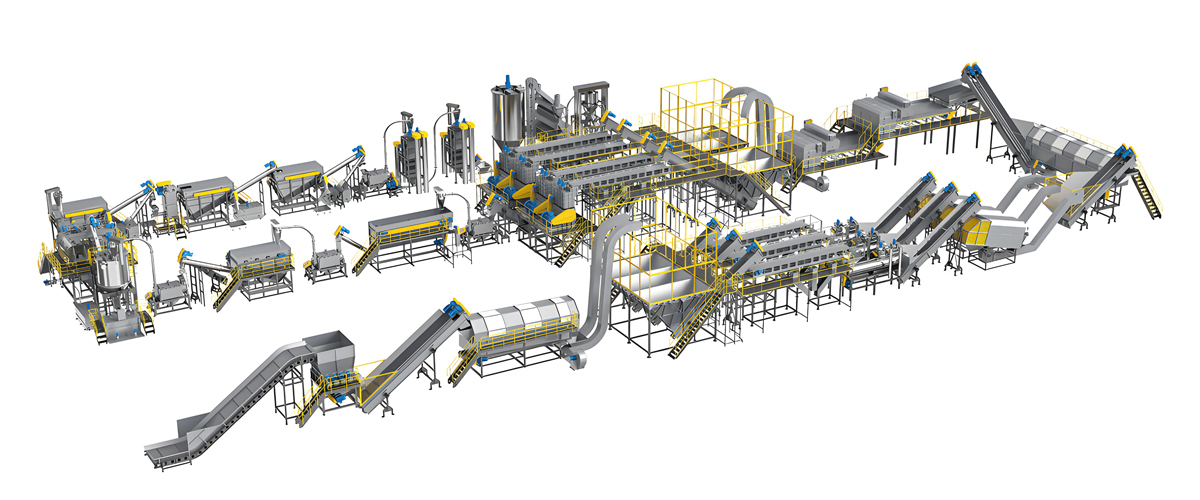
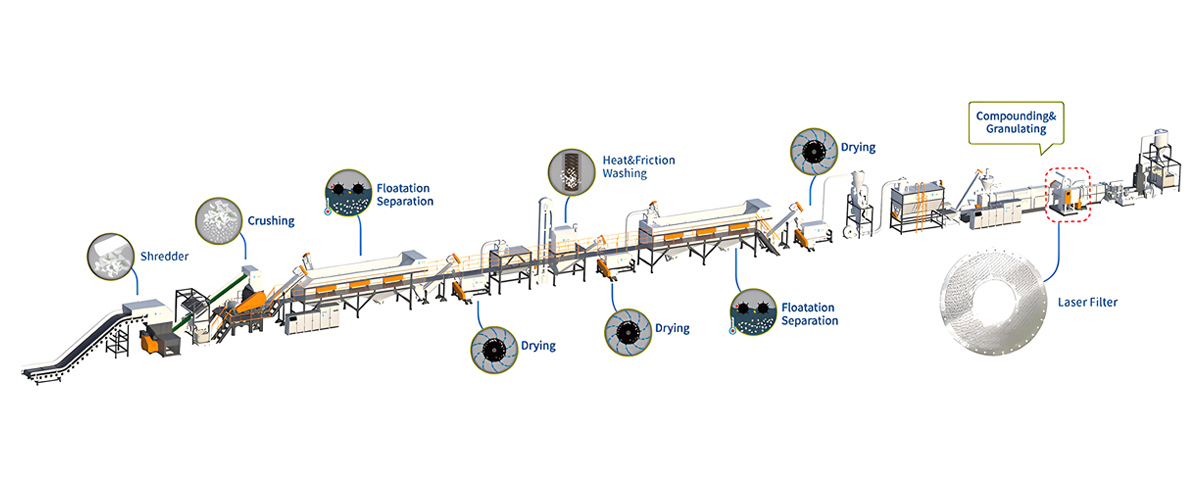
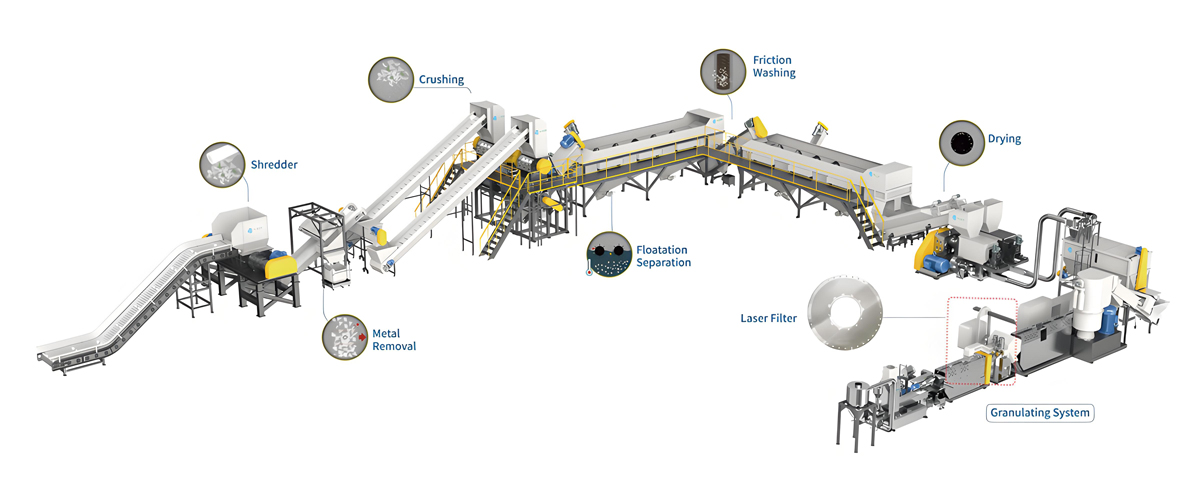
POLYRETEC turnkey solutions include complete integrated production lines that cover every stage of the recycling process from shredding and crushing to washing, drying, extrusion, and pelletizing. All components of the line are designed and manufactured to work together seamlessly, ensuring optimal performance and reliability.
Our integrated production lines feature:
Balanced capacity across all stages to eliminate bottlenecks and maximize throughput.
Centralized control system that allows for complete monitoring and control of the entire production process from a single interface.
Automated material handling systems that ensure smooth, continuous flow of material throughout the line.
Advanced safety features to protect workers and equipment.
Energy-efficient and environmentally friendly design to minimize operational costs and environmental impact.
By choosing an integrated production line from POLYRETEC, you avoid the compatibility issues and integration problems that often occur when sourcing equipment from multiple suppliers. This results in higher overall equipment effectiveness, lower maintenance costs, and faster return on investment.
7.3 Intelligent Production Management Systems
POLYRETEC intelligent production management systems use advanced data analytics and automation to optimize production performance and maximize profitability. Our systems collect real-time data from all stages of the production process, providing you with complete visibility into your operation.
Key features of our intelligent management systems include:
Real-time production monitoring: Track production volume, throughput, and equipment performance in real-time.
Energy management: Monitor and optimize energy consumption across all equipment to reduce energy costs.
Quality control: Track product quality parameters and identify trends to ensure consistent product quality.
Maintenance management: Schedule and track preventive maintenance activities to minimize downtime.
Inventory management: Track raw material and finished product inventory levels to optimize production scheduling and reduce inventory costs.
Reporting and analytics: Generate detailed reports and analytics to identify opportunities for process improvement and cost reduction.
Our intelligent management systems allow you to make data-driven decisions that improve operational efficiency, reduce costs, and increase profitability.
7.4 Comprehensive Training and Support
POLYRETEC provides comprehensive training and support to ensure that your recycling operation runs smoothly and profitably. Our training programs cover all aspects of plant operation, including equipment operation, maintenance, quality control, and safety procedures.
We offer both classroom and hands-on training at our manufacturing facilities and at your site. Our experienced trainers will work with your staff to ensure they have the knowledge and skills to operate and maintain the equipment effectively.
In addition to training, we provide ongoing technical support to our customers. Our global service network includes service centers in key regions around the world, staffed by experienced technicians who can provide on-site support when needed. We also offer remote monitoring and diagnostic services, allowing us to identify and resolve issues quickly without the need for on-site visits.
Our goal is to ensure that your recycling plant operates at maximum efficiency and profitability throughout its entire lifecycle.
8. Detailed Cost Analysis and Return on Investment
Investing in a plastic recycling production line is a significant capital expenditure, but it can provide substantial returns when done correctly. The following analysis provides a detailed breakdown of the costs and returns associated with a POLYRETEC 1,000 kg/hour PET bottle recycling line, one of the most popular and profitable recycling configurations.
8.1 Initial Investment Cost Breakdown
The initial investment for a complete 1,000 kg/hour PET bottle recycling line from POLYRETEC includes the following components:
Shredder and crusher: $30,000 – $50,000
PET bottle washing line: $150,000 – $250,000
Sorting equipment (optical sorter, metal separator, density separation): $80,000 – $150,000
Drying system: $20,000 – $40,000
Single-screw extruder and pelletizing system: $80,000 – $150,000
Control system: $15,000 – $30,000
Installation and commissioning: $40,000 – $80,000
Training and documentation: $10,000 – $20,000
Total initial investment: $425,000 – $770,000
Additional costs to consider include facility construction or renovation, utility connections, initial raw material inventory, and working capital. These costs can vary significantly depending on location and specific requirements.
8.2 Annual Operating Cost Analysis
The following table compares the annual operating costs for a traditional 1,000 kg/hour PET recycling line versus a POLYRETEC advanced recycling line, based on 24 hours per day, 300 days per year operation:
Traditional recycling line: Raw material cost: $2,160,000 per year ($300/ton × 7,200 tons) Energy costs: $240,000 per year Water costs: $60,000 per year Labor costs: $360,000 per year (6 operators per shift) Maintenance costs: $80,000 per year Chemical costs: $30,000 per year Waste disposal costs: $40,000 per year Total annual operating costs: $2,970,000
POLYRETEC advanced recycling line: Raw material cost: $2,160,000 per year ($300/ton × 7,200 tons) Energy costs: $144,000 per year (40% reduction) Water costs: $12,000 per year (80% reduction) Labor costs: $180,000 per year (3 operators per shift) Maintenance costs: $40,000 per year (50% reduction) Chemical costs: $18,000 per year (40% reduction) Waste disposal costs: $12,000 per year (70% reduction) Total annual operating costs: $2,566,000
Annual cost savings with POLYRETEC equipment: $2,970,000 – $2,566,000 = $404,000
8.3 Revenue and Profitability Analysis
The revenue and profitability of the recycling plant depend on the quality of the final product and market conditions. The following analysis is based on producing industrial-grade PET pellets with a selling price of $700 per ton and a material recovery rate of 90%:
Annual production capacity: 1,000 kg/hour × 24 hours/day × 300 days/year = 7,200 tons per year Product yield: 90% (7,200 tons × 0.9 = 6,480 tons of PET pellets per year) Annual revenue: 6,480 tons × $700/ton = $4,536,000 per year Annual operating costs: $2,566,000 per year Annual gross profit: $4,536,000 – $2,566,000 = $1,970,000 per year
By upgrading to produce food-grade PET pellets with a selling price of $1,100 per ton, the annual revenue increases to $7,128,000, and the annual gross profit increases to $4,562,000.
8.4 Return on Investment Calculation
Using the figures from the previous sections, we can calculate the return on investment (ROI) for the POLYRETEC 1,000 kg/hour PET recycling line. The total initial investment is approximately $597,500 (midpoint of the range), and the annual cost savings are $404,000.
Payback period = Total initial investment ÷ Annual cost savings = $597,500 ÷ $404,000 = 1.48 years (approximately 18 months)
This means that the initial investment in the POLYRETEC recycling line is fully recovered in less than 1.5 years through cost savings alone. When considering the additional revenue from increased production capacity and improved product quality, the actual payback period is often even shorter.
Over the 15-year service life of the equipment, the total savings would be: Total savings over 15 years = ($404,000 × 15) – $597,500 = $5,462,500
This represents a return on investment of over 900% over the life of the equipment.
9. Real-World Case Studies
The following case studies demonstrate how POLYRETEC plastic recycling solutions have helped businesses around the world achieve significant improvements in profitability and operational efficiency.
9.1 Case Study 1: PET Bottle Recycling Plant in Germany
A leading PET bottle recycling plant in Germany was operating two traditional recycling lines with a total capacity of 1,500 kg/hour. The plant was experiencing high operational costs, low product quality, and frequent downtime. Their profit margins were declining due to increasing energy and labor costs, and they were struggling to