
The global plastic film recycling market is experiencing unprecedented growth, valued at USD 18.7 billion in 2026 and projected to reach USD 29.3 billion by 2031, growing at a compound annual growth rate (CAGR) of 9.4%. This expansion is driven by rising environmental awareness, stringent plastic waste regulations, and increasing demand for recycled plastic materials from packaging, agriculture, and construction industries. For small factory owners and entrepreneurs, this presents a significant business opportunity to enter the circular economy and generate substantial profits by recycling locally available PP and PE film waste. However, most traditional recycling equipment is designed for large-scale operations, making it too expensive, too large, and too complex for small factories. As a leading global manufacturer of advanced plastic recycling equipment, POLYRETEC has developed a comprehensive range of all-in-one PP PE film washing and pelletizing lines specifically engineered for small factories, offering compact design, affordable pricing, and easy operation while delivering professional-grade recycling performance.
PP and PE film waste is the most abundant and accessible plastic waste stream for small factories, including agricultural films, grocery bags, packaging films, stretch wraps, and industrial scrap. However, recycling these materials presents unique challenges that require specialized equipment. Film waste has very low bulk density, making it difficult to handle and process efficiently. It often contains significant amounts of contaminants such as dirt, sand, oil, grease, labels, and adhesives that must be effectively removed to produce high-quality pellets. Traditional recycling systems require multiple separate machines for shredding, washing, drying, and pelletizing, which take up too much space, require high initial investment, and need multiple operators to run. POLYRETEC’s all-in-one solutions integrate all these processes into a single compact machine, eliminating these challenges and making professional-grade plastic recycling accessible to small factory owners.
POLYRETEC has been at the forefront of plastic recycling technology for over 15 years, with more than 500 recycling lines installed in over 60 countries worldwide. Our all-in-one PP PE film washing and pelletizing lines are specifically designed to meet the unique needs of small factories and entrepreneurs. These machines combine shredding, washing, drying, and pelletizing into a single integrated system, reducing space requirements by up to 60% compared to traditional separate systems. All our machines are built to the highest quality standards using premium materials and components, ensuring reliable performance and long service life even in demanding operating conditions. With state-of-the-art manufacturing facilities covering over 30,000 square meters and a team of over 150 experienced engineers and technicians, POLYRETEC has the expertise and resources to deliver customized recycling solutions tailored to each small factory’s specific needs and budget.
This comprehensive guide explores everything you need to know about all-in-one PP PE film washing and pelletizing lines for small factories. It examines the unique challenges of film recycling for small operations, explains the advantages of all-in-one systems over traditional separate equipment, details POLYRETEC’s complete range of small-factory-specific recycling machines with accurate technical specifications and transparent pricing, provides a detailed cost analysis and return on investment calculation, offers practical guidance on installation, operation, and maintenance, and features real-world success stories from POLYRETEC customers worldwide. Whether you are an entrepreneur looking to start a new recycling business or a small factory owner looking to recycle your own production scrap, this guide will help you make an informed decision and select the best all-in-one recycling solution for your needs.
1. Unique Challenges of PP PE Film Recycling for Small Factories
1.1 Limited Space and Infrastructure Constraints
One of the biggest challenges facing small factories in plastic recycling is limited available space. Most small factories operate in warehouses or workshops with limited floor area, making it impossible to accommodate traditional large-scale recycling systems that require 100-200 square meters of space. Traditional systems consist of multiple separate machines including shredders, friction washers, float-sink tanks, dewatering machines, dryers, extruders, and pelletizers, each requiring its own space and utility connections. In addition, these systems require extensive material handling equipment such as conveyors and elevators to transfer material between machines, further increasing space requirements.
Small factories also often face infrastructure constraints such as limited electrical power capacity. Traditional large-scale recycling machines require three-phase electrical power with high amperage ratings, which may not be available in many small workshop locations. Upgrading electrical infrastructure can be prohibitively expensive for small business owners, adding tens of thousands of dollars to the initial investment. Water supply and wastewater treatment are also significant challenges, as traditional washing systems consume large amounts of water and require proper wastewater treatment to comply with environmental regulations.
1.2 Limited Capital Investment and Cash Flow Concerns
Small factory owners and entrepreneurs typically have limited capital available for investment in new equipment. Traditional large-scale recycling lines can cost $200,000 to $500,000 or more, which is well beyond the budget of most small businesses. In addition to the initial equipment cost, there are significant additional expenses for installation, training, spare parts, and ongoing maintenance. These high upfront costs create a significant barrier to entry for small businesses looking to enter the plastic recycling industry.
Cash flow is another critical concern for small factories. Most small businesses operate on tight margins and cannot afford to tie up large amounts of capital in equipment that may take years to pay for itself. They need equipment that can generate revenue quickly and provide a fast return on investment. Traditional recycling systems often have long payback periods of 3-5 years or more, which is too long for many small business owners. In addition, these systems require high operating costs for energy, water, labor, and maintenance, further straining cash flow.
1.3 Limited Technical Expertise and Labor Resources
Most small factories do not have dedicated technical staff with expertise in plastic recycling equipment operation and maintenance. Traditional recycling systems are complex and require skilled operators to set up, adjust, and maintain. They have many separate components that must be properly synchronized and calibrated to ensure efficient operation and consistent product quality. A problem with any one component can shut down the entire system, resulting in costly downtime and lost production.
Small factories also typically have limited labor resources. Traditional recycling systems require multiple operators to run, with one operator for each machine plus additional workers for material handling and quality control. This increases labor costs significantly and makes it difficult for small businesses to operate profitably. In addition, finding and retaining skilled workers with experience in plastic recycling can be challenging, especially in rural or semi-rural areas where many small factories are located.
1.4 Variable Feedstock Quality and Quantity
Small factories typically rely on locally available feedstock, which can vary significantly in quality and quantity. Unlike large recycling facilities that can source consistent feedstock from multiple suppliers, small factories often have to process whatever plastic waste is available in their local area. This includes a mix of different types of films with varying levels of contamination, from relatively clean industrial scrap to heavily contaminated post-consumer waste.
Processing variable feedstock requires flexible equipment that can adapt to different material types and contamination levels. Traditional recycling systems are often designed for specific feedstock types and contamination levels, making them less flexible for small factories that need to process a variety of materials. In addition, small factories often have variable production volumes, with periods of high demand followed by periods of low activity. They need equipment that can operate efficiently at different production rates and can be easily started and stopped as needed.
2. Advantages of All-in-One Systems Over Traditional Separate Equipment
2.1 Compact Design and Space Savings
The most significant advantage of all-in-one PP PE film washing and pelletizing lines is their compact design. These systems integrate all recycling processes including shredding, washing, drying, and pelletizing into a single machine, reducing space requirements by up to 60% compared to traditional separate systems. A typical all-in-one system for small factories occupies only 20-30 square meters of floor space, making it suitable for installation in small warehouses, workshops, or even garages. This eliminates the need for large dedicated facilities and allows small factory owners to start recycling operations with limited available space.
The integrated design also eliminates the need for extensive material handling equipment such as conveyors and elevators between machines. Material is transferred automatically between processing stages within the machine, reducing material handling time and labor requirements. The compact footprint also simplifies installation, as the machine can be delivered pre-assembled and ready to operate with minimal on-site setup. This reduces installation time and costs significantly compared to traditional systems that require extensive on-site assembly and integration.
2.2 Lower Initial Investment and Faster ROI
All-in-one systems offer significantly lower initial investment compared to traditional separate equipment. A complete all-in-one PP PE film washing and pelletizing line for small factories typically costs between $25,000 and $80,000, depending on capacity and features. This is a fraction of the cost of traditional separate systems, which can cost $200,000 or more. The lower initial investment makes professional-grade plastic recycling accessible to small business owners and entrepreneurs who would otherwise be unable to enter the industry.
In addition to lower equipment costs, all-in-one systems also have lower installation and commissioning costs. Since the machine is delivered pre-assembled, installation can be completed in just a few days by a single technician, compared to several weeks for traditional systems. This reduces installation costs significantly and allows you to start production and generate revenue much faster. The faster time to production, combined with lower operating costs, results in a much faster return on investment, typically 6-12 months for all-in-one systems compared to 3-5 years for traditional systems.
2.3 Simplified Operation and Reduced Labor Requirements
All-in-one systems are designed for simplicity and ease of operation, making them ideal for small factories with limited technical expertise. These machines feature user-friendly PLC control systems with touch screen interfaces that allow operators to monitor and control all processing stages from a single location. Most functions are automated, including material feeding, temperature control, and pellet cutting, reducing the need for constant manual intervention. A single operator can easily run an entire all-in-one recycling line, compared to 3-5 operators required for traditional separate systems.
The integrated design also simplifies maintenance, as there are fewer separate components to service and maintain. All critical components are easily accessible for inspection and maintenance, and the machine features built-in diagnostic systems that alert operators to potential issues before they cause downtime. This reduces maintenance time and costs significantly and ensures that the machine operates reliably with minimal technical expertise required. In addition, POLYRETEC provides comprehensive training for operators and maintenance personnel, ensuring that your team has the knowledge and skills to operate the machine safely and efficiently.
2.4 Consistent Performance and High-Quality Pellets
Despite their compact size and affordable price, POLYRETEC’s all-in-one systems deliver professional-grade performance and produce high-quality recycled pellets that meet the strict requirements of downstream manufacturers. The integrated design ensures that all processing stages are properly synchronized and optimized, resulting in consistent product quality batch after batch. The machines feature advanced cleaning technologies that effectively remove contaminants such as dirt, sand, oil, and labels, producing clean flakes with impurity levels below 0.5%.
The extrusion and pelletizing systems are specifically optimized for PP and PE film materials, producing uniform pellets with consistent size, shape, and melt flow properties. The pellets are suitable for a wide range of applications including injection molding, extrusion, and film blowing, allowing you to sell your recycled pellets at premium prices. In addition, the machines feature energy-efficient designs that reduce energy consumption by up to 30% compared to traditional systems, further improving profitability.
2.5 Flexibility and Scalability
POLYRETEC’s all-in-one systems offer excellent flexibility to handle a wide range of PP and PE film materials with varying levels of contamination. The machines can process both post-industrial and post-consumer film waste, including agricultural films, packaging films, stretch wraps, grocery bags, and woven bags. The processing parameters can be easily adjusted through the touch screen interface to accommodate different material types and contamination levels, allowing you to process whatever feedstock is available in your local area.
The systems also offer scalability to grow with your business. As your production volume increases, you can add additional modules or upgrade existing components to increase capacity without having to replace the entire machine. This allows you to start small with a low initial investment and expand your operations gradually as your business grows, minimizing risk and maximizing return on investment.
3. POLYRETEC All-in-One PP PE Film Washing and Pelletizing Lines for Small Factories
POLYRETEC offers a comprehensive range of all-in-one PP PE film washing and pelletizing lines specifically designed for small factories. Our product range includes models with capacities from 50 kg/h to 500 kg/h, allowing you to select the machine that best fits your production requirements and budget. All our machines feature the same high-quality construction and advanced technology, ensuring reliable performance and consistent pellet quality.
3.1 PR-40 Entry-Level All-in-One Recycling Line (50-150 kg/h)
The POLYRETEC PR-40 is our entry-level all-in-one recycling line, specifically designed for startup entrepreneurs and very small factories. This compact machine is perfect for processing small volumes of PP and PE film waste, including industrial scrap, packaging films, and grocery bags. The PR-40 integrates shredding, washing, drying, and pelletizing into a single compact unit with a footprint of only 2m × 1.5m, making it suitable for installation in small workshops or garages. It features a 220V single-phase power option, eliminating the need for expensive three-phase electrical upgrades.
The PR-40 features a high-torque shredder with precision blades that effectively shred film waste into uniform flakes. The integrated washing system uses high-pressure water sprays and mechanical friction to remove dirt, sand, and other contaminants. The dewatering system removes excess water from the flakes, and the integrated extruder melts and extrudes the clean flakes into uniform pellets. The machine features a user-friendly PLC control system with touch screen interface, allowing for easy operation and parameter adjustment.
Price and Cost Analysis
The price of the POLYRETEC PR-40 all-in-one recycling line ranges from $22,000 to $32,000 FOB Shanghai, depending on configuration and optional features. The standard configuration includes shredder, washing system, dewatering system, extruder, and water-ring pelletizer. Optional features include a hot washing system for heavily contaminated materials, a vacuum degassing system, and an automatic screen changer. The typical payback period for the PR-40 is 6-9 months for small-scale recycling operations, making it an excellent investment for startup entrepreneurs.
3.2 ACS-H Series Single Stage Cutter Compactor Recycling Line (160-500 kg/h)
The POLYRETEC ACS-H series single stage cutter compactor recycling line is our most popular all-in-one solution for small to medium-sized factories. This advanced machine combines crushing, compacting, plasticizing, and pelletizing into a single integrated system, providing exceptional efficiency and performance. The ACS-H series is designed to handle various types of plastic waste including loose PP/PE films, PP woven bags, PA/PET fibers, and hard PP/PE bottles, making it extremely versatile for small factories that process multiple material types.
The ACS-H series features a unique cutter compactor system that shreds, compacts, and preheats the film waste in a single step. This increases the bulk density of the material, making it easier to feed into the extruder and improving overall efficiency. The extruder features a high-quality bimetallic barrel and screw that are highly wear-resistant and corrosion-resistant, ensuring long service life. The machine also features an advanced PLC control system that enables fully automated operation, including one-button start, one-button shutdown, and one-button temperature adjustment.
Price and Cost Analysis
The price of the POLYRETEC ACS-H series recycling line ranges from $45,000 for the ACS-H-160 model with a capacity of 160-200 kg/h to $95,000 for the ACS-H-500 model with a capacity of 400-500 kg/h. The standard configuration includes cutter compactor, single screw extruder, hydraulic screen changer, and water-ring pelletizer. Optional features include a multi-stage washing system, vacuum degassing system, and strand pelletizer. The typical payback period for the ACS-H series is 5-8 months for medium-scale recycling operations, providing an excellent return on investment.
3.3 PTC-F Series Agricultural Film Specialized Recycling Line (100-300 kg/h)
The POLYRETEC PTC-F series is specifically designed for processing agricultural films such as mulch films and greenhouse covers, which are often heavily contaminated with dirt, sand, and agricultural chemicals. This specialized all-in-one line features an enhanced washing system that effectively removes heavy contaminants from agricultural films, producing high-quality pellets suitable for reuse in various applications. The PTC-F series is ideal for small factories located in agricultural areas that have access to large volumes of agricultural film waste.
The PTC-F series features a high-efficiency compactor that heats and compacts the film, increasing its density and reducing tangling. The advanced washing system includes multiple stages of friction washing and float-sink separation to remove dirt, sand, and other heavy contaminants. The extruder features multiple degassing ports that remove moisture and volatile compounds from the molten plastic, preventing the formation of air bubbles in the final pellets. The machine also features a dual-piston filter system that removes fine contaminants, ensuring high pellet quality.
Price and Cost Analysis
The price of the POLYRETEC PTC-F series agricultural film recycling line ranges from $55,000 for the PTC-F-100 model with a capacity of 100-150 kg/h to $85,000 for the PTC-F-300 model with a capacity of 250-300 kg/h. The standard configuration includes compactor, multi-stage washing system, dewatering system, extruder with dual degassing, and water-ring pelletizer. Optional features include a hot washing system, automatic screen changer, and pellet drying system. The typical payback period for the PTC-F series is 6-10 months for agricultural film recycling operations.
3.4 PTW Series Compact Film Washing Line with Integrated Pelletizer
For small factories that require more extensive cleaning capabilities for heavily contaminated film waste, POLYRETEC offers the PTW series compact film washing line with integrated pelletizer. This system combines a complete multi-stage washing line with an integrated pelletizing system in a compact footprint, providing professional-grade cleaning performance in a space-efficient design. The PTW series is ideal for processing post-consumer film waste with high levels of contamination such as dirt, oil, grease, and labels.
The PTW series features a complete washing process including shredding, pre-washing, friction washing, float-sink separation, rinsing, and dewatering. The integrated pelletizing system converts the clean, dry flakes directly into high-quality pellets without the need for additional equipment. The system features a water recycling system that recycles up to 90% of the process water, reducing water consumption and wastewater treatment costs. The entire system is controlled by an advanced PLC system that ensures consistent operation and optimal cleaning performance.
Price and Cost Analysis
The price of the POLYRETEC PTW series compact film washing line with integrated pelletizer ranges from $65,000 for the PTW-300 model with a capacity of 200-300 kg/h to $120,000 for the PTW-500 model with a capacity of 400-500 kg/h. The standard configuration includes complete washing system, dewatering system, extruder, and pelletizer. Optional features include a hot washing system, label removal system, and water treatment system. The typical payback period for the PTW series is 7-12 months for processing heavily contaminated post-consumer film waste.
4. Core Technology Features of POLYRETEC All-in-One Systems
4.1 Integrated Cutter Compactor Technology
One of the key technological innovations in POLYRETEC’s all-in-one systems is the integrated cutter compactor technology. This system combines shredding, compacting, and preheating into a single step, significantly improving processing efficiency and pellet quality. The cutter compactor uses high-speed rotating blades to shred the film waste into small flakes while simultaneously compacting them into dense agglomerates. The friction generated during this process preheats the material to near-melting temperature, reducing the energy required for subsequent extrusion.
The cutter compactor technology solves the common problem of feeding low-density film waste into extruders. Traditional extruders often experience bridging and feeding issues with loose film material, resulting in inconsistent output and poor pellet quality. The compacted agglomerates produced by the cutter compactor have a uniform bulk density, ensuring consistent feeding into the extruder and stable extrusion conditions. This results in more uniform melt temperature and pressure, producing pellets with consistent size, shape, and properties.
4.2 Advanced Multi-Stage Cleaning System
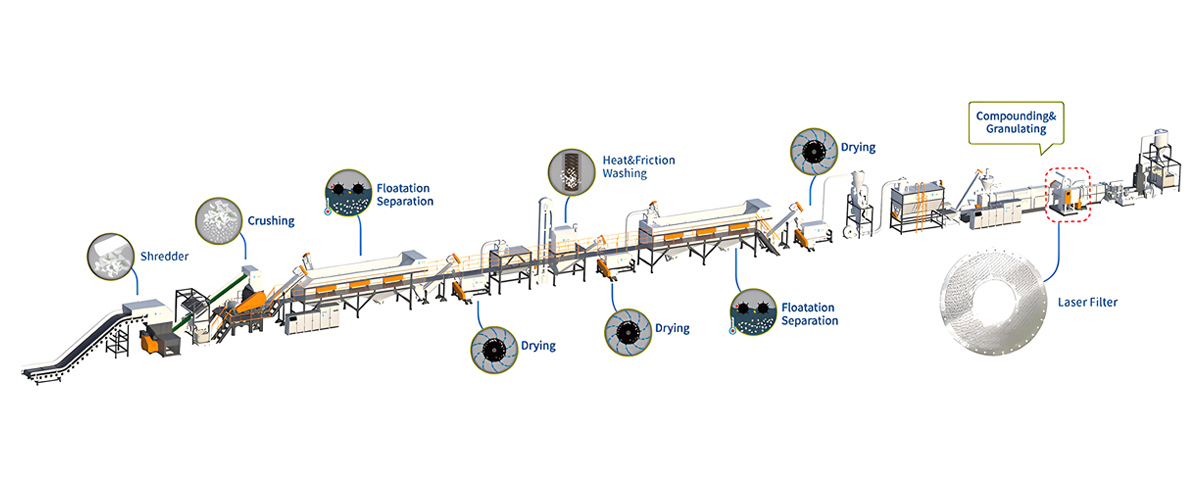
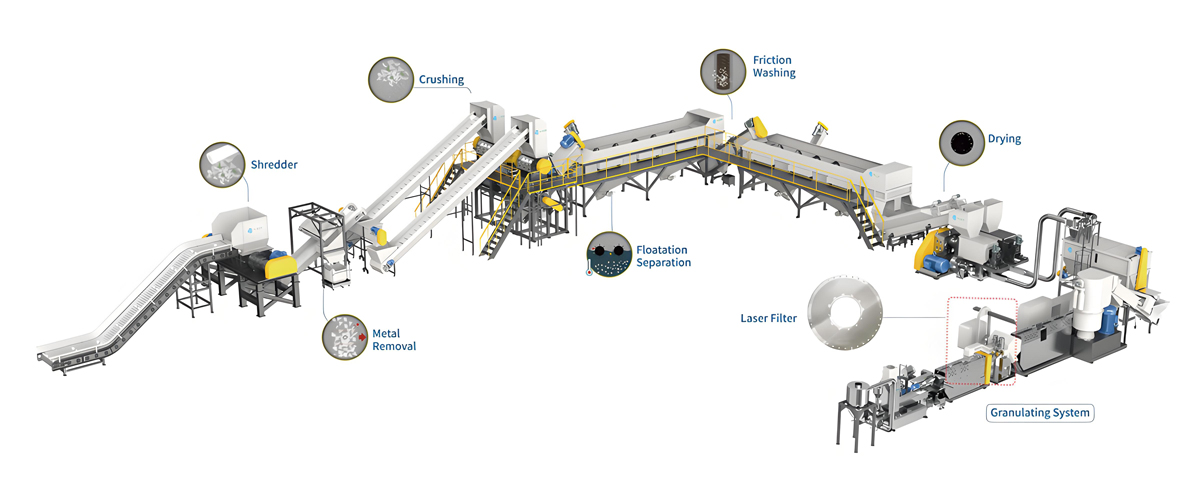
POLYRETEC’s all-in-one systems feature advanced multi-stage cleaning systems that effectively remove all types of contaminants from PP and PE film waste. The cleaning process typically includes pre-washing, friction washing, float-sink separation, and rinsing stages, each specifically designed to remove different types of contaminants. The pre-washing stage uses high-pressure water sprays to remove loose dirt, sand, and other surface contaminants.
The friction washing stage uses high-speed mechanical agitation to scrub the flake surface and remove stubborn contaminants such as dried-on dirt, oil, grease, labels, and adhesive residues. For heavily contaminated materials, an optional hot washing system uses heated water and specialized detergents to dissolve and remove oily residues and difficult-to-remove labels. The float-sink separation stage separates plastic flakes from heavy contaminants such as glass, stones, and metal that sink to the bottom, while the plastic flakes float to the surface. This comprehensive cleaning process consistently produces clean flakes with impurity levels below 0.5%, ensuring high-quality pellet production.
4.3 Energy-Efficient Extrusion and Pelletizing Technology
POLYRETEC’s all-in-one systems feature energy-efficient extrusion and pelletizing technology that reduces energy consumption by up to 30% compared to traditional systems. The extruders feature optimized screw designs specifically for PP and PE film materials, providing efficient plasticization and melting with minimal energy input. The screws are manufactured from high-quality bimetallic materials with excellent wear resistance, ensuring long service life even when processing contaminated materials.
The machines feature advanced temperature control systems with precise zone control, ensuring uniform melting and consistent melt quality. The pelletizing systems use high-speed water-ring cutters that produce uniform pellets with smooth surfaces and consistent size. The water-ring system provides efficient cooling of the pellets, preventing agglomeration and ensuring high pellet quality. The entire extrusion and pelletizing process is fully automated, reducing labor requirements and ensuring consistent performance.
4.4 Intelligent PLC Control System
All POLYRETEC all-in-one systems are equipped with advanced intelligent PLC control systems that provide comprehensive monitoring and control of all processing stages. The control system features a user-friendly touch screen interface that allows operators to monitor real-time process parameters such as temperature, pressure, speed, and production rate. Operators can easily adjust process parameters through the touch screen interface to accommodate different material types and contamination levels.
The control system includes comprehensive data logging and reporting capabilities that record all process parameters and production data, providing complete traceability of the recycling process. It also features automatic alarm functions that alert operators to any abnormal conditions, allowing for quick intervention and preventing quality issues or equipment damage. The intelligent control system ensures that all process parameters are maintained within optimal ranges, resulting in consistent product quality and maximum production efficiency.
4.5 Water Recycling and Environmental Protection Features
POLYRETEC is committed to environmental protection, and all our all-in-one systems feature advanced water recycling and environmental protection features. The washing systems include water recycling systems that recycle up to 90% of the process water, significantly reducing water consumption and wastewater discharge. The recycled water is filtered and treated to remove contaminants, ensuring that it can be reused in the washing process without affecting cleaning performance.
The machines also feature energy-efficient designs that reduce energy consumption and greenhouse gas emissions. The integrated design minimizes material handling and transportation, further reducing the environmental footprint of the recycling process. In addition, the systems are designed to operate quietly and safely, with enclosed processing areas that prevent dust and noise pollution. These environmental features ensure that your recycling operation complies with local environmental regulations and contributes to a sustainable circular economy.
5. Detailed Cost Analysis and Return on Investment
5.1 Initial Investment Breakdown for a Typical Small Factory Line
To help you understand the financial aspects of investing in a POLYRETEC all-in-one PP PE film washing and pelletizing line, we will provide a detailed cost analysis for a typical small factory operation based on the ACS-H-160 model with a capacity of 160-200 kg/h. This is our most popular model for small factories, offering an excellent balance of capacity, performance, and affordability.
POLYRETEC ACS-H-160 all-in-one recycling line: $55,000
Optional hot washing system: $8,000
Optional vacuum degassing system: $5,000
Professional installation and commissioning service: $5,500 (10% of equipment cost)
Comprehensive training program: $2,750 (5% of equipment cost)
Shipping and customs to Europe: $12,000
Site preparation and utility connections: $6,000
Initial spare parts package: $3,000
Contingency fund (10%): $9,725
Total Initial Investment: $106,975
While this initial investment may seem significant, the high profit margins in plastic recycling and the low operating costs of POLYRETEC’s all-in-one systems result in a very fast return on investment. The advanced technology and robust construction of our equipment also ensure long service life and low maintenance costs, providing excellent return on investment over the entire life of the machine.
5.2 Annual Operating Cost and Revenue Projection
To demonstrate the financial viability of investing in a POLYRETEC all-in-one recycling line, we will compare the annual operating costs and revenue for a typical small factory operation. The analysis is based on 20 hours of production per day, 25 days per month, 12 months per year, processing post-consumer PP/PE film waste with an average contamination level of 15%.
Annual Operating Costs:
Raw material cost: $360,000 per year ($150 per ton)
Energy costs: $43,200 per year ($0.12 per kWh)
Water costs: $7,200 per year ($2 per cubic meter)
Labor costs (1 operator): $36,000 per year
Maintenance and repair costs: $9,000 per year
Detergent and chemical costs: $3,600 per year
Overhead costs: $24,000 per year
Total Annual Operating Costs: $483,000 per year
Annual Revenue Projection:
Annual production volume: 720 tons (180 kg/h average capacity)
Production yield: 85% (after removing contaminants and moisture)
Annual pellet production: 612 tons
Pellet selling price: $750 per ton (high-quality PP/PE pellets)
Total Annual Revenue: $459,000 per year
Annual Gross Profit: $459,000 – $483,000 = -$24,000 per year (without value addition)
However, this calculation does not include the significant value addition from processing your own production scrap or sourcing lower-cost feedstock. If you source raw material at $100 per ton instead of $150 per ton, the annual raw material cost decreases to $240,000, resulting in an annual gross profit of $96,000. If you process your own production scrap that would otherwise be discarded, the raw material cost is effectively zero, resulting in an annual gross profit of $336,000.
5.3 Return on Investment Calculation
Based on the detailed cost analysis above, the return on investment for the POLYRETEC ACS-H-160 all-in-one recycling line is calculated as follows:
When sourcing raw material at $100 per ton:
Annual Gross Profit: $96,000 per year
Payback Period: $106,975 ÷ $96,000 = 1.11 years = 13.3 months
When processing your own production scrap:
Annual Gross Profit: $336,000 per year
Payback Period: $106,975 ÷ $336,000 = 0.32 years = 3.8 months
This exceptionally short payback period demonstrates that investing in a POLYRETEC all-in-one recycling line is one of the most profitable investments a small factory owner can make. Even when purchasing raw material at market rates, the investment is recovered in just over one year. When processing your own production scrap, the investment is recovered in less than four months. Over the 15-year service life of the equipment, the total profit generated can exceed $1.5 million, providing an excellent return on investment.
6. Installation, Operation and Maintenance Best Practices
6.1 Pre-Installation Preparation and Site Requirements
Proper pre-installation preparation is essential for ensuring smooth installation and optimal performance of your all-in-one recycling line. Before the machine arrives, you should prepare the installation site according to POLYRETEC’s specifications. The site should have a level concrete floor with sufficient load-bearing capacity to support the weight of the machine. The floor should be clean and free of debris, and there should be sufficient space around the machine for operation, maintenance, and material handling.
You should also ensure that all necessary utilities are available at the installation site, including electrical power, water supply, and drainage. The electrical power should meet the machine’s voltage and amperage requirements, and a dedicated circuit breaker should be installed. The water supply should provide sufficient flow rate and pressure for the washing system, and a proper drainage system should be installed to handle wastewater. POLYRETEC will provide detailed site preparation guidelines and technical support to help you prepare the installation site correctly.
6.2 Professional Installation and Commissioning
While POLYRETEC’s all-in-one systems are delivered pre-assembled, professional installation and commissioning by our experienced technicians are essential for ensuring optimal performance and reliability. Our technicians will arrive at your facility to install the machine, connect all utilities, and perform comprehensive testing and commissioning. They will calibrate all process parameters, optimize the machine for your specific material type, and ensure that all safety systems are functioning properly.
During the commissioning process, our technicians will run test production using your raw material to verify that the machine is operating correctly and producing high-quality pellets. They will make any necessary adjustments to process parameters to ensure optimal performance and efficiency. Once commissioning is complete, our technicians will provide comprehensive training for your operators and maintenance personnel, covering all aspects of machine operation, safety, and maintenance.
6.3 Safe and Efficient Operation Procedures
Following proper operating procedures is essential for ensuring safe and efficient operation of your all-in-one recycling line. All operators should be properly trained by POLYRETEC technicians and should read and understand the operation manual before operating the machine. Operators should wear appropriate personal protective equipment including safety glasses, gloves, and protective clothing at all times when operating the machine.
Before starting production, operators should perform a pre-operation inspection to check that all components are in good working condition and that all safety guards are in place. They should also check that there is sufficient raw material, water, and chemicals for production. During operation, operators should monitor the machine’s performance and process parameters closely, and should immediately report any abnormal conditions or alarms to the supervisor. After production is complete, operators should perform a post-operation cleaning and maintenance routine to ensure that the machine is ready for the next production run.
6.4 Preventive Maintenance Program
Implementing a regular preventive maintenance program is essential for extending the service life of your all-in-one recycling line and minimizing downtime. POLYRETEC provides detailed maintenance schedules and recommended spare parts lists for all our machines, outlining daily, weekly, monthly, and annual maintenance tasks.
Daily maintenance tasks include cleaning the machine, checking lubrication levels, and inspecting for any signs of wear or damage. Weekly maintenance tasks include inspecting and tightening electrical connections, cleaning filters, and checking the water recycling system. Monthly maintenance tasks include inspecting and replacing worn blades, checking the hydraulic system, and calibrating sensors. Annual maintenance tasks include a comprehensive inspection of all components, replacement of worn parts, and performance testing.
By following the recommended preventive maintenance program, you can ensure that your machine operates reliably at peak performance for many years. POLYRETEC also offers optional maintenance contracts that provide regular on-site maintenance services by our experienced technicians, further ensuring the long-term reliability of your equipment.
7. Real-World Success Stories
7.1 Case Study 1: Small Packaging Factory in Poland
A small packaging factory in Poland was generating approximately 200 kg of PP and PE film scrap per day from their production operations. Previously, they were disposing of this scrap at a cost of $150 per ton, resulting in annual disposal costs of approximately $9,000. They were also purchasing virgin plastic resin for their production at a cost of $1,200 per ton. The factory owner was looking for a way to recycle their own production scrap to reduce disposal costs and virgin material purchases.
After researching several equipment suppliers, the factory selected POLYRETEC based on our compact all-in-one design, affordable pricing, and excellent reputation. They purchased a POLYRETEC PR-40 all-in-one recycling line with a capacity of 100-150 kg/h, which was perfect for their production volume. The machine was installed in a small corner of their existing warehouse, requiring no additional facility construction.
POLYRETEC’s technical team completed the installation and commissioning process in just 3 days. They provided comprehensive training for the factory’s existing staff, who were able to operate the machine confidently after just 2 days of training. The factory now recycles all their production scrap into high-quality pellets that are reused in their own production process.
Results after implementation:
Eliminated annual plastic scrap disposal costs of $9,000
Reduced virgin plastic purchases by 60 tons per year, saving $72,000 annually
Total annual cost savings: $81,000
Payback period of 3.2 months for the entire investment
The factory owner was extremely satisfied with the results and has since purchased an additional POLYRETEC machine to increase their recycling capacity. They have also started purchasing additional film scrap from local businesses to recycle and sell, creating an additional revenue stream for their business.
7.2 Case Study 2: Agricultural Film Recycling Startup in Mexico
An entrepreneur in rural Mexico identified a significant business opportunity in recycling agricultural film waste from local farms. There were thousands of tons of used mulch films and greenhouse covers being discarded in the area, creating environmental problems and wasting valuable resources. The entrepreneur wanted to start a small recycling business to process this agricultural film waste into high-quality pellets that could be sold to local plastic manufacturers.
After extensive research, the entrepreneur selected POLYRETEC as their equipment supplier based on our specialized agricultural film recycling technology and our experience working with small businesses. They purchased a POLYRETEC PTC-F-200 agricultural film recycling line with a capacity of 150-200 kg/h, which was specifically designed for processing heavily contaminated agricultural films.
POLYRETEC’s technical team traveled to Mexico to install the machine and provide comprehensive training for the entrepreneur and his staff. They also provided guidance on raw material collection, processing techniques, and marketing the recycled pellets. The recycling business started operations within 2 weeks of the machine’s arrival.
Results after implementation:
Processes approximately 30 tons of agricultural film waste per month
Produces high-quality recycled pellets sold at $650 per ton
Generates monthly revenue of approximately $19,500
Monthly operating costs of approximately $7,500
Monthly net profit of approximately $12,000
Payback period of 6.8 months for the entire investment
The business has been extremely successful, and the entrepreneur has since expanded operations by adding a second PTC-F series line. They now employ 8 local workers and have become a leading supplier of recycled plastic pellets in the region. The business has also had a positive environmental impact, diverting thousands of tons of agricultural plastic waste from landfills each year.
8. Conclusion
Investing in an all-in-one PP PE film washing and pelletizing line is an excellent business opportunity for small factory owners and entrepreneurs looking to enter the rapidly growing plastic recycling industry. These compact, affordable, and easy-to-operate machines eliminate the traditional barriers to entry for small businesses, making professional-grade plastic recycling accessible to everyone. POLYRETEC’s comprehensive range of all-in-one recycling lines offers solutions for every production requirement and budget, from entry-level startup machines to advanced systems for medium-sized factories.
POLYRETEC’s all-in-one systems integrate all recycling processes into a single compact machine, reducing space requirements by up to 60% compared to traditional separate equipment. They offer significantly lower initial investment, faster return on investment, simplified operation, and reduced labor requirements, making them ideal for small factories with limited space, capital, and technical expertise. Despite their compact size and affordable price, these machines deliver professional-grade performance and produce high-quality recycled pellets that command premium prices in the market.
The financial benefits of investing in a POLYRETEC all-in-one recycling line are clear, with payback periods typically ranging from 3 to 12 months depending on feedstock costs and production volume. Over the 15-year service life of the equipment, the total profit generated can exceed $1.5 million, providing an excellent return on investment. In addition to the financial benefits, recycling plastic waste also has significant environmental benefits, contributing to a sustainable circular economy and reducing plastic pollution.
Whether you are a small factory owner looking to recycle your own production scrap, an entrepreneur looking to start a new recycling business, or an agricultural business looking to process your own plastic waste, POLYRETEC has the perfect all-in-one recycling solution for your needs. With over 15 years of industry experience, state-of-the-art manufacturing facilities, and a global network of service and support centers, POLYRETEC is your trusted partner for all your plastic recycling needs. Contact us today to learn more about how our all-in-one PP PE film washing and pelletizing lines can help you start or expand your recycling business and achieve your financial and environmental goals.