
Table of Contents
- What Is a Rigid Plastic (HDPE and PP) Crushing and Washing Line?
- Why Recycle HDPE and PP Rigid Plastic?
- How a Rigid Plastic Washing Line Works: The Core Process Stages
- Key Components of a Rigid Plastic Washing Line
- Washing Line Configurations by Capacity
- Final Flake Quality and Key Specifications
- Leading Rigid Plastic Recycling Equipment Manufacturers
- Cost Analysis: What Does a Rigid Plastic Washing Line Cost?
- How to Choose the Right Rigid Plastic Washing Line
- Industry Trends in HDPE and PP Recycling in 2026
- Frequently Asked Questions
- Conclusion
What Is a Rigid Plastic (HDPE and PP) Crushing and Washing Line?
A plastic recycling machine built for rigid plastics is, in practical terms, a complete crushing and washing line that takes post-consumer and post-industrial HDPE and PP containers, bottles, caps, crates, and pipes and turns them into clean, uniform rigid plastic flakes ready for re-extrusion or direct molding. Unlike a film line that handles soft, stretchy PE and PP film, a rigid line is engineered for thick-walled, high-strength parts that behave very differently in a crusher and a washer. The global plastics machinery market is valued at roughly 35 to 40 billion USD, and recycling equipment is one of its fastest-growing segments as brands and regulators push recycled content into packaging and durable goods.
HDPE, or high-density polyethylene, and PP, or polypropylene, are the workhorse resins of rigid packaging. HDPE is the opaque plastic of milk jugs, detergent bottles, shampoo bottles, and chemical drums; PP is the semi-cigid plastic of caps, pails, crates, automotive components, and food containers. Both float in water, both tolerate repeated mechanical recycling, and both command a stable resale value when cleaned to a consistent grade. A dedicated rigid plastic recycling machine does the size reduction and washing that converts mixed, dirty rigid scrap into a specification flake a compounder can buy with confidence.
What separates a true washing line from a loose granulator is integration. A bare crusher only makes dirty flakes that still carry labels, glue, metal springs, and aluminum foil. A rigid washing line delivers flakes with documented purity, controlled moisture, and consistent size, screened and dried so a buyer can compound or mold without re-cleaning. That integration is why the same machine is specified differently for a pipe producer, a compounder, or a bottle-to-bottle HDPE plant, and why the washing module, not the crusher alone, defines the economics of the investment.
The flakes a plastic recycling machine produces are not a single product. Natural HDPE flakes become new bottles and pipe; colored HDPE and PP flakes become crates, pallets, and automotive parts; and high-purity PP regrind re-enters food-contact applications where allowed. Mechanical recycling covers the vast majority of rigid plastic volume today because it is energy-efficient and proven, and chemical recycling remains a niche for streams too contaminated for washing. For a buyer, the question is not whether to recycle rigid plastic, but how clean and how consistent the output needs to be for the intended market.
Key statistic: Global plastic production sits near 400 million tons per year, and HDPE plus PP together account for well over a third of that volume. Post-consumer rigid collection is expanding as deposit and extended-producer-responsibility schemes widen, which is why rigid washing capacity is one of the fastest-growing segments of the recycling equipment market.
Why Recycle HDPE and PP Rigid Plastic?
Rigid HDPE and PP scrap is among the most recyclable plastic streams in existence, yet it is also one of the most contaminated at the point of collection. A single bale of rigid bottles can contain milk jugs, detergent bottles, caps, labels, metal springs from pump dispensers, and aluminum foil liners. Left unprocessed, that mix is landfill or energy recovery at best. Processed correctly, it becomes a high-value, reusable raw material with a predictable market price, which is why a rigid plastic recycling machine is a strategic asset rather than a cost center for processors and brand owners alike.
The demand side is strengthening. Recycled HDPE and PP are now written into packaging targets across the European Union, and many global brands have public commitments to include recycled content in bottles, pails, and crates. RHDPE and RPP carry a premium over virgin resin when supply is tight and quality is certified, and that premium is the payback engine for a washing line. Because both resins float, they are easy to separate from heavier contaminants such as PET, glass, and most metals, which keeps the separation logic of a rigid line simpler and more robust than a line that must split sinking and floating food-grade PET.
Environmental pressure is the second driver. Mechanical recycling of rigid plastic uses a fraction of the energy of producing virgin polymer and avoids the emissions associated with new resin. For municipalities and producers under extended-producer-responsibility obligations, owning or contracting washing capacity is increasingly the difference between meeting a target and paying a penalty. A well-run rigid line also closes loops locally: bottles collected in a region can become crates and pipes used in the same region, cutting transport and import dependence on virgin plastic.
The final argument is operational resilience. Virgin resin prices swing with oil and gas markets, while a captive recycled flake stream insulates a converter from those swings. A processor who can wash their own rigid scrap is less exposed to resin volatility and more able to promise recycled content to customers on a long-term basis. That stability is exactly what justifies the capital outlay for a plastic recycling machine dedicated to HDPE and PP rigid material.
How a Rigid Plastic Washing Line Works: The Core Process Stages
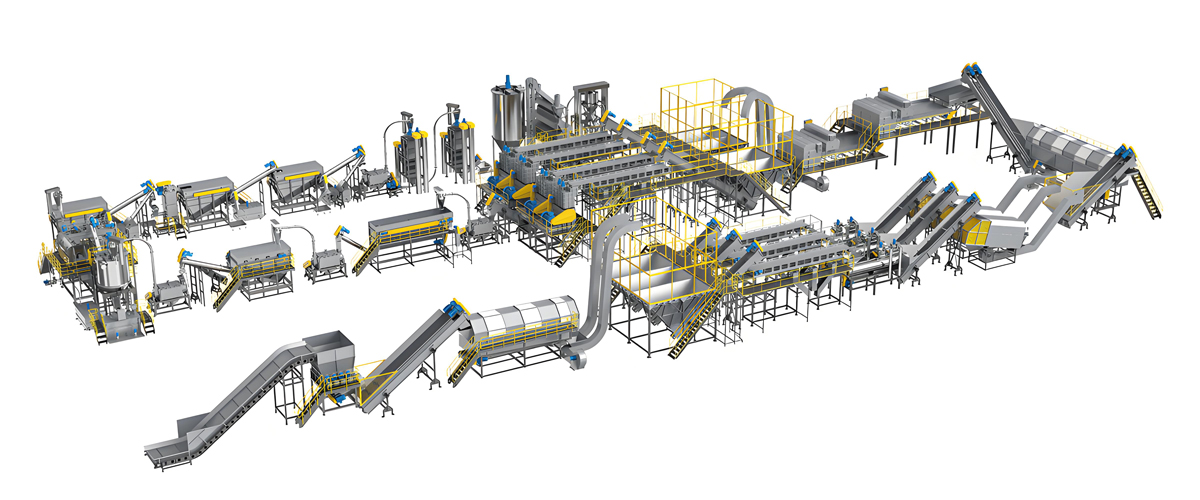
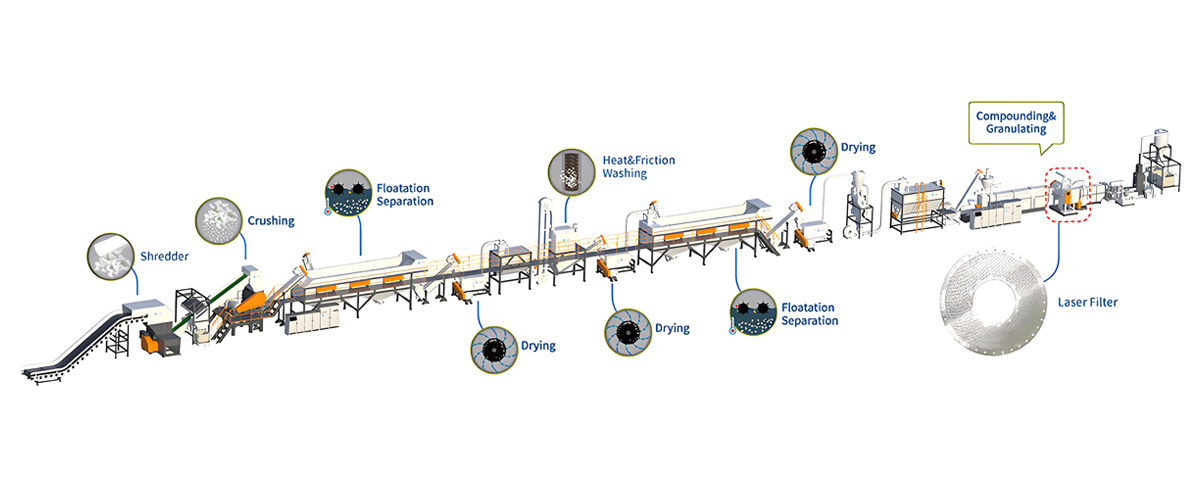
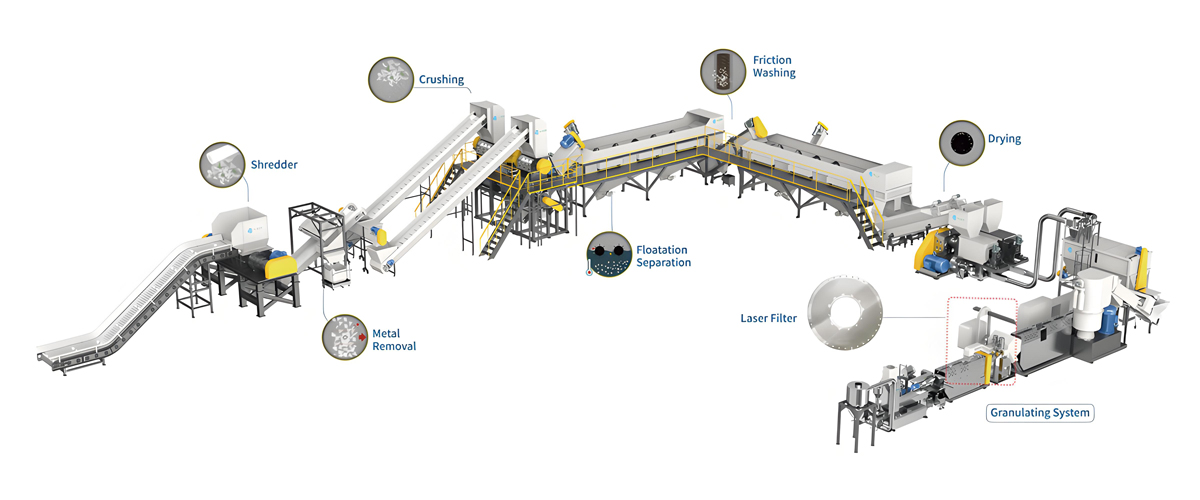
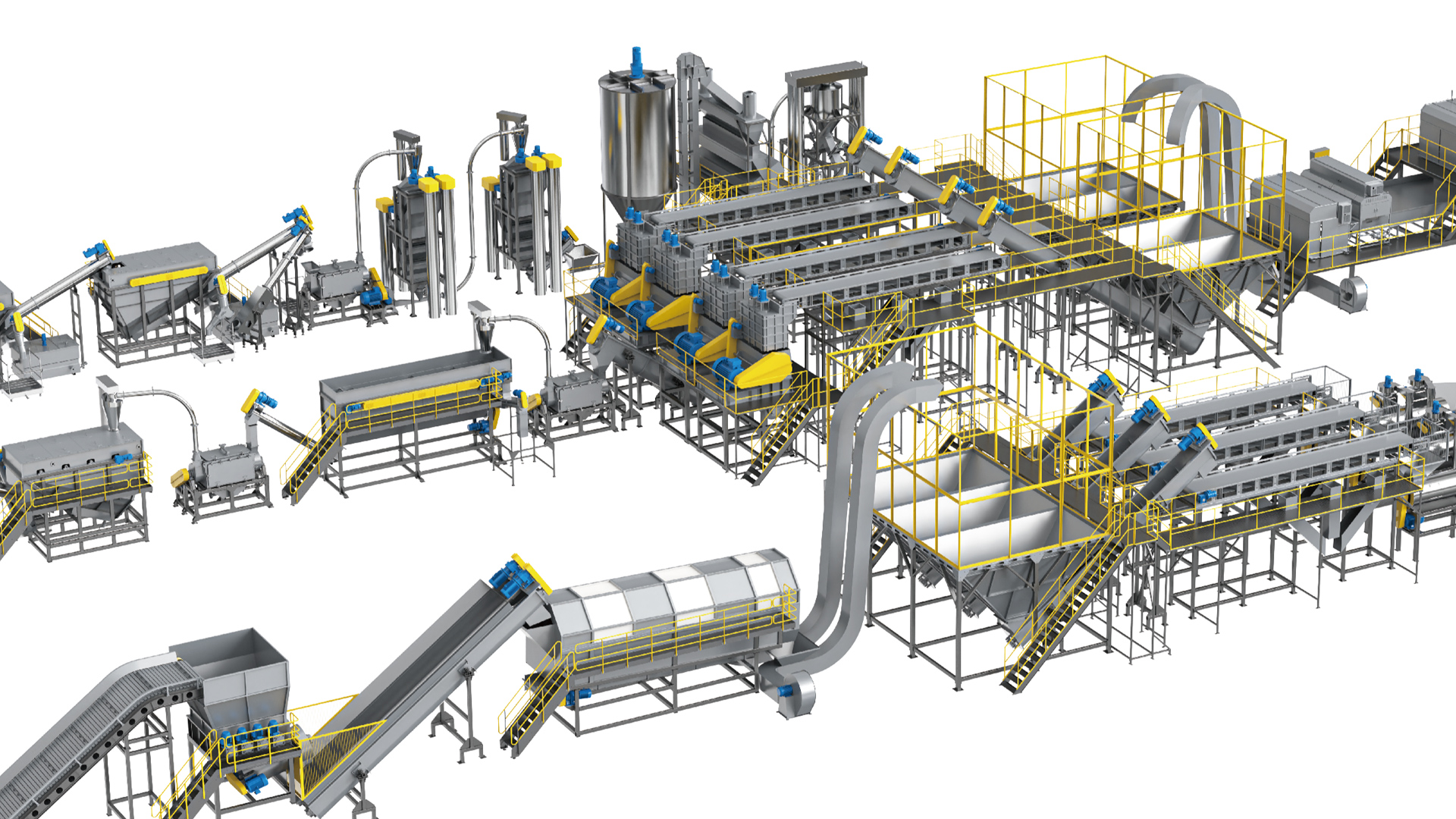
A modern rigid plastic washing line is a wet, multi-stage process built around three process modules: crushing and cleaning, hot washing, and multi-stage rinsing. Each stage removes a specific contaminant: labels, glue, metal springs, aluminum foil, and organic residue. The goal is flakes with low metal and foil content, controlled moisture, and consistent bulk density that a compounder can use without re-cleaning. Below are the stages a well-designed plastic recycling machine for rigid HDPE and PP typically includes, in the order material flows through the plant.
Stage 1: Pre-Treatment Shredding
Rigid plastic arrives as bales, loose containers, or mixed post-industrial scrap. A pre-treatment single-roller shredder opens and pre-breaks bulky items so the fine crusher downstream is never overloaded by whole pails or crates. This stage protects the fine crusher, reduces the risk of jams, and begins the water-based cleaning logic by feeding material into the line’s internal water circulation, filtration, and reuse system, which cuts fresh water use across the whole plant.
Stage 2: Fine Crushing to 20 mm
Material pre-broken by the single-roller shredder is fed into the fine crusher, where it is reduced to a controlled fine-crushing size of about 20 millimeters. Fine crushing at a consistent dimension is what makes later washing and separation predictable, because flakes of uniform size behave consistently in water and in screens. After fine crushing, the material is dehydrated by friction and moved to the first rinsing stage rather than sitting wet and clumped.
Stage 3: Friction Washing and First-Stage Rinsing
The first-stage rinsing pool receives the friction-dehydrated flakes. Here most of the metal springs, aluminum foil, and other submerged rigid flakes with a specific gravity greater than one are removed, and most of the organic pollutants carried on the material are cleaned away and dewatered. This is the stage that strips the heavy, non-plastic contaminants that would otherwise damage downstream equipment or contaminate the flake, and it is where the line earns its reliability by protecting every module that follows.
Stage 4: High-Temperature Hot Washing
After fine crushing and dehydration, most labels have separated from the flakes, but self-adhesive labels and hot-melt aluminum foil remain bound to the surface. The high-temperature hot-washing module, running above 90 degrees Celsius and cooking for more than 30 minutes, uses heat and cleaning agents to rub away stubborn dirt, adhesive, and foil so the flakes return to their original color. To guarantee temperature and time are always met, the line is designed with two heating tanks working alternately, so one tank heats while the other discharges, holding cleaning quality steady across a continuous campaign.
Stage 5: Three-Stage Rinsing
The three-stage rinsing module uses a pool for floating elutriation, mainly to remove cleaning agents and any floating or sinking flakes that survived earlier steps. Clean water is added for the final flake rinse to achieve the highest purity. This staged approach matters because residual alkali or surfactant in the flake can spoil a compounder’s batch, so the last rinse is a quality gate rather than a courtesy, and it is where the line secures the clean, bright flake that commands the premium price.
Stage 6: Separation, Screening, and Drying
Following rinsing, density-based separation removes remaining floatables and heavies, vibrating screens pull out fines and off-size flake, and the drying stage drops moisture to a level suitable for storage, transport, and direct extrusion. The result is bagged or silo-stored rigid HDPE and PP flakes ready for sale or in-house recompounding. At this point the material has moved from dirty bales and loose containers to a specification product with a market price and a documented grade.
Throughout these stages, effective lines sample and monitor output rather than waiting for a complaint. Inline metal detection, periodic foil and purity checks, and moisture probes let operators catch a drifting separator or a worn blade before it ships bad material. The difference between a line that merely runs and one that consistently ships specification flake is this discipline of in-process control, and it is why commissioning support matters as much as the steel in a rigid plastic recycling machine.
Key Components of a Rigid Plastic Washing Line
The quality of a plastic recycling machine depends on how these modules are specified and integrated. Buyers should evaluate each on reliability and serviceability, because a single weak module caps the performance of the whole line.
- Pre-treatment single-roller shredder – opens bales and pre-breaks bulky rigid items without overloading the fine crusher.
- Fine crusher or granulator – reduces material to a consistent 20 millimeter flake; blade design and screen size set flake dimensions and energy use.
- Friction washer and dehydrator – scrubs and dewaters flakes, beginning contaminant removal before the hot wash.
- First-stage rinsing tank – removes metal springs, aluminum foil, and other heavy submerged contaminants and organic pollutants.
- High-temperature hot washer – twin alternating heating tanks above 90 degrees Celsius for more than 30 minutes to strip adhesive and foil.
- Three-stage rinsing module – floating elutriation and final clean-water rinse for the highest flake purity.
- Sink-float and density separation – pulls residual floatables and heavies to protect flake grade.
- Vibrating screens – remove fines and off-size flake so output is uniform.
- Dryer – brings flake moisture down to a level suitable for storage and extrusion.
- Control system – PLC and HMI with load monitoring, water recycling logic, and remote support.
Washing Line Configurations by Capacity
A rigid plastic recycling machine is offered across a capacity range that scales from a compact line for a regional collector to a high-throughput line for an integrated recycler. The table below reflects the standard PEPP series configurations for HDPE and PP rigid material, with installation power, required floor space, and utility consumption at nameplate capacity.
| Model | Capacity | Installation Power | Floor Space | Steam | Compressed Air | Water |
|---|---|---|---|---|---|---|
| PEPP500 | 500 kg/h | 98 kW | 500 m2 | 0.5 m3/h | 2 m3/min | 2 m3/h |
| PEPP1000 | 1000 kg/h | 150 kW | 700 m2 | 0.5 m3/h | 2 m3/min | 2 m3/h |
| PEPP2000 | 2000 kg/h | 230 kW | 1000 m2 | 0.5 m3/h | 3 m3/min | 3 m3/h |
Capacity choice should follow secured feedstock, not ambition. A 500 kg/h line fits a collector with steady local supply and limited space, while a 2000 kg/h line suits an integrated recycler with established bale sourcing and the utilities to match. Because the line reuses water through its internal circulation, filtration, and reuse system, the fresh-water figures above are modest relative to the throughput, which also helps with discharge permitting. Power and space scale roughly with capacity, so budget the building and the electrical connection alongside the machine rather than after it.
Final Flake Quality and Key Specifications
The product of a rigid plastic washing line is not just flake, it is graded flake. Buyers should specify the output they need in measurable terms so a supplier can tune the line and prove it on a trial run. The table below lists the parameters that matter most for RHDPE and RPP flake.
| Parameter | Typical Target | Why It Matters |
|---|---|---|
| Flake size | About 20 mm (configurable) | Consistent size improves feeding and compounding |
| Metal and foil content | Near zero, detected inline | Metal damages extruders and ruins batches |
| Moisture | Low, suitable for storage and extrusion | High moisture lowers throughput and adds energy |
| Bulk density | Stable and uniform | Protects dosing and silo behavior |
| Color separation | Natural and colored sorted as needed | Natural commands the higher price |
| Residual contaminants | Minimal glue, label, and organic residue | Contaminants reduce mechanical properties |
Because HDPE and PP both float, density separation in a rigid line is robust: the target resins rise while PET, glass, and most metals sink and are rejected. The harder contaminants in rigid scrap are metal springs from pump bottles and aluminum foil liners, which is why the first-stage rinsing and inline metal detection are engineered deliberately rather than left to chance. A line that controls these parameters ships flake a compounder can use without re-cleaning, and that is the difference between a product and a problem.
Leading Rigid Plastic Recycling Equipment Manufacturers
The market for rigid plastic washing lines spans European engineering brands and Asian value-focused manufacturers. Buyers benefit from benchmarking across both, because the trade-off is usually certification depth and reference installations against delivered cost and lead time.
| Supplier | Origin | Strength | Best For |
|---|---|---|---|
| Polyretec | China (Austrian-derived technology) | Cost-effective rigid washing lines with global service | Value with process know-how |
| Lindner | Austria | Robust shredders and pre-treatment | Heavy-duty size reduction |
| Herbold | Germany | Washing and granulation engineering | Process depth |
| Erema | Austria | Integrated washing and pelletizing | One-step recycling systems |
| Starlinger | Austria | Food-grade recycling lines | Reference installations |
European suppliers set the benchmark for engineering depth and reference plants, while manufacturers such as Polyretec compete on delivered cost, lead time, and the Austrian-derived process know-how that defines modern rigid washing. The practical advice is to benchmark at least one European quote against one Asian quote, then weigh certification support and local service against the price gap for your specific flake grade. Neither is universally better; the right choice follows your outlet and your risk tolerance, not a flag on a brochure.
Cost Analysis: What Does a Rigid Plastic Washing Line Cost?
A plastic recycling machine for rigid HDPE and PP is a capital investment measured in hundreds of thousands of US dollars once you include installation, commissioning, and water treatment. The table below reflects typical 2026 market ranges; exact pricing depends on capacity, automation, and the grade of flake required.
Total cost of ownership extends beyond the machine itself. Foundation and utilities, water treatment to meet discharge limits, and conveyor or crane interfaces are often underestimated. Spare parts for wear items such as blades and screens should be budgeted as a recurring line, and a realistic commissioning and training budget prevents the false economy of a line that starts late or runs below specification. When comparing quotes, normalize them to installed, trainable capacity rather than ex-works equipment price, because the lowest headline number rarely corresponds to the lowest cost per clean ton.
| Capacity Tier | Equipment Range (USD) | Installed TCO (USD) | Payback Driver |
|---|---|---|---|
| 500 kg/h | 90,000 to 200,000 | 130,000 to 280,000 | Local collection margin |
| 1000 kg/h | 220,000 to 420,000 | 320,000 to 580,000 | Flake premium, volume |
| 2000 kg/h | 450,000 to 850,000 | 650,000 to 1,150,000 | Contract rHDPE and rPP offtake |
Return on investment is driven by the spread between bale cost and clean flake price, which widens when recycled-content mandates lift demand for RHDPE and RPP. Buyers should budget for water treatment, spare blades, and at least one week of operator training, and they should model energy and labor per ton rather than just the equipment line item. A line purchased only on lowest price often costs more in downtime and rejected flakes than a better-specified machine, because the hidden cost of a contaminated shipment is a lost customer, not a discount.
As a worked example, a 1000 kg/h rigid line might process roughly 7000 tons per year of HDPE and PP scrap at a flake premium of 80 to 200 USD per ton over virgin resin, against added energy and labor of roughly 30 to 60 USD per ton; the incremental margin can recover the equipment premium within two to four years, after which it is pure upside on every ton. The same logic punishes a line that misses grade, because a flake load with metal or foil converts a premium order into a rejected one overnight.
How to Choose the Right Rigid Plastic Washing Line
Choosing the right plastic recycling machine is a process, not a purchase. Follow these steps to avoid the most common mistakes that sink otherwise promising projects.
- Audit your feedstock. Know the mix of HDPE and PP, the level of labels, glue, metal springs, and foil, and your steady monthly volume before sizing capacity.
- Define your flake grade. Decide whether you need natural, colored, or food-contact-capable output, because the spec changes the whole design and the cleaning intensity.
- Verify separation performance. Ask for a trial run on your own material and measure metal, foil, and purity, not just throughput, since vendors optimize demos.
- Check water and energy loops. Closed-loop water and efficient drying cut operating cost for the life of the machine and ease permit approval.
- Confirm service and spares. Blades, screens, and bearings wear; local stock and remote support shorten downtime that otherwise erases margins.
- Validate compliance. Ensure CE marking, ISO 9001, and any regional documentation needed for your target market.
The most common mistake is buying capacity before securing feedstock. A 2000 kg/h line is only economical if you can feed it 2000 kg/h of sortable rigid plastic every day; many operators would do better with a 500 kg/h or 1000 kg/h line running at full tilt than a larger line running at half. The second mistake is neglecting water discharge permits, which can delay startup longer than equipment lead time, and the third is skipping commissioning on real material, which leaves grade issues hidden until the first customer complaint.
Finally, plan for commissioning and training as part of the purchase, not an afterthought. A line commissioned with your real feedstock, run by operators who understand separation physics, reaches nameplate purity faster and stays there. Budget a supported ramp of several weeks, and keep the supplier engaged through the first full campaign rather than cutting them loose at first flake, because that is exactly when the hidden tuning happens.
Industry Trends in HDPE and PP Recycling in 2026
Three forces are reshaping rigid plastic recycling in 2026. First, recycled-content mandates in the European Union and several other markets are lifting demand for RHDPE and RPP faster than supply can grow, which keeps the flake premium healthy. Second, automated sorting and better washing chemistry are raising purity while lowering labor, letting smaller lines hit grades that once required heavy manual sorting. Third, brands are signing long-term offtake agreements for recycled resin, which makes a documented, certifiable washing line far more valuable than a cheap one.
Mechanical recycling remains the backbone for rigid plastic because it is energy-efficient and proven, but integrated washing-and-pelletizing systems are gaining ground for operators who want flakes and pellets from one line. For most buyers, the practical move is a well-specified mechanical rigid washing line with room to add inspection and extrusion later, protecting today’s budget while keeping the upgrade path open.
Regionally, Asia-Pacific remains the fastest-growing market by volume, driven by rising collection rates and domestic recycled-resin capacity, while Europe leads on regulation and brand commitments. North American momentum is building as state-level mandates take effect. For equipment buyers this means a global supplier base but also divergent certification expectations, so specify the target market before finalizing the line design, because a line built for one region is not automatically accepted in another.
Frequently Asked Questions
What is a rigid plastic crushing and washing line?
It is a plastic recycling machine that crushes and washes HDPE and PP rigid containers, bottles, and crates into clean flakes, typically including pre-shredding, fine crushing, friction washing, hot washing, rinsing, separation, and drying modules.
How does a rigid plastic washing line work?
Rigid scrap is pre-shredded, fine-crushed to about 20 millimeters, friction-washed and dehydrated, rinsed to remove metal and foil, hot-washed above 90 degrees Celsius for more than 30 minutes, then three-stage rinsed, separated, screened, and dried into clean flake.
How much does a rigid plastic washing line cost?
Equipment typically ranges from about 90,000 USD for a 500 kg/h line to more than 850,000 USD for a 2000 kg/h plant, with installed cost higher after water treatment, foundations, and commissioning.
What is the difference between a rigid line and a PET bottle line?
A rigid line targets floating HDPE and PP containers and emphasizes metal, foil, and adhesive removal, while a PET line targets sinking PET bottles and emphasizes PVC and food-grade purity; the separation physics and cleaning intensity differ.
Which plastic recycling machine is best for HDPE and PP?
For most operations a wet rigid crushing and washing line with hot washing, three-stage rinsing, and density separation is best; choose capacity and flake grade to match your feedstock and intended market.
How to maintain a rigid plastic washing line?
Follow scheduled blade and screen changes, monitor water quality, lubricate bearings, and keep spare wear parts in stock; most lines run reliably with basic planned maintenance and inline metal detection.
What materials can a rigid washing line process?
It is optimized for HDPE and PP rigid bottles, containers, caps, crates, and pipes; mixing in large non-polyolefin fractions or excessive PET should be removed upstream by sorting.
Conclusion
A plastic recycling machine for HDPE and PP rigid plastic is the front end of the circular economy for bottles, pails, and crates: it converts dirty, mixed rigid scrap into clean RHDPE and RPP flakes that converters and brands urgently need. Buy on measured flake purity, controlled metal and foil removal, water and energy loops, and proven service, not on headline price. Whether you start with a 500 kg/h compact line or scale to a 2000 kg/h plant, the right washing line turns a low-value waste stream into a premium, reusable raw material. Polyretec designs rigid plastic crushing and washing lines across that full capacity range, built on Austrian-derived process know-how with global commissioning and training support. Contact the engineering team to size a line to your feedstock and flake grade, and to map the upgrade path from washed flake to integrated pelletizing.
The bottom line for any buyer evaluating a plastic recycling machine for rigid HDPE and PP is simple: treat flake grade as the product, not the machine as the product. When you specify, trial, and verify grade on your own material, the capital decision becomes straightforward, and the line pays for itself in clean, certifiable flake rather than in idle capacity. The window for rigid recycling economics is open now, and it rewards operators who plan feedstock, permits, and quality together from day one.