
Table of Contents
- What Is a PET Bottle Recycling Machine?
- How a PET Washing Line Works: The Core Process Stages
- Key Components of a PET Washing Line
- Washing Line Configurations by Capacity and Purity
- Key Specifications to Consider When Buying
- Leading PET Recycling Equipment Manufacturers
- Cost Analysis: What Does a PET Washing Line Cost?
- How to Choose the Right PET Washing Line
- Industry Trends in PET Bottle Recycling in 2026
- Frequently Asked Questions
- Conclusion
What Is a PET Bottle Recycling Machine?
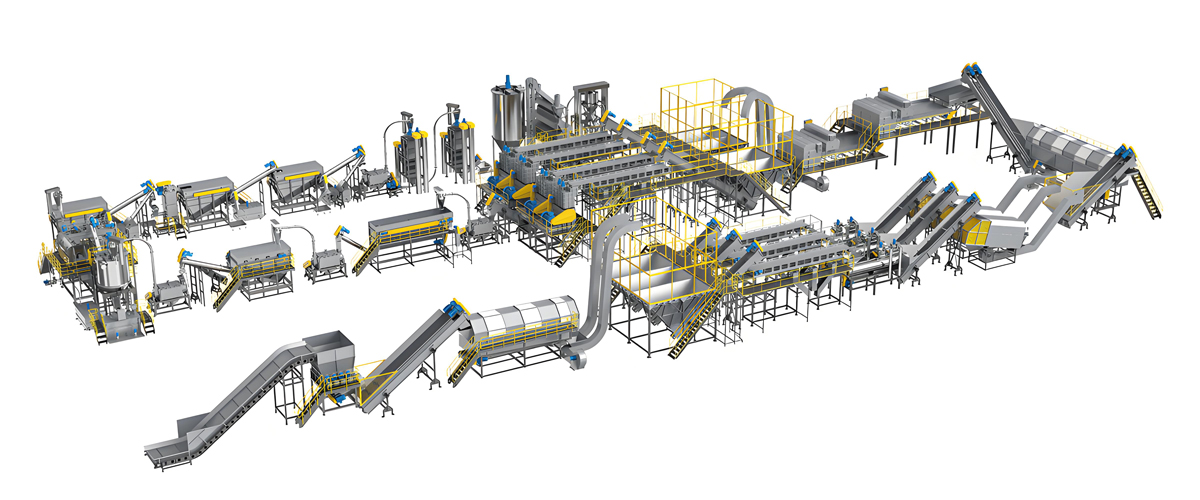
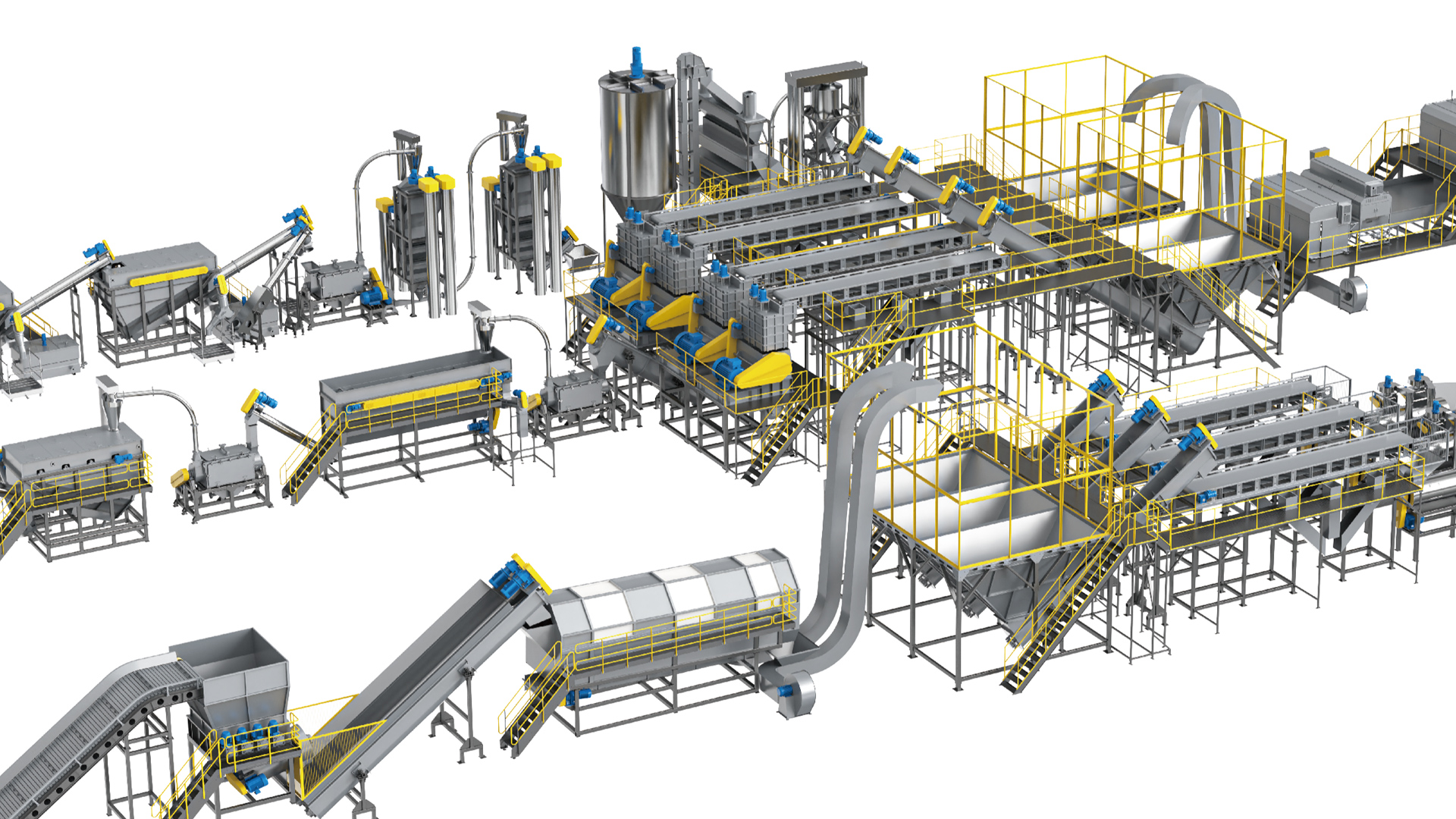
A plastic recycling machine built for PET bottles is, in practice, a complete PET bottle washing line: a series of connected modules that take post-consumer or post-industrial PET bottles and turn them into clean, uniform PET flakes ready for re-extrusion. The global plastics machinery market is valued at roughly 35 to 40 billion USD, and recycling equipment is one of its fastest-growing segments as brands race to meet recycled-content mandates. For a buyer, understanding this machine means understanding the difference between dirty bales of bottles and food-grade rPET flakes that can re-enter the bottle-to-bottle loop.
PET, or polyethylene terephthalate, is the clear plastic used for beverage bottles, food trays, and many rigid packages. When collected and processed correctly, it can be recycled mechanically into flakes and then into new bottles, sheets, strapping, or fibers. A dedicated PET bottle recycling machine does the cleaning and size-reduction work; a separate pelletizing line can later convert those flakes into recycled pellets. The washing line is the front end of that value chain, and its output purity decides everything downstream.
What makes a PET washing line a true plastic recycling machine rather than a simple grinder is integration. A loose crusher only makes dirty flakes; a washing line delivers flakes with documented purity, controlled moisture, and consistent size that a buyer can extrude without re-cleaning. That integration is why the same equipment is specified very differently for a fiber producer, a sheet maker, or a food-grade rPET plant.
The flakes a plastic recycling machine produces are not a single product. Standard flakes feed polyester staple fiber for textiles, strapping band for packaging, and non-food sheet for thermoforming. Food-grade flakes re-enter bottle and tray production, the highest-value outlet, where they compete with virgin PET on price only when purity is certified. Mechanical recycling covers the vast majority of volume today; chemical recycling is emerging for streams too contaminated for washing, but it is not yet the default choice for a bottle washing investment.
Key statistic: Global plastic production sits near 400 million tons per year, yet post-consumer plastic recycling rates remain around 9 percent globally according to UNEP data. PET bottle collection is among the highest of any plastic stream, which is why bottle-to-bottle recycling capacity is expanding fastest.
How a PET Washing Line Works: The Core Process Stages
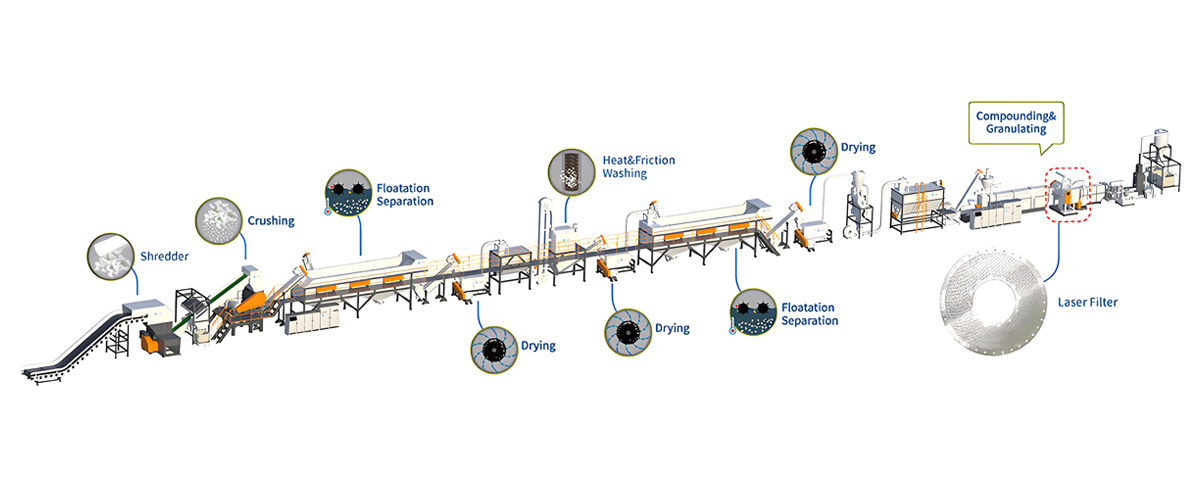
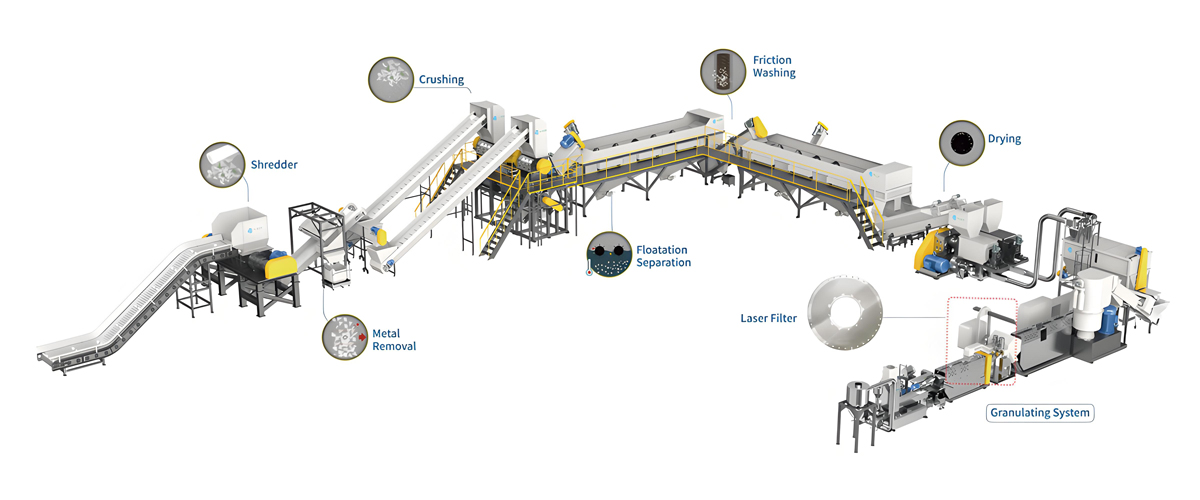
A modern PET washing line is a wet, multi-stage process. Each stage removes a specific contaminant: labels, glue, caps, rings, PVC, dirt, and residual liquids. The goal is flakes with low PVC content, low moisture, and consistent bulk density. Below are the stages a well-designed plastic recycling machine for PET bottles typically includes, in the order material flows through the plant.
Stage 1: Bale Breaking and Pre-Washing
Bottles arrive compressed into bales that can weigh several hundred kilograms. A bale breaker loosens them with rotating fingers, and a pre-wash removes surface sand, grit, and sugar residues that would otherwise abrade later equipment. This step protects the crusher and reduces load on the hot washer, and it is where most of the loose dirt leaves the stream before grinding.
Stage 2: Label Removal and Sorting
Most PET bottles carry PVC or PO labels and HDPE or PP caps. A label remover and air classifier strip labels; an optical sorter or manual station pulls out non-PET items such as PP trays, PVC bottles, and metal. Removing PVC early is critical because PVC and PET have similar densities and are hard to separate later, and even small PVC traces spoil food-grade flake by yellowing it during extrusion.
Stage 3: Wet Grinding
A wet crusher cuts bottles into roughly 10 to 16 millimeter flakes directly in a water bath. Grinding wet suppresses dust, cools the material, and begins the wash. Flake size is chosen to balance throughput with later separation efficiency, and a poorly set screen here forces the entire downstream line to work harder.
Stage 4: Hot Washing and Caustic Treatment
Hot washers at 80 to 95 degrees Celsius with a caustic solution loosen glues, oils, and residual label adhesive. This is the step that most affects final flake cleanliness and, for food-grade lines, the step that must be engineered carefully to meet EFSA or FDA expectations. Contact time, temperature, and chemical concentration are tuned to the label chemistry of the local bottle mix.
Stage 5: Friction Washing and Sink-Float Separation
A high-speed friction washer scrubs flakes, then a float tank exploits density: PET sinks while PP, PE, and most labels float and are skimmed off. A second separation stage removes residual PVC and HDPE, pushing flake purity above 99 percent. Some lines add a water bath with controlled specific gravity to pull the last PVC fraction that floats with PET.
Stage 6: Rinsing, Drying, and Screening
Clean water rinses away chemicals, a centrifuge or thermal dryer drops moisture below 1 percent, and vibrating screens remove fines and off-size flakes. The result is bagged or silo-stored PET flakes ready for sale or in-house re-extrusion. At this point the material has moved from waste bales to a specification product with a market price.
Throughout these stages, effective lines sample and monitor output rather than waiting for a finished-flake complaint. Inline metal detection, periodic PVC checks, and moisture probes let operators catch a drifting separator or a tired blade before it ships bad material. The difference between a line that merely runs and one that consistently ships specification flake is this discipline of in-process control, and it is why commissioning support matters as much as the steel.
Key Components of a PET Washing Line
The quality of a plastic recycling machine depends on how these modules are specified and integrated. Buyers should evaluate each on reliability and serviceability, because a single weak module caps the performance of the whole line.
- Bale breaker – opens compressed bales without shredding whole bottles, reducing pre-contamination and protecting the crusher.
- Label remover and air classifier – strip and separate paper, PO, and PVC labels before grinding.
- Wet crusher or granulator – the heart of size reduction; blade design and screen size set flake dimensions and energy use.
- Metal detector and destoner – remove ferrous, non-ferrous, and heavy inert contaminants that damage blades.
- Hot washer – heated, agitated tank that removes glue and organic residue.
- Friction washer – high-shear scrubbing for tough contaminants bound to the flake surface.
- Float separation tank – density-based PET recovery and PO/PP removal.
- Centrifuge or thermal dryer – brings flake moisture down to food-grade levels.
- Silo and dosing unit – buffer and meter output to packing or extrusion without surges.
- Control system – PLC and HMI with load monitoring, water recycling logic, and remote support.
Beyond the individual machines, the control system deserves as much attention as any single module. A line that coordinates bale breaking, washing, and drying through one PLC avoids the cascade where one module starves or floods the next. Remote monitoring also lets the equipment supplier diagnose problems quickly, which shortens the downtime that erodes margin on thin recycling spreads.
Washing Line Configurations by Capacity and Purity
PET bottle washing lines are usually specified by throughput and by the purity grade they target. A standard line produces flakes for strapping, fibers, or non-food sheet. A food-grade line adds tighter washing, finer separation, and often a final inspection or extrusion step. Capacity ranges from pilot lines to large municipal plants, and the right size follows your steady feedstock, not your peak ambition.
| Configuration | Throughput (kg/h) | Target Purity | Typical Use |
|---|---|---|---|
| Compact line | 500 to 1000 | Standard, 95 to 98 percent | Start-ups, regional collectors |
| Mid-range line | 1500 to 2000 | Standard to high, 98 to 99 percent | Reclaimers serving sheet and fiber |
| Food-grade line | 2000 to 4000 | Food-grade, above 99 percent | Bottle-to-bottle, food contact |
| High-capacity line | 5000 to 6000 | Food-grade, above 99.5 percent | National bottlers, large recyclers |
Polyretec, a manufacturer that pairs Austrian process technology with China-based manufacturing, offers PET bottle washing lines rated from 500 kg/h up to 6000 kg/h and designs flake grades to customer requirements. Matching capacity to your steady feedstock supply is more important than buying the largest line, because an underfed high-capacity line wastes energy and labor while a right-sized line runs at nameplate efficiency. Automation level is the other axis: manual sorting stations are cheap but labor-heavy, while optical sorters and automated packing raise capital cost but lower operating cost per ton.
Capacity and purity are not the only levers. The same tonnage can be delivered by a labor-intensive line with manual sorting or a capital-intensive line with optical sorters and automated packing. The crossover point is your labor cost and your purity target: high labor cost and food-grade ambition both push toward automation, while low labor cost and standard flakes keep manual stations competitive. Specify both the grade and the automation level together so the quote you compare is the line you actually intend to run.
Key Specifications to Consider When Buying
When comparing any plastic recycling machine for PET bottles, judge it on measurable outputs, not brochure claims. The numbers below are the ones that decide whether flakes sell at a premium or get rejected by downstream extruders.
| Specification | What Good Looks Like | Why It Matters |
|---|---|---|
| Flake purity (PET content) | Above 99 percent, food-grade above 99.5 percent | Sets resale value and food-contact eligibility |
| PVC content | Below 50 ppm for food grade | PVC contaminates re-extrusion and yellows product |
| Moisture after drying | Below 1 percent | Prevents hydrolysis in extrusion |
| Bulk density | 350 to 450 kg per cubic meter | Affects storage and feeding downstream |
| Water consumption | Closed-loop, under 1.5 cubic meters per ton | Operating cost and discharge permits |
| Installed power | Scales with capacity, 150 to 600 kW | Drives energy cost per ton |
Purity and PVC content are the two numbers that separate a commodity flake from a food-grade one. A line that quotes high throughput but delivers flakes with 200 ppm PVC will be rejected by bottle-to-bottle buyers regardless of price. Moisture matters because PET hydrolyzes in the extruder when too wet, lowering molecular weight. Water and power are the recurring costs that decide lifetime economics, so a closed-loop water system and an efficient dryer pay back faster than the headline equipment discount suggests.
Buyers should also ask how purity and moisture are verified. Reputable suppliers provide a laboratory protocol: sieve analysis for flake size, density or optical sorting checks for PVC, and oven tests for moisture. Insist on seeing results from a trial on your own bottles rather than generic certificates, because the contamination profile of your local bale is unique and generic data rarely survives first contact with a real post-consumer mix.
Leading PET Recycling Equipment Manufacturers
The PET washing segment is led by a handful of specialists, most of them European, with strong Asian and Chinese suppliers closing the gap on cost and service. Knowing the field helps buyers benchmark quotes and understand which reference installations resemble their own project.
| Manufacturer | Origin | Specialty | Positioning |
|---|---|---|---|
| Erema | Austria | Integrated washing and reprocessing | Premium, turnkey rPET |
| Sorema | Italy | Washing and separation lines | High-purity flakes |
| Starlinger | Austria | Food-grade rPET lines | Bottle-to-bottle reference |
| Polyretec | China (Austrian tech) | Cost-effective washing lines | Value with global service |
| Lindner | Austria | Shredders and pre-treatment | Robust size reduction |
| Herbold | Germany | Washing and granulation | Engineering depth |
European suppliers set the benchmark for food-grade certification and reference installations, while Chinese manufacturers such as Polyretec compete on delivered cost and lead time without abandoning the Austrian-derived process know-how that defines modern PET washing. The practical advice is to benchmark at least one European quote against one Asian quote, then weigh certification support and local service against the price gap for your specific flake grade.
It is worth noting that the leading European names dominate reference food-grade plants and certification support, which matters most for bottle-to-bottle projects, whereas value-focused suppliers win on delivery time and total installed cost for standard and mid-grade flakes. Neither is universally better; the right choice follows your outlet and your risk tolerance on certification, not a flag on a brochure.
Cost Analysis: What Does a PET Washing Line Cost?
A plastic recycling machine for PET bottles is a capital investment measured in hundreds of thousands of US dollars, not thousands, once you include installation, commissioning, and water treatment. The table below reflects typical 2026 market ranges; exact pricing depends on capacity, purity grade, and automation.
Total cost of ownership extends beyond the machine itself. Foundation and utilities, water treatment to meet discharge limits, and crane or conveyor interfaces are often underestimated. Spare parts for wear items such as blades and screens should be budgeted as a recurring line, and a realistic commissioning and training budget prevents the false economy of a line that starts late or runs below specification. When comparing quotes, normalize them to installed, trainable capacity rather than ex-works equipment price, because the lowest headline number rarely corresponds to the lowest cost per clean ton.
| Capacity Tier | Equipment Range (USD) | Installed TCO (USD) | Payback Driver |
|---|---|---|---|
| 500 to 1000 kg/h | 80,000 to 180,000 | 120,000 to 250,000 | Local collection margin |
| 1500 to 2000 kg/h | 200,000 to 400,000 | 300,000 to 550,000 | Flake premium, volume |
| 3000 to 4000 kg/h food-grade | 450,000 to 800,000 | 650,000 to 1,100,000 | Food-grade contract price |
| 5000 to 6000 kg/h food-grade | 900,000 to 1,500,000 | 1,300,000 to 2,000,000 | Long-term brand offtake |
Return on investment is driven by the spread between bale cost and clean flake price, which widens sharply for food-grade material. Buyers should budget for water treatment, spare blades, and at least one week of operator training, and they should model energy and labor per ton rather than just the equipment line item. A line purchased only on lowest price often costs more in downtime and rejected flakes than a better-specified machine, because the hidden cost of a 2 percent purity miss is a rejected shipment, not a discount.
As a worked example, a 2000 kg/h food-grade line might process around 14000 tons per year at a flake premium of 150 to 300 USD per ton over standard grade, against added energy and labor of roughly 40 to 80 USD per ton; the incremental margin can recover the food-grade premium in the equipment price within two to four years, after which it is pure upside on every ton. The same logic punishes a line that misses grade, because a 200 ppm PVC result converts a premium order into a discounted one overnight.
How to Choose the Right PET Washing Line
Choosing the right plastic recycling machine is a process, not a purchase. Follow these steps to avoid the most common mistakes that sink otherwise promising projects.
- Audit your feedstock. Know the bottle mix, contamination, and steady monthly volume before sizing capacity, because a line sized to a peak that never arrives runs half-empty.
- Define your flake grade. Decide whether you need standard or food-grade output, because the spec changes the whole design and the certification path.
- Verify separation performance. Ask for a trial run on your own material and measure PVC and purity, not just throughput, since vendors optimize demos.
- Check water and energy loops. Closed-loop water and efficient drying cut operating cost for the life of the machine and ease permit approval.
- Confirm service and spares. Blades, screens, and bearings wear; local stock and remote support shorten downtime that otherwise erases margins.
- Validate compliance. Ensure CE marking, ISO 9001, and a path to EU 10/2011 or FDA food-contact documentation if needed.
The most common mistake is buying capacity before securing feedstock. A 4000 kg/h line is only economical if you can feed it 4000 kg/h of sortable bottles every day; many operators would do better with a 1500 kg/h line running at full tilt than a 4000 kg/h line running at half. The second mistake is neglecting water discharge permits, which can delay startup longer than equipment lead time.
Finally, plan for commissioning and training as part of the purchase, not an afterthought. A line commissioned with your real feedstock, run by operators who understand separation physics, reaches nameplate purity faster and stays there. Budget a supported ramp of several weeks, and keep the supplier engaged through the first full campaign rather than cutting them loose at first flake, because that is exactly when the hidden tuning happens.
Industry Trends in PET Bottle Recycling in 2026
Three forces are reshaping the PET washing business in 2026. First, recycled-content mandates in the European Union and several US states are lifting demand for food-grade rPET faster than supply can grow, which keeps the flake premium healthy. Second, AI-assisted optical sorting is raising purity while lowering labor, letting smaller lines hit food-grade specs that once required heavy manual sorting. Third, brands are signing long-term offtake agreements, which makes a documented, certifiable washing line far more valuable than a cheap one.
Mechanical recycling remains the backbone, but chemical recycling pilots are beginning to complement it for heavily contaminated streams that mechanical lines cannot clean. For most buyers, the practical move is a well-specified mechanical PET washing line with room to add inspection and extrusion later, protecting today’s budget while keeping the bottle-to-bottle upgrade path open.
Regionally, Asia-Pacific remains the fastest-growing market by volume, driven by rising collection rates and domestic rPET capacity, while Europe leads on food-grade regulation and brand commitments. North American momentum is building as state-level mandates take effect. For equipment buyers this means a global supplier base but also divergent certification expectations, so specify the target market before finalizing the line design, because a line certified for one region is not automatically accepted in another.
Frequently Asked Questions
What is a PET bottle recycling machine?
It is a washing line that cleans and size-reduces used PET bottles into flakes suitable for re-extrusion, typically including sorting, grinding, hot washing, separation, and drying modules.
How does a PET washing line work?
Bottles are debaled, labels and caps are removed, flakes are produced by wet grinding, then hot and friction washing strip contaminants, density separation removes PVC and floatables, and finally flakes are rinsed, dried, and screened.
How much does a PET washing line cost?
Equipment typically ranges from 80,000 USD for a compact 500 kg/h line to more than 1,500,000 USD for a 6000 kg/h food-grade plant, with installed cost higher after water treatment and commissioning.
What is the difference between standard and food-grade flakes?
Food-grade flakes meet stricter purity limits, especially for PVC and residual contaminants, and follow food-contact documentation such as EU 10/2011 or FDA expectations, allowing bottle-to-bottle use.
Which plastic recycling machine is best for PET bottles?
For most operations a wet PET washing line with hot washing and sink-float separation is best; choose capacity and purity grade to match your feedstock and intended flake market.
How to maintain a PET washing line?
Follow scheduled blade and screen changes, monitor water quality, lubricate bearings, and keep spare wear parts in stock; most lines run reliably with basic planned maintenance.
What materials can a PET washing line process?
It is optimized for PET bottles and PET rigid packaging; mixing in high PVC or large non-PET fractions degrades flake quality and should be removed upstream by sorting.
Conclusion
A plastic recycling machine for PET bottles is the front end of the circular economy for packaging: it converts waste bottles into clean rPET flakes that brands urgently need. Buy on measured flake purity, water and energy loops, and proven service, not on headline price. Whether you start with a 500 kg/h compact line or scale to a 6000 kg/h food-grade plant, the right washing line turns a low-value waste stream into a premium, certifiable raw material. Polyretec designs PET bottle washing lines across that full capacity range and supports commissioning and training worldwide. Contact the engineering team to size a line to your feedstock and flake grade, and to map the upgrade path from standard flakes to food-grade bottle-to-bottle output.
The bottom line for any buyer evaluating a plastic recycling machine for PET bottles is simple: treat flake purity as the product, not the machine as the product. When you specify, trial, and verify purity on your own material, the capital decision becomes straightforward, and the line pays for itself in clean, certifiable rPET rather than in idle capacity. The window for food-grade economics is open now, and it rewards operators who plan feedstock, permits, and certification together from day one.