
With the rapid development of the global chemical, pesticide, daily chemical and coating industries, the consumption of rigid plastic packaging containers such as chemical barrels, pesticide bottles, detergent buckets and paint buckets continues to grow, generating a huge amount of rigid plastic waste every year. Most of these waste plastic containers have residual chemical raw materials, oil stains, dyes and other pollutants, which belong to hazardous waste in a strict sense. If they are discarded or landfilled at will, they will cause serious pollution to soil and water sources, and also waste valuable plastic resources. Under the background of global circular economy promotion and increasingly strict environmental protection regulations, professional recycling and reuse of chemical plastic bottles and barrels has become an inevitable trend of industry development. The core equipment to realize high-value recycling of such highly polluted rigid plastic waste is the professional chemical bottle washing line.
Ordinary plastic washing lines are difficult to deal with heavily polluted chemical plastic waste, and there are also great safety risks in the treatment process. As a professional manufacturer focusing on plastic recycling equipment, POLYRETEC has launched a special chemical bottle washing line for the characteristics of rigid plastic waste such as chemical barrels and pesticide bottles. Relying on multi-stage deep cleaning process, corrosion-resistant equipment design, closed-loop sewage treatment system and highly automated operation mode, the production line can efficiently remove various residual pollutants on the surface and inside of plastic containers, and produce clean recycled plastic flakes that meet the secondary processing standards, helping recycling enterprises achieve safe, efficient and compliant production. This article will systematically analyze the recycling value and technical difficulties of chemical plastic bottles, explain the process flow and core configuration of professional washing lines, provide detailed investment cost and return on investment analysis, and share equipment selection and operation management experience, providing a comprehensive reference for rigid plastic recycling enterprises.
1. Recycling Value and Industry Pain Points of Chemical Rigid Plastic Waste
1.1 Huge Resource Value and Policy-Driven Demand
Chemical bottles and barrels are mainly made of HDPE, PP and other high-quality rigid plastics, which have excellent mechanical strength, corrosion resistance and processing performance. After professional cleaning and recycling, they can be used to produce new plastic barrels, plastic pallets, pipes, profiles and other products, with very high reuse value. Compared with new plastic raw materials, qualified recycled rigid plastic flakes can reduce the cost by 30% to 50%, and are widely welcomed by downstream plastic processing enterprises. With the continuous rise of global crude oil prices and the promotion of plastic restriction and circular economy policies in various countries, the market demand for high-quality recycled rigid plastic materials continues to grow, and the price remains firm, bringing good profit space for the recycling industry.
At the policy level, more and more countries have clearly stipulated the recycling responsibility of plastic packaging, requiring producers to bear the recycling and disposal costs of packaging waste, and encouraging the use of recycled plastic raw materials. The European Union’s Plastic Strategy and Packaging Waste Directive, the United States’ state-level plastic recycling bills, and China’s solid waste resource utilization policies all provide strong policy support for the standardized recycling of chemical plastic bottles. In this context, building a professional chemical bottle washing line not only has good economic benefits, but also conforms to the direction of environmental protection policy development, with broad market prospects.
1.2 Technical Difficulties in Treating Heavily Polluted Chemical Plastics
Different from ordinary domestic plastic waste, chemical bottles and barrels usually have a large amount of residual chemical liquids, pastes, oil stains, dyes and other pollutants, and some also have corrosiveness and toxicity, which brings great challenges to the recycling and cleaning process. First of all, the residual chemicals have strong adhesion, and ordinary water washing can not effectively remove them. High-temperature hot washing and special cleaning agents are needed, which puts forward higher requirements for the corrosion resistance and high temperature resistance of the equipment. If the cleaning is not thorough, the recycled materials will have peculiar smell and discoloration, which can only be used for low-end products with very low value.
Secondly, there are potential safety hazards in the treatment process. Volatile gases generated by residual chemicals during crushing and heating may cause poisoning or even explosion risks. The traditional open washing line has poor working environment and high safety risks for operators. Thirdly, the washing process will produce a large amount of sewage containing chemical components. If it is discharged directly without treatment, it will cause serious environmental pollution, and enterprises will face huge environmental compliance risks. Most small recycling workshops do not have professional sewage treatment capacity, and have been gradually shut down under the tightening environmental protection supervision. In addition, chemical plastic waste is often mixed with a variety of impurities such as metal accessories, labels, rubber rings and glass fragments, which requires a perfect sorting and impurity removal system to ensure the purity of final recycled materials.
1.3 Deficiencies of Traditional Washing Processes
At present, many small and medium-sized recycling enterprises still use simple traditional washing processes to treat chemical plastic bottles, which have many shortcomings. The traditional process usually only includes simple crushing and one or two times of water washing, with poor cleaning effect. The residual rate of pollutants is high, and the quality of recycled materials is unstable, which can only be sold at a low price. The equipment is mostly made of ordinary carbon steel, which is easy to corrode and damage under the corrosion of chemical agents, with short service life and high later maintenance cost. The open production mode has serious dust and waste gas overflow, poor working environment and large safety risks. The sewage is discharged directly or simply precipitated, which can not meet the environmental protection standards, and there are great policy risks.
In terms of automation, traditional lines rely heavily on manual work, requiring a large number of workers to be responsible for feeding, sorting and material transfer. The labor cost is high, and workers are in direct contact with polluted plastics, which is harmful to their health. The production efficiency is low, and the quality of finished products fluctuates greatly with the level of operators. All these factors restrict the large-scale and standardized development of chemical plastic bottle recycling. To solve these problems, it is necessary to adopt a professional, fully enclosed and highly automated chemical bottle washing line to achieve safe, efficient and compliant production.
2. Core Process Flow of POLYRETEC Chemical Bottle Washing Line
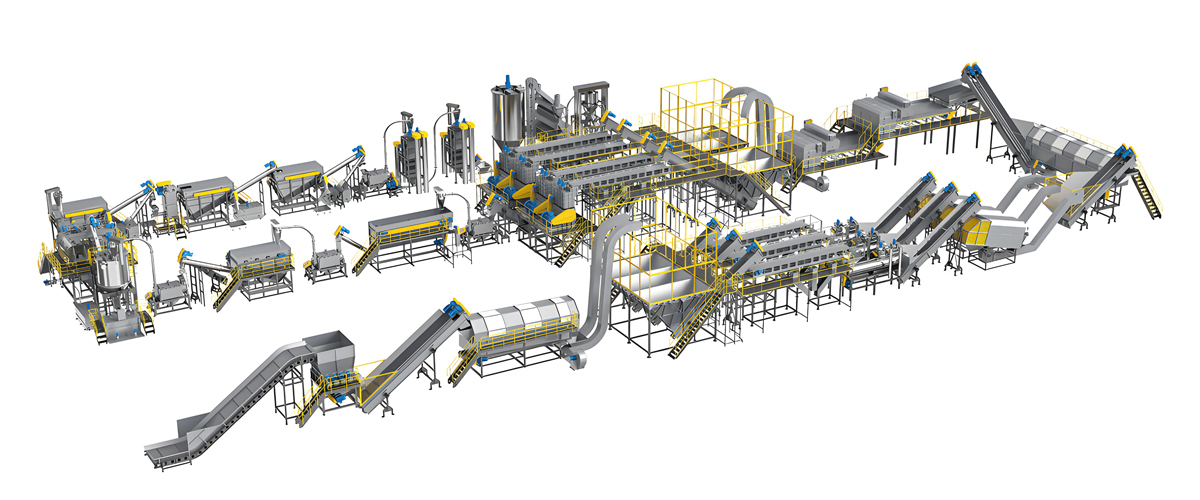
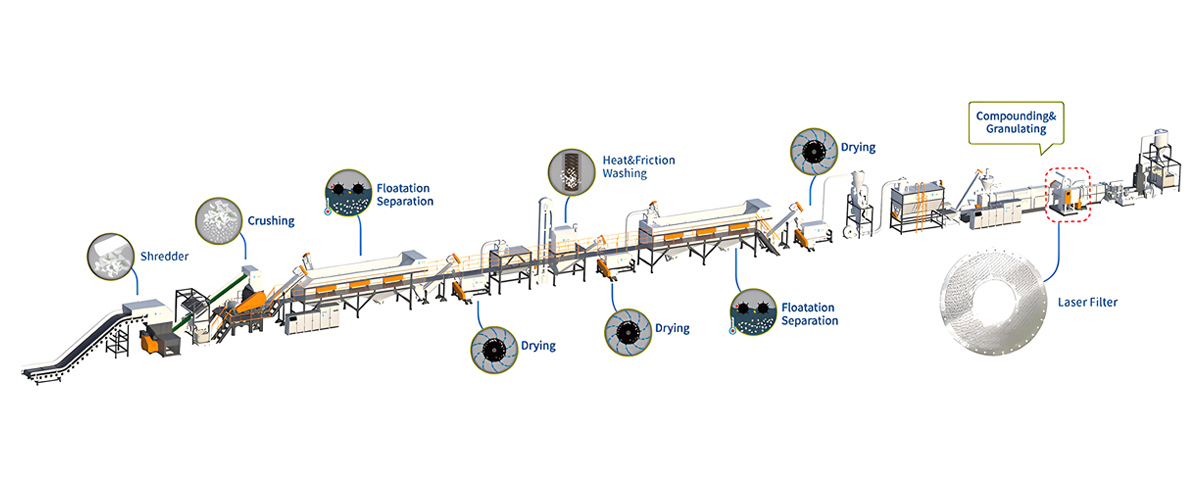
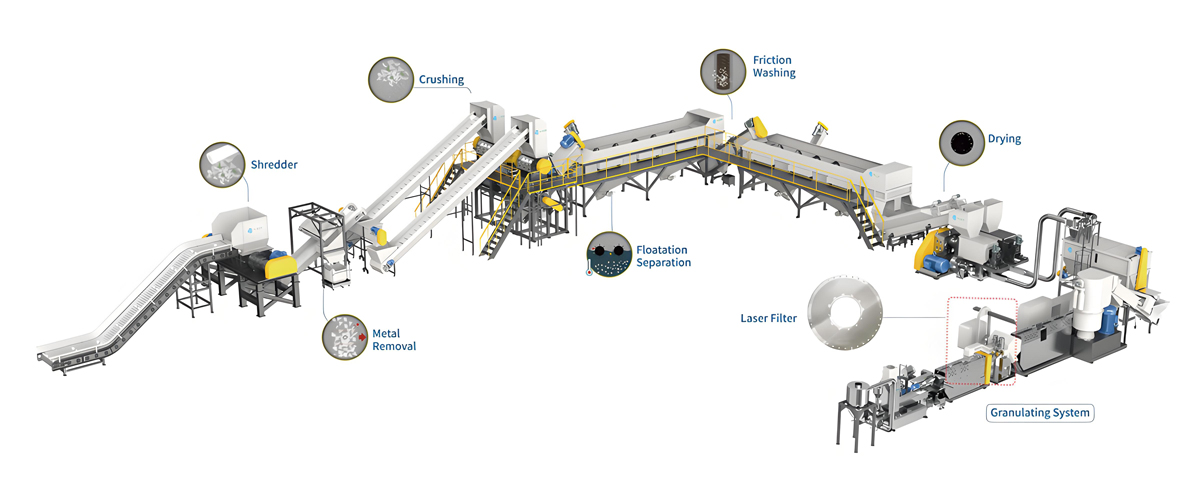
POLYRETEC chemical bottle washing line adopts a multi-stage progressive deep cleaning process, which goes through multiple links from raw material pretreatment to final finished product discharge, and removes various pollutants layer by layer, so as to ensure that the final recycled flakes reach high cleanliness. The whole line has reasonable process design, high degree of automation and good operation safety, and can stably treat various heavily polluted rigid plastic waste.
2.1 Pretreatment and Sorting Unit
The first link of the washing line is the pretreatment and sorting unit, which is mainly used for primary sorting and impurity removal of raw materials, removing non-plastic impurities and preparing for subsequent crushing and cleaning. The raw materials are evenly fed to the manual sorting platform through the feeding conveyor belt. Workers pick out large pieces of impurities such as metal, glass, rubber and wood mixed in the waste bottles and barrels, and simply sort plastics of different materials and colors. The sorting platform is equipped with an exhaust air device, which can discharge the volatile waste gas generated in the feeding process in time to protect the health of workers.
After manual sorting, the materials enter the metal separator to remove ferromagnetic metal impurities such as iron nails and iron sheets mixed in the plastics, so as to prevent hard metal objects from entering the crusher and damaging the blade and the machine body. For materials with more non-ferrous metals such as aluminum caps, an eddy current separator can be configured to efficiently remove non-ferrous metal impurities and further improve the purity of materials. The pretreatment link can effectively remove large impurities, protect subsequent core equipment, and lay a foundation for improving the quality of finished products.
2.2 Heavy-Duty Crushing and Label Removing Unit
After pretreatment, the whole chemical bottles and barrels enter the heavy-duty crusher for crushing processing. POLYRETEC PR-C series heavy-duty crusher adopts optimized rotor structure and high-hardness alloy blades, which can easily crush various rigid plastic containers of different sizes and thicknesses, and the discharged flakes are uniform in size, usually between 12mm and 30mm, which can be adjusted by replacing screens with different apertures. The crushing chamber is designed with a sealed structure and is equipped with a dust collection device to reduce dust and waste gas overflow during the crushing process. The crusher has overload protection function. When hard objects are accidentally mixed in, it can automatically reverse and discharge materials, effectively protecting the motor and blades from damage.
For waste plastics with a large number of paper labels and adhesive labels, a label remover can be configured after crushing. The high-speed friction of the label remover can separate the labels from the plastic flakes, and then the labels are discharged out of the system through the wind sorting system, with a label removal rate of more than 95%. Removing labels before cleaning can greatly reduce the burden of the subsequent cleaning process, improve the cleaning effect and the purity of finished products.
2.3 Pre-Washing and Sink-Float Separation Unit
The crushed plastic flakes enter the pre-washing tank, also known as the sink-float separation tank, for preliminary cleaning and density separation. The tank is filled with clean water. The materials are fully stirred and rubbed in the water to remove surface dust, sediment and part of floating pollutants. At the same time, the density difference is used for separation. Polyolefin plastics such as PP and HDPE float on the water surface, while heavy impurities such as glass, metal and stone sink to the bottom of the tank and are automatically discharged through the screw at the bottom.
The pre-washing tank is made of high-quality stainless steel as a whole, which has good corrosion resistance and is suitable for long-term operation in chemical sewage environment. The tank is equipped with a spiral stirring device to make the materials fully dispersed and cleaned in water. The floating materials on the water surface are automatically scraped to the next process by the scraper conveyor. The water in the tank is filtered by the circulating filtration system and can be recycled, reducing fresh water consumption. The pre-washing link can remove more than 60% of surface impurities and sediment, lighten the burden of the subsequent deep cleaning link, and save the dosage of cleaning agent and heating energy consumption.
2.4 High-Temperature Hot Washing Unit with Chemical Agents
Hot washing is the core link to remove heavy oil, chemical residues and stubborn stains. The materials enter the hot washing tank, which is filled with hot water added with special environmentally friendly cleaning agents. The temperature is usually controlled between 80℃ and 95℃. Under the combined action of high temperature and chemical agents, the stubborn oil stains, chemical residues and adhesives on the surface of plastic flakes are fully decomposed and separated. The hot washing tank is equipped with a continuous stirring device to make the materials fully contact with the cleaning liquid, ensuring uniform cleaning effect.
The hot washing tank is made of thickened high-quality stainless steel, which has excellent corrosion resistance and high temperature resistance, and can adapt to the long-term action of various chemical cleaning agents. The heating system can choose steam heating or electric heating, which can be determined according to the actual conditions of customers. The temperature control system adopts PID automatic control, with accurate temperature and small fluctuation, ensuring stable cleaning effect. The specially formulated cleaning agent has strong decontamination ability, is easy to biodegrade, and will not cause secondary pollution. After hot washing, most of the stubborn pollutants on the surface of plastic flakes are removed, and the cleanliness of the materials is greatly improved.
2.5 High-Speed Friction Washing Unit
After hot washing, the materials enter the high-speed friction washing machine for mechanical deep cleaning. The friction washing machine uses the high-speed rotating blade to drive the plastic flakes to move at high speed, so that the flakes rub against each other and between the flakes and the inner wall of the machine body, mechanically stripping the softened residual stains and attachments on the surface. The friction washing machine is equipped with a water spray device, which washes away the stripped dirt while rubbing, to prevent the dirt from adhering to the plastic surface again.
The inner wall of the friction washing machine is lined with wear-resistant stainless steel plate, which has high strength and good wear resistance. The screen at the discharge end can timely discharge sewage and fine impurities to avoid secondary pollution of materials. The high-speed friction washing can further improve the cleanliness of plastic flakes, especially for the surface pores and uneven parts, and the cleaning effect is far better than that of simple soaking. After friction washing, the surface of plastic flakes is bright and clean, and the residual amount of pollutants is extremely low.
2.6 Multi-Stage Rinsing and Dehydration Unit
After friction washing, the plastic flakes carry a large amount of sewage and residual cleaning agent, which need to be cleaned by multi-stage rinsing. The materials pass through two to three stages of clear water rinsing tanks in turn, and are cleaned step by step with clean water from low to high cleanliness, gradually removing the residual sewage and cleaning agent on the surface of the flakes. The rinsing water adopts countercurrent circulation design, that is, clean water enters from the last stage of rinsing tank and flows forward step by step, making full use of water resources and greatly reducing fresh water consumption.
After rinsing, the materials enter the centrifugal dehydrator for dehydration. The dehydrator uses high-speed rotation to generate centrifugal force to throw off the surface moisture of the plastic flakes. The moisture content of the materials after dehydration can be reduced to about 3% to 5%, which can meet the requirements of subsequent storage, packaging or granulation. The dehydrator is made of stainless steel, with stable operation and high dehydration efficiency. The dehydrated clean flakes are conveyed to the finished product silo through the closed conveying system, and can be automatically weighed and packaged by the automatic packaging machine.
2.7 Optional Fine Sorting and Sewage Treatment Unit
For customers with higher requirements for material purity, an electrostatic separator or optical sorting machine can be added after cleaning to accurately sort plastic flakes of different materials such as PP, PE and PET, further improving the purity of finished products. The color sorting machine can also be configured to classify materials of different colors to meet the needs of high-end applications.
The washing line is equipped with a complete sewage treatment system as standard, which can treat the sewage generated in the production process through sedimentation, filtration, air flotation, biodegradation and other processes, so that the water quality can reach the reuse standard and be recycled to the production line, with a water recycling rate of more than 95%. Only a small amount of fresh water needs to be supplemented regularly, which greatly reduces sewage discharge. The sludge generated in the treatment process is pressed and dehydrated by a filter press and then disposed of in a harmless manner, fully meeting the local environmental protection discharge standards. The closed-loop water treatment system fundamentally solves the problem of environmental compliance of chemical plastic washing, and helps enterprises achieve green production.
3. Technical Advantages of POLYRETEC Professional Chemical Bottle Washing Line
Compared with ordinary plastic washing lines on the market, POLYRETEC chemical bottle washing line has obvious technical advantages in equipment material, safety design, cleaning effect, energy conservation and environmental protection, and automation degree, and is specially built for heavily polluted rigid plastic recycling scenarios.
3.1 All-Stainless Steel Corrosion-Resistant Design
Considering the corrosiveness of chemical residual liquids and cleaning agents, all parts of the washing line in contact with materials and water are made of high-quality corrosion-resistant stainless steel, including cleaning tanks, friction washers, dehydrators, screw conveyors, pipelines, etc. Compared with ordinary carbon steel equipment, stainless steel material has excellent acid and alkali corrosion resistance, will not rust and corrode due to long-term contact with chemical sewage, and has a service life of more than 3 times that of ordinary equipment. It reduces the later maintenance cost and avoids the problem of iron pollution affecting the quality of recycled materials.
Key components such as crusher blades are made of high-chromium alloy tool steel, which has both high hardness and good toughness, and can maintain sharpness for a long time when crushing chemical barrels containing impurities. The service life of the blades is more than 2 to 3 times that of ordinary blades, reducing the frequency of replacement and shutdown maintenance time. The overall design life of the whole set of equipment is more than 15 years, which can create stable value for customers for a long time.
3.2 Fully Enclosed Safe Production Structure
Safety is the primary consideration in chemical plastic recycling. POLYRETEC washing line adopts a fully enclosed design as a whole. All links from crushing, cleaning to conveying are operated in a closed space, which can effectively prevent the overflow of toxic and harmful volatile gases and dust, and protect the health of on-site operators. The production line is equipped with a waste gas collection and treatment system, which collects the waste gas generated in each link in a unified manner, and discharges it after being treated by activated carbon adsorption and other processes, fully meeting the standard of waste gas emission.
The equipment is equipped with perfect safety protection devices, including overload protection, over-temperature alarm, leakage protection, emergency stop device, etc. When abnormal conditions occur during operation, the system can automatically alarm and stop in time to avoid safety accidents. The electrical control cabinet adopts explosion-proof design, which is suitable for the production environment containing flammable and explosive volatile gases, further improving the safety of production. The fully enclosed safe production structure not only protects the health of employees, but also avoids the environmental protection and safety risks of enterprises, so that enterprises can operate with peace of mind.
3.3 High Cleaning Efficiency and Stable Finished Product Quality
Through the combination of multi-stage progressive cleaning processes such as pre-washing, hot washing, friction washing and multi-stage rinsing, the washing line can efficiently remove various pollutants such as residual chemicals, oil stains, pigments, dust and labels on the surface of chemical plastic bottles and barrels. The cleaning cleanliness can reach more than 98%, and the recycled flakes have bright color, no peculiar smell and low impurity content, which can directly enter the downstream high-end application scenarios such as blow molding and pipe extrusion, and the selling price is much higher than that of roughly cleaned materials.
The whole line adopts automatic control, and all process parameters such as temperature, concentration and cleaning time are accurately controlled, which will not fluctuate due to human factors, ensuring the stability of cleaning quality of each batch of products. Stable and reliable product quality helps enterprises establish a good market reputation, win long-term cooperative customers and obtain higher product profits.
3.4 High Degree of Automation and Low Labor Dependence
The whole washing line adopts PLC intelligent control system, and the whole production process from feeding, crushing, cleaning to finished product packaging runs automatically. Only 2 to 3 operators are needed to take charge of feeding patrol, parameter monitoring and simple maintenance, which greatly reduces the number of operators and saves labor costs. The control interface is a large-size touch screen, which displays the operation status and parameters of each equipment in real time. The operation is intuitive and simple, and workers can master it after short-term training.
The system has perfect fault self-diagnosis function. When equipment abnormality occurs, it can automatically send out sound and light alarm, display the cause of the fault and treatment suggestions, and help operators quickly eliminate the fault. For large recycling enterprises, the production line can also be connected to the MES system to realize remote monitoring and data statistics, and improve the management level of the factory. The high degree of automation not only reduces labor costs, but also reduces the time that workers are exposed to polluted environments, and improves the safety of production operations.
3.5 Energy Saving and Environmental Protection with Closed-Loop Water Circulation
The washing line is equipped with a complete sewage treatment and recycling system. The production wastewater is treated by sedimentation, filtration, air flotation, biochemical treatment and other processes, and then recycled to the production line. The water recycling rate reaches more than 95%, which greatly reduces fresh water consumption and sewage discharge. Compared with the traditional open washing line, it can save more than 80% of water resources, which not only reduces the water cost, but also solves the problem of environmental compliance, and avoids the risk of high fines and production suspension caused by sewage discharge.
In terms of energy saving, the production line adopts frequency conversion energy-saving design, and the motor power can be automatically adjusted according to the actual load, reducing energy waste. The hot washing tank is equipped with an insulation layer to reduce heat loss and save heating energy consumption. The energy-saving design reduces the operating cost of the production line and improves the profitability of the project.
4. Configuration Specifications and Investment Cost Analysis
POLYRETEC provides chemical bottle washing lines of different specifications to meet the needs of customers with different production scales. The following is a detailed introduction of the configuration and investment cost of common models for reference.
4.1 Initial Investment Breakdown by Production Capacity
Small-scale production line with a processing capacity of 300 to 500 kg per hour is suitable for small recycling enterprises and start-up projects. The standard configuration includes feeding conveyor, manual sorting platform, magnetic separator, heavy-duty crusher, pre-washing tank, hot washing tank, friction washing machine, rinsing tank, centrifugal dehydrator, finished product conveyor and control system. The FOB price of the standard configuration is about 55,000 to 75,000 US dollars. If the sewage treatment system and label remover are added, the total investment is about 80,000 to 100,000 US dollars. This type of production line covers a small area, has low investment and quick effect, and is very suitable for initial entrepreneurs and small regional recycling stations.
Medium-sized production line with a processing capacity of 800 to 1200 kg per hour is the most widely used model, suitable for medium-sized recycling enterprises and regional waste treatment centers. On the basis of the small line, this configuration increases the scale of each unit, adds a label remover, a two-stage friction washing and a more perfect water circulation treatment system, with better cleaning effect and higher degree of automation. The FOB price of the standard configuration is about 120,000 to 160,000 US dollars. With the complete sewage treatment system and automatic packaging machine, the total investment is about 170,000 to 210,000 US dollars. Medium-sized production lines have both output efficiency and investment cost, with strong profitability and wide application range, which is the first choice for most customers.
Large-scale production line with a processing capacity of 1500 to 2000 kg per hour is suitable for large recycling groups, industrial park waste treatment centers and regional renewable resource bases. This configuration adopts double-stage cleaning process, with higher cleaning accuracy and larger processing capacity. It is equipped with electrostatic sorting or optical sorting equipment, complete sewage treatment and waste gas treatment system, fully meeting the highest environmental protection standards. The degree of automation is higher, and functions such as automatic batching and automatic packaging are added. The FOB price of the standard configuration is about 250,000 to 320,000 US dollars. With all supporting systems, the total investment is about 330,000 to 400,000 US dollars. Although the investment amount of large-scale production lines is relatively high, the unit processing cost is lower, the scale benefit is more obvious, and the profitability is stronger.
4.2 Annual Operating Cost Calculation
Taking the most common medium-sized 1000 kg per hour production line as an example, the annual operating cost is calculated based on 300 working days per year and 20 hours of effective operation per day, with an annual processing capacity of about 6000 tons of waste chemical plastic bottles.
Raw material cost is the main part of the cost. The purchase price of waste HDPE chemical barrels varies greatly in different regions, generally between 200 and 350 US dollars per ton. Calculated at an average price of 280 US dollars per ton, the annual raw material purchase cost is about 1,680,000 US dollars. The comprehensive recovery rate of cleaned finished products is about 90%, and about 5400 tons of clean recycled flakes can be produced annually.
Electricity cost: the total installed power of the whole production line is about 230 kW. Due to the adoption of frequency conversion energy-saving design, the actual average operating power is about 160 kW. Calculated at an industrial electricity price of 0.1 US dollars per kWh, the annual electricity cost is about 96,000 US dollars.
Water and cleaning agent cost: the production line adopts closed-loop water circulation, with very low fresh water consumption. Including the cost of cleaning agent, the annual cost is about 12,000 US dollars.
Labor cost: the production line is equipped with 3 operators per shift, and a total of 6 workers are required for two-shift production. Calculated at an average annual salary of 6,000 US dollars per person, the annual labor cost is about 36,000 US dollars. In regions with high labor costs, the cost saving effect of automated production lines is more significant.
Equipment maintenance and depreciation cost: under normal use and standardized maintenance, the annual maintenance and spare parts cost is about 3% of the total equipment price, that is, about 5,700 US dollars. In addition, plant rent and other management expenses are about 25,000 US dollars per year.
Overall, excluding raw material costs, the total annual operating cost is about 174,700 US dollars.
4.3 Revenue Estimation and Investment Payback Period
In terms of income, the selling price of clean HDPE recycled flakes after professional cleaning varies according to quality and region, generally between 450 and 600 US dollars per ton. Calculated at an average price of 520 US dollars per ton, the annual sales revenue of 5400 tons of finished products is about 2,808,000 US dollars.
Annual gross profit = sales revenue – raw material cost = 2,808,000 – 1,680,000 = 1,128,000 US dollars.
Annual net profit = gross profit – operating costs excluding raw materials = 1,128,000 – 174,700 = 953,300 US dollars.
Calculated according to the total initial investment of 190,000 US dollars for the medium-sized production line with complete configuration, the static investment payback period is about 190,000 / 953,300 ≈ 0.2 years, that is, about 2.4 months. Even considering factors such as insufficient capacity utilization and raw material price fluctuations, calculated on the basis of 70% capacity utilization, the investment payback period is only about 3.4 months.
It can be seen that investing in a professional chemical bottle washing line has extremely high return on investment and short payback period. While obtaining considerable economic benefits, it also has good environmental and social benefits. For small production lines, although the total profit is slightly lower, the investment is less, and the payback period is also about 3 to 4 months, which also has very good economic benefits.
5. Applicable Scenarios and Selection Suggestions
5.1 Wide Range of Applicable Materials
POLYRETEC chemical bottle washing line has strong adaptability and can handle various rigid plastic waste. The main applicable materials include: various chemical plastic barrels, including HDPE and PP material chemical raw material barrels, paint barrels, coating barrels, lubricating oil barrels, etc.; pesticide bottles and veterinary drug bottles, including various high-density plastic bottles containing pesticides and veterinary drugs; daily chemical packaging barrels, such as detergent barrels, laundry detergent barrels, disinfectant barrels, etc.; industrial plastic turnover boxes and plastic pallets; other rigid plastic packaging containers with oil stains and chemical residues. For different types of materials, the process parameters can be flexibly adjusted to achieve the best cleaning effect.
Correspondingly, the target customers of the production line are also very extensive, including plastic recycling enterprises, hazardous waste treatment enterprises, chemical enterprises that treat their own packaging waste, daily chemical enterprises, renewable resource companies, environmental protection engineering companies, etc. The recycled finished flakes can be widely used in the production of new plastic barrels, plastic pipes, plastic profiles, plastic pallets, blow molded products, injection molded parts and other fields, with broad market demand and smooth sales channels.
5.2 Key Points for Equipment Selection
When selecting a chemical bottle washing line, enterprises should comprehensively consider according to their own actual situation. First of all, determine the appropriate processing capacity according to the local waste supply and market demand. It is necessary to avoid insufficient production capacity to meet market demand, and also to avoid excessive production capacity leading to idle equipment. For start-ups, it is recommended to choose a small production line first, and then expand the scale after the operation is stable and the channels are mature.
Secondly, select the appropriate process configuration according to the pollution degree of raw materials and the quality requirements of finished products. If the raw materials are heavily polluted and require high cleanliness of finished products, it is necessary to increase the number of hot washing and friction washing stages, and configure a more perfect sewage treatment system. If the raw materials are relatively clean and the quality requirements are general, the process can be appropriately simplified to save investment.
Finally, we must attach great importance to the environmental protection and safety of the equipment. Chemical plastic washing involves hazardous waste and sewage discharge, which must meet the local environmental protection and safety production requirements. We should choose a regular manufacturer with mature technology and perfect supporting environmental protection facilities, and do not blindly pursue low prices, so as to avoid being unable to put into normal production due to environmental protection problems in the later stage.
6. Why Choose POLYRETEC as Your Equipment Supplier
6.1 Rich Industry Experience and Customized Solution Capability
POLYRETEC has been focusing on the R&D and manufacturing of plastic recycling equipment for many years, and has a technical R&D team composed of senior engineers with rich industry experience. The company has accumulated hundreds of plastic washing line project cases, served customers in dozens of countries and regions around the world, and is familiar with the waste characteristics and environmental protection requirements of different regions. For the recycling of chemical plastic bottles, POLYRETEC has mature process technology and rich project experience, and can provide targeted solutions according to the actual situation of customers.
The company supports fully customized services. According to the customer’s waste type, treatment volume, finished product quality requirements, site conditions and budget range, it tailors the most suitable process flow and equipment configuration to ensure that the scheme can maximize benefits for customers. Customers can bring raw materials to the factory for on-site test to intuitively understand the cleaning effect and equipment performance.
6.2 Strict Quality Control and Perfect After-Sales Service
POLYRETEC implements strict quality control throughout the whole process from raw material procurement, parts processing to complete machine assembly and testing. Core components such as electrical components, hydraulic parts and motors all adopt well-known brands at home and abroad to ensure reliable performance and long service life. All stainless steel welds are treated with pickling and passivation to ensure corrosion resistance. Each set of equipment must undergo strict operation test before leaving the factory, and can be delivered only after all performance indicators meet the standards.
In terms of after-sales service, POLYRETEC has a complete global after-sales service system. After the equipment arrives at the site, senior engineers will be sent to guide the installation and commissioning, be responsible for the normal operation of the whole line and produce qualified finished products, and conduct systematic operation and maintenance training for customers’ operators. The whole machine is guaranteed for one year, and core components are guaranteed for a longer time. After the warranty period, lifetime technical support and preferential supply of spare parts are provided. The equipment supports remote diagnosis function, which can quickly solve most faults online and reduce downtime loss.
Conclusion
Under the dual promotion of global circular economy development and environmental protection policy tightening, the standardized recycling of chemical rigid plastic waste has become an inevitable trend of industry development. The traditional extensive washing process has been unable to meet the requirements of cleaning effect, safety and environmental protection. Investing in a professional chemical bottle washing line can not only obtain high return on investment, but also help enterprises meet environmental protection compliance requirements and achieve long-term stable development.
As a professional plastic recycling equipment manufacturer, POLYRETEC’s special chemical bottle washing line has outstanding advantages such as good cleaning effect, high safety performance, strong corrosion resistance, energy saving and environmental protection, and high degree of automation. It can efficiently treat various heavily polluted rigid plastic waste and produce high-quality recycled flakes, helping customers gain an advantage in the fierce market competition. Whether you are a small recycling enterprise starting a business or a large group planning to build a large-scale recycling base, POLYRETEC can provide you with targeted solutions and perfect supporting services. With professional technology, reliable quality and sincere service, POLYRETEC is committed to working with global customers to promote the development of plastic recycling industry and realize the win-win situation of economic benefits and environmental benefits.