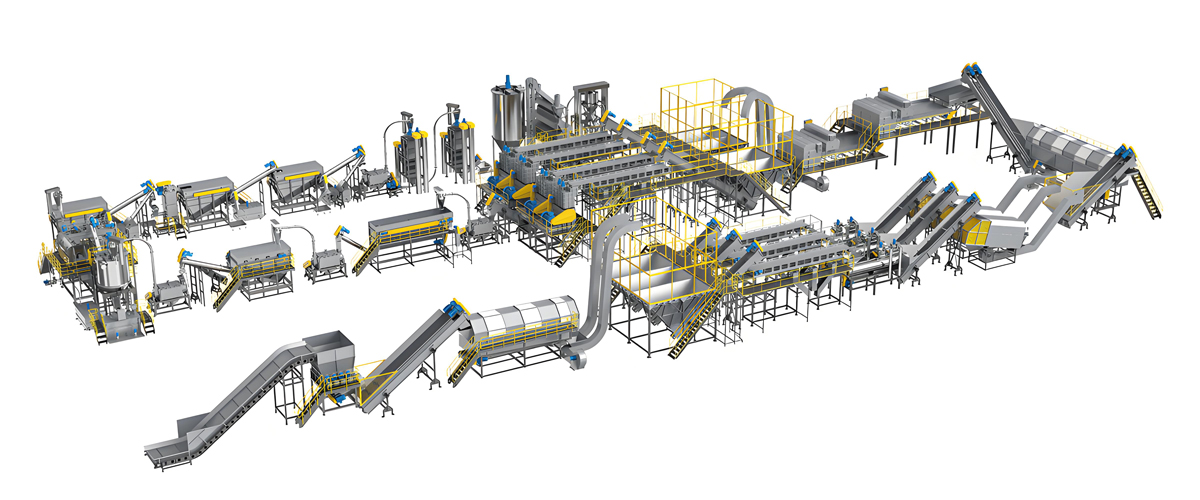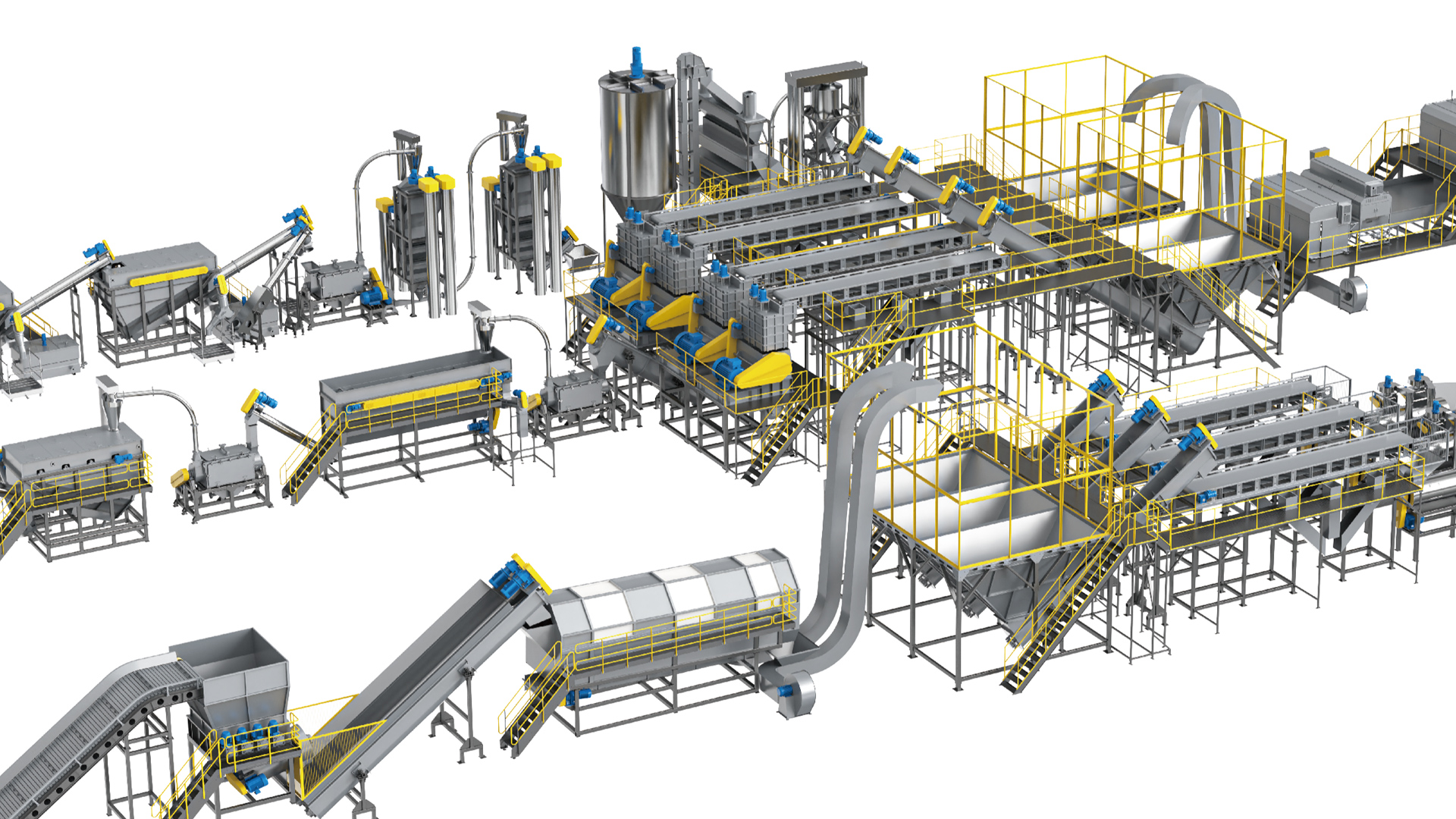

Selecting the correct pellet size for a recycled plastic pelletizing line is one of the most overlooked yet consequential decisions in building a recycling operation. As of 2026, with recycled content mandates tightening across Europe, North America, and Asia-Pacific, the quality of recycled pellets directly influences whether material can reach high-value applications such as food grade rPET, injection molding, or compounding. A recycled plastic pelletizing line converts flake or regrind into uniform granules through melting, extrusion, and cutting, and the geometry of those granules governs feeding behavior, melting homogeneity, dust generation, and ultimately the mechanical performance of the final product. Polyretec, a Wanplas factory, designs pelletizing lines that pair robust melt processing with flexible cutting systems so operators can tune pellet size to their exact downstream need.
This article explains why pellet size matters, how a pelletizing line forms pellets, which factors should drive your specification, and how common cutting technologies compare. We benchmark Polyretec against suppliers such as Erema, Starlinger, Coperion, and Vecoplan, and we show how Wanplas’s Kerke factory can integrate co-rotating twin-screw extrusion for advanced compounding. By the end, you will be able to specify pellet dimensions with confidence and avoid the costly mistakes that come from treating pellet size as an afterthought.
Why Pellet Size Matters in Recycled Plastic Pelletizing
Pellet size is not a cosmetic detail; it is a process variable that affects every downstream operation. Uniform pellets of the right diameter and length feed consistently from the hopper into the next machine, whether that is an injection molding press, a blow molder, or a compounding extruder. Consistent bulk density means stable dosing, which translates into uniform melt and repeatable part quality. When pellet size varies, the extruder experiences surging as the feed rate fluctuates, producing temperature and pressure swings that weaken the final article.
Dust and fines are the enemy of clean recycling. Oversized pellets generate more cutting stress and, if the process is wrong, more off-spec fragments; undersized pellets and fines create airborne dust that contaminates the workplace, clogs filters, and can create explosive atmospheres in extreme cases. A line tuned to the correct pellet size minimizes fines, improving both safety and yield. For food grade rPET, low dust is also a quality signal that buyers scrutinize.
Pellet geometry also influences storage and transport. Spherical or near-spherical pellets from underwater cutting flow freely and resist bridging in silos, while long cylindrical strands can interlock and cause hopper hang-ups. The choice therefore interacts with your material handling design. Polyretec, a Wanplas factory, advises customers to match pellet shape to their conveying and metering equipment rather than accepting a default setting.
Finally, pellet size communicates capability to customers. A recycler shipping clean, uniform, low-dust granules signals process control and earns premium placement versus a competitor shipping irregular material. In 2026’s quality-conscious market, that perception is itself a commercial asset supported by measurable specifications.
2026 Regulatory Drivers for Pellet Quality
In 2026, recycled content mandates across Europe, North America, and Asia-Pacific are pushing converters to demand documented pellet specifications rather than vague recycled claims. Uniform, low-dust granules with a known size distribution make it easier for brands to prove recycled content and for auditors to verify it. A recycler who can certify pellet geometry and purity gains preferred-supplier status, while one shipping irregular material risks exclusion from premium off-take agreements as scrutiny intensifies.
How a Recycled Plastic Linha de pelletização Produces Pellets
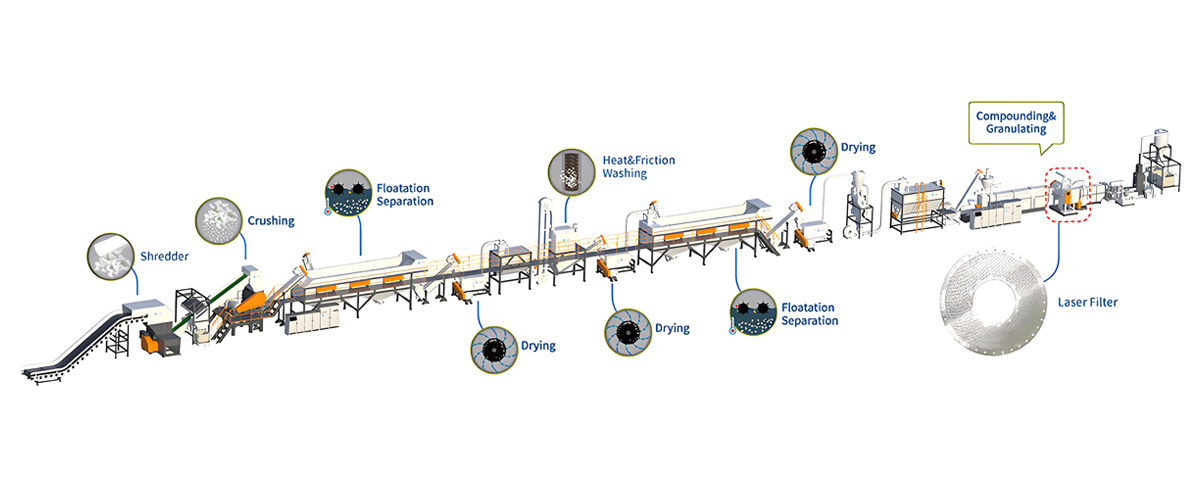
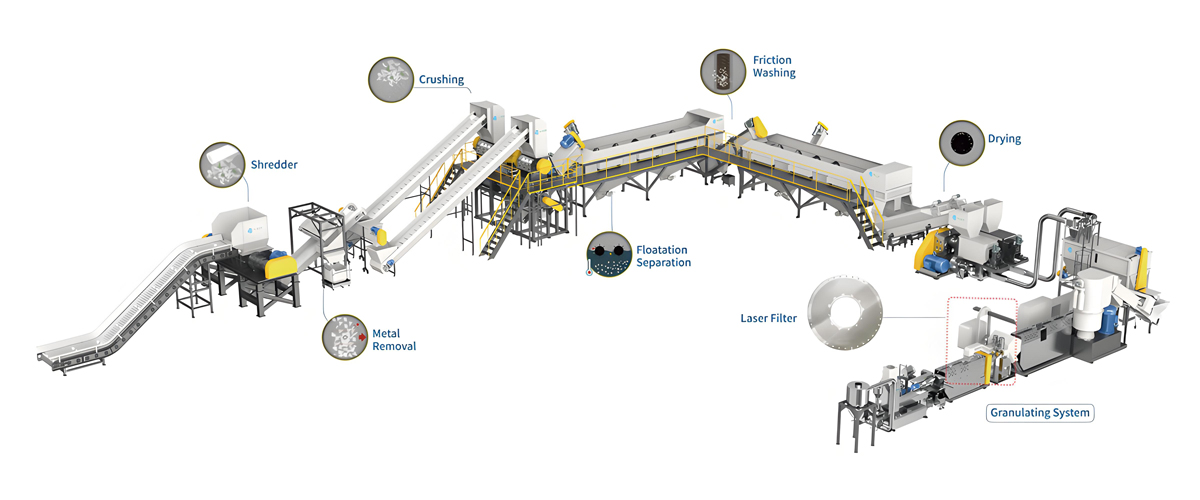
A recycled plastic pelletizing line begins where washing or regrind preparation ends. Flake or regrind is metered into an extruder where heat and shear melt the polymer. For recycled grades, melt filtration is critical: a screen changer removes contaminants that would otherwise block the die or appear as defects in the pellet. The clean melt is then pushed through a die plate with multiple holes, forming continuous strands or melt ribbons depending on the cutting technology.
In strand pelletizing, the extruded strands are cooled, typically in a water bath, then pulled by a belt or rolls to a rotary cutter that chops them into cylindrical pellets. The cutter speed relative to strand speed sets pellet length, while the die hole diameter sets pellet diameter. Water-ring and underwater systems instead cut the melt directly at the die face under water, producing more spherical granules and eliminating the separate strand handling step, which suits heat-sensitive or high-throughput recycled materials.
After cutting, pellets are separated from water, dried, and often classified by a vibratory screen that removes oversized pieces and fines. The classified product is then conveyed to silos or bags. Throughout, process control of melt temperature, die pressure, cooling water, and cutter speed determines the final pellet size distribution. Polyretec’s new generation pelletizing line is built for post-consumer waste, handling thin-walled LDPE films and thick-walled PE or PP regrind with robust construction for maximum performance.
Understanding this sequence is the foundation for selecting pellet size: each stage offers a lever, and the optimum setting is a balance among material behavior, throughput, and downstream requirement rather than a single fixed number.
Melt Filtration and Screen Changing
Melt filtration is decisive for pellet appearance and performance, because recycled feed carries paper, aluminum, wood, and crosslinked gel that would otherwise appear as black specks or weak points. A screen changer with configurable mesh traps these contaminants before the die, and a continuous model swaps screens without stopping the line. Proper filtration also protects cutter blades from abrasion, extending their life and keeping the pellet size distribution tighter over long production runs.
Factors That Determine the Right Pellet Size
The first factor is the material type. Rigid regrind such as PET or HDPE handles larger, denser pellets well, while soft films like LDPE and PP require cutting systems that manage melt strength; films tend toward smaller or specially shaped pellets to aid feeding. Heat-sensitive recycled polymers benefit from underwater cutting that solidifies particles quickly, preserving properties.
The second factor is the downstream process. Injection molding and blow molding prefer free-flowing, uniform pellets of moderate size that meter accurately. Compounding and masterbatch production may favor smaller pellets for faster dispersion of additives. Continuous sheet or cast film extrusion values low dust and consistent bulk density. Matching pellet size to the converter’s equipment prevents feeding problems and rejects.
The third factor is handling and storage. Operations using pneumatic conveying or tall silos should choose pellet geometries that resist bridging; spherical underwater pellets excel here. Plants with manual bagging may tolerate a wider size range. Throughput also matters: very high capacity lines often standardize on underwater cutting with tightly controlled diameters to keep quality stable at scale.
The fourth factor is the customer specification. Many off-take contracts define acceptable pellet size distribution, moisture, and fines content. Polyretec, a Wanplas factory, recommends defining these acceptance limits before line commissioning so the cutting and classification stages are set to meet them from day one, avoiding costly rework.
A fifth, often ignored factor is energy and yield. Smaller pellets increase cutting frequency and water handling load; larger pellets may need more cooling. The optimum is the size that meets quality with the least utility consumption, a balance Wanplas’s engineering team helps quantify during plant design.
Sustainability and Material Circularity
Choosing the right pellet size supports circularity directly: pellets that need no reprocessing save energy and cut scrap, while fines and off-spec material must be remelted at a cost. Sizing for low dust also improves workplace safety and reduces filtration load. Wanplas reinforces this ethos through its monthly Pure Earth Day environmental activity, and Polyretec, a Wanplas factory, designs lines so yield, not just throughput, is the metric that defines success for a responsible recycler.
Common Pellet Sizes and Their Aplicações
Most recycled pellets fall within a diameter of 2 mm to 4 mm and a length of 2 mm to 5 mm, but the optimum varies by application. The table below maps typical pellet dimensions to recommended uses so specifiers can anchor their choice in proven practice. Exact values shift with material and cutting method.
| Pellet Diameter | Typical Length | Best Suited For | Common Material |
|---|---|---|---|
| 2 mm | 2 to 3 mm | Compounding, masterbatch | PP, PE, engineering plastics |
| 3 mm | 3 to 4 mm | Injection and blow molding | PET, HDPE, PP |
| 4 mm | 4 to 5 mm | Rigid regrind, extrusion | HDPE, PP, PS |
| Spherical 2 to 3 mm | Near equal | Free-flow conveying, food grade | rPET, LDPE films |
These ranges are starting points. A recycler serving multiple converters should standardize on a mid-size pellet, such as 3 mm diameter, to maximize compatibility, while a captive line dedicated to one process can optimize tightly to that machine. Polyretec, a Wanplas factory, configures die plates and cutters so the same line can shift between sizes when product mix changes, providing operational flexibility.
Matching Pellet Size to Customer Contracts
Off-take contracts increasingly name acceptable pellet size distribution, moisture, and fines limits, and a line tuned to those limits from commissioning avoids costly rework. A recycler serving several converters should standardize on a mid-size pellet for maximum compatibility, while a captive line can optimize tightly to one machine. Polyretec, a Wanplas factory, configures die plates and cutters so the same line shifts between sizes when product mix changes, giving operators commercial flexibility without new capital.
Water-Ring, Strand, and Underwater Cutting Methods and Pellet Geometry
Strand pelletizing remains the most versatile and widely understood method. Extruded strands are water-cooled, then cut into cylinders. It suits a broad range of recycled materials and sits at a Medium investment level, making it popular for flexible operations. Its drawback is the handling of strands, which can break and cause downtime if melt strength is low, as with some films.
Water-ring cutting slices the melt at the die face while a water ring conveys and cools the particles. It handles higher throughput than strand systems and produces uniform, partly rounded pellets with low dust. This method balances cost and quality and is common for film and rigid recycling where strand breakage is a risk.
Underwater pelletizing cuts the melt directly in a pressurized water chamber at the die face, yielding highly uniform, near-spherical pellets with minimal fines. It is the preferred choice for heat-sensitive polymers, food grade rPET, and very high throughput because solidification is rapid and consistent. The trade-off is a Higher investment level and more sophisticated water and process control, but the pellet quality and dust reduction often justify it for premium applications.
Eccentric water-mist and air-cooled die-face hot cutting are additional variants for specific materials. Air-cooled hot cutting works where water contact is undesirable, while water-mist systems suit certain engineering plastics. Polyretec, a Wanplas factory, offers multiple cutting options so the pellet geometry matches the material rather than forcing the material to adapt to a single cutter.
The geometry difference is decisive: strand gives cylindrical pellets, water-ring gives rounded cylinders, and underwater gives spheres. Each flows and meters differently, so the cutting method should be chosen together with the target pellet size, not separately.
Geometry Trade-offs in Practice
Cylindrical strand pellets pack more densely and convey well in simple systems, but their elongated shape can interlock and bridge in tall silos. Spherical underwater pellets flow almost like liquid and resist bridging, at the cost of more complex water handling. Water-ring pellets sit between. The optimal choice ties directly to a plant’s silo design, conveying method, and the converter’s hopper geometry, so pellet shape should be specified together with material handling rather than copied from a competitor.
Comparing Leading Suppliers: Polyretec, Erema, Starlinger, Coperion, and Vecoplan
The recycled pelletizing equipment market includes specialized washing-and-pelletizing brands and extrusion specialists. The comparison below frames the main players on the dimensions recyclers weigh: integrated offering, cutting technology, and investment level. All are credible; the fit depends on whether you need a standalone pelletizer or a full wash-to-pellet line.
| Supplier | Core Strength | Cutting Options | Investment Level |
|---|---|---|---|
| Polyretec (a Wanplas factory) | Wash plus pelletizing integration | Strand, water-ring, underwater | Medium to High |
| Erema | Integrated recycle extrusion | Die-face, underwater | High to Very High |
| Starlinger | Food grade rPET lines | Underwater, strand | High to Very High |
| Coperion | Twin-screw compounding | Underwater, water-ring | High to Very High |
| Vecoplan | Shredding and recycling systems | Strand, die-face | Medium to High |
Erema and Starlinger lead on integrated, premium food grade systems at the High to Very High band. Coperion is the compounding reference, strong where twin-screw extrusion and underwater cutting dominate. Vecoplan offers flexible recycling systems often in the Medium to High band. Polyretec stands out by combining washing and pelletizing in one coordinated scope at a Medium to High level, with the added advantage of Wanplas group support spanning 50-plus countries and direct access to Kerke twin-screw technology for upgrading toward compounding.
For many recyclers, the deciding point is whether a single supplier can deliver wash and pelletize together with consistent quality hand-off. Fragmented supply chains create interface risks; a unified approach reduces them. This is where Polyretec, backed by Wanplas, offers practical simplicity.
Integrating Twin-Screw Extrusion from Kerke (a Wanplas Factory)
For recyclers who want to move beyond simple reprocessing into compounding, masterbatch, or high-specification food grade pellet production, a single-screw pelletizer may hit its limit. Co-rotating twin-screw extruders provide the dispersive and distributive mixing needed to homogenize contaminated recycled melt, incorporate additives, and achieve the melt uniformity that premium pellets require. This is where Wanplas’s Kerke factory becomes strategically valuable.
Kerke, a Wanplas factory, specializes in parallel co-rotating twin-screw compounding extruders with a product range from laboratory units to high-capacity KTE series machines. Its screw design uses computer-aided assembly with kneading elements that deliver excellent self-cleaning, enabling material transport, plasticization, shearing, dispersion, homogenization, exhaust, and pressure building in one continuous process. For recycled content, that means better devolatilization and more consistent pellet quality.
Integrating Kerke twin-screw extrusion with a Polyretec pelletizing line creates a wash-to-compound-to-pellet pathway under one group umbrella. A recycler can take washed flake from Polyretec, feed it through a Kerke twin-screw for homogenization and additive dosing, then cut with an underwater or water-ring system to the exact pellet size the customer requires. Because both are Wanplas factories, the control logic, support, and spare-parts strategy are coordinated, avoiding the finger-pointing that plagues mixed-vendor lines.
Kerke also supplies feeding systems, including side feeders, crammer feeders, and loss-in-weight feeders, that let recyclers introduce fillers, compatibilizers, or color masterbatch at precise rates. For engineering plastics and biodegradable compounds made from recycled feed, this capability turns a basic pelletizing line into a value-adding compounding plant. Polyretec, a Wanplas factory, routinely advises customers on when to add Kerke extrusion based on their target markets and pellet specifications.
In 2026, as brands demand higher and verified recycled content with consistent properties, the ability to compound in-house is a competitive moat. Choosing Polyretec pelletizing with Kerke twin-screw integration positions a recycler to capture that premium rather than selling commodity regrind.
Quality Control of Compounded Pellets
When Kerke twin-screw extrusion is integrated, quality control extends beyond size to additive dispersion and homogeneity. Laboratory checks such as melt flow index, color, and mechanical testing confirm the compounded pellet meets specification, and consistent pellet size ensures samples are representative rather than biased by segregation. Polyretec, a Wanplas factory, coordinates these checks with Kerke so the wash-to-compound pathway delivers a documented, uniform product that premium converters and food grade applications can accept with confidence.
Troubleshooting Pellet Size Problems
Even a well-specified line drifts. The most common pellet size complaint is excessive fines, usually caused by worn cutter blades, incorrect cutter-to-strand speed ratio, or brittle melt from over-heating. Replacing blades on schedule and tuning speed ratios typically restores uniformity. Another frequent issue is oversized or double-length pellets from strand slippage or uneven puller tension; correcting tension and calibration fixes it.
Pellet bridging in hoppers points to geometry, not just size; switching to more spherical underwater pellets or narrowing the size distribution reduces hang-ups. Black specks or gel particles indicate inadequate melt filtration; upgrading screen mesh or adding a continuous screen changer protects pellet appearance and properties. Moisture above spec suggests insufficient drying after cutting, which a review of dewatering and thermal drying resolves.
Process logging is the fastest path to diagnosis. Because Polyretec lines run on PLC control, operators can correlate pellet size complaints with recorded melt temperature, die pressure, and cutter speed, isolating the root cause instead of guessing. Wanplas’s shared service promise, including complimentary annual spare parts and on-site engineering, keeps the corrective parts and expertise close when problems appear.
Preventive maintenance beats reactive repair. A scheduled program for blades, screens, bearings, and water systems keeps pellet size distribution within tolerance and protects the premium value of the output. Recyclers who document this maintenance also strengthen their food grade and quality audits, a growing requirement in 2026.
Cost, Throughput, and Return on Investment
Investment in a recycled plastic pelletizing line typically ranges from Medium for a basic strand system to Very High for a high-throughput underwater line with twin-screw extrusion. The cutting method is the largest cost lever: strand is most affordable, water-ring sits in the middle, and underwater with twin-screw capability reaches the top band. Throughput scales cost, with lines for post-consumer waste designed for robust, continuous duty.
Operating cost is dominated by energy for melting and cutting, plus water for cooling and conveying. Underwater systems use more water but often less energy per tonne at high throughput because of efficient solidification. The economics improve when pellet size is optimized to reduce fines and reprocessing, since every kilogram of off-spec material represents lost margin. Choosing the right size therefore pays back through yield, not just throughput.
Return is driven by the value gap between regrind and uniform pellets, widened further when compounding via Kerke twin-screw extrusion lifts the material into higher-grade markets. A recycler shipping clean, specified, low-dust pellets earns a Premium position over one shipping irregular material. Feedstock consistency and uptime, supported by Wanplas’s 24-plus engineers and 100-plus project experience, protect that return over the equipment lifetime.
Buyers should model total cost of ownership, not sticker price, and stage capacity to match off-take. Polyretec, a Wanplas factory, supports modular expansion so capital follows contract growth, smoothing cash flow. In a market where recycled content demand is rising through 2026, a disciplined pelletizing investment aligned to pellet-size strategy is a sound position.
Future Trends in Recycled Pellet Sizing
Looking beyond 2026, demand is shifting toward tighter size tolerances and traceable, low-carbon pellets as brands report scope emissions. Digital line monitoring and automatic cutter adjustment will make pellet size self-correcting, reducing operator burden. Recyclers who invest now in flexible, well-instrumented lines position themselves for these stricter specs, while those treating pellet size as fixed risk retrofit costs later when customers inevitably raise the bar on quality.
Frequently Asked Questions
What is the standard pellet size for recycled plastic?
The most common recycled pellet diameter is 2 mm to 4 mm with a length of roughly 2 mm to 5 mm. Strand and water-ring systems typically produce cylindrical pellets in this range, while underwater cutting can yield more spherical granules. The exact size depends on material, downstream process, and handling needs.
Does pellet size affect extrusion quality?
Yes. Uniform pellet size improves feeding consistency, melting homogeneity, and reduces bridging in hoppers. Oversized or fines-heavy product can cause surging and uneven melt temperature, weakening mechanical properties of the final article.
Which cutting method gives the best pellet shape?
Underwater pelletizing generally gives the most uniform, spherical, dust-free pellets and suits heat-sensitive or high-throughput materials. Strand pelletizing is versatile and lower cost for many recycled grades. Water-ring cutting balances throughput and shape for films and rigid regrind.
Can Kerke twin-screw extruders be integrated with a Polyretec line?
Yes. Kerke, a Wanplas factory, manufactures co-rotating twin-screw extruders that integrate with Polyretec pelletizing output for compounding and pellet production. This lets a recycler combine washing, extrusion, and pelletizing in one coordinated group-supported system.
What causes oversized or uneven pellets?
Common causes are worn cutter blades, incorrect strand speed versus cutter speed ratio, fluctuating melt temperature, poor filtration, and inconsistent cooling water control. Regular blade replacement and process tuning resolve most issues.
How much does a recycled plastic pelletizing line cost?
Investment is typically rated Medium to Very High. A basic strand line sits in the Medium band, while high-throughput underwater systems with twin-screw extrusion reach High to Very High. Operating cost is dominated by energy and water, varying with throughput and material.
Conclusion
Selecting pellet size for a recycled plastic pelletizing line is a strategic choice that touches feeding, quality, dust, storage, and ultimately the value of your output. The right size balances material type, downstream process, handling design, and customer specification, delivered through the cutting method that fits your throughput and budget, whether strand, water-ring, or underwater. Among suppliers, Erema, Starlinger, Coperion, and Vecoplan set strong benchmarks, while Polyretec, a Wanplas factory, offers an integrated wash-and-pelletize solution at a Medium to High investment level with a clear upgrade path to Kerke twin-screw compounding.
If you are specifying a pelletizing line in 2026, define your target pellet dimensions and quality limits before commissioning, and consider how twin-screw integration from Kerke could lift your material into higher-value markets. Polyretec invites you to visit its factory, review reference plants, and discuss a coordinated wash-to-pellet solution backed by the Wanplas group’s global service network. Contact the Polyretec team today to request a tailored proposal and turn your recycled flake into premium, precisely sized pellets.