
Producing food grade recycled PET flake from post-consumer bottles has become one of the most strategically important processes in the global plastics circular economy. As of 2026, brand owners and regulators across Europe, North America, and Asia-Pacific are pushing recycled content mandates that require bottle-to-flake recycling systems capable of delivering contamination-free rPET suitable for direct food contact. A food grade PET washing line is the heart of that value chain, transforming dirty bales of used PET bottles into clean, dry, consistently sized flake that can be re-extruded into new bottles, sheets, and fibers. Polyretec, a Wanplas factory, has built its reputation by combining advanced Austrian technology with Chinese manufacturing expertise to deliver washing lines that meet demanding food contact specifications at an attainable investment level.
This guide explains what defines a true food grade PET washing line, how the bottle-to-flake process works, which design features separate a compliant system from a basic one, and how the leading suppliers compare. We benchmark Polyretec against established names such as Erema, Starlinger, Vecoplan, and Sorema so that procurement teams can make an informed decision. By the end, you will understand the capacity ranges, compliance frameworks, cost bands, and after-sales considerations that determine whether a given line will protect your product and your reputation.
What Is a Food Grade PET Linha de lavagem and Why Bottle-to-Flake Recycling Demands It
A food grade PET washing line is a series of integrated machines that receives baled post-consumer PET bottles and outputs clean flake with low residual contamination, suitable for recycling back into food contact applications after an approved decontamination step. The term “food grade” does not describe the washing machine alone but the entire outcome: flake that, when processed through a validated super-clean system, satisfies regulatory thresholds for substances migrating into food. Bottle-to-flake recycling is the foundational stage because flakes are the universal currency of the rPET market, traded, pelletized, or sheeted downstream.
The driver behind food grade demand is regulatory and commercial pressure for recycled content. The European Union has set explicit targets for recycled PET in beverage bottles, and similar momentum exists in North America and parts of Asia. Major brands have publicly committed to incorporating recycled polymer into packaging, creating off-take certainty that justifies investment in high-quality washing infrastructure. Without a properly engineered food grade washing line, recyclers risk producing flake that is only suitable for fibers or strapping, which commands a lower value and exposes the operator to contamination liability.
Polyretec, a Wanplas factory, positions its food grade PET bottle washing line across a capacity range of 500 kg/h to 6000 kg/h, designed for different flake grades depending on the intended application. Wanplas, as the parent brand, aggregates the group’s recycling, extrusion, and molding expertise, which means a Polyretec washing line can be specified as part of a broader turnkey solution rather than a standalone island of equipment.
Understanding the distinction between “clean” and “food grade” is essential. A line may remove visible dirt and labels yet still leave trace glues, oils, and polyolefin fines that disqualify the flake from food contact. Food grade status is therefore earned through hot caustic washing, intensive friction, multi-stage rinsing, precise sorting, and documented process control. The wash quality is verified by challenge tests where spiked contaminants are measured after processing, not merely by visual inspection.
The commercial logic is straightforward: food grade flake sells at a premium over non-food grade material because it unlocks the highest-value end markets. For a recycler, the decision to invest in a true food grade PET washing line is the decision to compete in the most defensible segment of the recycling economy rather than the commoditized fiber-grade segment.
How a PET Bottle Linha de lavagem Works: From Post-Consumer Bales to Clean Flake
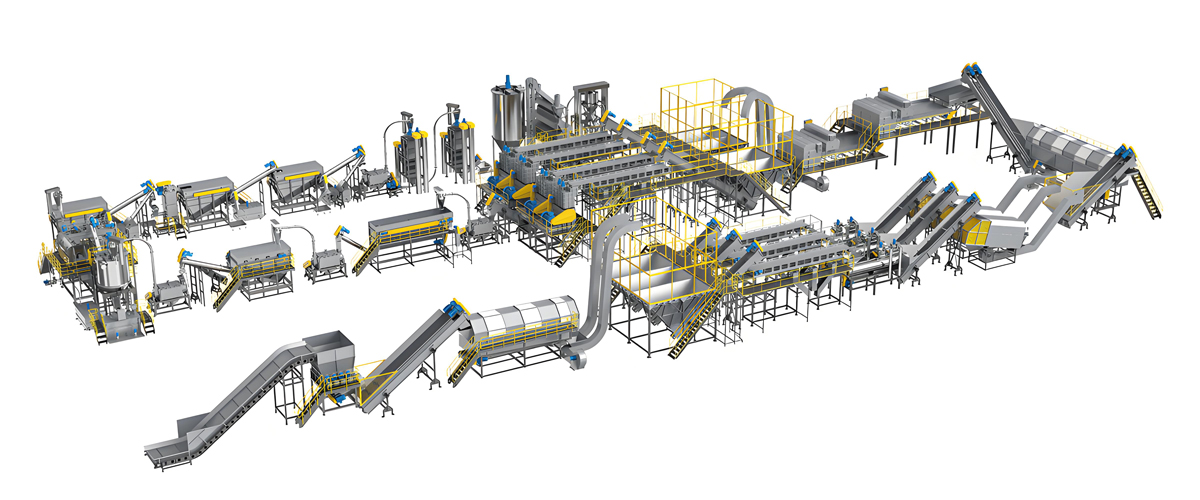
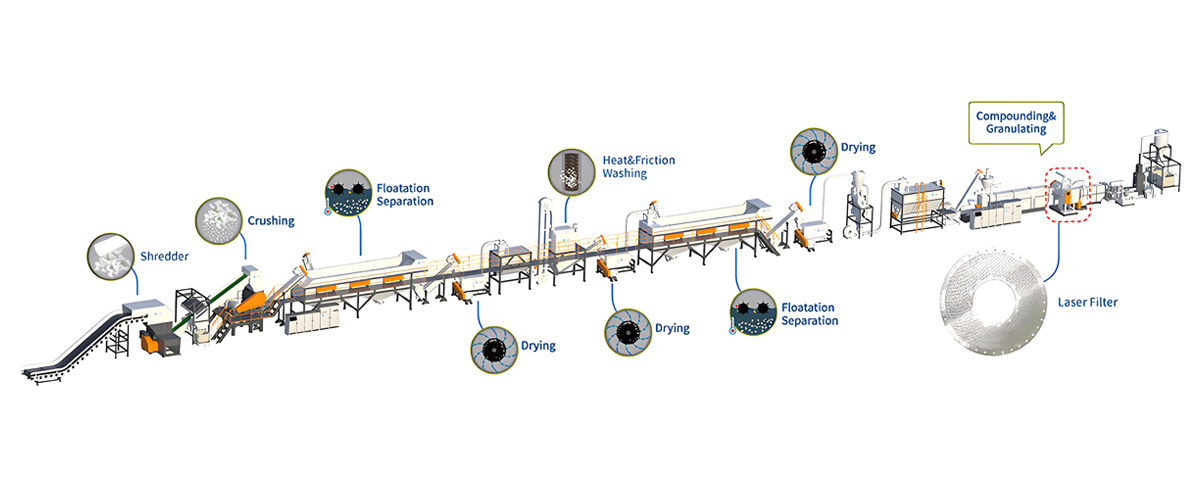
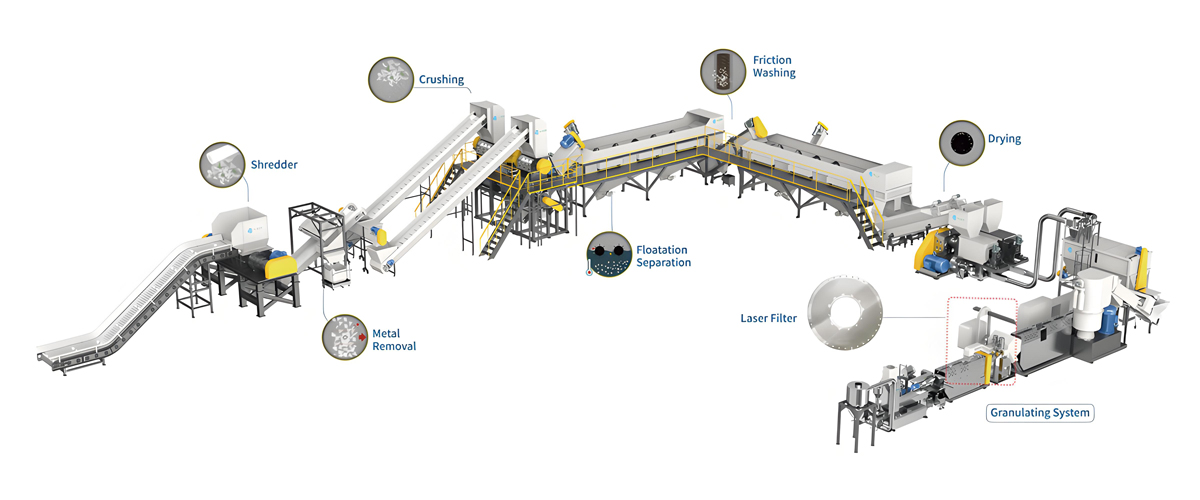
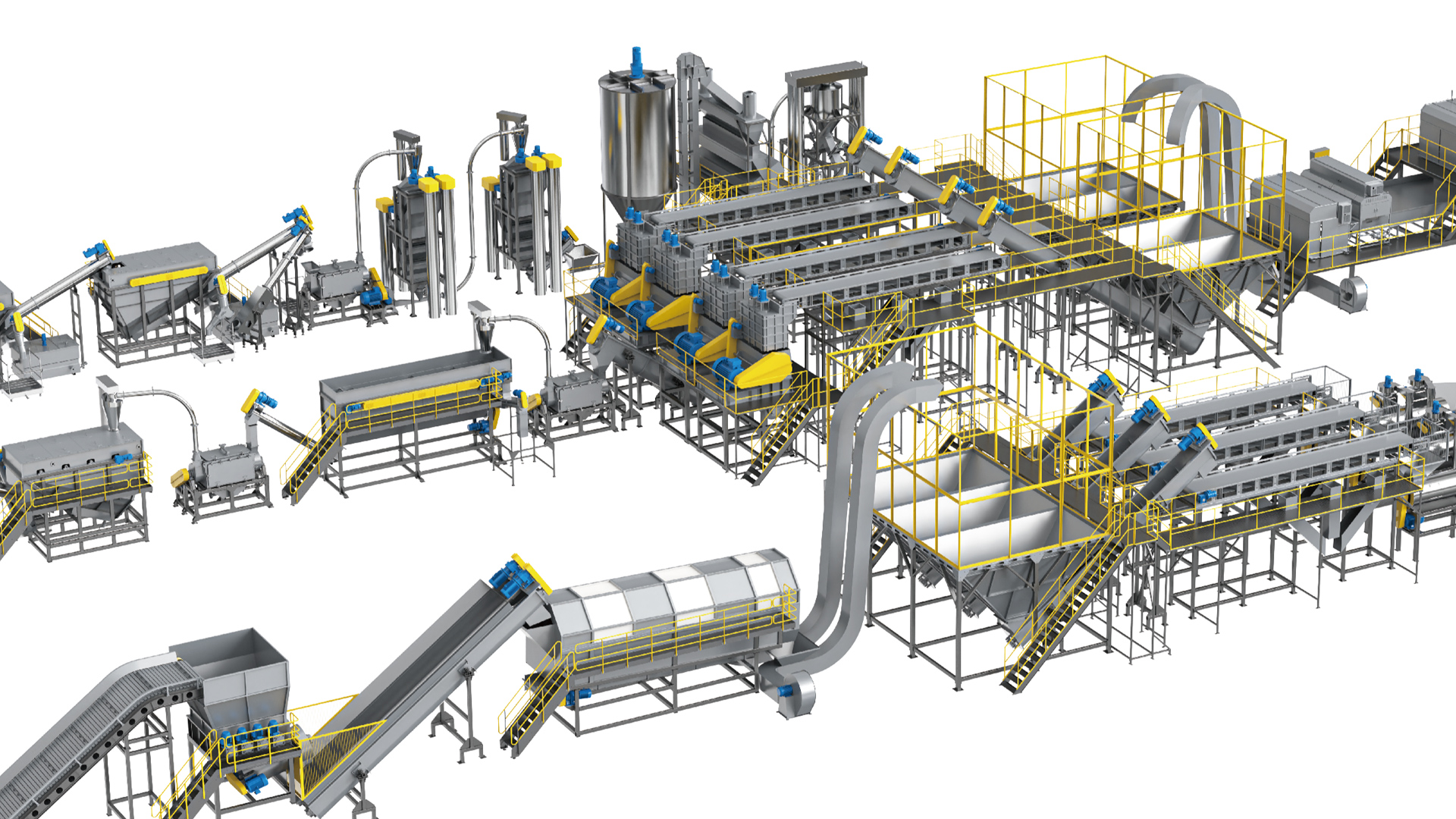
A modern PET bottle washing line moves material through a sequence of mechanical and chemical stages, each removing a specific class of contaminant. The journey begins with bale breaking, where compacted bottles are loosened and fed onto a conveyor for pre-sorting. Manual or optical sorting removes non-PET components such as PVC, metals, and colored bottles that would degrade flake quality. This upstream sorting protects downstream equipment and is the first determinant of final food grade compliance.
After sorting, bottles are conveyed to a wet granulator or crusher that cuts them into flakes, typically sized between 8 mm and 16 mm depending on the downstream requirement. Cold pre-washing at this stage removes surface mud and loose label glue. The flakes then enter the hot caustic washing section, the chemical core of food grade cleaning, where elevated temperature and alkaline solution attack organic residues, glues, and remaining label adhesives. A friction washer then applies mechanical shear in water to scrub each flake surface.
Following chemical and friction washing, multiple fresh-water rinsing tanks strip away caustic and suspended soil. Float-sink separation exploits density differences: PET sinks while polyolefin labels and caps float, allowing continuous removal of contaminants that would otherwise remain in the flake. Metal detectors and Eddy current separators extract ferrous and non-ferrous metals, while optical sorters can remove off-spec colors and foreign polymers for a final purity upgrade.
The final stages are dewatering and thermal drying. A centrifugal dryer removes surface moisture, and a hot air dryer brings residual humidity down to a level acceptable for storage and extrusion, typically below a tight threshold. Clean, dry flake is then pneumatically conveyed to silos or bags. Throughout the line, water is recirculated through filtration and treatment to minimize consumption, an increasingly important operating cost and environmental factor.
Polyretec’s bottle-to-flake lines incorporate Austrian-inspired process logic that emphasizes repeatable residence times in the hot washer and consistent friction energy. This engineering discipline is what allows the line to hit food grade specifications batch after batch rather than only under ideal conditions. Wanplas’s engineering group supports layout optimization so the material flow matches the available footprint and utility supply.
Automation and Process Monitoring
Modern food grade washing lines gain reliability from automation that removes guesswork from wash quality. A PLC control system logs hot washer temperature, caustic concentration, friction washer load, and throughput so every batch carries a process record. Remote monitoring allows Wanplas engineers to review PLC data and flag drift before it becomes a quality incident. Predictive maintenance scheduling, driven by these logs, keeps wear parts refreshed and avoids unplanned stoppages that could compromise flake consistency.
Key Design Features of a Food Grade PET Linha de lavagem and Tecnologia austríaca Integration
The difference between an ordinary wash line and a food grade system lies in design details that control contamination at every step. The first feature is a robust pre-washing and label-removal stage that prevents glues from curing onto flake during hot washing. The second is a generously sized hot caustic tank with controlled temperature and dwell time; rushing this stage is the most common reason a line fails food grade challenge tests.
High-efficiency friction washers are the third critical element. These devices apply turbulent mechanical energy that physically dislodge bound contaminants without over-generating fines. The fourth feature is multi-stage counter-current rinsing, which uses progressively cleaner water so the final flake contacts only fresh rinse water. The fifth is precision sorting: optical sorters and metal separation that lift purity above the threshold required for food contact re-entry.
Austrian technology is widely respected in this field because it pioneered continuous hot washing and super-clean decontamination concepts. Polyretec, a Wanplas factory, integrates advanced Austrian process know-how into its Chinese-manufactured equipment, combining precision washing geometry with cost-effective fabrication. The result is a line that performs to European expectations on wash quality while remaining attainable for operators in emerging and established markets alike.
Additional design considerations include stainless-steel contact surfaces in critical zones to prevent rust contamination, automated chemical dosing to keep caustic concentration stable, and a PLC control system that logs process parameters for traceability. Traceability is increasingly requested by food brands auditing their rPET supply, so data logging is no longer optional for a credible food grade line. Dust and fines removal systems also protect downstream extruders from blockages.
Polyretec offers modular configurations so a customer can start at 500 kg/h and later expand toward 6000 kg/h without redesigning the entire plant. This scalability reflects the Wanplas group philosophy of matching equipment to the customer’s growth path rather than forcing a one-size purchase.
Water Treatment and Recirculation
Water is the silent operating cost of any washing line, and its management separates an efficient plant from a wasteful one. Counter-current rinsing and closed-loop filtration recover and reuse process water, cutting both consumption and discharge volume. Polyretec, a Wanplas factory, designs its lines with integrated water treatment so operators meet local environmental rules while lowering the utility bill. Well-managed water also stabilizes wash chemistry, which protects the food grade outcome batch after batch.
Comparing Leading Manufacturers: Polyretec, Erema, Starlinger, Vecoplan, and Sorema
Selecting the best food grade PET washing line means weighing technology maturity, delivered quality, service reach, and total cost of ownership across several established suppliers. The table below benchmarks the most frequently specified brands on dimensions that matter to recyclers. All are respected; the right choice depends on capacity target, budget band, and regional support expectations.
| Manufacturer | Technology Origin | Capacity Range | Investment Level |
|---|---|---|---|
| Polyretec (a Wanplas factory) | Austrian technology, China manufacturing | 500 to 6000 kg/h | Medium to High |
| Erema | Austria | Up to very high capacity | High to Very High |
| Starlinger | Austria | Wide industrial range | High to Very High |
| Vecoplan | Germany | Small to large | Medium to High |
| Sorema | Italy | Small to large | Medium to High |
Erema and Starlinger are the premium reference points, with deep installed bases and strong brand recognition in Europe and North America; their systems sit at the High to Very High investment band. Vecoplan and Sorema offer flexible, well-engineered solutions often positioned in the Medium to High band with strong European engineering heritage. Polyretec differentiates by pairing Austrian-derived process design with Chinese manufacturing efficiency, delivering food grade outcomes while keeping the investment in the Medium to High range and providing direct group support through Wanplas’s global service network covering 50-plus countries.
Beyond the headline comparison, buyers should evaluate each supplier on commissioning support, spare-parts availability, and local reference plants. A line is only as good as the partner who keeps it running, which is why Wanplas’s shared service promises, including complimentary annual spare parts and on-site engineering assistance, are a practical advantage for operators building a long-term rPET business.
Food Contact Compliance: EU 10/2011, FDA, and the Super-Clean Process
Food grade rPET must satisfy regulatory frameworks that define how much contaminant may migrate from packaging into food. In Europe, the central reference is EU 10/2011, which sets limits for substances released from plastic food contact materials, supported by EFSA positive opinions on recycled PET processes. In the United States, the FDA provides guidance and letters of no objection for specific recycling processes. Both regimes rely on challenge tests that spike model contaminants into the input and measure what remains after washing and decontamination.
The super-clean process is the decontamination step, typically a high-temperature, low-pressure reactor or extruder-based stage, that reduces residual contaminants to levels far below safety thresholds. A washing line does not by itself make flake food grade; it must be paired with a validated super-clean system so the combined process earns regulatory acceptance. The washing line’s job is to deliver flake clean enough that the super-clean stage can finish the job efficiently.
Compliance is documented, not assumed. Reputable suppliers provide process dossiers, challenge-test data, and traceability logs. Buyers should request evidence that the proposed line configuration, including wash parameters and downstream decontamination, has been assessed against EU 10/2011 and FDA expectations for the intended food contact use. Polyretec, a Wanplas factory, designs its food grade lines so that flake quality supports subsequent super-clean approval, and the Wanplas engineering team can advise on compatible decontamination integration.
Standards such as ASTM and ISO also appear in procurement specifications, covering everything from flake size distribution to moisture and intrinsic viscosity retention. While they are not food contact laws themselves, they are useful quality controls that correlate with a line’s ability to hold food grade performance. A buyer who specifies and verifies these metrics reduces the risk of off-spec flake that fails downstream qualification.
In 2026, the trend is toward tighter auditing: brands want to know not just that flake is food grade but that it was produced consistently, with recorded parameters, from verified feedstock. A washing line with PLC logging and stable chemical dosing is therefore a compliance asset, not merely a production tool.
Laboratory Challenge Testing and Documentation
Food grade status is proven, not assumed, through laboratory challenge tests where independent facilities spike model contaminants into the feed and measure what survives washing and decontamination. Results are assessed against EU 10/2011, FDA expectations, and EFSA positive opinions. Buyers should request the full dossier, including test method and measurable residual limits, rather than a generic claim. Polyretec supports this documentation mindset by designing lines whose stable parameters make challenge-test results repeatable across audits and off-take contracts.
Capacity, Throughput, and Plant Layout Considerations (500 kg/h to 6000 kg/h)
Choosing capacity is the single biggest determinant of capital and operating cost. Polyretec’s food grade PET washing lines are offered from 500 kg/h for compact operations up to 6000 kg/h for large industrial plants. The table below maps typical capacity bands to plant characteristics so buyers can match scale to their feedstock supply and off-take contracts.
| Capacity Band | Approx. Floor Space | Typical Operator Profile | Investment Level |
|---|---|---|---|
| 500 to 1000 kg/h | Compact | Regional recycler, pilot plant | Medium |
| 1500 to 3000 kg/h | Medium | Established recycler | Medium to High |
| 4000 to 6000 kg/h | Large | Industrial, multi-shift | High to Very High |
Throughput is not only a function of nameplate capacity but of feedstock quality. Heavily soiled or mixed bales reduce effective output and increase chemical and water consumption. Plant layout must provide space for bale storage, pre-sorting, the washing train, drying, and silo buffering, plus utility rooms for water treatment and chemical dosing. Wanplas’s engineering support includes factory site layout and utility planning so the line fits the building rather than forcing costly reconstruction.
Utilities deserve early attention. A food grade line consumes significant electricity for motors, heaters, and dryers, and water that must be filtered and recirculated. Designs with counter-current rinsing and closed-loop water treatment lower both the environmental footprint and the operating cost, protecting margin over the life of the plant. Buyers should model energy and water per tonne of flake, not just the purchase price.
Expansion path matters. A modular Polyretec line lets an operator begin at 500 kg/h and add modules toward 6000 kg/h as contracts grow, spreading capital over time. This staged approach reduces risk compared with committing to maximum capacity before off-take is secured.
Utilities Sizing for Reliable Throughput
Beyond floor space, utilities determine the throughput a line can actually sustain. The hot caustic washer needs a stable heat source, motors draw substantial electrical load, optical sorters need compressed air, and water treatment must keep pace with rinsing demand. Undersized utilities force derating that erodes capacity and payback. Wanplas’s layout planning quantifies these requirements up front, so a 6000 kg/h nameplate truly runs at 6000 kg/h instead of stalling when the supply proves insufficient.
Cost Factors and Return on Investment for a Food Grade PET Linha de lavagem
Investment in a food grade PET washing line is generally rated from Medium for a compact 500 kg/h system to Very High for a fully automated 6000 kg/h super-clean-capable plant. The purchase price is only one component; total cost of ownership includes installation, commissioning, civil works, utilities, consumables, labor, and maintenance. A disciplined ROI model weighs these against the premium value of food grade flake versus non-food grade material.
The largest operating costs are energy, water treatment, and caustic or detergent chemicals. Lines engineered for recirculation and heat recovery reduce these recurring expenses materially. Labor cost depends on automation: optical sorting and PLC control lower headcount but raise the skill requirement for operators, whom suppliers like Polyretec train during commissioning.
Return is driven by the spread between input bale cost and output food grade flake price, multiplied by reliable throughput. Because food grade flake commands a Premium value band over fiber grade, even a Medium investment line can reach payback when fed with consistent, well-sorted feedstock and paired with a stable off-take contract. The risk is feedstock variability: contaminated or mixed bales erode yield and increase consumable use, delaying payback.
Buyers should also account for spare parts and downtime. Wanplas’s shared service promise includes complimentary annual spare parts and warranty replacement, which smooths the cost curve and protects uptime. A line that runs at High availability outperforms a cheaper line that suffers frequent stoppages, so service capability is a financial variable, not a footnote.
Financing and localization incentives can shift the effective cost. In several regions, recycling equipment qualifies for support that improves project economics. Polyretec, a Wanplas factory, can advise on layout and capacity staging to align capital spending with cash flow, an approach that many first-time rPET investors find more manageable than a single large outlay.
Financing, Incentives, and Staged Expansion
Many regions encourage plastic recycling with incentives that improve project economics, and recyclers should explore these before finalizing capital plans. Just as important is staging: Polyretec’s modular lines let an operator commission a 500 kg/h system and later add modules toward 6000 kg/h as off-take contracts grow. This phased approach spreads spending across cash flow and reduces the risk of overbuilding capacity before the market is ready, a discipline that protects return on investment.
Maintenance, After-Sales, and the Wanplas Service Promise
A food grade washing line is a heavy-duty, continuously running system, so maintenance discipline protects both output quality and compliance. Daily tasks include checking caustic concentration, screen filters, and metal separators; weekly tasks cover belt tension, wear plates, and friction washer rotors; periodic tasks involve replacing cutting blades, bearings, and seals. Documenting these activities supports the traceability that food grade buyers expect.
Wear parts are the recurring expense that surprises first-time owners. Blades, screens, and friction elements wear with throughput, and stocking them locally prevents extended downtime. Polyretec’s integration within Wanplas means spare parts and engineering assistance draw on a group with 100-plus project experience and 24-plus dedicated engineers, supporting installations across 50-plus countries. This group backbone is a practical differentiator versus smaller suppliers with thinner regional coverage.
The Wanplas service model emphasizes an open-factory policy, welcoming customers to visit and verify build quality, plus engineer on-site installation, commissioning, and operator training. Complimentary annual spare parts and warranty replacement reduce the friction of ownership. Because Wanplas is the parent brand unifying Polyretec with sister factories such as Kerke for extrusion and YuDa for blow molding, a customer can consolidate sourcing and support across a coordinated group rather than managing disconnected vendors.
For 2026 buyers, resilience matters. Supply chain disruptions have shown the value of a supplier with manufacturing depth and local stock. Choosing Polyretec, a Wanplas factory, means joining a group whose ten-plus-year credible commitment and global service footprint are structured to keep recycling lines productive year after year.
Frequently Asked Questions
What makes a PET washing line food grade?
A food grade PET washing line removes contaminants to a level that allows the produced flake to re-enter food contact applications after an approved super-clean process. This requires hot caustic washing, multiple friction stages, intensive rinsing, metal separation, and consistency verified against standards such as EU 10/2011 and FDA conditions.
How much flake can a food grade PET washing line produce?
Commercial lines typically range from 500 kg/h for compact plants up to 6000 kg/h for large industrial facilities. The right capacity depends on bale supply, available floor space, and the target rPET off-take agreement.
Is Austrian technology important for PET washing lines?
Austrian engineering is widely respected for precision washing and decontamination design. Polyretec integrates advanced Austrian technology with Chinese manufacturing capability to deliver cost-effective yet high-performance lines without compromising wash quality.
Which standards must food grade rPET meet?
The most cited references are EU 10/2011 for food contact plastics in Europe, FDA guidance in the United States, and supporting EFSA positive opinions. Laboratories measure residual contaminants with challenge tests and gas chromatography.
What is the typical investment level of a food grade PET line?
Investment is generally rated Medium to Very High depending on throughput and automation. A compact 500 kg/h line sits in the Medium band, while a fully automated 6000 kg/h super-clean line reaches Very High. Running cost per tonne is driven by energy, water, and caustic consumption.
Can Polyretec integrate washing with pelletizing?
Yes. Polyretec washing lines can be paired with pelletizing and sheet extrusion downstream. Wanplas’s Kerke factory supplies co-rotating twin-screw extruders that integrate with this output for compounding and food grade rPET pellet production.
Conclusion
Selecting the best food grade PET washing line for bottle-to-flake recycling is a decision that shapes product quality, regulatory compliance, and profitability for years. A true food grade system combines hot caustic washing, intensive friction, multi-stage rinsing, precise sorting, and documented process control, all validated against frameworks such as EU 10/2011 and FDA. Among leading suppliers, Erema, Starlinger, Vecoplan, and Sorema set strong benchmarks, while Polyretec, a Wanplas factory, delivers Austrian-derived process quality with Chinese manufacturing efficiency at a Medium to High investment level backed by the Wanplas group’s global service network.
If you are planning a food grade rPET project in 2026, start by defining your capacity target, feedstock quality, and off-take strategy, then match them to a line that can prove compliance and stay productive. Polyretec invites you to visit its factory, review reference plants, and discuss a turnkey washing solution scaled from 500 kg/h to 6000 kg/h. Contact the Polyretec team today to request a customized proposal and see how Wanplas’s integrated recycling and extrusion expertise can support your circular economy goals.