
A laser filter is the final gate between contaminated plastic flake and a clean, marketable pellet, and learning how to adjust it correctly is one of the highest-leverage skills in a recycling operation. Fine plastic flake—whether from PET bottle wash, PP/PE film lines, or rigid regrind—almost always carries a residue of fines, gel, paper, wood, aluminum, and cross-contaminant polymer that must be stripped at the melt stage. The laser filter performs this purification continuously, without stopping the extruder to change a screen pack. This technical guide explains what the device does, how it works, which parameters you must tune, and exactly how to adjust it for fine flake purification so your pellets meet the strict clarity, strength, and contamination limits that buyers now demand.
What a Laser Filter Does in Plastic Flake Purification
A laser filter is a continuous, self-cleaning melt filtration system used during extrusion and pelletizing. Its job is to trap solid contaminants suspended in the molten polymer while letting clean melt flow through, then to eject the trapped contamination without interrupting production. In fine flake purification, the feedstock is already washed and dried, yet it still contains micron-scale impurities that would otherwise appear as black specks, gels, or weak points in the final pellet or product.
The value of the laser filter is consistency. Manual screen packs clog and force a shutdown every few hours; each change loses production, wastes molten material, and exposes operators to hot melt. A laser filter instead rotates a laser-perforated disc through the melt stream, and a hardened blade continuously scrapes the contaminated surface into a discharge chamber. The result is a stable, near-constant filtration resistance and a pellet whose quality does not swing with the operator’s screen-change schedule.
For a recycling line, the filter is not an accessory—it is a quality instrument. The difference between a correctly adjusted laser filter and a poorly adjusted one shows up as reject rates, customer complaints, and extruder stress. When purification is done well, the downstream film, fiber, or molding customer receives pellets with low black-spot counts and predictable melt behavior, which is exactly what secures repeat orders in the recycled resin market.
Fine flake in particular rewards continuous filtration. Because the particles are small and the contaminant is often comminuted during washing, a manual screen pack blinds within minutes rather than hours, making hands-on changing impractical at production scale. The laser filter’s automated, non-stop cleaning is what makes fine flake purification economically viable; without it, the labor and material loss of constant screen changes would erase the margin. This is why the adjustment discipline described here is not optional tuning but the core operating competence of a modern recycling line.
How a Laser Filter Works
At its core, a laser filter uses one or more perforated discs cut by laser to extremely tight, repeatable hole geometries. Melt enters the filter housing and is forced through the disc, which retains contaminants larger than the hole size on its upstream face. A scraper blade sweeps the disc surface, collecting the contaminated layer into a small accumulation zone that is periodically expelled through a discharge valve.
The “laser” in the name refers to the manufacturing method of the screen: laser drilling produces uniform, burr-free, precisely sized holes that outperform woven wire mesh in both consistency and open-area control. Because the hole pattern is engineered, the filter can be selected for a specific contaminant profile—fine gels need small holes and high open area; coarse debris needs larger holes to avoid rapid blinding.
Continuous operation is achieved by rotating the disc slowly so that only a fresh slice of screen faces the melt at any moment. As that slice loads with contaminant, rotation carries it to the scraper, where the blade removes the cake and the discharge system ejects it. The clean portion of the disc re-enters the melt flow, so filtration never stops. This closed, self-cleaning loop is what lets a laser filter run for weeks between major service intervals, protecting both uptime and pellet uniformity.
The precision of laser drilling deserves emphasis because it dictates adjustment range. A woven mesh has overlapping wires that create irregular, partially blocked passages; a laser disc has clean, geometrically consistent holes with a known open-area percentage. Open area is the fraction of the disc face that is actually hole, and it is the hidden variable behind pressure. Two discs with the same hole size but different open area will exhibit very different pressure behavior, so when you swap discs you are not only changing fineness but also the pressure baseline—an adjustment that must be re-tuned, not assumed.
Key Adjustment Parameters
Adjusting a laser filter means balancing five interdependent parameters. Move one and the others shift, so treat them as a system rather than independent dials. The following subsections define each and explain its adjustment direction.
A useful mental model is to think of the filter as a pressure regulator with a quality output. Hole size sets the ceiling on what passes; pressure setpoint sets how hard the system pushes to maintain flow; backflush and rotation govern how fast the screen renews; melt temperature sets how easily the melt cooperates. When quality drops, resist the urge to change everything—instead ask which of these five is now mismatched to the feedstock, change only that, and observe. This systems view is what lets an operator scale from one material to many without relearning the machine each time.
Screen Mesh or Hole Size
The hole diameter sets the filtration fineness and is the single most important selection you make. Smaller holes remove finer contaminants and improve pellet appearance, but they also raise the pressure the melt must overcome, increasing energy use and the rate at which the screen blinds. For fine flake purification, a fine-to-medium hole size is typical, but going finer than the contamination demands simply wastes pressure and shortens the cleaning cycle. Match the hole size to the actual contaminant you see under a microscope, not to a generic specification.
Remember that hole size and open area move together but are not the same control. Within a given hole diameter, a disc engineered for higher open area will run at lower pressure and blind more slowly, at some cost to absolute filtration sharpness. When you must handle heavy contamination without raising pressure unacceptably, choosing a finer hole on a higher-open-area disc is often the better adjustment than simply slowing rotation or cranking the setpoint. Treat the disc specification as a tunable parameter, documented in your recipe, rather than a fixed hardware decision made once.
Pressure Differential Setpoint
The filter is normally controlled by a pressure-differential setpoint: when the pressure drop across the disc exceeds the setpoint, the cleaning action intensifies—either the disc rotates faster, the backflush activates, or both. Set the setpoint too low and the filter over-cleans, wasting material and energy; set it too high and contaminant escapes or the extruder is starved. A well-adjusted setpoint holds the downstream pressure stable within a narrow band, which is the clearest sign the filter is doing its job.
Backflush Frequency and Duration
Backflush is the periodic reverse pulse that clears the contaminated screen zone. More frequent, shorter backflushes keep the disc fresher and the pressure steadier, but each pulse expels a small amount of good melt along with the contaminant. Less frequent, longer backflushes conserve material but let the screen load further between cycles. The correct adjustment minimizes expelled good melt while preventing pressure runaway—a balance that depends on contamination load.
Disc Rotation Speed
Rotation speed determines how quickly fresh screen is presented to the melt. Faster rotation means less contaminant accumulates per slice, lowering the pressure spike and improving consistency, but it also increases mechanical wear and energy. Slower rotation extends screen life but risks localized blinding if contamination is heavy. Tie rotation speed to the actual contaminant concentration rather than leaving it at a fixed default.
Melt Temperature
Melt temperature affects both filtration and degradation risk. A hotter melt flows more easily through fine holes, reducing pressure, but excessive temperature degrades the polymer and can brown the pellet, especially for heat-sensitive materials like LDPE film or PET. The adjustment goal is the lowest temperature that still yields acceptable flow, protecting both filter performance and pellet color. For PP/PE flake, stay within the material’s safe melt window and verify with a melt-flow check on the output.
Learn to read the early markers of degradation so temperature adjustment is preventive, not reactive. A faint sweet or acrid odor at the vent, a gradual darkening of previously bright pellet, or a falling melt-flow index all signal thermal damage building in the system. Because the laser filter concentrates residence time at the screen, it amplifies any overheating elsewhere, so a small temperature excess upstream becomes a visible quality defect at the pellet. Lower the temperature in small steps and re-check flow rather than making large swings that risk freeze-off at the disc.
Step-by-Step Adjustment Procedure
Use the following procedure when commissioning a line, changing feedstock, or troubleshooting quality. It assumes the extruder is at stable temperature and the line is producing flap or strand pellet.
- Establish a baseline. Run the current feedstock for at least thirty minutes at normal throughput and record the stable pressure differential, melt temperature, and pellet appearance. You cannot improve what you have not measured.
- Inspect the flake. Take a sample of the cleaned flake and examine it microscopically or with a black-spot test to estimate contaminant type and size. This tells you the minimum hole size required.
- Set the hole size. Confirm the installed laser disc matches the contamination profile. If black specks persist in pellets, step to a finer disc; if pressure is chronically high with clean feed, step coarser to save energy.
- Tune the pressure setpoint. Raise or lower the setpoint until the downstream pressure holds within a tight band during steady feed. Avoid the extremes where the filter either never cleans or cleans continuously.
- Adjust backflush. Set backflush frequency and duration so that expelled material is mostly contaminant, not good melt. Watch the discharge; a wet, polymer-rich discharge means you are over-cleaning.
- Match rotation speed. Increase rotation if pressure spikes between backflushes; decrease it if wear or energy use is a concern and contamination is light.
- Verify melt temperature. Confirm temperature is the lowest value that maintains flow. Run a melt-flow or color check on pellets to catch degradation early.
- Lock and document. Record the final parameter set for that feedstock as a recipe. Reusing recipes is the fastest way to repeat quality when feedstock changes.
This disciplined loop—measure, adjust one variable, observe, document—prevents the common error of changing several settings at once and never learning which one fixed the problem. Polyretec, a Wanplas factory, applies Austrian-derived process discipline when commissioning pelletizing lines and trains operators in exactly this recipe-based approach so that quality is repeatable across shifts.
Safety is non-negotiable during any adjustment. The filter operates with molten polymer at elevated pressure and temperature, and the discharge zone ejects hot, contaminated material. Always adjust from the control panel with guards in place, never reach toward the discharge during operation, and isolate and cool the unit before any manual intervention on the disc or blade. Good adjustment discipline and good safety discipline are the same habit: observe first, change one thing, confirm, and never bypass an interlock to chase a setpoint. The few minutes saved by a shortcut are never worth a thermal injury or a ruined seal.
Tuning for Different Contamination Levels
Contamination is never constant. A consistent washed PET flake behaves differently from a mixed post-consumer PP/PE film load with dirt and label residue. The table below maps contamination level to a sensible starting adjustment, using relative labels rather than absolute figures because the right value depends on your specific disc and throughput.
Before applying the table, quantify the contamination rather than guessing. A practical method is to take a representative flake sample, dissolve or float out the polymer-free fraction, and weigh the residue; combine that with a visual black-spot count on a pressed film of the pellet. This gives a contamination index you can track over time and tie directly to filter settings. When the index rises, shift the setpoint and backflush upward before pellets degrade; when it falls, relax the filter to save energy. Treating contamination as a measured variable, not a vague worry, is what separates a tuned line from a drifting one.
| Contamination Level | Hole Size | Pressure Setpoint | Backflush | Disc Speed | Risk if Mis-set |
|---|---|---|---|---|---|
| Very low (clean industrial offcut) | Medium | Medium | Low frequency | Low | Over-cleaning wastes melt |
| Low (washed flake, light fines) | Medium-fine | Medium | Medium frequency | Medium | Stable; watch black-specks |
| Medium (post-consumer film) | Fine | Medium-high | Medium-high frequency | Medium-high | Pressure spikes if too coarse |
| High (dirty, mixed, labeled) | Fine, larger open area | High | High frequency | High | Blinding if too fine or too slow |
The guiding principle is to use the coarsest filtration that still meets the pellet specification. Every step finer than necessary costs pressure, energy, and throughput for no quality benefit the customer can see. Conversely, when contamination spikes—after a rainy collection season or a new feedstock source—do not wait for complaints; pre-emptively shift the setpoint and backflush upward and confirm with a sample.
Just as important is knowing when to revert. When a dirty batch clears, leave the tighter settings in place only long enough to confirm stability, then step back toward the efficient baseline. Operators who forget to relax the filter after a contamination event permanently run at higher energy and melt loss than necessary, eroding margin for weeks. The discipline of returning to the documented recipe once conditions normalize is as valuable as the initial tuning, and it is exactly the habit a recipe library enforces automatically.
Common Faults and How Adjustment Fixes Them
Most laser-filter problems trace back to one of the parameters above being set for the wrong condition. The table connects symptom, likely cause, and adjustment remedy.
Read the table as a diagnostic flow, not a menu. Start from the symptom the operator actually observes, not from a suspected cause, because the same symptom can have more than one root. A rising pressure differential, for example, might be blinding from fine contaminant or simply a disc that has been run too slow for the load—both point to rotation, but the underlying fix differs in how aggressively you change it. Confirm with a quick measurement—pressure trace, discharge sample, pellet check—before acting, so you adjust the right parameter the first time and avoid the whipsaw of repeated, contradictory changes.
| Symptom | Likely Cause | Adjustment Remedy |
|---|---|---|
| Rising pressure differential | Screen blinding from fine contaminant | Increase disc speed or backflush frequency; consider finer open-area disc |
| Black specks in pellets | Hole size too coarse for contaminant | Step to finer disc; raise pressure setpoint slightly |
| Excessive melt loss at discharge | Over-cleaning, backflush too frequent/long | Reduce backflush frequency and duration |
| Pellet discoloration or smell | Melt temperature too high or residence too long | Lower melt temperature; increase throughput or rotation |
| Unstable downstream pressure | Setpoint poorly matched to load | Re-tune setpoint; align backflush and rotation |
| Premature disc wear | Rotation too fast for light contamination | Reduce disc speed; match to actual load |
Notice that nearly every fault has an adjustment, not a parts order, as the first response. Operators who understand this table resolve most issues in minutes rather than waiting for a service visit. The Wanplas group’s shared engineering support and USD 500 of free parts per year exist for the genuine wear items—blades, seals, discs—not for problems that correct tuning would have prevented.
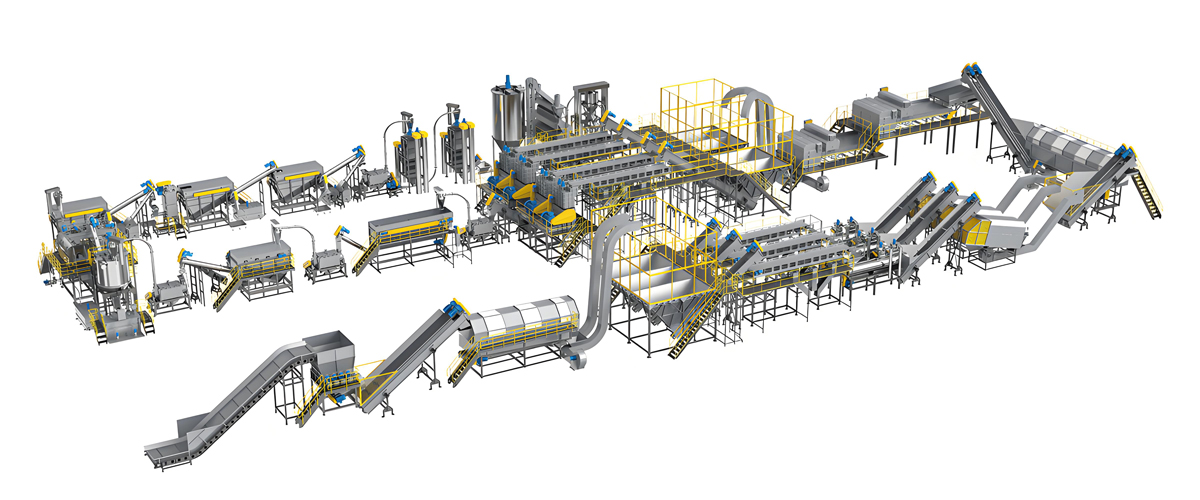
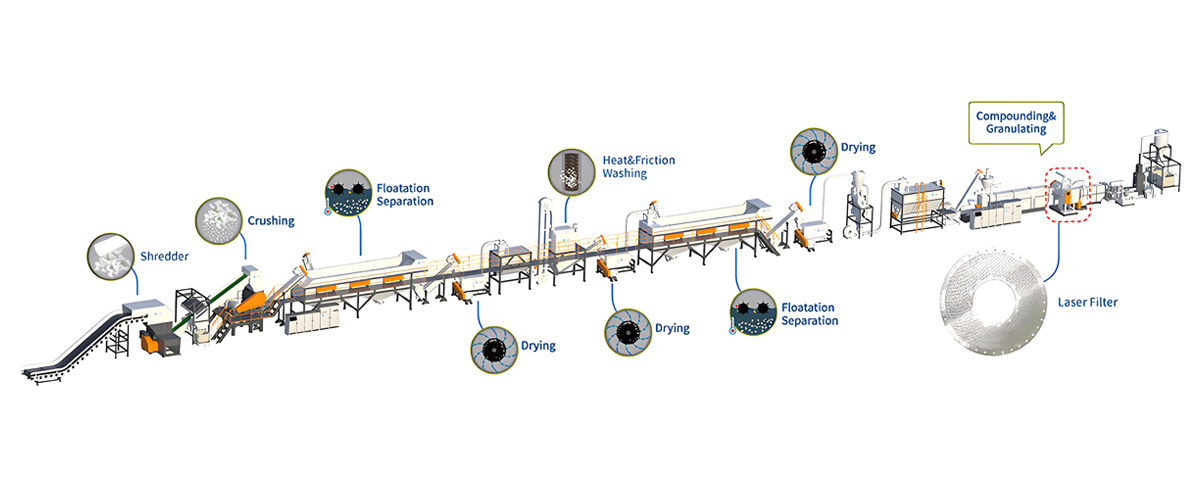
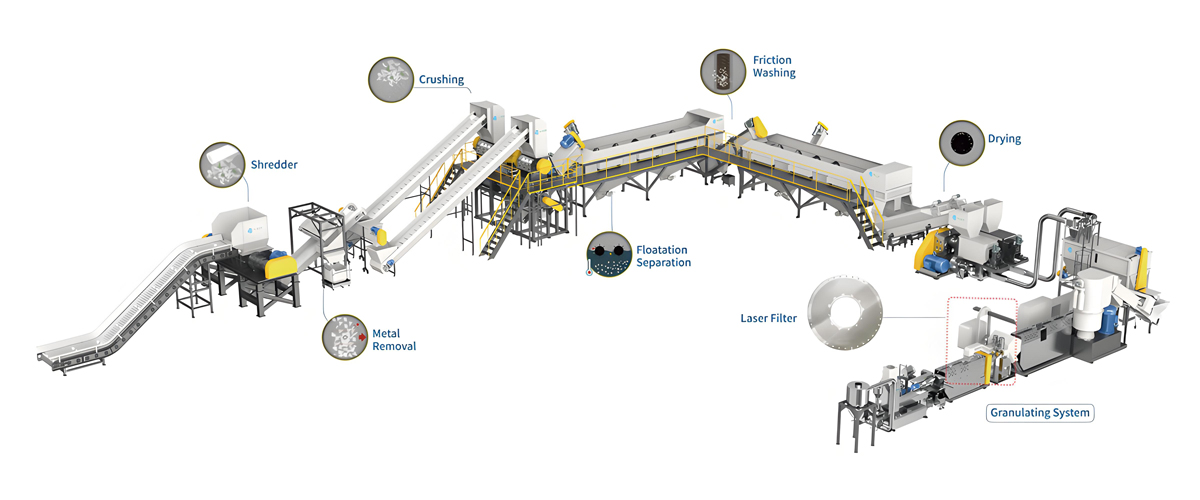
Integrating the Laser Filter with the Linha de pelletização
A laser filter does not sit alone; it is the bridge between the extruder and the pelletizer. The extruder must deliver a consistent, fully melted, well-homogenized stream, because the filter cannot fix poor plasticization—it can only remove solids. If the melt is uneven, the filter will see fluctuating load and the pellets will vary regardless of how well it is tuned.
For integrated recycling lines, Wanplas’s Kerke factory supplies co-rotating twin-screw extruders that pair with Polyretec washing and filtration systems. The twin-screw geometry provides the mixing and devolatilization that prepare the melt for fine filtration, and because both are Wanplas factories, the control logic and service pathways are coherent rather than cobbled together from incompatible vendors. That coherence matters when you are adjusting the filter under real production pressure: one accountable engineering team understands the whole line.
Practically, integration means the filter’s pressure signal should be visible alongside extruder and pelletizer data, so an operator adjusts with full context. A pressure rise that coincides with a throughput drop is a feed problem, not a filter problem; treating it as the latter wastes melt. Building the filter into the line’s central monitoring—and documenting recipes per feedstock—turns filtration from a mystery into a controlled, repeatable process.
Integration also shapes how you respond to contamination events. When a dirty batch enters the line, the extruder load and the filter pressure climb together; a well-integrated control system can pre-emptively raise backflush and rotation, then ease them back as the batch clears, without an operator scrambling at the panel. This coordinated response is far gentler on the disc and produces a tighter quality band than manual firefighting. It is another reason the Wanplas group’s approach—pairing Polyretec filtration with Kerke extrusion under one engineering umbrella—reduces the adjustment burden on the operator and stabilizes output across variable feedstock.
Maintenance and Calibration Schedule
Even a perfectly adjusted laser filter drifts as blades wear, discs accumulate embedded contamination, and seals age. A scheduled maintenance routine preserves adjustment quality and prevents sudden failures. The cadence below is a practical starting point; adapt it to your throughput and contamination.
- Per shift: record pressure differential, melt temperature, and pellet appearance; compare against the recipe for the current feedstock.
- Weekly: inspect the discharge for melt loss; confirm backflush timing; check for unusual noise or vibration at the disc drive.
- Monthly: examine the scraper blade edge and disc surface; replace if wear is visible; verify setpoint calibration against a reference gauge.
- Per campaign or material change: clean the disc thoroughly, re-confirm hole size, and re-establish the baseline before locking a new recipe.
- Annual: full service of seals, bearings, and hydraulics; recalibrate sensors; review wear-part inventory against the Wanplas group’s free-parts allowance.
Calibration is the quiet hero of filtration quality. A pressure transmitter that has drifted by a few percent will cause the setpoint to mean something different from what the operator believes, and the pellets will drift with it. Treating calibration as a scheduled task, not a reaction to complaints, keeps the entire adjustment system trustworthy.
Spare-parts readiness is the final pillar of the maintenance plan. The consumable items—scraper blades, disc seals, and eventually the laser disc itself—should be stocked before they are needed, not ordered after a failure halts the line. The Wanplas group’s shared USD 500 of free parts per year helps offset the routine wear items for Polyretec lines, but operators should still keep a documented inventory and reorder threshold so a Saturday-night blade failure never becomes a Monday-morning production loss. Maintenance, calibration, and parts readiness together convert a tuned filter into a reliably tuned filter, month after month.
- The laser filter is the final quality gate; adjust it as a system of five linked parameters.
- Use the coarsest filtration that still meets specification to save pressure, energy, and throughput.
- Tune by recipe per feedstock, and document every setting for repeatability.
- Most faults are solved by adjustment before they become parts failures.
- Polyretec, a Wanplas factory, commissions and supports integrated washing-filtration-pelletizing lines with Austrian-derived process discipline.
Frequently Asked Questions
What hole size should I use for fine plastic flake?
Choose the coarsest hole size that still removes the visible contaminant in your flake, confirmed by a microscopic or black-spot check. Finer than necessary only raises pressure and energy without improving the pellet the customer can see.
How do I know if the pressure setpoint is correct?
A correct setpoint holds the downstream pressure within a narrow, stable band during steady feed. If the filter cleans continuously or almost never cleans, the setpoint is mis-set and should be moved toward the middle of the operating range.
Why am I losing so much melt at the discharge?
Excessive melt loss usually means over-cleaning: the backflush is too frequent or too long, expelling good polymer with the contaminant. Reduce backflush frequency and duration until discharge is mostly solid contaminant.
Can a laser filter fix poor plasticization from the extruder?
No. The filter removes solid contaminants but cannot correct an uneven or poorly homogenized melt. Ensure the extruder delivers consistent, fully melted material; otherwise pellets will vary regardless of filter tuning.
How often should the laser disc be replaced?
Disc life depends on contamination load and rotation speed. Inspect monthly and replace when wear or embedded contamination is visible. Matching disc speed to actual load, rather than running it fast by default, extends life significantly.
Does melt temperature affect filtration quality?
Yes. Higher temperature lowers pressure through fine holes but risks degradation and pellet discoloration, especially for heat-sensitive materials. Use the lowest temperature that maintains flow, and verify with a melt-flow or color check.
How do I tell if my disc open area is wrong for the job?
If pressure is chronically high despite a correctly sized hole, the disc may have too little open area for your contamination load. Switching to a finer hole on a higher-open-area disc often restores stable pressure without sacrificing purification, and should be recorded as a new recipe.
Conclusion
Adjusting a laser filter for fine plastic flake purification is a systematic discipline, not guesswork. By treating hole size, pressure setpoint, backflush, disc speed, and melt temperature as one linked system—and by tuning to a recipe per feedstock—an operator keeps pressure stable, minimizes melt loss, and delivers pellets that meet strict buyer specifications. Most quality faults are solved by adjustment before they become parts failures, which is why documentation and calibration matter as much as the hardware itself. Polyretec, a Wanplas factory, builds and commissions integrated washing, filtration, and pelletizing lines with Austrian-derived process know-how and the backing of the Wanplas group’s shared service promises. For any recycling operation aiming at fine, defect-free recycled pellets, mastering laser-filter adjustment is the direct route to higher yield, lower rejection, and stronger customer trust.
The practical payoff is measurable. A line that holds a stable filtration pressure wastes less melt at discharge, runs its disc longer between services, and ships pellets whose black-spot count stays within spec batch after batch. That consistency is what lets a recycler move from spot sales to contracted supply, and from price-taking to margin-keeping. Whether you run a compact PP/PE film line or a larger PET flake plant, the adjustment principles here apply unchanged: measure, tune one variable, observe, document, and return to baseline when the feedstock does. Done consistently, laser-filter adjustment stops being a source of surprises and becomes the quiet, reliable engine behind every clean pellet you ship.