Low-Density Polyethylene (LDPE) film is one of the most widely used flexible plastic materials in packaging, agricultural covering, industrial wrapping, and daily consumer goods recycling. Waste LDPE film collected from municipal recycling programs, industrial waste streams, and post-consumer packaging almost always carries adhesive stickers, paper labels, plastic tags, and residual glue layers. These sticker contaminants are the most common and problematic impurities in LDPE film recycling, severely reducing the cleanliness, transparency, and market value of recycled LDPE flakes.
Unlike rigid plastic impurities that can be easily separated through conventional washing, LDPE sticker residues feature strong adhesive bonding, thin and flexible attachment, and stubborn glue penetration into film surface textures. Traditional simple plastic washing lines often fail to completely remove sticker residues, resulting in low-purity recycled flakes that cannot meet the requirements of high-grade pelletizing and film reproduction. Professional sticker removal technology integrated into standard plastic washing lines has become a necessary process for qualified LDPE film recycling production.
POLYRETEC, a professional manufacturer of full-set plastic recycling and washing equipment, has developed targeted sticker removal systems and optimized process solutions exclusively for LDPE film recycling scenarios. This article comprehensively explains the hazards of LDPE film sticker pollution, core sticker removal principles, step-by-step washing line operation processes, professional equipment configurations, cost and price analysis, common troubleshooting, and optimization skills. It covers all practical information that recycling plant operators and project investors need to master to achieve high-purity LDPE film recycling.
1. Overview of LDPE Film Sticker Pollution and Recycling Challenges
1.1 Common Types of Stickers on Waste LDPE Film
Waste LDPE film involved in industrial recycling mainly contains three major types of sticker contaminants, each with different adhesion characteristics and removal difficulties. The first type is paper adhesive stickers, widely used in commodity packaging labels, logistics marking labels, and product description labels. These stickers have paper surface layers and water-based or oil-based adhesive layers, which easily peel partially during washing and leave residual glue and paper fiber impurities on LDPE film surfaces.
The second type is plastic self-adhesive labels, made of PP, PE, or PVC thin film with high-viscosity pressure-sensitive adhesive. This type of sticker has strong tensile resistance and tight fitting with LDPE film, which is not easy to break in conventional crushing and washing processes, becoming the main cause of flake surface speckles and impurity spots. The third type is residual glue stains without label carriers, formed by long-term aging and falling off of original stickers. The aged glue layer penetrates the tiny surface pores of LDPE film, forming stubborn embedded contamination that is extremely difficult to clean thoroughly.
1.2 Negative Impacts of Unremoved Stickers on LDPE Recycling Quality
Incomplete sticker removal directly leads to multiple quality defects in recycled LDPE flakes and pellets, greatly reducing product market competitiveness. Residual sticker paper fibers and plastic fragments will cause surface black spots, white spots, and impurity lines on recycled LDPE pellets, making the products unable to meet the production standards of high-transparency film, food-grade packaging, and precision plastic products. Residual adhesive glue will decompose and carbonize during high-temperature granulation, producing yellowing, blackening, and brittle cracking of finished products.
In addition, residual glue layers will affect the melting uniformity and tensile strength of recycled LDPE materials, resulting in unstable physical properties of secondary processed film products and easy tearing and deformation. For recycling enterprises, unqualified flake cleanliness will lead to low sales prices, limited downstream order channels, and increased product rejection rates, directly reducing the overall profit margin of LDPE film recycling projects.
1.3 Technical Difficulties of LDPE Sticker Removal in Washing Lines
Compared with rigid plastic label removal, LDPE film sticker removal has unique technical difficulties. First, LDPE film is soft and flexible, easy to fold and wrap in the washing process, resulting in stickers being wrapped inside the film layers and unable to contact washing water and friction components. Second, LDPE material has low surface hardness, and excessive high-strength friction will cause film breakage and excessive powder generation, increasing material loss rate.
Third, most sticker adhesives will age and harden after long-term storage, forming a firm bonding state with LDPE film. Conventional normal-temperature water washing cannot dissolve and strip aged glue layers. Finally, mixed types of stickers in waste LDPE film require hierarchical removal processes, and a single washing mode cannot adapt to different label and glue characteristics, resulting in incomplete impurity removal. POLYRETEC’s optimized LDPE washing line solves these industry pain points through targeted process and equipment upgrades.
2. Core Working Principles of Sticker Removal in LDPE Washing Lines
2.1 Adhesive Softening and Degreasing Principle
The core premise of thorough sticker removal is to soften and decompose adhesive layers. POLYRETEC professional LDPE washing lines adopt hot water circulation degreasing and environmental protection detergent auxiliary technology. Moderate high temperature can reduce the viscosity of aged adhesive layers, destroy the molecular bonding force between glue and LDPE film surface, and make hard and stubborn residual glue lose adhesion activity. The special recycling detergent can quickly decompose oil-based and water-based adhesives, strip label carriers, and dissolve residual glue components in circulating water, avoiding secondary adhesion on film surfaces.
2.2 Differential Friction Stripping Principle
Based on the softening of adhesive layers, differential high-speed friction is the key physical removal method. The density and surface friction coefficient of stickers, glue layers, and LDPE film are different. The high-speed rotating friction blades of POLYRETEC washing machines drive the material to generate directional turbulent water flow and mutual extrusion friction. The hard label fragments and loose glue residues are stripped from the soft LDPE film surface through high-frequency friction, realizing physical separation without damaging the integrity of LDPE flakes.
2.3 Density Floating and Sinking Separation Principle
After friction stripping, separated sticker impurities and LDPE flakes are separated by density difference in the circulating water tank. Most paper label fragments and light plastic label residues have lower density than water and float on the water surface, which can be automatically scraped and discharged by the floating slag removal system. A small number of heavy glue precipitates and aged label fragments sink to the bottom of the tank and are discharged through regular sewage discharge procedures, realizing thorough separation of impurities and qualified LDPE flakes.
3. Complete Step-by-Step Sticker Removal Process in POLYRETEC LDPE Washing Line
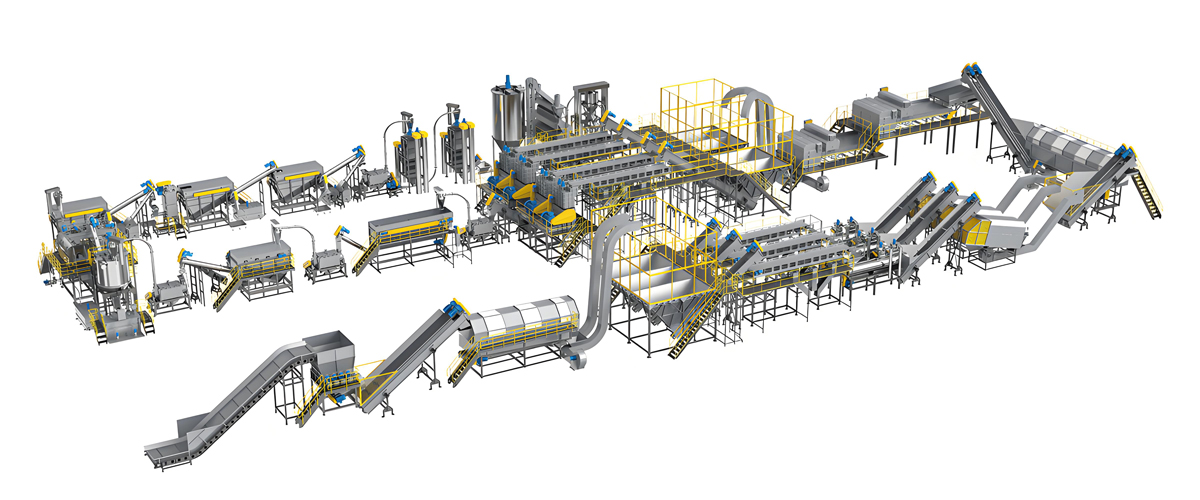
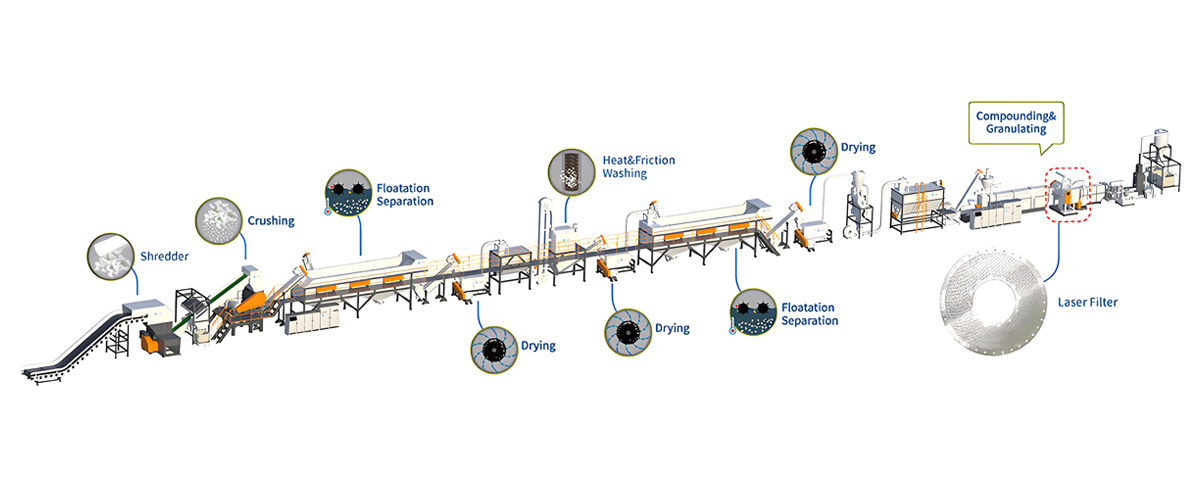
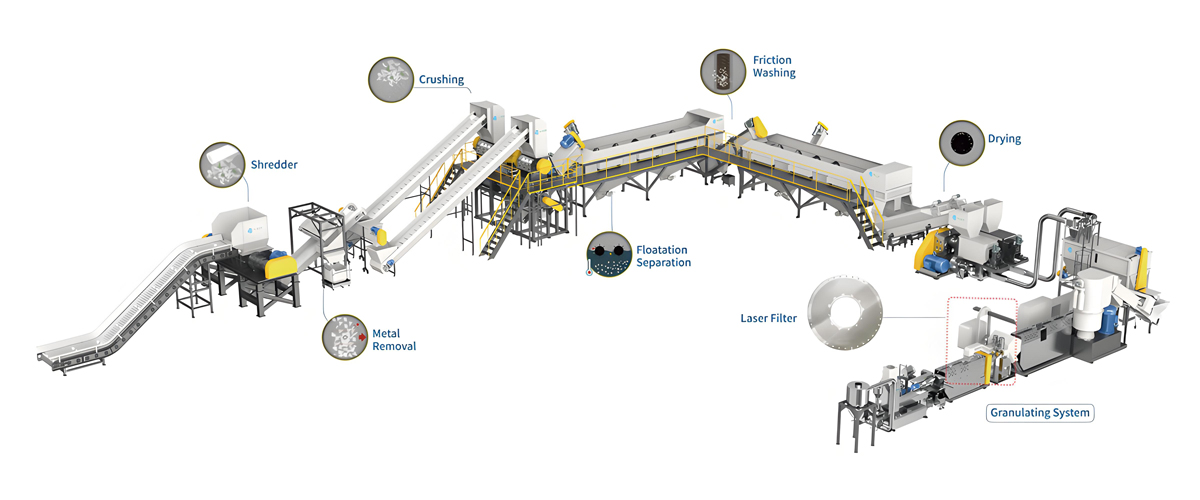
POLYRETEC full-set LDPE film plastic washing lines form a standardized closed-loop sticker removal process through pre-sorting, targeted crushing, hot water degreasing, multi-stage friction washing, fine impurity separation, and high-purity dewatering. Each process link is optimized for sticker removal effect, ensuring that the final LDPE flakes are free of visible stickers and residual glue.
3.1 Pre-Sorting and Preliminary Manual Label Removal
Before feeding into the washing line, waste LDPE film undergoes strict pre-sorting treatment. Workers remove large-area intact stickers, thick paper labels, and obvious hard impurity attachments manually to reduce the pressure of subsequent mechanical washing. This step can avoid large-size label agglomeration from blocking subsequent crushing and friction equipment, and improve the overall sticker removal efficiency by more than 30%. At the same time, severely polluted and heavily aged film materials are sorted separately for targeted enhanced washing treatment, ensuring unified processing standards for batch materials.
3.2 Targeted Low-Damage Crushing Process
Ordinary high-speed crushers are easy to tear LDPE film into fine fragments and wrap stickers inside the flakes. POLYRETEC supporting LDPE special crusher adopts low-speed high-torque and flexible blade design, which can cut continuous LDPE film into uniform 15-20mm flakes without excessive tearing and powdering. The reasonable flake size ensures that all sticker attachment surfaces are fully exposed to the washing medium, eliminating the dead angle of internal wrapping contamination and laying a foundation for thorough sticker removal.
3.3 Hot Water Circulation Degreasing and Glue Softening Treatment
Crushed LDPE flakes are sent to the hot water pre-washing tank, which is the core link to remove aged residual glue. The water temperature is stably controlled at 55℃ to 65℃, the most suitable temperature range for adhesive softening without damaging LDPE material properties. Quantitative environmental protection recycling detergent is added automatically to the circulating water to fully infiltrate the flake surface. After 3-5 minutes of constant-temperature soaking and stirring, the hardened residual glue layers are fully softened, and the bonding force between stickers and film is completely destroyed, making subsequent friction stripping more efficient and thorough.
3.4 Multi-Stage High-Speed Friction Washing for Sticker Stripping
POLYRETEC LDPE washing line is equipped with two-stage series high-efficiency friction washing machines to realize secondary deep sticker removal. The first-stage coarse friction washing strips most intact labels and loose residual glue, removing more than 80% of surface sticker contaminants. The second-stage fine friction washing adopts optimized blade rotation speed and water flow turbulence design, aiming at tiny residual glue spots and embedded label fibers to achieve deep cleaning. The whole friction process maintains moderate material movement intensity, ensuring thorough sticker removal while avoiding excessive loss of LDPE raw materials.
3.5 Floating Impurity Scrapping and Fine Washing Purification
After friction washing, the mixed material of LDPE flakes and stripped sticker impurities enters the floating and sinking separation tank. Light label paper, plastic label fragments, and floating glue residues float on the water surface and are continuously scraped out by the automatic slag scraper. The preliminarily purified LDPE flakes sink into the lower layer of the water tank and are transported to the fine washing tank for secondary cleaning. The fine washing process removes residual detergent traces and tiny unseparated sticker impurities, further improving the surface cleanliness of LDPE flakes.
3.6 High-Efficiency Dewatering and Finished Product Collection
After completing all sticker removal and washing processes, the clean LDPE flakes are sent to a high-speed centrifugal dewatering machine for dewatering treatment. The dewatering rate of POLYRETEC professional dewatering equipment reaches 98%, which can quickly remove surface moisture without secondary contamination. The final dry LDPE flakes have no visible stickers, glue spots, or fiber impurities, fully meeting the high-standard granulation and reprocessing requirements.
4. Professional Equipment Configuration for LDPE Sticker Removal Washing Line
The complete set of POLYRETEC LDPE film washing line for sticker removal includes customized crushing equipment, hot water degreasing system, multi-stage friction washing equipment, automatic slag removal device, circulating water purification system, and dewatering equipment. Different production capacity configurations have targeted matching schemes to ensure the best sticker removal effect and production efficiency.
4.1 Core Equipment Composition and Functional Advantages
The customized flexible plastic crusher is designed for LDPE film characteristics, with flexible cutting and low-loss crushing function, avoiding material excessive fragmentation. The constant-temperature hot water circulation system supports adjustable temperature control, adapting to different aging degrees of sticker glue layers. The double-stage friction washing unit improves the sticker removal rate by hierarchical cleaning, solving the problem of incomplete single washing. The automatic floating slag scraper continuously removes label impurities, avoiding secondary adhesion of stripped stickers to LDPE flakes. The closed circulating water filtration system filters glue residues and fine impurities in water, ensuring long-term stable washing effect and reducing water resource waste.
4.2 Different Capacity Model Configuration and Price Estimation
POLYRETEC provides serialized LDPE film washing lines covering 500kg/h to 3000kg/h output, all equipped with complete sticker removal functional modules. The 500kg/h small-scale LDPE washing line, suitable for small recycling stations, has an FOB price of 21,500 US dollars to 25,200 US dollars. It adopts single hot water tank and double-stage friction washing configuration, with a sticker removal rate of over 98%, meeting basic high-purity recycling demands.
The 1000kg/h standard LDPE washing line is the most cost-effective mainstream model, with an FOB price of 34,800 US dollars to 39,500 US dollars. It upgrades the automatic detergent dosing system and intelligent temperature control system, with a sticker removal rate of up to 99.2%, suitable for most standardized LDPE film recycling factories.
The 2000kg/h to 3000kg/h large-scale high-efficiency washing line is equipped with fully automatic intelligent control and multi-group combined slag removal system, with a sticker removal rate of 99.5% or above. The FOB price ranges from 52,000 US dollars to 68,000 US dollars, suitable for large-scale industrial recycling projects with high requirements for finished product purity.
5. Full-Cycle Project Cost and Benefit Analysis
5.1 Initial Equipment Investment Cost
The initial investment of the LDPE film sticker removal washing line includes complete equipment procurement, installation and commissioning, and simple factory adaptation. All POLYRETEC equipment quotations include free on-site installation and technical commissioning services without hidden costs. The small 500kg/h line requires a factory area of 200-300 square meters with a transformation cost of 2,500-4,000 US dollars. The standard 1000kg/h line needs 300-500 square meters of factory space with a transformation cost of 4,000-6,000 US dollars. Large-scale lines need more standardized factory layout with a transformation cost of 8,000-12,000 US dollars.
5.2 Daily Operating Consumption Cost
The main operating costs include electricity, water, and detergent consumption. All POLYRETEC washing lines adopt frequency conversion energy-saving design. The daily power consumption of 500kg/h line for 10-hour production is 160-200 kWh, with a monthly electricity cost of 450-600 US dollars. The 1000kg/h line consumes 280-320 kWh daily, with a monthly electricity cost of 800-950 US dollars. The closed circulating water system achieves a 95% water recycling rate, with extremely low daily supplementary water cost below 40 US dollars for small and medium lines.
Detergent consumption is the core special cost for sticker removal. The professional environmental protection detergent has low dosage and high efficiency. The monthly detergent cost for small lines is 300-450 US dollars, and for standard lines is 500-700 US dollars. The cost is far lower than the profit premium brought by high-purity finished flakes.
5.3 Labor and Maintenance Cost
The automated design of POLYRETEC washing lines reduces labor dependence. The 500kg/h and 1000kg/h lines only require 1-2 operators for feeding and patrol inspection, with a monthly labor cost of 700-1400 US dollars. The annual equipment maintenance cost is 500-800 US dollars for small lines and 900-1200 US dollars for standard lines. The equipment has a service life of more than 12 years with low long-term depreciation cost.
5.4 Project Profit and Payback Cycle
LDPE flakes with complete sticker removal have a 15%-25% higher market sales price than ordinary uncleaned flakes. After deducting all operating costs, the monthly net profit of the 500kg/h production line is 3800-5200 US dollars, with an investment payback cycle of 13-16 months. The monthly net profit of the 1000kg/h standard line reaches 7500-11000 US dollars, with a payback cycle of 10-12 months. Large-scale lines have higher profit margins and shorter payback cycles, with stable and reliable project returns.
6. Common Sticker Removal Problems and Professional Solutions
6.1 Incomplete Removal of Aged Residual Glue
Aged hard glue residues are the most difficult contamination to remove, easily causing tiny glue spots on flake surfaces. The main reasons include insufficient hot water temperature, short soaking time, and insufficient detergent dosage. The solutions are to appropriately adjust the hot water temperature to 60-65℃, extend the pre-soaking time by 1-2 minutes, increase the dosage of special degreasing detergent for aged glue, and appropriately improve the friction intensity of the second-stage washing machine to enhance deep stripping effect.
6.2 Secondary Adhesion of Stripped Stickers
Stripped label fragments and glue residues may re-adhere to LDPE flake surfaces due to untimely slag removal and turbid circulating water. The solution is to increase the operating frequency of the automatic floating slag scraper, regularly replace and clean the circulating water filter screen, timely discharge turbid water and impurity sediment at the bottom of the tank, and maintain clean circulating water quality to avoid secondary contamination.
6.3 Excessive LDPE Film Loss During Sticker Removal
Excessively high friction speed and unreasonable blade gap will cause LDPE film fragmentation and material loss. It is necessary to adjust the rotating speed of the friction washing machine to a moderate range suitable for flexible film cleaning, optimize the gap between washing blades, avoid rigid cutting of soft film materials, and balance sticker removal effect and material yield rate.
6.4 Ununiform Sticker Removal Effect in Batch Production
Unbalanced manual pre-sorting and uneven feeding volume lead to inconsistent cleaning effect of batch materials. The solution is to standardize pre-sorting standards, classify materials according to pollution degree for separate processing, and adjust the feeding conveyor speed to ensure uniform and quantitative feeding, making each batch of materials obtain consistent hot water soaking and friction cleaning effect.
7. Key Optimization Skills to Improve LDPE Sticker Removal Efficiency
7.1 Material Pre-Classified Processing Optimization
Classify waste LDPE film into lightly polluted, moderately polluted, and heavily aged polluted materials before production. Lightly polluted materials with few new stickers adopt conventional washing parameters to save energy consumption. Moderately polluted materials appropriately extend friction washing time. Heavily aged materials start enhanced hot water degreasing and high-dose detergent treatment. Classified processing avoids excessive energy waste and insufficient cleaning of mixed materials, greatly improving overall production efficiency and finished product qualification rate.
7.2 Circulating Water Quality Maintenance Optimization
Keep the circulating water system clean at all times, regularly clean the filter device and tank bottom sediment, and replace circulating water periodically according to production volume. Clean circulating water can ensure the maximum activity of detergent and avoid the accumulation of glue impurities affecting subsequent cleaning effect. Maintaining stable water quality is the most economical and effective way to ensure long-term stable sticker removal performance of the washing line.
7.3 Equipment Parameter Dynamic Adjustment
Adjust washing line parameters dynamically according to seasonal temperature changes and raw material pollution conditions. In low-temperature winter environments, appropriately increase hot water temperature and extend soaking time to compensate for reduced adhesive softening efficiency caused by low ambient temperature. For raw materials with more plastic labels, improve friction washing speed and slag scraping frequency to ensure thorough removal of tough plastic sticker fragments.
8. Advantages of POLYRETEC LDPE Washing Line Sticker Removal Technology
8.1 Targeted Process Design for Flexible Film Characteristics
Different from universal plastic washing lines on the market, POLYRETEC LDPE film washing lines are specially optimized for flexible film sticker removal pain points. The low-loss crushing, moderate-temperature glue softening, and hierarchical friction washing processes perfectly adapt to the soft texture and easy-tearing characteristics of LDPE materials, achieving the dual goals of thorough sticker removal and low material loss, which cannot be realized by traditional rigid plastic washing equipment.
8.2 High-Purity Cleaning and Stable Product Quality
Through the combination of physical friction stripping and chemical glue decomposition, the sticker removal rate of POLYRETEC equipment is far higher than the industry average. The finished LDPE flakes have no visible stickers, glue spots, and fiber impurities, with stable and uniform quality, which can meet the production standards of high-grade recycled film, plastic bags, and industrial packaging materials, helping customers obtain high-end market order resources and higher profit margins.
8.3 Energy-Saving and Environmentally Friendly Production Mode
The closed circulating water recycling system greatly reduces water resource consumption, and the frequency conversion energy-saving control system reduces invalid power consumption. The matched environmental protection detergent is non-toxic, harmless, and biodegradable, meeting global environmental protection emission standards. The whole production process has no secondary pollution, realizing green and sustainable LDPE film recycling production.
8.4 Professional Customization and Full After-Sales Service
POLYRETEC can customize personalized sticker removal process schemes and equipment configurations according to customers' raw material types, pollution degrees, and production capacity requirements. The professional technical team provides on-site installation, parameter debugging, operator training, and long-term after-sales maintenance services, helping customers quickly master professional sticker removal production technology and avoid production trial-and-error costs.
9. Industry Application and Market Value Analysis
With the continuous improvement of global recycled plastic quality standards, high-purity impurity-free LDPE recycled flakes have become scarce resources in the plastic recycling market. Most small and medium-sized recycling enterprises are restricted by backward sticker removal technology, unable to produce high-cleanliness products and can only occupy the low-end low-price market. Adopting POLYRETEC professional LDPE washing line sticker removal technology can help enterprises upgrade product quality, open high-end downstream markets, and greatly improve core market competitiveness.
LDPE film recycling projects with perfect sticker removal processes have low investment risk, stable market demand, and sustainable profit growth space. With the increasing awareness of global plastic resource recycling and the improvement of environmental protection policies, standardized and high-purity flexible plastic recycling production will become the mainstream development trend of the industry, bringing long-term stable economic benefits to recycling enterprises.
10. Conclusion
Sticker and residual glue contamination is the core bottleneck restricting the quality improvement and profit growth of LDPE film recycling projects. Traditional washing processes cannot solve the problem of thorough sticker removal, resulting in low product value and limited development space. POLYRETEC professional LDPE film plastic washing line integrates targeted glue softening, hierarchical friction stripping, and precise impurity separation technology, which can efficiently and stably remove various types of stickers and aged residual glue on LDPE film.
With diversified capacity configurations, transparent and reasonable price costs, low full-cycle operating costs, and perfect after-sales service support, POLYRETEC washing lines provide the most reliable and cost-effective solution for global LDPE film sticker removal and high-purity recycling. By adopting standardized production processes and reasonable equipment parameter optimization, recycling enterprises can effectively improve finished product purity, increase product profit margins, and realize long-term stable and high-quality development of LDPE plastic recycling business.
|(注:部分内容可能由 AI 生成)