
Introduction to Sheet and Film Waste Recycling
Plastic sheet and film waste represents one of the most challenging yet valuable segments of the recycling industry. The lightweight nature, large surface area, and tendency of sheet and film materials to tangle and wrap around equipment create unique processing challenges that require specialized recycling machinery. POLYRETEC has developed advanced recycling machines specifically engineered to handle the difficulties of sheet and film waste while maximizing yield and processing efficiency. These specialized machines incorporate cutting, feeding, and processing technologies that address the specific characteristics of sheet and film materials, enabling profitable recycling of materials that often end up in landfills due to processing difficulties.
The economic potential of sheet and film waste recycling is substantial when considering the volume of waste generated and the value of the materials. Packaging films, agricultural films, industrial sheet waste, and other film-based products represent significant material streams that can be profitably recycled with appropriate equipment. POLYRETEC recycling machines for sheet and film waste achieve yields of 92 to 97 percent while processing capacities from 200 to 2000 kilograms per hour, enabling economic viability for both small and large scale recycling operations.
Unique Challenges of Sheet and Film Waste Processing
Sheet and film waste presents unique processing challenges that conventional recycling equipment cannot effectively handle. Understanding these challenges is essential for selecting appropriate recycling machinery. POLYRETEC has developed solutions for each of these challenges through extensive experience with sheet and film recycling applications.
Material handling represents the most significant challenge with sheet and film waste. The lightweight materials tend to float rather than feed properly into shredders and granulators. Films have a strong tendency to wrap around rotating components, causing equipment jams and reduced efficiency. POLYRETEC addresses these challenges through specialized feeding systems with forced feeding mechanisms, anti-wrap cutting chambers, and intelligent material handling that ensures consistent feed to the recycling process. The specialized handling systems enable processing of materials that would cause constant operational issues with conventional equipment.
Low bulk density of sheet and film materials creates storage, handling, and processing efficiency challenges. The large volume-to-weight ratio requires substantial storage space and creates difficulty in achieving consistent feed rates. POLYRETEC offers pre-compaction systems that increase bulk density by 300 to 500 percent before material enters the primary shredding stage. This pre-compaction reduces storage requirements by 60 to 80 percent and enables consistent, efficient feeding to the recycling line. The pre-compaction investment of 8,000 to 25,000 dollars provides substantial operational benefits and space savings.
Specialized Cutting and Shredding Technology
Effective size reduction of sheet and film materials requires cutting technology specifically designed for thin, flexible materials. Standard shredders designed for rigid plastics often struggle with films, resulting in stringy output, poor cutting quality, and frequent equipment jams. POLYRETEC offers specialized shredding and granulating equipment optimized for sheet and film processing.
Film-Specific Granulators
POLYRETEC film granulators feature high-speed cutting rotors with specialized knife geometries that achieve clean cuts on thin films without creating stringy output. The granulators achieve particle sizes of 3 to 8 millimeters ideal for feeding to extrusion systems. Throughput capacities range from 200 to 1500 kilograms per hour depending on material type and desired particle size. Film granulator investment ranges from 25,000 to 120,000 dollars depending on capacity and features.
The specialized knife designs in POLYRETEC granulators maintain sharp cutting edges significantly longer than conventional granulators. The knife life extends from 200 to 400 hours of operation before resharpening is required, compared to 50 to 150 hours for conventional granulators. This extended knife life reduces maintenance downtime by 60 to 75 percent and provides substantial annual savings in knife replacement and labor costs.
Sheet Shredding Systems
For thicker sheet materials exceeding 1 millimeter thickness, POLYRETEC offers heavy-duty sheet shredders that can handle rigid sheets while maintaining film processing capabilities. The shredders feature adjustable cutting gaps that accommodate various thicknesses and materials. Throughput capacities for sheet shredders range from 300 to 2000 kilograms per hour. Sheet shredder investment ranges from 40,000 to 180,000 dollars depending on capacity and capabilities.
The adjustable cutting gap technology enables processing of mixed materials with varying thicknesses without requiring equipment reconfiguration. This flexibility is particularly valuable for recycling operations handling diverse material streams including packaging films, agricultural films, and industrial sheet waste. The ability to process diverse materials without equipment changes increases operational flexibility and reduces changeover time by 70 to 85 percent.
Advanced Feeding Systems
Feeding systems for sheet and film waste must overcome the materials’ tendency to float, wrap, and bridge. POLYRETEC has developed comprehensive feeding solutions that ensure consistent material feed to the size reduction and extrusion systems. These feeding systems are essential for achieving consistent operation and maximum equipment utilization.
Forced Feeding Conveyors
Conventional conveyor systems often cannot effectively feed lightweight film materials to size reduction equipment. POLYRETEC forced feeding conveyors utilize paddle or flight systems that actively push material into the cutting chamber rather than relying on gravity feeding. The forced feeding systems achieve feed rates 200 to 400 percent higher than conventional conveyors for film materials, enabling full utilization of equipment capacity.
The forced feeding systems incorporate variable speed drives that enable optimization of feed rates for different material types and processing conditions. The systems can be adjusted to match the optimal feed rate for each material, maximizing throughput while preventing equipment overload. Forced feeding conveyor investment ranges from 12,000 to 45,000 dollars depending on capacity and features.
Anti-Wrap Cutting Chambers
Film materials have a strong tendency to wrap around cutting rotors, causing equipment jams and reduced efficiency. POLYRETEC anti-wrap cutting chambers feature designs that prevent film from wrapping around rotors and shafts. The anti-wrap technology reduces equipment jams by 80 to 95 percent compared to conventional designs, dramatically improving operational reliability.
The anti-wrap design incorporates optimized chamber geometry, specialized rotor shafts, and strategic knife placement that work together to prevent material wrapping. The technology works with both film granulators and sheet shredders, providing broad applicability across different material types and thicknesses. The anti-wrap design typically adds 15 to 25 percent to base equipment cost but provides substantial operational benefits through reduced downtime and maintenance requirements.
Agglomeration and Densification Technology
The extremely low bulk density of loose sheet and film waste creates significant challenges in storage, handling, and feeding to extrusion systems. POLYRETEC offers agglomeration and densification systems that increase bulk density and create flowable agglomerates suitable for extrusion processing. These systems are essential for economic processing of loose film materials.
Compact Agglomerators
POLYRETEC compact agglomerators use friction heat generated by material movement in a confined chamber to partially melt and densify film materials. The agglomerates produced have bulk densities 8 to 12 times higher than loose film, dramatically improving handling and feeding characteristics. Throughput capacities range from 100 to 800 kilograms per hour. Compact agglomerator investment ranges from 35,000 to 150,000 dollars depending on capacity.
The compact agglomeration process produces uniformly sized agglomerates that feed consistently to extrusion systems without bridging or feeding issues. The agglomerates have dimensions typically 10 to 25 millimeters, ideal for feeding to standard extrusion feed throats. The agglomeration process can handle mixed film types without requiring sorting, adding significant operational flexibility.
Pelletizing Agglomerators
For operations requiring consistent pellet form, POLYRETEC offers pelletizing agglomerators that produce uniform pellets from film materials. The pelletizing agglomerators produce pellets 3 to 6 millimeters in diameter with consistent size and shape ideal for storage and handling. Throughput capacities range from 150 to 1000 kilograms per hour. Pelletizing agglomerator investment ranges from 50,000 to 220,000 dollars depending on capacity.
The pelletizing agglomeration process produces pellets that can be stored, transported, and sold as intermediate products. This capability enables separation of collection and densification operations from extrusion processing, providing operational flexibility. The pellets have bulk densities 10 to 15 times higher than loose film, dramatically reducing storage and transportation costs.
Extrusion Systems for Film Recycling
Extrusion systems for film recycling must handle the specific characteristics of reprocessed film materials, including potential degradation, melt flow variations, and impurity content. POLYRETEC extrusion systems for film recycling incorporate specialized screw designs, filtration systems, and degassing capabilities optimized for film materials.
Film-Optimized Screw Designs
POLYTEC film recycling extruders feature screw designs optimized for processing reprocessed film materials. The screws incorporate gentle mixing sections that prevent excessive shear that could further degrade film materials while ensuring adequate homogenization. The optimized screw designs achieve 20 to 35 percent higher throughput for film materials compared to general-purpose screw designs.
The film-optimized screws feature extended compression ratios and mixing sections that handle the variations in melt flow index common in reprocessed film materials. The screws maintain consistent extrusion quality even with input material variations of plus or minus 30 percent in melt flow index. Film-optimized screw investment typically adds 10 to 20 percent to base extruder cost but provides substantial operational benefits through improved quality and throughput.
Advanced Filtration Systems
Film materials often contain contaminants including paper labels, adhesive residues, and other impurities that must be removed during recycling. POLYRETEC filtration systems for film recycling feature multi-stage filtration with automatic screen changers that maintain continuous operation. The filtration systems achieve contaminant removal efficiency of 95 to 98 percent while minimizing material loss.
The automatic screen changers enable continuous filtration by switching between multiple filter screens without stopping production. This technology prevents the yield losses of 1 to 3 percent that typically occur with manual screen changes during film recycling. Advanced filtration system investment ranges from 20,000 to 80,000 dollars depending on capacity and filtration requirements.
Enhanced Degassing Capabilities
Film materials, particularly those that have been used for packaging or agricultural applications, may contain absorbed volatiles or degradation products that must be removed during extrusion. POLYTEC film recycling extruders feature enhanced multi-stage degassing systems that remove 70 to 90 percent of volatiles, preventing defects and quality issues in finished products.
The enhanced degassing systems utilize optimized vent port designs and vacuum systems that efficiently remove volatiles without causing melt instability. The systems maintain stable extrusion while achieving thorough degassing, which is challenging with film materials due to their high surface area and potential for contamination.
Complete Recycling Line Configuration
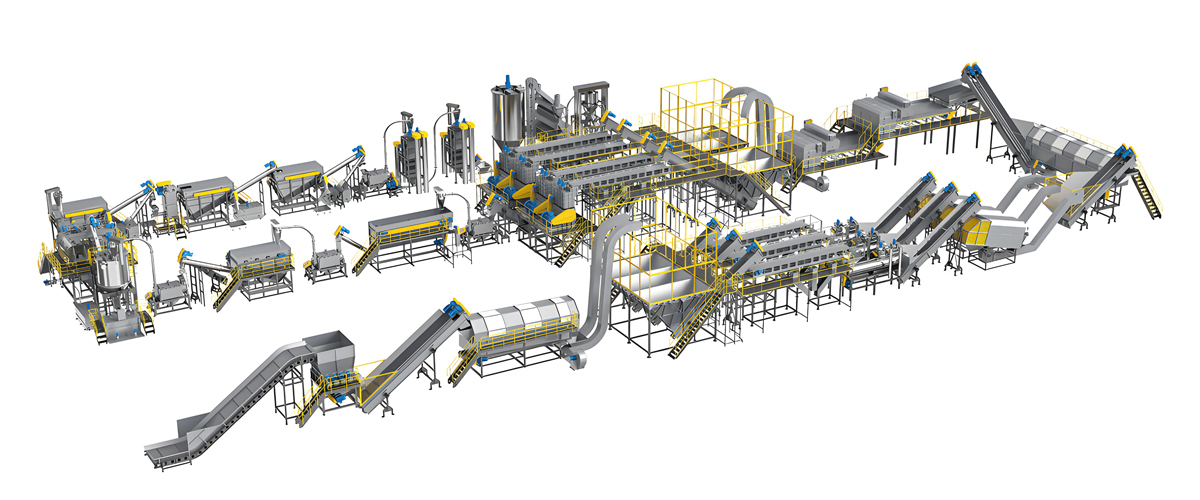
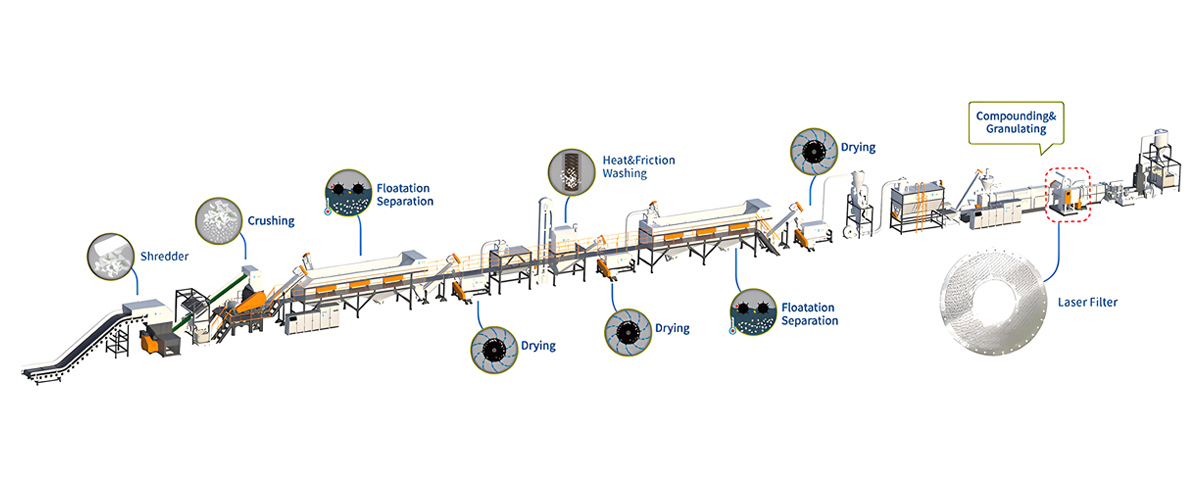
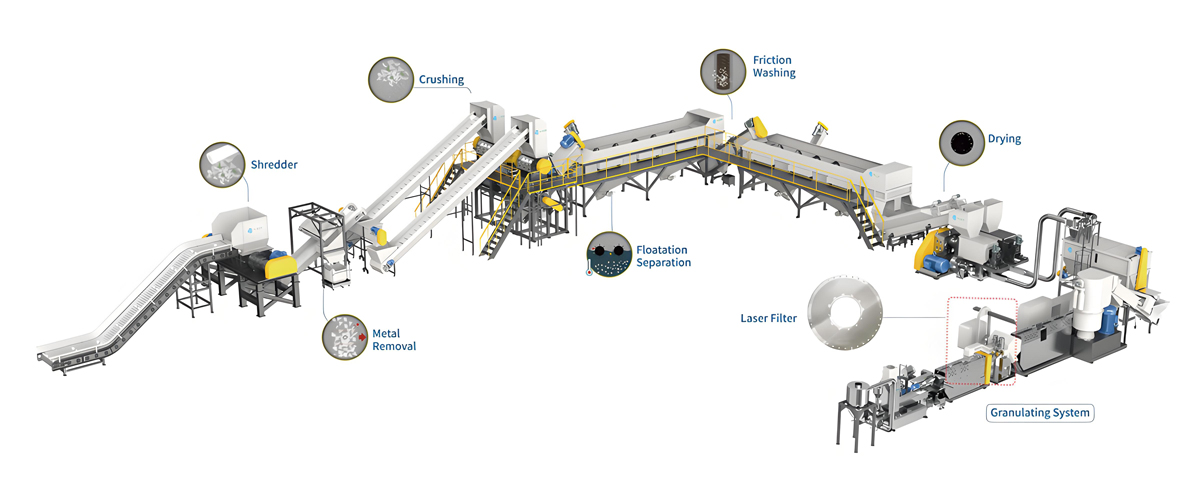
POLYTEC offers complete recycling line configurations specifically designed for sheet and film waste processing. These integrated systems include feeding, size reduction, agglomeration, extrusion, and pelletizing components that work together seamlessly. Complete line configurations provide operational efficiency advantages compared to piecing together individual components.
Small Capacity Lines
Small capacity film recycling lines from POLYTEC process 200 to 500 kilograms per hour of loose film waste. These compact lines include forced feeding conveyor, film granulator, optional agglomerator, film-optimized extruder, and pelletizer. Total equipment investment ranges from 80,000 to 250,000 dollars depending on configuration and included options. The small capacity lines are ideal for workshops, small recycling operations, or facilities with limited film waste volumes.
The small capacity lines require 100 to 150 square meters of floor space and 50 to 80 kilowatts of electrical power. Water requirements for cooling range from 2 to 5 cubic meters per hour. The compact size and modest utility requirements make these lines suitable for installation in existing facilities without extensive modifications.
Medium Capacity Lines
Medium capacity film recycling lines process 500 to 1200 kilograms per hour of loose film waste. These lines include all components of small lines plus enhanced automation and control systems. Total equipment investment ranges from 200,000 to 600,000 dollars. The medium capacity lines are suitable for dedicated recycling facilities or manufacturing operations with significant film waste generation.
The medium capacity lines require 200 to 350 square meters of floor space and 100 to 180 kilowatts of electrical power. Water requirements range from 5 to 12 cubic meters per hour. The increased capacity and automation enable economic processing of larger film waste volumes while maintaining low labor requirements.
Large Capacity Lines
Large capacity film recycling lines from POLYTEC process 1200 to 2000 kilograms per hour of loose film waste. These comprehensive lines include all components of medium lines plus additional features such as material sorting systems, advanced quality control, and enhanced automation. Total equipment investment ranges from 500,000 to 1,500,000 dollars.
The large capacity lines require 350 to 600 square meters of floor space and 180 to 350 kilowatts of electrical power. Water requirements range from 12 to 25 cubic meters per hour. The large capacity lines are designed for high-volume recycling facilities or centralized recycling operations serving multiple material sources.
Material-Specific Processing Capabilities
Different film materials require specific processing approaches to achieve optimal results. POLYTEC film recycling lines can be configured to process various film types including polyolefin films, PVC films, and multi-layer films. Understanding material-specific requirements enables selection of appropriate equipment configuration.
Polyolefin Film Processing
Polyolefin films including high-density polyethylene, low-density polyethylene, and polypropylene films are the most common film materials in recycling streams. These materials process relatively easily but require attention to melt flow index variations and potential degradation. POLYTEC polyolefin film recycling lines achieve yields of 94 to 97 percent with throughput capacities matching the standard line ranges.
Polyolefin films typically produce pellets with melt flow indexes suitable for injection molding, extrusion, and blow molding applications. The reprocessed pellets maintain 80 to 95 percent of the mechanical properties of virgin material when properly processed. The value of reprocessed polyolefin film pellets ranges from 0.50 to 0.85 dollars per kilogram depending on quality and color consistency.
PVC Film Processing
PVC films present processing challenges due to the thermal sensitivity of PVC and the need for extensive degassing. POLYTEC PVC film recycling lines incorporate specialized screw designs with short residence times, enhanced multi-stage degassing, and temperature profiles optimized for PVC stability. These lines achieve yields of 90 to 94 percent for PVC films.
PVC film processing requires particular attention to removing contaminants that could generate hydrochloric acid during processing. The enhanced degassing systems remove 85 to 95 percent of potential volatiles, preventing equipment corrosion and ensuring safe operation. PVC film pellets typically command prices of 0.60 to 1.00 dollars per kilogram due to the processing challenges and the value of recycled PVC.
Multi-Layer Film Processing
Multi-layer films containing different plastic materials present separation challenges during recycling. POLYTEC offers solutions for multi-layer film processing including material separation technologies and compatibilizer systems that enable processing of mixed materials. The approach depends on the specific layer composition and the desired output quality.
For multi-layer films where one material comprises 70 percent or more of the total, POLYTEC offers processing systems that produce acceptable quality recycled material with compatibilizer additives. For films with more balanced layer compositions, POLYTEC offers separation technologies that can separate the layers for individual recycling. Multi-layer film processing typically achieves yields of 85 to 92 percent depending on the specific film composition and separation approach.
Cost Analysis and Economic Considerations
Comprehensive cost analysis is essential for evaluating the economic viability of sheet and film recycling operations. POLYTEC provides detailed economic analysis tools that help customers understand the investment requirements, operating costs, and potential returns for various recycling scenarios.
Capital Investment Analysis
Total capital investment for sheet and film recycling operations varies based on capacity, automation level, and included features. Small capacity lines with 200 to 500 kilograms per hour capacity typically require total investment of 120,000 to 350,000 dollars including equipment, installation, and initial training. Medium capacity lines with 500 to 1200 kilograms per hour capacity require 250,000 to 800,000 dollars total investment. Large capacity lines with 1200 to 2000 kilograms per hour capacity require 600,000 to 2,000,000 dollars total investment.
Installation costs typically range from 10 to 20 percent of equipment cost and include site preparation, utility connections, equipment setup, and commissioning. Training costs range from 5,000 to 20,000 dollars depending on the number of personnel trained and the depth of training provided. Working capital for initial material purchase and operating expenses typically ranges from 30,000 to 100,000 dollars depending on capacity and local conditions.
Operating Cost Analysis
Operating costs for sheet and film recycling include material costs, energy consumption, labor, maintenance, and consumables. Material costs represent the largest operating expense, typically 0.15 to 0.45 dollars per kilogram depending on the quality and source of the film waste. Energy consumption ranges from 0.25 to 0.50 kilowatt-hours per kilogram of finished pellets. With electricity costs of 0.12 to 0.20 dollars per kilowatt-hour, energy costs range from 0.03 to 0.10 dollars per kilogram.
Labor costs vary significantly based on automation level and local wage rates. Highly automated lines may require only one operator per shift, while less automated lines may require two to three operators. Labor costs typically range from 0.04 to 0.15 dollars per kilogram depending on automation level and local conditions. Maintenance costs typically range from 0.02 to 0.08 dollars per kilogram over equipment life, with proper maintenance practices at the lower end of this range.
Revenue and Profitability Analysis
Revenue potential for sheet and film recycling operations depends on the quality of the output pellets, material type, and local market conditions. Polyolefin film pellets typically sell for 0.50 to 0.85 dollars per kilogram depending on quality and color. PVC film pellets command prices of 0.60 to 1.00 dollars per kilogram. High-quality sorted film pellets for specialized applications may achieve prices up to 1.20 dollars per kilogram.
Profitability analysis for a 500 kilogram per hour polyolefin film recycling line operating 20 hours per day, 250 days per year shows compelling economics. Annual production of 2,500,000 kilograms at a selling price of 0.70 dollars per kilogram generates annual revenue of 1,750,000 dollars. With total operating costs of 1,250,000 dollars including materials, energy, labor, maintenance, and overhead, annual profit of 500,000 dollars is achievable. This represents a 40 to 50 percent margin and a payback period of 18 to 30 months on a 750,000 dollar total investment.
Market Applications for Recycled Film Pellets
Understanding the market applications for recycled film pellets helps guide processing decisions and quality requirements. POLYTEC has extensive knowledge of recycled pellet applications and can help customers target their production to appropriate market segments.
Injection Molding Applications
Injection molding represents a significant market for recycled polyolefin film pellets. Applications include non-critical components, containers, and household goods. The recycled pellets provide cost savings of 30 to 50 percent compared to virgin materials while maintaining adequate performance for many applications. Injection molding applications typically require pellet melt flow indexes of 5 to 20 grams per 10 minutes, which POLYTEC film recycling lines can consistently achieve.
Extrusion Applications
Extrusion applications including pipe, profile, and sheet production utilize recycled film pellets extensively. The applications benefit from the cost advantages of recycled materials while maintaining performance requirements. Extrusion applications typically require melt flow indexes of 0.2 to 5 grams per 10 minutes, which film recycling lines can achieve through appropriate screw design and processing conditions.
Blow Molding Applications
Blow molding applications including bottles and containers can utilize recycled film pellets for non-food applications. The recycled pellets provide cost advantages while meeting performance requirements for many blow molding applications. Blow molding typically requires melt flow indexes of 0.2 to 1.5 grams per 10 minutes, which POLYTEC film recycling lines can achieve through appropriate processing and potential blending with higher melt flow materials.
Quality Control and Testing
Comprehensive quality control is essential for producing recycled film pellets that meet customer requirements and achieve market acceptance. POLYTEC recycling lines incorporate quality monitoring and testing capabilities that ensure consistent output quality.
Melt Flow Index Testing
Melt flow index testing determines the processing characteristics of recycled pellets and ensures they meet application requirements. POLYTEC offers online melt flow index testers that provide real-time monitoring of this critical parameter. The testers measure melt flow index according to ASTM D1238 standards and can be configured for different temperature and weight conditions.
Online melt flow index testers cost 15,000 to 45,000 dollars depending on configuration and automation level. The testers enable real-time process adjustments to maintain target melt flow index within plus or minus 10 percent of specification. Consistent melt flow index is essential for customer acceptance and enables predictable processing behavior in downstream applications.
Mechanical Properties Testing
Mechanical properties testing verifies that recycled pellets maintain adequate strength and toughness for intended applications. Tensile testing and impact testing provide key indicators of material performance. POLYTEC can provide testing equipment recommendations based on target applications and quality requirements.
Mechanical properties testing typically requires investment of 8,000 to 25,000 dollars for basic testing equipment. More comprehensive testing including elongation and modulus measurements may require 25,000 to 60,000 dollars investment. Regular testing ensures consistent quality and provides data for marketing and customer assurance.
Customer Success Stories
Multiple POLYTEC customers have achieved success with sheet and film waste recycling operations using POLYTEC specialized equipment. These success stories demonstrate the real-world performance and economic benefits of POLYTEC technology.
Agricultural Film Recycling Success
A large agricultural operation generating 800 kilograms per hour of used agricultural film waste implemented a POLYTEC film recycling line to process this material on-site. The line processes the mixed agricultural films including mulch film, greenhouse film, and silage film into pellets used for agricultural products manufacturing. The recycling operation achieves a yield of 94 percent and generates annual profit of 320,000 dollars while eliminating disposal costs of 150,000 dollars annually. The total investment of 580,000 dollars achieved payback in 22 months.
Packaging Film Recycling Success
A packaging manufacturer generating 1200 kilograms per hour of mixed packaging film wastes implemented a POLYTEC complete recycling line. The line processes various packaging films including stretch film, shrink film, and packaging laminates into pellets used for injection molding applications. The operation achieves a yield of 95 percent and generates annual profit of 480,000 dollars. The recycling line investment of 920,000 dollars achieved payback in 23 months while also providing sustainability benefits and reducing material purchasing costs.
Environmental and Sustainability Benefits
Sheet and film recycling provides substantial environmental and sustainability benefits beyond the direct economic advantages. POLYTEC supports customers in understanding and communicating these benefits to stakeholders and regulatory bodies.
Landfill Diversion
Recycling sheet and film waste prevents these materials from entering landfills where they would persist for hundreds of years. For a 500 kilogram per hour recycling operation, the annual landfill diversion of 2,500,000 kilograms represents a significant environmental contribution. Many regions have landfill diversion targets and incentives that can provide additional economic benefits for recycling operations.
Carbon Footprint Reduction
Recycling plastic films reduces the carbon footprint compared to virgin material production by 60 to 80 percent. The energy savings and reduced greenhouse gas emissions provide significant environmental benefits. Some regions have carbon credit programs that can generate additional revenue for recycling operations based on the carbon footprint reduction achieved.
Future Technology Developments
POLYTEC continues to invest in research and development for sheet and film recycling technology. Emerging technologies promise to further improve efficiency, yield, and material quality while reducing costs and environmental impact.
Advanced Sorting Technologies
Near-infrared and optical sorting technologies continue to improve, enabling better separation of different film types and removal of contaminants. Future sorting systems will achieve sorting accuracy of 99.5 percent and processing speeds of 5000 kilograms per hour. These advanced sorting systems will enable higher quality recycled pellets and expanded applications for recycled film materials.
Process Integration
Advanced process integration technologies will enable more efficient operation with reduced energy consumption and improved material quality. Model predictive control systems will optimize processing parameters in real-time based on material conditions and quality requirements. Artificial intelligence will enable continuous process improvement and predictive maintenance. These technologies will reduce operating costs by 15 to 25 percent while improving yield by 2 to 4 percent.
Conclusion
Sheet and film waste recycling presents unique challenges that require specialized equipment and expertise. POLYTEC has developed comprehensive solutions addressing all aspects of film recycling from material handling to finished pellet quality. The combination of specialized cutting technology, advanced feeding systems, extrusion optimization, and complete line configurations enables economic and reliable recycling of sheet and film materials.
The economic analysis demonstrates compelling returns on investment for sheet and film recycling operations, with typical payback periods of 18 to 30 months. The environmental benefits of landfill diversion and carbon footprint reduction add additional value beyond direct economic returns. POLYTEC partnership in sheet and film recycling provides customers with the technology, expertise, and support needed for successful and profitable recycling operations.