
The global demand for recycled PET flakes continues to surge as countries worldwide strengthen plastic waste management, carbon neutrality policies, and sustainable packaging regulations. Recycled PET flakes serve as core raw materials for rPET packaging bottles, textile polyester fibers, plastic straps, and industrial plastic products, making PET bottle recycling and washing systems essential equipment for the global plastic circular economy. A high-quality PET bottle flake washing line determines the purity, cleanliness, moisture content, and batch stability of final PET flakes, directly affecting downstream product quality and market qualification for export-oriented recycling enterprises.
POLYRETEC, a professional manufacturer of high-standard plastic recycling and washing equipment, designs and produces fully automatic PET bottle flake washing lines tailored to diverse global market standards, regional environmental regulations, and varying waste plastic material conditions. Different from ordinary domestic washing equipment, POLYRETEC export-grade PET washing lines adopt international standardized configurations, multi-stage impurity removal technology, energy-saving water circulation systems, and customizable process schemes, fully meeting the certification and quality requirements of Europe, North America, Southeast Asia, Middle East, and Latin American markets. This article comprehensively analyzes global market access standards, core equipment configuration advantages, process flow optimization, cost performance, price estimation, and operation guidelines of export-grade PET bottle flake washing lines, providing systematic reference for enterprises investing in global PET recycling projects.
1. Global Market Access Standards for Export-Grade PET Flake Washing Lines
1.1 International Quality Standards for Recycled PET Flakes
Different regional markets have strict and differentiated quality standards for recycled PET flakes, which are the core evaluation basis for qualified PET bottle flake washing lines. European markets enforce strict EU REACH regulations and EFSA food-grade safety standards, requiring recycled PET flakes for food packaging to have zero harmful residue, ultra-low impurity content, and stable molecular purity. North American markets follow FDA food contact safety standards and strict moisture content control requirements, limiting foreign particle content, glue residue, and pigment residue in finished flakes.
Southeast Asian, Middle Eastern, and Oceanian markets focus on comprehensive impurity removal efficiency and production stability, with flexible requirements for food-grade standards but strict regulations on plastic flake cleanliness and environmental protection discharge. All global high-end markets uniformly require finished PET flakes to have low moisture content below 0.3%, ultra-low PVC and PE impurity content, no label paper residue, and uniform flake size distribution. Ordinary traditional washing lines cannot meet these international standards due to single impurity removal function and incomplete cleaning process, while POLYRETEC export-grade PET bottle flake washing lines are fully calibrated according to global unified quality specifications to ensure exported products pass international inspections smoothly.
1.2 Global Environmental Protection and Emission Standards for Recycling Equipment
In addition to product quality standards, export-oriented PET washing lines must comply with local environmental protection emission regulations, including wastewater discharge, waste gas treatment, and noise control. European countries implement strict industrial wastewater recycling rate requirements, requiring plastic washing equipment to achieve over 90% water circulation utilization and zero direct discharge of polluted wastewater. North American markets have strict noise control standards for industrial equipment, limiting operating noise below 75 decibels to meet factory environmental assessment requirements.
Most emerging markets require equipment to be equipped with complete waste residue classification and recovery systems to avoid secondary plastic pollution. POLYRETEC export PET bottle flake washing lines are pre-configured with international standard water circulation purification systems, noise reduction structures, and waste residue centralized recovery devices, fully adapting to environmental assessment requirements of various global regions and eliminating equipment export qualification barriers caused by non-compliant environmental configurations.
1.3 Global Equipment Operational Safety and Certification Requirements
Industrial equipment exported to global mainstream markets must pass local safety certification standards, including CE certification for European markets, UL safety certification for North America, and local industrial safety standard certification for emerging markets. These certifications put forward strict requirements on equipment circuit safety, mechanical protection, electrical control stability, and emergency protection devices.
POLYRETEC export-grade PET bottle flake washing lines adopt full international standard electrical components, complete mechanical safety protection structures, and intelligent emergency stop systems. The whole machine meets global industrial safety certification specifications, avoiding export detention, return, and qualification failure caused by unqualified safety configurations, and is the most reliable standardized equipment for global PET recycling project investment.
2. Core Technical Pain Points of Ordinary PET Washing Lines for Global Export
2.1 Incomplete Impurity Removal Unable to Meet International Flake Standards
Most ordinary domestic PET washing lines adopt simple single-stage cold water cleaning and single gravity separation technology, which can only remove large-particle label paper and surface floating dirt. They cannot effectively remove adhesive glue residues, oil stains, embedded fine impurities, PVC mixed materials, and deep-layer pigment residues on PET bottle flakes. The finished flakes have high impurity content, failing to meet food-grade and high-end textile-grade PET raw material standards required by European and American markets, resulting in inability to enter high-end global markets and low product profit margins.
2.2 High Water Consumption and Non-Compliant Environmental Discharge
Traditional PET washing lines lack professional wastewater circulation purification systems, relying on a large amount of fresh water for repeated cleaning, with water consumption up to 15 to 20 tons per ton of finished flakes. The discharged wastewater contains a large amount of plastic fine powder, glue pollutants, and oil stains, which cannot meet global environmental protection discharge standards. Export projects using such equipment will face environmental assessment failure, production shutdown rectification, and high environmental fines, bringing huge operational risks to overseas investment enterprises.
2.3 Unstable Batch Production and Low Automation
Ordinary washing lines have low overall automation, requiring a large number of manual sorting, cleaning, and material transfer operations. Manual intervention leads to unstable product quality, inconsistent flake cleanliness in different batches, and difficulty in meeting unified international order standards. At the same time, the equipment has low operational stability, high failure rate, and short continuous operation time, unable to adapt to long-term high-efficiency mass production requirements of large-scale global recycling factories, resulting in low project output and poor economic benefits.
2.4 Poor Adaptability to Global Diversified Raw Materials
Waste PET bottle raw materials in different global regions have significant differences: European and American waste PET bottles have clean single components with few impurities, while Southeast Asian, African, and Middle Eastern waste PET materials have complex components, mixed with various plastic impurities, thick oil stains, and stubborn glue residues. Ordinary fixed-process washing lines cannot adjust process parameters according to raw material differences, resulting in poor cleaning effect for complex materials and resource waste for high-purity materials, with extremely low global market adaptability.
3. Core Advantages of POLYRETEC Export-Grade PET Bottle Flake Washing Line
3.1 International Standard Multi-Stage Graded Cleaning Process
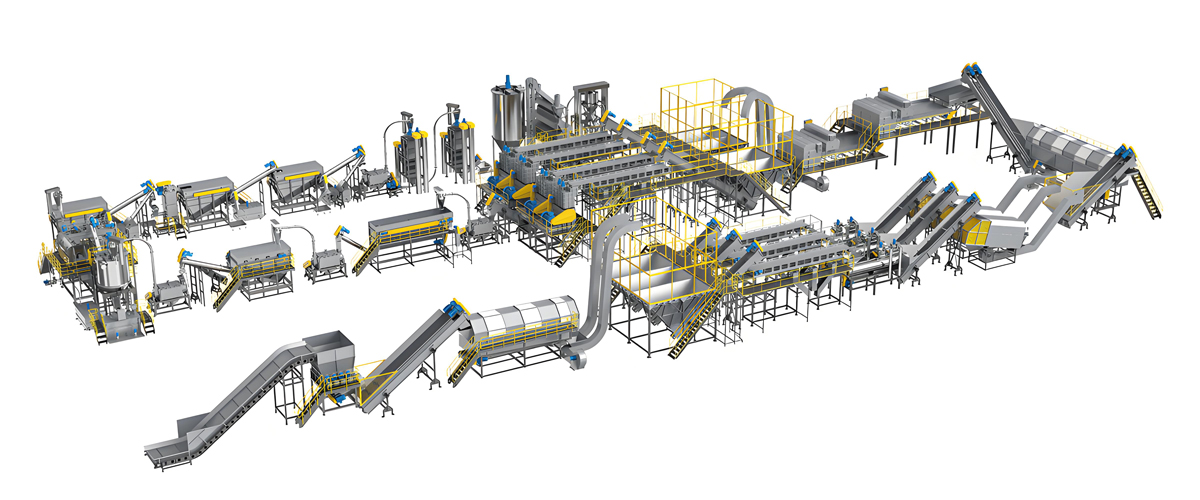
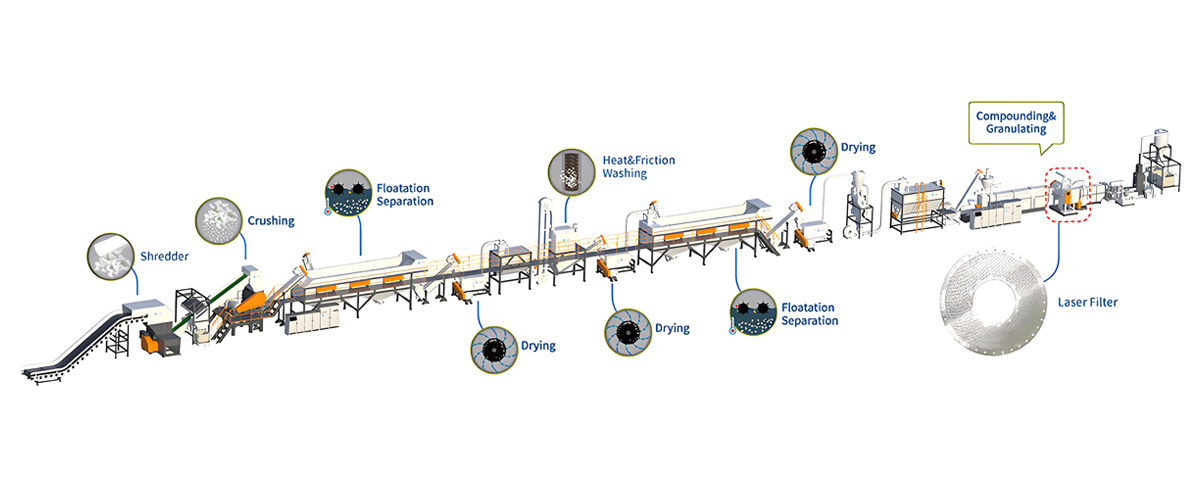
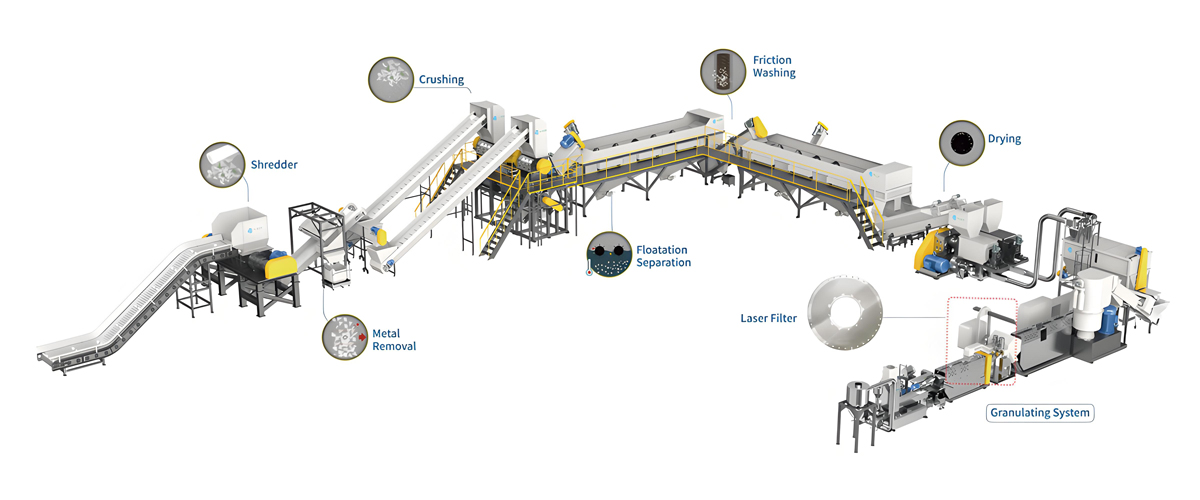
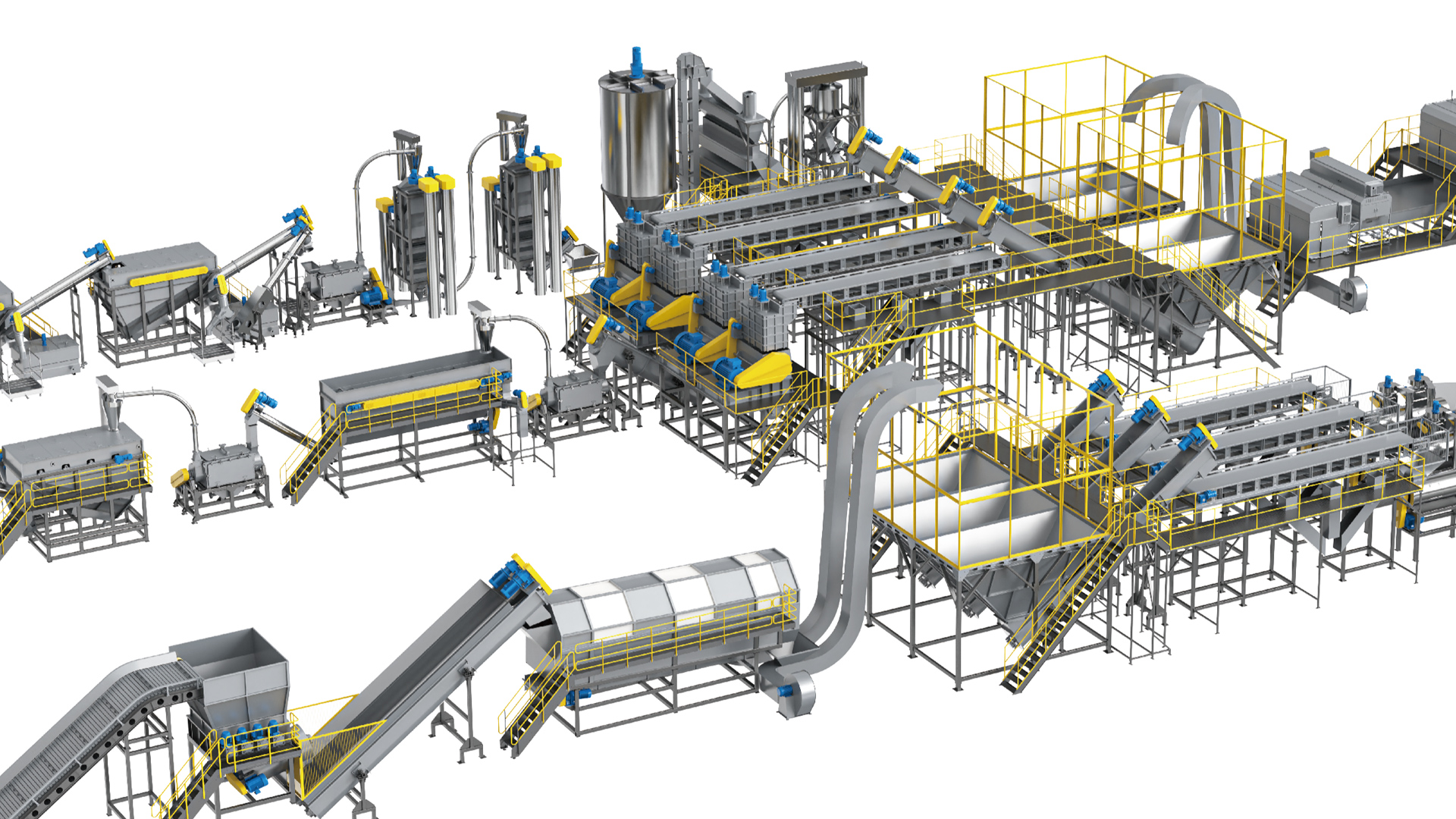
POLYRETEC independently develops and designs export-specific multi-stage graded cleaning technology, breaking through the limitations of traditional single cleaning process. The complete process includes pre-sorting, bottle breaking, label removing, cold water rough washing, high-temperature alkali washing, friction fine washing, floating and sinking separation, fine impurity removal, and hot air drying, achieving layered removal of different types of impurities. The high-temperature alkali washing link adopts 80℃ to 100℃ constant-temperature hot water with professional environmental-friendly cleaning agents, which can completely dissolve stubborn adhesive glue, oil stains, and residual pigments on PET flakes, solving the core problem of incomplete cleaning of ordinary equipment.
The multi-stage friction fine washing device strengthens surface friction cleaning of flakes, removing embedded fine dust and residual tiny impurities. The final finished PET flake purity can reach over 99.9%, fully meeting EU food-grade recycling standards, FDA safety standards, and global high-end industrial raw material requirements, supporting enterprises to enter high-value global markets.
3.2 Intelligent Variable Process Adaptation for Global Diversified Raw Materials
Aiming at the raw material differences in global regional markets, POLYRETEC export PET washing line is equipped with an intelligent adjustable process system. Enterprises can freely switch cleaning modes according to local waste PET material conditions: high-purity material lightweight cleaning mode for European and American clean raw materials, and heavy-duty deep cleaning mode for mixed and heavily polluted raw materials in Southeast Asia and Africa. The system can automatically adjust cleaning temperature, friction frequency, water circulation volume, and separation precision, realizing targeted cleaning for different raw materials and maximizing production efficiency and finished product quality.
3.3 Energy-Saving Water Circulation and Global Environmental Protection Configuration
The equipment is equipped with a full-set professional wastewater circulation purification system, including sedimentation filtration, fine filtration, oil-water separation, and disinfection and purification devices. The cleaning wastewater generated during production is fully recycled and reused after multi-stage purification, with a water circulation utilization rate of over 95%, and actual water consumption is only 3 to 5 tons per ton of finished flakes, far lower than the industry average. The zero direct discharge design fully complies with EU, North American, and global national environmental protection standards, completely solving the environmental assessment problem of overseas projects.
In addition, the whole machine adopts energy-saving servo motor configuration and optimized structural design, reducing comprehensive power consumption by 20% to 25% compared with ordinary equipment. The silent vibration reduction structure controls operating noise below 70 decibels, meeting global factory noise control standards.
3.4 High-Automation Unmanned Continuous Production System
POLYRETEC export-grade PET bottle flake washing line realizes full-process automatic operation from raw material feeding, sorting, crushing, cleaning, separation to finished product drying and discharging. The intelligent centralized control system integrates all equipment links, realizing one-key start and stop, automatic parameter adjustment, and real-time fault alarm. The whole line only requires 1 to 2 workers for auxiliary monitoring, greatly reducing manual labor costs and avoiding product quality fluctuation caused by manual operation errors.
The equipment supports 24-hour continuous stable operation, with low failure rate and long continuous working cycle. The batch production quality is highly uniform, fully meeting the standardized and large-scale production requirements of global export recycling enterprises, and helping enterprises obtain long-term stable overseas orders.
3.5 Global Safety Certification and Standardized Export Configuration
All electrical components, control systems, and mechanical protection structures of POLYRETEC export PET washing lines are configured in accordance with international standards, supporting CE, UL, and other global mainstream safety certifications. The equipment is equipped with perfect emergency stop protection, overload protection, and leakage protection devices, with high operational safety and stability. The standardized modular assembly structure facilitates overseas transportation, installation, debugging, and later maintenance, reducing project construction cycle and after-sales maintenance costs for global customers.
4. Complete Process Flow of POLYRETEC Export PET Bottle Flake Washing Line
4.1 Raw Material Pre-Sorting and Feeding Stage
Waste PET bottle materials recovered from global markets are transported to the production line through an automatic feeding conveyor. The professional pre-sorting device manually and automatically sorts raw materials to remove non-PET impurities such as glass, metal, and other plastic bottles, ensuring single-component raw material input and laying a foundation for subsequent high-purity cleaning. The speed of the feeding conveyor can be intelligently adjusted according to production capacity and raw material pollution degree to avoid material accumulation and insufficient sorting.
4.2 Bottle Crushing and Primary Label Removal Stage
The sorted PET bottles enter the high-efficiency crushing unit for uniform crushing, forming standard-size PET bottle flakes of 12mm to 18mm, which is convenient for subsequent full cleaning and impurity separation. The specially designed blade structure ensures uniform flake size without excessive fine powder generation. After crushing, the primary label removal device removes most of the surface label paper through wind selection and friction separation, reducing the impurity pressure of subsequent fine cleaning links.
4.3 Multi-Stage Washing and Deep Impurity Removal Stage
This is the core link to determine the quality of export-grade PET flakes. First, cold water rough washing removes surface floating dust, loose dirt, and residual floating labels. Then high-temperature alkali washing softens and decomposes stubborn glue residues, oil stains, and pigment attachments on the flake surface. After that, multiple groups of high-speed friction fine washing devices perform deep friction cleaning to remove residual tiny impurities. Finally, the floating-sinking separation tank uses the density difference principle to completely separate light impurities such as PE labels and heavy impurities such as PVC, sand, and metal, realizing thorough purification of PET flakes.
4.4 Fine Filtration and Purification Stage
After multi-stage washing and separation, PET flakes enter the fine impurity removal system to filter residual tiny plastic particles and impurity powder. The high-precision screening device ensures uniform flake size and zero mixed impurities. The water circulation system synchronously filters and purifies the cleaning wastewater in real time to ensure clean circulating water quality and avoid secondary pollution of flakes caused by circulating water impurities.
4.5 High-Efficiency Dehydration and Hot Air Drying Stage
The cleaned PET flakes are first dehydrated by a high-speed centrifugal dehydrator to remove most surface moisture, with primary moisture content reduced below 5%. Then the continuous hot air drying system performs constant-temperature drying treatment, using circulating hot air for uniform drying, ensuring the final moisture content of finished PET flakes is stably controlled below 0.3%, fully meeting the moisture standard requirements of global export-grade recycled PET raw materials.
4.6 Finished Product Sorting and Packaging Stage
The dried high-purity PET flakes are automatically sorted by the precision sorting system to screen out a small number of unqualified flakes with residual impurities, ensuring 100% qualified rate of finished products. Finally, the automatic packaging machine completes quantitative packaging, forming standardized export-grade finished products that can be directly used for overseas order delivery and downstream high-end production.
5. 2026 POLYRETEC PET Washing Line Export Price & Project Cost Analysis
5.1 Equipment Export Price Grading Estimation
Combined with 2026 global plastic recycling equipment market quotations and export configuration standards, POLYRETEC export-grade PET bottle flake washing lines are divided into three capacity configurations with standardized price gradients, suitable for different scale overseas investment projects. The small-capacity export model with hourly output of 300kg to 500kg, suitable for small and medium-sized recycling factories in emerging markets, is priced at 38,000 to 42,000 US dollars per set. This model has complete basic cleaning functions and meets conventional global environmental protection and quality standards, with high cost performance for small-scale project investment.
The mainstream medium-capacity export model with hourly output of 800kg to 1000kg, equipped with full water circulation system, intelligent parameter adjustment, and multi-stage deep cleaning configuration, fully meeting European and American high-end market standards, is priced at 49,000 to 55,000 US dollars per set. This is the most popular export configuration, suitable for most global commercial recycling projects with stable output and high finished product added value.
The large-capacity high-end export model with hourly output of 1500kg to 2000kg, equipped with full intelligent unmanned system, ultra-precision impurity removal device, and food-grade flake dedicated configuration, is priced at 62,000 to 68,000 US dollars per set, suitable for large-scale industrial recycling enterprises and high-end rPET food packaging raw material production projects in Europe and North America.
5.2 Overseas Project Operation Cost Analysis
POLYRETEC export PET washing lines have significant advantages in long-term operation cost control. In terms of water cost, the 95% high water circulation rate reduces annual fresh water consumption cost by 60% compared with ordinary equipment, saving 8,000 to 12,000 US dollars in water fees annually for medium-capacity projects. In terms of power consumption, the energy-saving servo configuration reduces annual power consumption cost by 4,000 to 6,000 US dollars.
In terms of labor cost, the high-automation design reduces on-site workers from 6 to 8 persons for ordinary lines to 1 to 2 persons, saving annual labor cost of 20,000 to 30,000 US dollars in high-labor-cost European and American regions. The standardized modular structure of the equipment reduces annual maintenance and vulnerable parts replacement cost to 800 to 1,200 US dollars, far lower than the maintenance cost of ordinary export equipment.
5.3 Finished Product Benefit and Profit Analysis
Ordinary washing lines can only produce low-grade ordinary PET flakes with low market prices, suitable only for low-end industrial markets. POLYRETEC export-grade washing lines produce high-purity food-grade and textile-grade PET flakes, with a unit price 15% to 25% higher than ordinary flakes. Calculated based on the annual output of 8,000 tons of medium-capacity equipment, the annual incremental profit brought by high-quality finished products reaches 45,000 to 60,000 US dollars.
At the same time, qualified high-standard flakes can enter high-end European and American markets with stable order sources and low market competition, completely solving the problems of difficult sales and low profit of low-grade recycled products, and greatly improving the comprehensive profit level of overseas recycling projects.
5.4 Investment Return Cycle Evaluation
For medium-capacity mainstream export projects, the comprehensive annual cost savings and profit increment reach 70,000 to 90,000 US dollars. The one-time equipment investment can be fully recovered within 7 to 9 months under stable production conditions. For small-capacity projects, the return cycle is 6 to 8 months, and for large-scale high-end projects, the return cycle is 10 to 12 months. The equipment has a service life of more than 12 years with stable long-term performance, bringing continuous and stable economic benefits for global investment enterprises, with extremely high long-term investment value.
6. Key Configuration Selection Tips for Global Export PET Washing Lines
6.1 Matching Configuration According to Regional Raw Material Conditions
For European and American markets with clean and single waste PET raw materials, customers can choose standard multi-stage cleaning configuration to balance quality and cost. For Southeast Asian, African, and South American markets with complex raw materials, many impurities, and heavy oil stains, it is necessary to upgrade the high-temperature deep cleaning system and enhanced friction washing configuration to ensure finished product purity. For markets with high food-grade flake demand, food-grade dedicated filtration and purification accessories must be equipped to meet international food safety standards.
6.2 Customization According to Local Environmental Protection Policies
For European regions with ultra-strict environmental protection standards, configure advanced wastewater fine purification system and full noise reduction configuration to meet high-standard environmental assessment requirements. For regions with loose environmental policies but scarce water resources, prioritize high-efficiency water circulation system configuration to reduce water consumption costs. For high-temperature and high-humidity tropical regions, upgrade equipment electrical and anti-corrosion configurations to adapt to harsh climatic environments and ensure long-term stable operation.
6.3 Production Capacity Matching According to Market Demand
Small-scale start-up projects and regional small-order markets are suitable for 300kg to 500kg small-capacity lines to avoid over-investment and resource waste. Stable medium and large-order markets and long-term cooperative downstream factories are suitable for 800kg to 2000kg medium and large-capacity lines to realize scale effect and reduce unit production cost, improving overall project profit margin.
7. Common Operation Problems and Troubleshooting for Export Washing Lines
7.1 Unqualified Finished Flake Purity
Unqualified flake purity is mostly caused by insufficient cleaning temperature, blocked circulating water filter elements, or unreasonable raw material feeding speed. The troubleshooting method is to calibrate the high-temperature washing temperature to ensure stable temperature within the standard range, clean the water circulation filter system regularly to avoid impurity accumulation, and adjust the feeding speed to match the cleaning cycle to ensure full cleaning of each batch of flakes.
7.2 Excessive Finished Product Moisture Content
Excessive moisture content is caused by insufficient drying temperature, short drying time, or blocked drying air duct. The optimization scheme is to appropriately increase the hot air drying temperature and extend the drying time for high-humidity regional production, clean the drying system air duct regularly to ensure smooth hot air circulation, and ensure the final flake moisture content meets export standards.
7.3 Low Water Circulation Efficiency
Reduced water circulation efficiency and increased water consumption are caused by blocked sedimentation tank impurities and failed purification accessories. Operators need to regularly clean sedimentation tank waste residue, replace aging purification filter materials, and maintain the normal operation of the water circulation system to ensure long-term high water-saving performance of the equipment.
8. Global After-Sales Service and Support of POLYRETEC Export Equipment
POLYRETEC provides full lifecycle global after-sales service for all export PET bottle flake washing lines. The company has overseas technical service teams covering Europe, Southeast Asia, Middle East, and Latin America, providing on-site equipment installation, commissioning, operator training, and standardized project acceptance services. A complete overseas spare parts warehouse system ensures rapid supply of vulnerable parts, avoiding production shutdown losses caused by spare parts shortage.
In addition, the professional technical team provides long-term remote equipment operation guidance, process parameter optimization, and fault diagnosis services, helping global customers quickly solve production problems, stabilize equipment operation status, and ensure long-term stable and high-efficiency production of export recycling projects.
9. Global Development Trend of PET Bottle Washing and Recycling Industry
With the continuous improvement of global carbon neutrality goals and plastic restriction policies, the market demand for high-purity recycled PET flakes will continue to grow, and high-standard export-oriented PET recycling projects will become the mainstream development direction of the industry. The future PET bottle flake washing line will develop towards higher intelligence, lower energy consumption, higher purification precision, and more flexible customization.
POLYRETEC will continue to iterate and upgrade export-grade washing equipment, optimize intelligent adaptive cleaning technology, further improve impurity removal precision and energy-saving effect, adapt to the changing quality standards and environmental protection requirements of global markets, and provide more efficient, environmentally friendly, and cost-effective professional recycling equipment solutions for global plastic circular economy development.
10. Conclusion
Investing in export-oriented PET bottle flake washing lines requires comprehensive consideration of global market quality standards, environmental protection specifications, regional raw material differences, and project economic benefits. Ordinary traditional washing lines have prominent defects in cleaning precision, environmental protection performance, automation, and global adaptability, unable to meet the export requirements of high-end PET recycled products. As the optimal equipment for global market export, POLYRETEC PET bottle flake washing line adopts international standard multi-stage deep cleaning technology, high-efficiency water circulation system, intelligent adjustable process, and standardized export configuration, fully adapting to the differentiated needs of global regional markets.
With reliable equipment quality, stable finished product performance, significant cost-saving advantages, and perfect global after-sales service, POLYRETEC export-grade PET washing lines can help overseas recycling enterprises produce high-purity export-qualified PET flakes, open high-value global markets, reduce comprehensive project operation costs, and obtain stable and high investment returns, becoming the core equipment support for global enterprises to layout high-end PET plastic recycling export business.
|(注:部分内容可能由 AI 生成)