
An Austrian technology PET bottle washing line is, in engineering terms, a contamination-removal system disguised as a materials handling plant. Every metre of conveyor, every degree of bath temperature and every second of residence time exists to strip a specific class of contaminant from post-consumer polyethylene terephthalate before it reaches an extruder. Buyers exporting recycled PET flake into European, North American, Japanese and Gulf markets in 2026 are no longer competing on volume alone; they are competing on intrinsic viscosity retention, on polyvinyl chloride residues measured in parts per million, and on whether their process can survive an audit against EFSA and FDA expectations. This guide explains, stage by stage, how a food-grade PET bottle washing line built on Austrian process principles and Chinese manufacturing capability actually works, what quality numbers it can hold, what it consumes, and how it should be specified when the destination is a plant on the other side of an ocean.
Polyretec, a Wanplas factory, has been building washing and pelletising systems since 2010 and formalised the brand in 2017. The recycling programme combines Austrian process technology with Chinese manufacturing scale, and the food-grade PET bottle washing line family spans 500 kg/h to 6,000 kg/h in installed throughput. More than 100 projects across over 50 countries have shaped the configuration logic described below, supported by an engineering group of 24 or more specialists who handle layout, water balance, commissioning and remote diagnostics. Wanplas, the parent brand, aggregates this recycling capability alongside compounding, extrusion and blow moulding factories, which matters because a washing line rarely exists in isolation — it feeds a pelletiser, a sheet line or a preform plant.
Why Austrian Washing Technology Became the Global Reference Point
Austrian washing technology earned its reputation not through exotic hardware but through disciplined process sequencing: contaminants are removed in the order that costs the least energy and damages the polymer the least. That single principle separates a line that produces 0.78 dl/g flake from one that produces 0.71 dl/g flake from the same bale.
The Austrian school of PET recycling grew out of a domestic market that had strict deposit-return infrastructure, high labour costs and expensive water and energy. Those constraints forced three design habits that are now industry orthodoxy. First, dry pre-treatment before wet processing: labels, dust, sand and light film are removed mechanically while the material is still dry, because every gram of contamination that enters the wet section must later be filtered out of water at significant cost. Second, counter-current water flow: the cleanest water enters at the last rinse and cascades backwards toward the dirtiest stage, so a tonne of flake is washed by several cubic metres of water even though only two to four cubic metres of fresh water are actually consumed. Third, controlled residence time rather than brute force: hot caustic washing is dosed and timed to hydrolyse adhesives and saponify fats without triggering measurable surface hydrolysis of the PET itself.
European equipment houses such as EREMA, Starlinger, Sorema and Amut popularised these principles in different ways, and NIR sorting specialists including TOMRA and Sesotec supplied the detection hardware that made ppm-level purity realistic. What has changed over the past decade is that the process know-how has become transferable while the manufacturing cost base has not. A Wanplas factory such as Polyretec builds tanks, screws, rotors and frames in China to the tolerances the Austrian process demands, then applies the same water balance and residence-time logic. The buyer receives European process behaviour with a considerably shorter delivery lead time and a materially lower capital intensity.
It is worth being precise about what “Austrian technology” means in a specification document, because the phrase is often used loosely. In a serious tender it should translate into verifiable design features: friction washers with defined rotor speed and screen open area, hot wash reactors with recirculating heat exchangers rather than direct steam injection into the flake bed, sink-float tanks with paddle-controlled dwell time instead of simple overflow weirs, horizontal centrifugal dewatering with staged screen apertures, and a water treatment island that is designed as part of the line rather than bolted on afterwards. If those items appear in the scope of supply with numbers attached, the technology claim is real.
Stage-by-Stage Process Map of a Food-Grade PET Bottle Washing Line
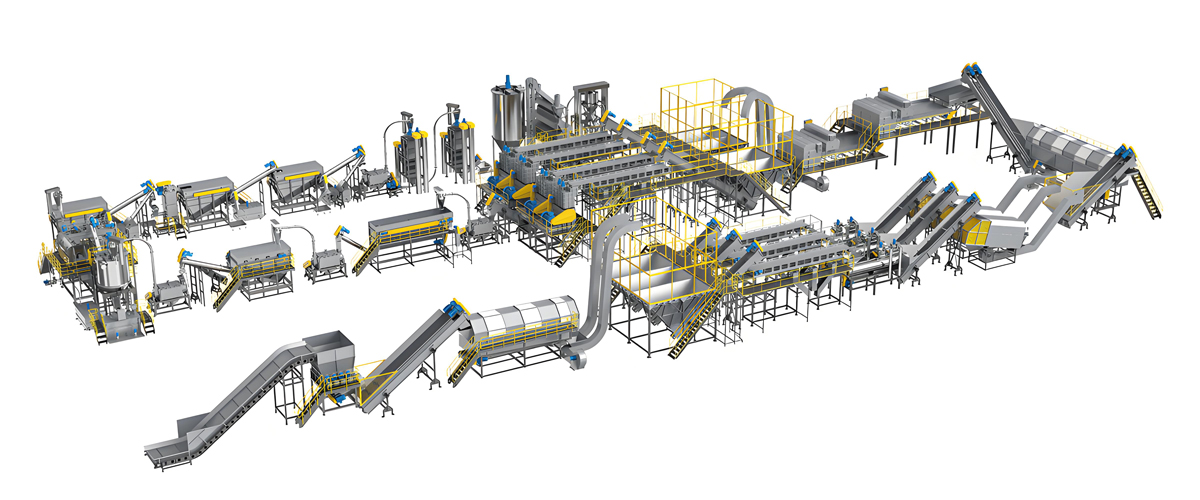
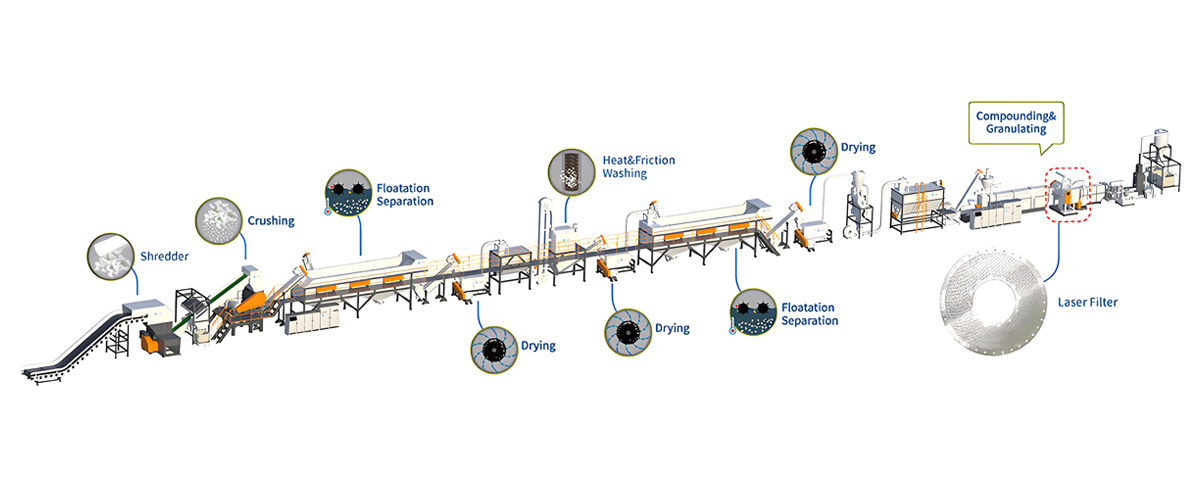
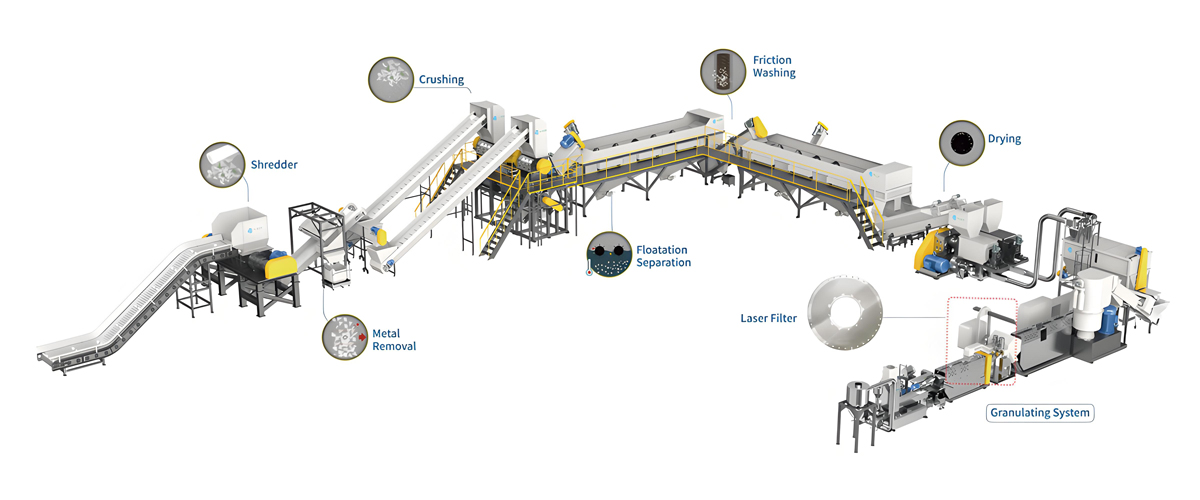
A food-grade PET bottle washing line performs roughly fourteen distinct unit operations, and each one targets a contaminant class that the previous stage cannot remove. Understanding the sequence is the fastest route to understanding why a line costs what it costs and why removing a stage almost always shows up later as an off-specification flake analysis.
1. Bale Intake, Bale Breaking and Dry Screening
Baled post-consumer bottles arrive at densities between 250 and 450 kg/m³. A chain conveyor with a controlled feed rate delivers bales to a bale breaker whose shaft speed is typically 15 to 30 rpm — deliberately slow, because aggressive breaking shatters bottles and drives label fragments into bottle necks. A rotating trommel or drum screen with 40 to 60 mm perforations then removes sand, stones, glass fragments and loose caps. This dry pre-screen alone typically removes 2 to 5 percent of incoming bale mass and protects every downstream bearing and pump.
2. Automatic and Manual Sorting
Near-infrared bottle sorters separate PET from PVC, PLA, PE and PP at bottle scale, where detection is far more reliable than at flake scale. A single NIR unit on a 1,200 mm belt handling 1.5 to 2.5 t/h of bottles typically achieves 95 to 98 percent PVC ejection efficiency. Colour sorting at bottle level splits clear, light blue, green and mixed streams. A manual picking platform with 4 to 10 stations then removes non-target items that machines miss: metal cans, silicone-sleeved bottles, heavily contaminated containers and oversized objects. Manual sorting is the stage most often under-specified in export projects, and it is the stage that most directly determines final PVC ppm.
3. Dry Label Removal
A dry delabelling machine uses high-speed rotating blades or friction rollers to abrade and detach shrink sleeves and wrap-around labels while the bottle is still intact. Removal efficiency of 85 to 95 percent is achievable on standard OPS and PVC sleeves. A zigzag air classifier immediately downstream carries away detached label material at air velocities of 8 to 14 m/s. Removing labels dry is the single highest-leverage decision in the whole line, because a PVC sleeve that survives into the wet section fragments into thousands of particles that must then be removed one by one.
4. Wet Granulation
Bottles are size-reduced in a wet granulator fitted with a 12 to 16 mm screen, with water injected into the cutting chamber at 1.5 to 3.0 m³ per tonne. Wet cutting suppresses dust, cools the blades, begins dissolving sugar residues and reduces knife wear. Rotor speed is generally 400 to 600 rpm with a scissor-cut geometry; blade clearance is held at 0.15 to 0.30 mm and must be re-set on a defined schedule, because worn clearance produces fines, and fines are the enemy of both yield and IV.
5. Pre-Washing and Fines Removal
A pre-wash unit combining a friction washer and a floating tank operates at 40 to 60 °C with mild surfactant dosing. Its job is to strip the bulk soil load — soft drink residues, soil, organic matter — before the flake enters the expensive hot caustic stage. Removing 60 to 75 percent of the soil load here dramatically extends caustic bath life and reduces chemical consumption per tonne.
6. Hot Caustic Washing
This is the heart of a food-grade line. Flakes are held in a heated reactor containing 1.5 to 3.5 percent sodium hydroxide by weight at 80 to 90 °C, with a residence time of 10 to 20 minutes and mechanical agitation. Non-ionic surfactant is dosed at 0.1 to 0.3 percent and an antifoam agent at 0.02 to 0.05 percent. The caustic bath saponifies fats and oils, hydrolyses hot-melt and pressure-sensitive adhesives, sterilises the flake stream and detaches residual label glue. Temperature control matters in both directions: below 75 °C adhesive removal collapses; above 92 °C with elevated caustic concentration, surface hydrolysis of PET begins to erode intrinsic viscosity and can raise the b* colour value of the finished flake.
Process control rule of thumb: caustic concentration and temperature trade against residence time, but not linearly. Increasing NaOH from 2.0 to 3.0 percent buys roughly the same adhesive removal as increasing residence time from 12 to 18 minutes, while consuming more chemical and imposing a greater rinse burden. Well-tuned lines settle near 2.0 to 2.5 percent at 85 °C with 15 minutes dwell.
7. Hot Friction Washing and Rinsing
Immediately after the caustic reactor, a high-speed friction washer with rotor tip speeds around 12 to 18 m/s scrubs flake against flake and against a perforated screen, mechanically removing the softened adhesive layer. Hot rinsing at 60 to 70 °C follows, then progressively cooler rinses. Skipping the hot rinse and dropping straight to cold water causes adhesive to re-deposit and is a common root cause of sticky flake complaints.
8. Sink-Float Separation
The float-sink tank exploits density: PET sits at 1.33 to 1.40 g/cm³ and sinks in water, while polypropylene caps at 0.90 to 0.91 g/cm³ and polyethylene at 0.94 to 0.96 g/cm³ float. Paddle-controlled dwell of 60 to 120 seconds and a well-designed underflow are what make the difference between 200 ppm and 30 ppm residual polyolefin. Note the physical limit: PVC at 1.32 to 1.45 g/cm³ also sinks, which is precisely why PVC must be removed by NIR sorting rather than by density.
9. Final Friction Washing, Dewatering and Drying
A final friction washer and clean-water rinse precede mechanical dewatering. A horizontal dewatering centrifuge running at 900 to 1,400 rpm brings surface moisture down to 3 to 5 percent. Thermal drying then follows in a hot air dryer with inlet temperatures of 130 to 160 °C and flake residence of 20 to 40 minutes in the drying loop, delivering final moisture of 0.3 to 1.0 percent. For direct food-contact extrusion, targets below 0.5 percent are normal, and below 0.3 percent where the flake feeds a single-screw extruder without upstream crystallisation.
10. Air Classification, Metal Detection and Flake Sorting
A final zigzag air classifier removes residual label fragments, film and fines. Metal separation combines overband magnets for ferrous material with eddy-current separators and inductive all-metal detectors for non-ferrous and stainless fragments, targeting below 5 ppm total metal. The last station is a flake colour and polymer sorter using CCD cameras plus NIR channels, which removes off-colour flakes, remaining PVC, metallised fragments and silicone. Two-pass flake sorting is what separates ordinary bottle-grade flake from super-clean food-grade flake.
Capacity Configurations from 500 kg/h to 6,000 kg/h
Line capacity should always be quoted as finished dry flake output, not bale input, because yield between the two differs by 15 to 30 percent depending on bale quality. Polyretec configures the food-grade PET bottle washing line family across six standard throughput bands, each with a defined equipment envelope, footprint and manpower requirement.
Standard Configuration Matrix
| Finished Flake Output | Typical Bale Input | Installed Power (approx.) | Indicative Footprint | Operators per Shift | Typical Application |
|---|---|---|---|---|---|
| 500 kg/h | 620–700 kg/h | 180–240 kW | 35 × 12 m | 5–7 | Entry plant, strapping / fibre grade |
| 1,000 kg/h | 1,250–1,400 kg/h | 300–380 kW | 45 × 15 m | 7–9 | Fibre and sheet grade flake |
| 2,000 kg/h | 2,450–2,750 kg/h | 520–650 kW | 60 × 18 m | 8–11 | Food-grade flake with 1-pass sorting |
| 3,000 kg/h | 3,650–4,100 kg/h | 720–900 kW | 70 × 20 m | 9–12 | Food-grade flake, 2-pass sorting |
| 4,500 kg/h | 5,500–6,100 kg/h | 1,000–1,250 kW | 85 × 22 m | 10–14 | Integrated flake-to-pellet plant |
| 6,000 kg/h | 7,300–8,200 kg/h | 1,300–1,650 kW | 100 × 25 m | 12–16 | Bottle-to-bottle, deposit-return feed |
Two design notes matter when reading this table. First, installed power is not consumed power; a well-loaded PET washing line draws 55 to 70 percent of installed kW under steady state, because dewatering centrifuges, granulators and dryers rarely peak simultaneously. Second, footprint assumes an indoor wet section with an adjacent outdoor water treatment island. In tropical export markets where bale storage must be roofed, add 30 to 50 percent building area for feedstock and finished-goods buffering — a plant that cannot buffer three days of bales will lose more availability to logistics gaps than to mechanical failure.
rPET Flake Quality Targets: IV, PVC, Polyolefins, Colour and Moisture
Recycled PET flake is sold against a specification sheet, and every line in the process map above exists to hold one or more numbers on that sheet. Buyers exporting flake or pellet should treat these values as contractual, not aspirational, and should sample at a defined frequency rather than once per shipment.
Flake Specification Bands by Grade
| Parameter | Fibre / Strapping Grade | Sheet / Thermoform Grade | Food-Grade Bottle-to-Bottle | Controlling Process Stage |
|---|---|---|---|---|
| Intrinsic viscosity (dl/g) | 0.68–0.74 | 0.72–0.78 | 0.74–0.80 | Caustic temperature, dwell, drying |
| IV loss vs. input bottle | up to 0.05 | 0.02–0.04 | 0.01–0.03 | Hot wash chemistry control |
| PVC residue (ppm) | below 200 | below 50 | below 10–20 | Bottle NIR + flake sorter passes |
| Polyolefin (PE/PP) residue (ppm) | below 300 | below 100 | below 30–50 | Sink-float dwell and underflow design |
| Metal (ppm) | below 50 | below 20 | below 5 | Magnet + eddy current + inductive detect |
| Moisture (%) | below 1.0 | below 0.7 | below 0.3–0.5 | Centrifuge + thermal dryer loop |
| Colour b* (clear flake) | below 6 | below 3.5 | below 2.0 | Bottle colour sorting + thermal history |
| Colour L* (clear flake) | above 72 | above 78 | above 82 | Wash efficiency and fines removal |
| Fines below 2 mm (%) | below 2.0 | below 1.0 | below 0.5 | Granulator blade clearance, air classify |
| Bulk density (kg/m³) | 280–340 | 300–360 | 320–380 | Flake geometry and screen selection |
Understanding Intrinsic Viscosity Loss
Intrinsic viscosity is the practical proxy for molecular weight, and it determines whether flake can be blown into a bottle, extruded into sheet or only spun into fibre. Virgin bottle-grade PET resin typically sits between 0.76 and 0.84 dl/g. Every thermal and hydrolytic exposure erodes that value. In a washing line, IV loss comes from three sources: hydrolysis in the hot caustic bath, hydrolysis during thermal drying if moisture is still present above the polymer glass transition, and mechanical shear in friction washers acting on already-weakened chains. A well-controlled line loses 0.01 to 0.03 dl/g. A poorly controlled line — 95 °C caustic at 4 percent concentration, or a dryer run at 175 °C to force throughput — can lose 0.06 dl/g or more, which permanently forecloses the bottle-to-bottle market for that material.
Why PVC Is the Contaminant That Defines the Line
Polyvinyl chloride is destructive out of all proportion to its concentration. At processing temperatures above 200 °C, PVC dehydrochlorinates and releases hydrogen chloride, which catalyses PET chain scission and produces black specks, yellowing and severe IV loss. A concentration of 50 ppm — fifty grams in a tonne — is enough to visibly degrade an extrusion run. Because PVC density overlaps PET density, no washing stage can remove it; only spectroscopic detection can. This is why a food-grade specification always implies both bottle-level NIR sorting and flake-level sorting, and why buyers should be sceptical of any food-grade claim from a line without both.
Colour, b* Value and the Thermal History Problem
The b* coordinate in the CIE Lab colour space measures blue-to-yellow. Rising b* in rPET flake signals thermal or oxidative history: excessive dryer temperature, long residence in hot zones, or acetaldehyde-related degradation products. Green and blue bottle fragments entering a clear stream also shift b* and a*. The controls are upstream colour sorting, disciplined dryer temperature, and avoiding recirculation of over-dried fines back into the main stream.
Water, Energy and Chemical Consumption Engineering
Utility intensity determines whether a washing line is viable in a market with expensive power or constrained water, and it is the area where Austrian process design delivers the clearest measurable advantage. A line that consumes 12 cubic metres of fresh water per tonne is not a cheaper line; it is a line with an unbuilt water treatment island.
Utility Consumption by Configuration
| Utility / Consumable | Basic Line (No Loop) | Counter-Current + Filtration | Full Closed Loop + Membrane | Notes |
|---|---|---|---|---|
| Fresh water (m³ per tonne flake) | 8.0–15.0 | 2.5–4.0 | 1.5–2.5 | Excludes evaporative loss in dryer |
| Electrical energy (kWh per tonne) | 240–340 | 220–320 | 240–350 | Loop pumps add load but save thermal |
| Thermal energy (GJ per tonne) | 1.4–2.0 | 0.9–1.4 | 0.7–1.1 | Heat recovery on hot wash overflow |
| Sodium hydroxide (kg per tonne) | 14–22 | 8–15 | 6–11 | Bath regeneration extends life |
| Surfactant / detergent (kg per tonne) | 1.5–3.0 | 1.0–2.0 | 0.8–1.6 | Must be low-foaming and rinsable |
| Sludge generated (kg dry per tonne) | 40–90 | 45–95 | 50–100 | Higher recovery concentrates solids |
| Direct labour (person-hours per tonne) | 4.5–7.0 | 3.5–5.5 | 3.0–5.0 | Dominated by manual sorting stations |
How the Water Loop Is Actually Built
A functioning water island has four stages. Coarse mechanical filtration — drum filters and vibrating screens with 200 to 500 micron apertures — removes label fragments and fibre. Sedimentation with lamella clarifiers removes sand and heavy solids. Dissolved air flotation with polymer flocculant removes fats, oils and fine suspended matter, typically achieving 80 to 92 percent suspended-solids removal. Finally, biological or membrane polishing reduces chemical oxygen demand before water re-enters the rinse stages. Caustic baths are handled separately: filtered, topped up on conductivity feedback, and only fully replaced on a schedule driven by dissolved organic load rather than by calendar.
Energy Reduction Levers
The three highest-value energy interventions are heat recovery from hot wash overflow to pre-heat incoming rinse water, which typically returns 15 to 25 percent of thermal load; variable frequency drives on all pumps, centrifuges and friction washers, which cut electrical demand by 8 to 15 percent under partial loading; and correctly sized dewatering before the thermal dryer, because every additional percentage point of surface moisture removed mechanically saves roughly 25 to 35 kWh-equivalent of thermal energy per tonne. Mechanical dewatering is always cheaper than evaporation — that is the single most useful sentence in any washing line energy audit.
Food-Grade Certification Pathways for Export Markets
A PET bottle washing line does not itself receive food-contact approval; the recycling process, including the plant and its documented control regime, is what gets assessed. Exporters must therefore design the line to be auditable, not merely to be clean.
European Union
In the European Union, recycled plastic intended for food contact falls under Regulation EU 2022/1616 on recycled plastic materials and articles, which operates alongside Regulation EU 10/2011 on plastic materials and articles intended to come into contact with food and the framework Regulation EC 1935/2004. The technical core is a decontamination efficiency assessment: the recycling process is evaluated by EFSA using a surrogate contaminant challenge test, and the process must demonstrate that residual concentrations of model contaminants are reduced sufficiently that modelled migration remains below the conservative threshold of 0.1 micrograms per kilogram of food. Crucially, EFSA evaluates the whole process — input material specification, washing conditions, and the super-clean decontamination step — not the washing line alone. A washing line that produces flake at below 20 ppm PVC and below 50 ppm polyolefin with tightly documented caustic parameters is the necessary foundation; the solid-state polycondensation or vacuum decontamination stage that follows provides the challenge-test performance.
United States
In the United States, recyclers seek a No Objection Letter from the Food and Drug Administration, submitted under FDA’s guidance for the use of recycled plastics in food packaging. The submission describes source control, the washing process with specific temperatures, caustic concentrations and residence times, the decontamination step, and challenge-test data using surrogate contaminants representing volatile polar, volatile non-polar, heavy metal and non-volatile categories. FDA’s threshold of regulation approach evaluates dietary concentration rather than issuing equipment approvals. Practically, this means the washing line’s process data logging capability is itself part of the submission quality: a plant that cannot produce continuous records of hot wash temperature and caustic concentration will struggle to defend its process.
Voluntary Standards and Management Systems
Beyond regulatory approval, buyers increasingly demand chain-of-custody and management-system evidence. The Global Recycled Standard, commonly referenced as GRS, verifies recycled content percentage, chain of custody, and social and environmental criteria across the supply chain, and is frequently a purchase condition for textile and consumer-brand customers. ISO 14001 environmental management and ISO 9001 quality management are baseline expectations for tenders in most export markets. Machinery supplied into the European Economic Area must carry CE marking under the Machinery Directive, with safety functions engineered to EN ISO 13849 performance levels appropriate to the risk assessment. Polyretec supplies CE-configured guarding, interlocks and control architecture as a standard export option, along with documentation packages in the destination language.
Building an Auditable Plant
Auditability requires four capabilities designed in from the start: continuous logging of hot wash temperature, caustic concentration and residence time with tamper-evident storage; input material traceability by bale lot with supplier declarations; finished-flake sampling at a defined frequency with retained samples; and a documented deviation procedure describing what happens when a parameter drifts out of range. These are process controls, but they have hardware consequences — inline conductivity meters, calibrated temperature probes in the reactor rather than in the recirculation line, and a PLC and SCADA architecture with historian capability. Specifying them at order stage costs a fraction of retrofitting them under audit pressure.
Designing the Line for Export: Voltage, Climate and Containerisation
An export project fails or succeeds on details that have nothing to do with washing performance. A line that works flawlessly in a factory acceptance test can lose months on site because a control cabinet was built for the wrong supply frequency or a tank did not fit a container.
Electrical Supply Configuration
Destination supplies vary widely: 380 V / 50 Hz across much of Asia, Africa and Europe; 400 V / 50 Hz in the European Union; 415 V / 50 Hz in parts of the Commonwealth; 440 to 480 V / 60 Hz in North America and much of Latin America; 220 V / 60 Hz in some Central American and Caribbean markets. Frequency, not just voltage, changes motor synchronous speed by 20 percent, which alters rotor tip speeds in friction washers, centrifuge g-forces and pump curves. A properly engineered export line either selects motors rated for the destination frequency or applies variable frequency drives across the process-critical machines so that speeds can be normalised in software. Control transformers, socket standards, cable colour codes and marking conventions should follow destination practice — IEC or UL/NEC — and the wiring diagram language should match the maintenance team’s language.
Climate and Site Conditions
Ambient conditions materially affect drying and water balance. In high-humidity tropical sites, dryer air must often be dehumidified or the dryer oversized by 10 to 20 percent to reach the same final moisture. In sites above 1,500 m altitude, fan and blower performance falls with air density and must be re-rated. In freezing climates, all outdoor water lines, sedimentation tanks and DAF units require trace heating and insulation, and the line needs a documented drain-down procedure for extended shutdowns. Dusty environments demand higher IP-rated motors and sealed bearing arrangements. These are inexpensive decisions at design stage and expensive discoveries after commissioning.
Containerisation and Shipping Strategy
A 2,000 kg/h food-grade line typically ships in a mix of 40-foot high-cube containers and flat racks, with large wash tanks, the sink-float unit and the dryer body as out-of-gauge items. Good export engineering splits tanks into flanged sections that reassemble on site with gasketed joints, pre-mounts drives and gearboxes where transport permits, and packs all fasteners, gaskets and small parts in numbered crates matched to the assembly drawing sequence. Every sub-assembly should carry a weatherproof tag corresponding to the erection manual. Wanplas brand practice includes a transportation guarantee across its factories, and Polyretec’s project engineers prepare a container loading plan that mirrors the site erection sequence, so the first container opened contains the first equipment installed.
Spare Parts and Wear Strategy
Consumables and wear parts should ship with the line, not be ordered after failure. A realistic first-year kit includes granulator rotating and fixed blades in at least two sets, friction washer screens and paddles, centrifuge screens, pump seals and impellers, dryer fan bearings, conveyor belts and scrapers, filter cloths for the drum filters, and a full set of sensors. Wanplas factories share an annual complimentary spare-parts allowance and free replacement of parts that fail within warranty, which meaningfully reduces the first-year risk profile for buyers who are far from any service centre.
Comparing Supply Options for Buyers Outside China
Buyers evaluating a PET bottle washing line generally face three supply archetypes, and the correct choice depends far more on the intended output grade and the plant’s technical maturity than on headline capacity.
Supply Archetype Comparison
| Criterion | Western European Turnkey Supplier | Austrian-Technology Line Built in China | Locally Assembled Generic Line |
|---|---|---|---|
| Relative capital intensity | Premium | Medium | Low |
| Achievable output grade | Bottle-to-bottle food grade | Bottle-to-bottle food grade | Fibre and strapping grade |
| Typical fresh water intensity | 1.5–3.0 m³/t | 2.5–4.0 m³/t | 8.0–15.0 m³/t |
| Typical delivery lead time | Long | Medium | Short |
| Process guarantee depth | Full specification guarantee | Capacity and quality guarantee | Capacity only, if any |
| Spare parts lead time to site | Medium | Medium | Short |
| Certification support | Extensive | Documented process data package | Minimal |
| Best suited to | Brand-owner captive plants | Export-oriented independent recyclers | Domestic low-grade markets |
The critical insight from this comparison is that the middle column is not a compromise between the other two — it is a different value proposition. A line built in China to Austrian process logic reaches the same output specification as a Western European turnkey plant because the specification is determined by process design, not by the country of manufacture of the tank plate. Where the archetypes genuinely diverge is in engineering depth of the water treatment island, in automation sophistication, and in the density of the service network. Buyers should therefore probe those three areas in technical clarification rather than accepting or rejecting a supplier on origin alone.
Integrating Washing with Downstream Pelletising and Decontamination
Washed flake is an intermediate product; the value step that most exporters eventually take is converting flake into pellet or directly into a finished article. The washing line specification should anticipate this from day one, because retrofitting a decontamination stage into a plant designed only for flake is far more disruptive than allowing space and utilities for it at the outset.
Flake to Pellet
PET pelletising from washed flake requires crystallisation and drying to below 50 ppm moisture before extrusion, melt filtration through screen changers typically at 40 to 80 micron, and vacuum degassing to strip volatiles. Twin-screw extrusion with high-efficiency vacuum is widely used for rPET because the shorter residence time and better devolatilisation reduce IV loss relative to single-screw processing. Wanplas’s Kerke factory manufactures KTE-series co-rotating parallel twin-screw extruders spanning KTE-16B through KTE-135D that integrate downstream of Polyretec washing lines, with underwater and water-ring die-face pelletising systems matched to rPET’s crystallisation behaviour. Where the objective is fibre or strapping, direct flake extrusion without pelletising may be preferable, since every additional heat history costs intrinsic viscosity.
Super-Clean Decontamination for Bottle-to-Bottle
Bottle-to-bottle applications require a decontamination step beyond washing. Solid-state polycondensation raises intrinsic viscosity by 0.05 to 0.15 dl/g while holding the material at 200 to 220 °C under vacuum or inert gas for 6 to 16 hours, simultaneously stripping migrated contaminants and rebuilding molecular weight. Alternative high-vacuum melt-phase decontamination systems achieve comparable challenge-test performance with shorter residence. Whichever route is chosen, the washing line must deliver flake that is already within specification for PVC, metal and moisture — decontamination removes molecular contaminants, not physical ones.
Direct Downstream Conversion
Several Polyretec customers feed washed flake or rPET pellet directly into converting equipment within the same industrial group. Wanplas’s YuanSu factory supplies PET, GAG and PLA sheet extrusion lines that run high rPET loadings for thermoformed packaging, while Wanplas’s YuDa factory builds full-automatic and FGX-series high-speed PET bottle blow moulding machines running from 1,000 BPH up to 15,000 BPH for converters closing the loop into new bottles. Planning the washing line and the converting line together allows shared utilities, shared quality laboratory resources and a single traceability system — advantages that are difficult to retrofit.
Adjacent Streams: PP and PE Washing
Many PET recyclers eventually add polyolefin capacity, either to process the caps and labels they already separate or to serve a different feedstock market. Polyretec’s PP/PE soft plastic crushing and washing lines run from 500 kg/h to 1,500 kg/h for film, woven bags and agricultural film, with optional one-step pelletising. The process logic differs — polyolefins float rather than sink, contamination is typically soil and organic rather than adhesive, and drying targets are less stringent because polyolefins are not hydrolysis-sensitive — but the water treatment island, workshop utilities and maintenance skill base are largely shared. Delivered projects include an LDPE film recycling and pelletising system in Turkey handling printed bags and films, a PP non-woven and TPE glove recovery project in Vietnam for a listed group, a heavy-duty LDPE film washing line with beater and shredder in Mexico for sticker-contaminated material, and a fully automated PTW1000 PP/PE film washing machine in Taiwan.
Commissioning, Maintenance and Operator Competence
The gap between a line’s nameplate performance and its actual performance is closed almost entirely by commissioning discipline and maintenance culture, not by hardware. Plants that hit specification in the first quarter of operation share the same three habits: they commission against a written protocol, they measure flake quality daily rather than weekly, and they treat the maintenance schedule as production-critical.
Structured Commissioning Sequence
A disciplined commissioning programme runs in five phases. Mechanical completion verifies alignment, rotation direction, guarding and lubrication on every machine. Dry running exercises each unit without material to confirm drive currents, vibration and interlocks. Water running fills the wet section, checks for leaks, verifies pump curves and calibrates level and temperature instruments. First material running introduces a controlled bale lot at 50 to 60 percent of design rate and samples flake at every stage transfer to build a stage-by-stage contamination profile. Performance running then ramps to full rate for a continuous 72-hour test with hourly sampling. The 72-hour continuous operation test is standard Wanplas brand practice across its factories and should be written into the contract, because a line that holds specification for three days will generally hold it for three years.
Maintenance Interval Framework
| Component | Check Interval | Typical Service Life | Failure Symptom if Neglected |
|---|---|---|---|
| Granulator blades | Every 80–120 operating hours | 3–5 regrinds, then replace | Rising fines, uneven flake, power draw up |
| Friction washer screens | Weekly visual | 6–14 months | Falling wash efficiency, flake loss to drain |
| Dewatering centrifuge screen | Weekly | 4–10 months | Residual moisture rise, dryer overload |
| Caustic reactor heat exchanger | Monthly | Descale quarterly | Temperature drift, adhesive carry-over |
| Sink-float paddles and bearings | Monthly | 12–24 months | Polyolefin ppm climbing |
| NIR sorter optics and lamps | Daily clean, monthly calibrate | Lamps 6–12 months | PVC ppm excursions |
| Drum filters and DAF skimmer | Daily | Cloth 6–12 months | Water quality decay, flake greying |
| Dryer fans and air ducts | Monthly | Bearings 18–30 months | Moisture out of specification |
Operator Competence and Quality Laboratory
A food-grade line needs a small but real laboratory: an intrinsic viscosity apparatus or a validated melt-flow correlation, a moisture analyser, a colorimeter for L*a*b* measurement, a laboratory sieve stack for fines, and a hot-plate or density-column method for spot-checking polyolefin content. Operators should be trained to run a defined sampling routine each shift and to interpret trends rather than single readings — a b* value creeping from 1.4 to 2.1 over ten days is a process signal worth investigating long before it becomes a customer complaint. Polyretec provides on-site installation supervision, operator training and remote diagnostic support through its engineering group, and the open-factory policy shared across Wanplas factories means buyers can witness equivalent lines running before committing to a configuration.
Frequently Asked Questions
What exactly does “Austrian technology” mean in a PET washing line specification?
It refers to a process design philosophy rather than a country of assembly: dry pre-treatment before any wet stage, counter-current water cascading from the cleanest rinse backwards, controlled hot caustic chemistry that removes adhesives without eroding intrinsic viscosity, staged mechanical dewatering before thermal drying, and a water treatment island engineered as part of the line. In a tender document, insist that these appear as specific numbers — rotor speeds, bath temperature and concentration ranges, residence times, screen apertures and water balance per tonne — because that is what makes the claim verifiable.
Can a washing line alone produce food-grade rPET?
No. A washing line produces food-grade-capable flake, which is the necessary input to a decontamination process. Food-contact approval under EU 2022/1616 and EU 10/2011 in Europe, or an FDA No Objection Letter in the United States, is granted to the recycling process as a whole after a surrogate contaminant challenge test, and that test performance comes from solid-state polycondensation or high-vacuum melt decontamination downstream. The washing line’s role is to deliver flake within specification for PVC, polyolefin, metal, colour and moisture so the decontamination step has a clean substrate to work on.
How much intrinsic viscosity will I lose across the washing line?
A well-controlled line loses 0.01 to 0.03 dl/g between input bottle and output flake. The main levers are hot caustic temperature and concentration, thermal dryer temperature, and total hot residence time. Running the caustic bath at 85 °C and 2.0 to 2.5 percent sodium hydroxide for 15 minutes, and holding dryer inlet temperature at or below 160 °C, keeps loss in the low band. Pushing to 95 °C or 4 percent caustic to force adhesive removal can double or triple the loss, which typically disqualifies the material from bottle-to-bottle use.
What is the realistic yield from bale to saleable flake?
Between 72 and 85 percent for typical post-consumer bottle bales, with the spread driven almost entirely by bale quality. Losses come from moisture in the incoming bale, labels and caps, non-PET rejects, fines generated in granulation, and off-specification flake removed by the sorter. Deposit-return-scheme bales with low contamination can exceed 88 percent, while mixed kerbside bales with heavy sleeve coverage and high organic load can fall below 70 percent. Yield should always be verified on the buyer’s own material during a trial before the guarantee is written.
How long does installation and commissioning typically take on an export site?
For a 2,000 kg/h food-grade line, mechanical erection generally runs four to seven weeks depending on local contractor capability and whether civil works, water connections and electrical supply are ready before containers arrive. Dry and water commissioning adds one to two weeks, first material running another one to two weeks, and the performance test a further week. The most common cause of delay is unfinished site preparation, not equipment issues, so a detailed civil and utility drawing package should be issued early in manufacturing rather than at shipment.
Is a fully closed water loop worth the added complexity?
It depends entirely on local water availability, discharge regulation and effluent handling constraints. Where water is metered, scarce or subject to strict discharge limits, closing the loop reduces fresh water intensity from 2.5 to 4.0 down to 1.5 to 2.5 cubic metres per tonne and removes discharge risk, which can be decisive for permitting. Where water is abundant and discharge to a municipal treatment plant is straightforward, a counter-current line with drum filtration, sedimentation and dissolved air flotation is usually the more sensible engineering balance, since a full loop adds pumps, membranes and a real operating skill requirement.
Can the same line process both clear and coloured bottles?
Yes, but not simultaneously if the output is intended for high-value clear flake. Standard practice is campaign running: process clear bales for a defined period, then flush the line and process coloured bales. Flushing between campaigns typically takes 30 to 60 minutes and involves running a small quantity of clear material through to purge residual coloured fragments from the wet section and dryer. Plants running high volumes of both streams often justify duplicate sink-float and drying trains rather than accepting campaign changeover losses.
What throughput should a first-time recycler start with?
A 1,000 to 2,000 kg/h line is usually the right entry point for an independent recycler with secured feedstock. Below 500 kg/h, fixed labour and utility overheads per tonne become difficult to absorb; above 3,000 kg/h, the plant needs a feedstock supply chain robust enough to keep it fed, which is often the binding constraint rather than the equipment. The pragmatic approach is to size the wet section for the target capacity, install sorting and drying capacity for the current volume, and leave civil and utility provision for later expansion.
Conclusion
An Austrian technology PET bottle washing line is best understood as a sequence of deliberate engineering decisions, each traceable to a number on a flake specification sheet. Dry label removal governs PVC carry-over. NIR bottle sorting and flake sorting jointly determine whether 20 ppm PVC is achievable. Caustic temperature, concentration and dwell decide how much intrinsic viscosity survives. Sink-float dwell time sets polyolefin residue. Mechanical dewatering capacity dictates thermal energy per tonne. Counter-current water design sets fresh water intensity. There is no stage that can be quietly removed to save capital without a corresponding, and usually more expensive, consequence in the flake analysis.
For exporters, the additional layer is auditability and site-readiness. Regulatory approval in Europe under EU 2022/1616 and EU 10/2011, or an FDA No Objection Letter in the United States, is granted on the strength of documented process control and challenge-test performance — which means the data logging architecture and the decontamination step matter as much as the wash tanks. Voluntary frameworks such as GRS, along with ISO 9001 and ISO 14001, increasingly function as commercial entry tickets rather than differentiators. And on the practical side, destination voltage and frequency, climate-adapted drying, containerisation matched to erection sequence, and a first-year spare-parts kit are what separate a smooth start-up from a six-month struggle.
Polyretec, a Wanplas factory, configures food-grade PET bottle washing lines from 500 kg/h to 6,000 kg/h on exactly this logic, drawing on more than 100 delivered projects across over 50 countries and an engineering group that handles layout, water balance, commissioning and remote diagnostics. Because Wanplas operates a network of specialised factories, a washing line can be planned together with Kerke twin-screw pelletising, YuanSu sheet extrusion or YuDa PET bottle blow moulding as a single value chain rather than a series of disconnected purchases. Buyers preparing a 2026 investment are encouraged to send a representative bale sample for trial processing, request a stage-by-stage contamination profile from that trial, and use the resulting data — not a generic brochure specification — as the basis for the capacity, sorting and water treatment configuration they commit to.