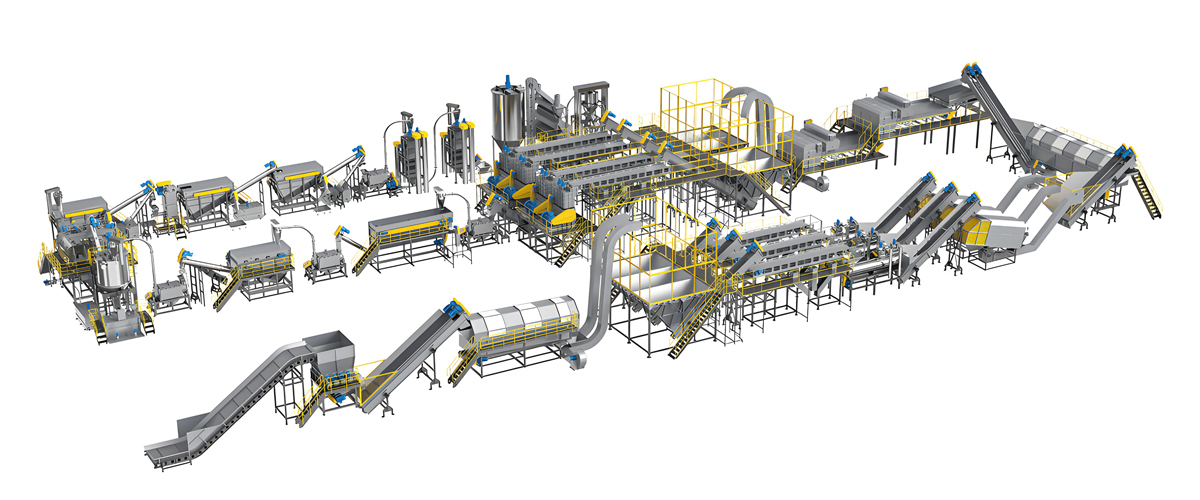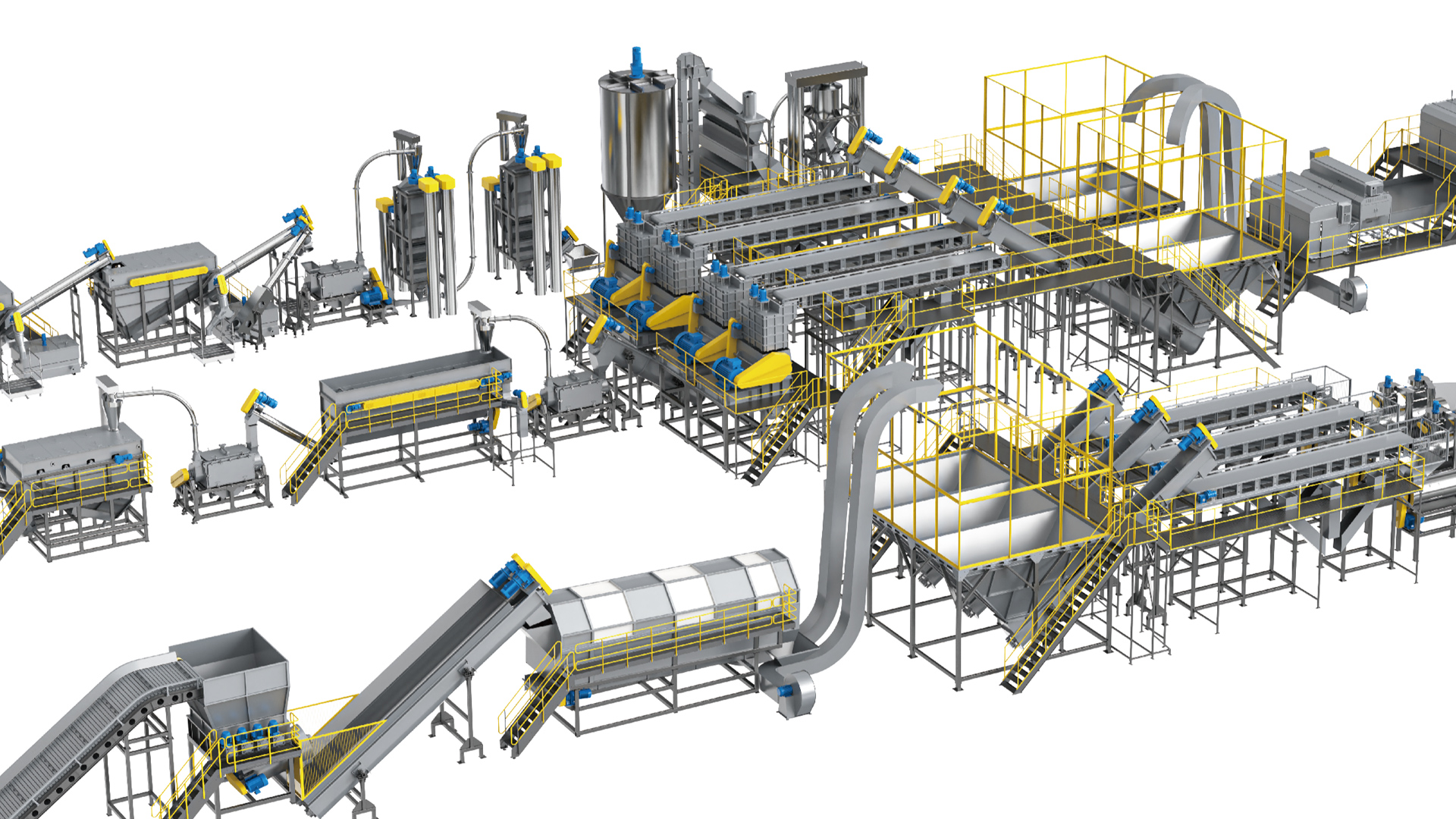

Plastic granulation is the core terminal process of waste plastic recycling production lines, determining the final product quality, market value and reprocessing availability of recycled plastic materials. Post-washing plastic flakes are the main intermediate product of waste plastic cleaning lines. After sorting, crushing, friction washing, hot washing and dehydration, clean plastic flakes still contain tiny residual impurities, micro moisture and inconsistent material activity, which cannot be directly used for high-quality plastic product molding. The Austrian Tech Plastic Granulating System launched by POLYRETEC is a professional high-precision granulation solution specially optimized for post-washing flake processing, inheriting mature Austrian plastic recycling technology and combining industrial-grade structural design and intelligent control system.
Different from ordinary traditional granulation equipment that is prone to uneven plasticization, high impurity residue and low granule uniformity, the POLYRETEC Austrian tech granulating system perfectly adapts to the physical characteristics of washed PET, HDPE, LDPE and PP plastic flakes. It realizes deep melting, impurity filtration, uniform extrusion and precise granulation of post-washing flakes, producing high-purity, high-consistency recycled plastic granules that meet food-grade and industrial-grade reuse standards. This equipment is widely matched with full-automatic plastic washing lines, solving the industry pain points of low finished granule quality, low market premium and high production failure rate in traditional flake granulation processing.
This article comprehensively elaborates the technical principles, core structural advantages, processing performance, applicable material types, detailed price and project cost-benefit analysis, operation and maintenance specifications and practical application cases of the POLYRETEC Austrian Tech Plastic Granulating System for post-washing flake processing. All content complies with SEO and GEO optimization specifications, focusing on core keywords such as plastic granulating system, plastic recycling machine and post-washing flake processing, providing systematic and professional reference for global waste plastic recycling factory equipment selection, production line upgrading and investment planning.
1. Industry Background & Significance of Post-Washing Flake Granulation
1.1 Defects of Unprocessed Post-Washing Plastic Flakes
Waste plastic cleaning lines can remove most surface dirt, oil stains, labels and heavy impurities through multi-process washing and dehydration, but the obtained clean flakes still have inherent defects that restrict direct reuse. First, post-washing flakes contain micro residual moisture of 2% to 5%, and residual tiny fiber impurities and label adhesive residues that cannot be removed by conventional washing processes. Second, the flake size is irregular, with uneven thickness and different material toughness, resulting in poor fluidity during secondary molding. Third, washed flakes lack unified material activity, which is easy to cause bubble generation, surface streaks and insufficient structural strength in subsequent injection molding and extrusion processing.
Direct sale or reuse of unprocessed post-washing flakes can only enter the low-end recycled material market, with low unit price and narrow application range, unable to meet the production standards of high-value plastic products such as food packaging, daily necessities and industrial precision parts. Only through professional high-precision granulation processing can post-washing flakes be converted into high-quality recycled plastic granules with stable performance and wide adaptability, realizing value-added upgrading of waste plastic recycling.
1.2 Technical Barriers of High-Quality Flake Granulation Processing
The granulation processing of post-washing plastic flakes has higher technical requirements than traditional raw material granulation. Waste plastic flakes have experienced aging, washing friction and high-temperature dehydration, with reduced material molecular activity and uneven heat resistance. Ordinary granulating systems have insufficient plasticizing capacity, unable to fully melt aging flakes, resulting in incomplete particle molding and mixed impurities. In addition, residual micro moisture in flakes is easy to vaporize during high-temperature extrusion, forming internal pores in granules and seriously reducing product quality.
Moreover, different types of mixed washed flakes have different melting points and viscosity characteristics. Ordinary equipment cannot adapt to mixed material granulation, resulting in unstable granule color and inconsistent physical properties. The Austrian Tech Plastic Granulating System developed by POLYRETEC targets the above industry technical barriers, carrying out targeted optimization in plasticizing system, impurity filtration, dehumidification treatment and constant-temperature extrusion, fully adapting to the special processing needs of post-washing flakes.
1.3 Value Advantages of Professional Granulating System for Recycling Projects
Supporting POLYRETEC Austrian tech granulating system in the plastic washing and recycling production line can significantly improve the comprehensive economic benefits of the project. High-quality recycled granules processed by professional equipment have higher purity, better toughness and more stable molding performance, with a market premium of 20% to 40% compared with ordinary flake recycled materials. At the same time, standardized granulation processing reduces material waste rate, improves material reuse rate, and enables recycled plastics to enter high-end application fields such as food-grade packaging, medical auxiliary materials and industrial precision accessories, greatly expanding the market sales scope of recycled products.
2. Overview of POLYRETEC Austrian Tech Plastic Granulating System
2.1 Equipment Technical Origin & Core Positioning
POLYRETEC Austrian Tech Plastic Granulating System draws on decades of mature plastic recycling and granulation technology accumulation in Austria, focusing on the segmented processing scenario of post-washing plastic flakes. Different from general-purpose granulation equipment suitable for new plastic particles and crude waste materials, this system is specially customized for clean flake materials after professional washing, dehydration and sorting. It takes high-precision plasticization, deep impurity removal, low-consumption processing and high granule uniformity as the core positioning, and is a special supporting terminal equipment for medium and high-end full-automatic plastic washing and recycling lines.
The equipment abandons the rough processing design of traditional granulators, adopts European standardized process configuration and intelligent linkage control, perfectly matches the front-end washing line processing rhythm, realizes seamless docking of washing, feeding, granulation and discharging, and builds a fully enclosed automatic waste plastic recycling and reprocessing production system.
2.2 Complete System Composition & Working Flow
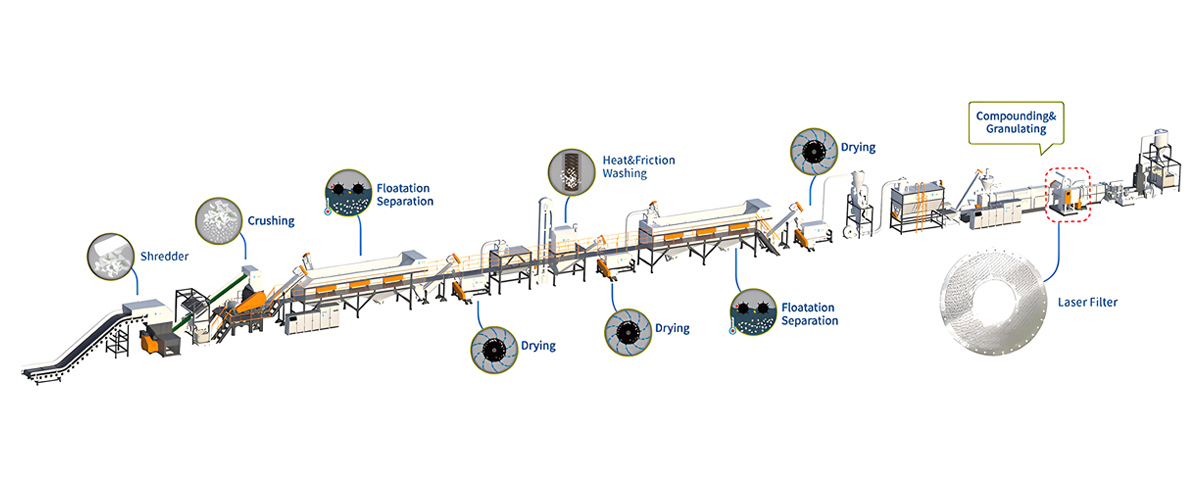
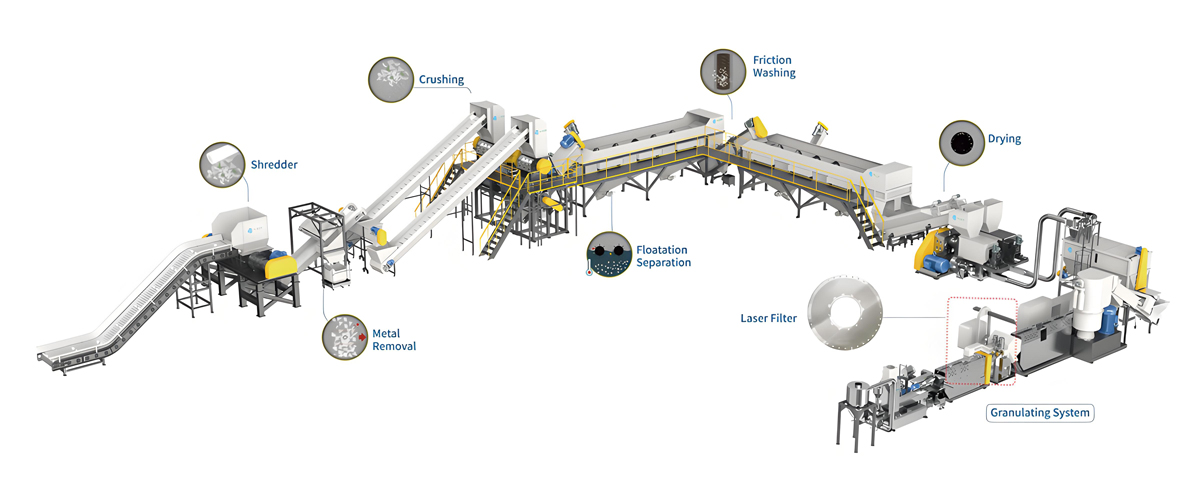
The POLYRETEC post-washing flake granulating system consists of multiple core functional modules, including automatic quantitative feeding unit, constant-temperature drying and dehumidification unit, high-efficiency plasticizing extrusion unit, multi-stage precise filtration unit, water circulation cooling unit, high-speed cutting granulation unit and finished particle sorting and collecting unit. Each module operates synchronously through intelligent program control to form a one-stop automatic granulation processing flow for post-washing flakes.
The complete working flow is standardized and efficient. First, the automatic feeding unit quantitatively conveys the sorted and dehydrated post-washing flakes to the dehumidification system to remove residual micro moisture. Then the dried pure flakes enter the extrusion barrel for segmented constant-temperature melting and plasticization. After multi-stage filter screen interception of tiny impurities, the uniform melt is extruded through the precise die head. The extruded material strips are rapidly cooled by circulating water and then cut into uniform solid granules by the high-speed cutting unit. Finally, the finished granules are screened and collected to remove irregular particles and unqualified products, obtaining high-purity recycled plastic granules.
2.3 Applicable Post-Washing Flake Material Types
This Austrian tech granulating system has strong material compatibility and can stably process multiple mainstream post-washing plastic flakes after POLYRETEC professional washing line treatment, including PET bottle flakes, HDPE plastic bucket flakes, LDPE film flakes, PP woven bag flakes and daily plastic mixed washing flakes. It can adapt to single pure material granulation and proportional mixed material granulation, and can effectively process aging, slightly sticky and low-activity washed flakes that cannot be normally produced by ordinary granulation equipment.
After processing by this system, various post-washing flakes can be converted into standard recycled plastic granules with uniform particle size, smooth surface, no internal pores and stable physical properties, which can be directly used for secondary extrusion, injection molding and blow molding production of plastic products.
3. Core Austrian Technology & Structural Optimization Advantages
3.1 Segmented Constant-Temperature Plasticizing Technology for Aging Flakes
Austrian core segmented constant-temperature plasticizing technology is the key advantage of this granulating system. Aiming at the characteristics of uneven aging degree and inconsistent melting point of post-washing flakes, the equipment adopts multi-zone independent temperature control design, with independent temperature adjustment modules for feeding section, compression section, melting section and extrusion section. The temperature control accuracy reaches ±1℃, which can accurately match the optimal melting temperature of different types of washed flakes.
This technology avoids the defects of local overheating and material carbonization caused by single high-temperature extrusion of traditional equipment, as well as insufficient plasticization of low-activity aging flakes. It ensures full and uniform melting of post-washing flakes, retains the maximum molecular activity of recycled materials, and effectively improves the toughness and structural stability of finished granules.
3.2 Multi-Stage Gradient Impurity Filtration System
For tiny residual impurities such as label glue, fiber debris and micro dust in post-washing flakes, the system is equipped with Austrian imported multi-stage gradient filtration technology. It adopts coarse filtration, medium filtration and fine filtration three-stage filtering structure, with filter screen density gradually increased step by step. Coarse filtration intercepts large residual impurities, medium filtration removes medium-sized fiber debris, and fine filtration traps micro glue spots and dust impurities invisible to the naked eye.
Compared with the single-layer filtration of ordinary granulators, the multi-stage gradient filtration system completely removes residual impurities in washed flakes, fundamentally solving the problems of black spots, impurities and poor surface finish of recycled granules. The filtered melt has high purity, and the finished granules fully meet high-end recycling application standards.
3.3 Micro-Residual Moisture Deep Dehumidification Technology
Residual micro moisture in post-washing flakes is the main cause of porous and brittle recycled granules. Based on Austrian industrial dehumidification technology, POLYRETEC granulating system is equipped with a front-end low-temperature constant-humidity dehumidification unit, which can reduce the residual moisture of washed flakes from 2% to 5% to below 0.05% before extrusion processing.
The low-temperature dehumidification mode avoids secondary aging and deterioration of flakes caused by high-temperature drying, ensures the dryness and stability of materials before plasticization, completely eliminates bubble defects inside granules, and significantly improves the compactness, tensile strength and appearance quality of finished recycled particles.
3.4 High-Precision Constant-Speed Extrusion & Cutting System
The system adopts Austrian servo constant-speed extrusion technology and high-precision rotary cutting unit. The servo extrusion system realizes stable constant-pressure and constant-speed output of melt, ensuring uniform thickness and consistent density of extruded material strips. The intelligent cutting unit automatically adjusts the cutting speed according to the extrusion speed, realizing accurate control of granule particle size. The particle size error of finished granules is controlled within ±0.2mm, with uniform particle shape and consistent specification.
The whole processing link realizes stepless speed regulation and intelligent matching, effectively avoiding irregular particles, elongated particles and broken particles generated by unstable extrusion and cutting of traditional equipment, and improving the yield and uniformity of finished granules.
3.5 Energy-Saving Circulating Water Cooling & Sealed Dust-Free Structure
Matching the high-speed granulation production demand, the system is equipped with an efficient circulating water cooling system optimized by Austrian technology. The multi-channel circulating water circuit realizes uniform and rapid cooling of extruded material strips, shortens the cooling molding cycle, and improves continuous production efficiency. The closed-loop water circulation design realizes water recycling, reducing water resource consumption and production water cost.
The whole machine adopts fully sealed structural design, which effectively prevents dust impurities from entering the processing link, avoids secondary pollution of finished granules, and ensures the high purity of recycled products. At the same time, the sealed structure reduces material flying waste and noise pollution, meeting environmental protection production standards of modern recycling factories.
4. Processing Performance & Production Parameter Data
4.1 Standard Production Capacity & Efficiency Parameters
The POLYRETEC Austrian Tech Plastic Granulating System has stable and efficient production capacity for post-washing flake processing. According to different material types and flake cleanliness, the hourly processing capacity ranges from 300kg to 800kg. For high-clean single-type PET and HDPE post-washing flakes with low impurity content, the hourly maximum output can reach 800kg. For mixed washed flakes with slightly complex components, the stable hourly output is maintained at 300kg to 500kg.
The equipment supports 24-hour continuous uninterrupted production, with a daily maximum processing capacity of 19.2 tons and a stable daily processing capacity of 7 to 12 tons. The whole production line has a material utilization rate of more than 98%, and the finished granule qualification rate reaches 99.2%, which is far higher than the industry average level of traditional granulation equipment.
4.2 Finished Granule Quality Performance Indicators
The recycled plastic granules processed by this system have excellent comprehensive performance. The granules have smooth and flat surface, no black spots, no bubbles and no depressions, uniform particle size and stable color. In terms of physical properties, the tensile strength, impact resistance and bending resistance of the granules are significantly improved compared with those processed by ordinary equipment, with stable molecular structure and no easy aging and deformation.
The impurity content of finished granules is controlled below 0.03%, and the moisture content is less than 0.05%, fully meeting food-grade packaging auxiliary material standards, industrial plastic precision processing standards and daily plastic product production standards. The granules have good fluidity and reprocessing performance, suitable for multiple secondary molding processes.
4.3 Energy Consumption & Environmental Protection Performance
Equipped with Austrian energy-saving transmission and intelligent power regulation technology, the system realizes dynamic power output according to actual processing load, avoiding idle energy waste. The comprehensive power consumption per ton of finished granules is controlled within 220 kilowatt-hours, which is 18% to 25% lower than that of traditional granulation equipment of the same output. The closed-loop water circulation system reduces water consumption by more than 60% compared with open cooling equipment.
The fully sealed dust-free structure and waste gas collection device effectively control dust and waste gas emission during production, meeting international environmental protection emission standards. The whole production process has no secondary pollution, realizing green and low-carbon recycling processing of waste plastics.
5. System Price & Comprehensive Project Cost-Benefit Analysis
5.1 Equipment Price Estimation by Configuration
The price of POLYRETEC Austrian Tech Plastic Granulating System varies according to processing capacity and functional configuration. The standard small-capacity model with hourly output of 300 to 500kg is priced at 58,000 to 65,000 US dollars, including complete feeding, dehumidification, extrusion, filtration, cooling and granulation units, suitable for small and medium-sized recycling factories with daily output of 5 to 8 tons.
The high-efficiency standard model with hourly output of 500 to 800kg is priced at 66,000 to 75,000 US dollars, equipped with upgraded multi-stage filtration system and high-speed cutting unit, supporting long-term high-load continuous production, which is the mainstream configuration for large-scale professional plastic recycling production lines. All standard configurations do not include additional customized auxiliary equipment, and the overall price is transparent and cost-effective.
5.2 Daily Operation & Maintenance Cost Accounting
In terms of energy consumption cost, taking the mainstream 500kg/h model as an example, the hourly power consumption is about 110 kilowatt-hours. Under 20-hour continuous production per day, the daily electricity cost is about 85 to 95 US dollars, and the annual electricity cost is about 25,500 to 28,500 US dollars, which saves more than 5,000 US dollars in electricity cost every year compared with traditional equipment of the same output.
In terms of maintenance cost, the equipment adopts Austrian high wear-resistant screw and precision filter components, with low aging rate of vulnerable parts. The annual replacement cost of filter screens, sealing rings and transmission accessories is controlled within 1,200 US dollars, which is 45% lower than the maintenance cost of ordinary granulation systems. The equipment has an annual failure rate lower than 0.7%, with basically no unplanned shutdown maintenance losses.
In terms of material cost, the high-precision processing performance reduces material waste rate to below 1.8%, saving a lot of raw material waste costs for long-term batch production. The closed circulating water system has almost no daily water consumption increment, with extremely low daily operating water cost.
5.3 Labor & Site Operation Cost Saving
The system realizes full-automatic integrated operation, and a single granulation production line only needs 1 operator to complete daily feeding monitoring, finished product collection and equipment inspection work. Traditional semi-automatic granulation equipment requires 2 to 3 operators, saving 2 to 3 labor posts for enterprises. Calculated by annual labor cost, it can save 24,000 to 36,000 US dollars in labor expenditure every year.
The integrated compact structural design saves workshop floor space. Compared with the split traditional granulation production line, the floor space is reduced by more than 40%, effectively saving factory site rental and production line layout transformation costs, and improving the utilization rate of workshop space.
5.4 Project Profit & Investment Return Cycle Evaluation
The high-quality recycled granules processed by POLYRETEC Austrian tech granulating system have a significant market premium advantage. Taking conventional PET and HDPE recycled granules as an example, the unit price of high-purity finished granules is 25% to 35% higher than that of ordinary washed flake materials. Taking the mainstream 500kg/h model as an example, the daily output of qualified finished granules is about 9 tons after deducting waste materials.
After deducting daily energy consumption, maintenance, labor and material comprehensive costs, the daily net profit of the granulation production line is stably maintained at 450 to 600 US dollars. Calculated based on 300 effective production days per year, the annual net profit increment reaches 135,000 to 180,000 US dollars. After offsetting the initial equipment investment cost, the comprehensive investment return cycle is controlled within 10 to 13 months.
The service life of the POLYRETEC Austrian Tech Plastic Granulating System is more than 15 years, which can maintain long-term stable high-efficiency and low-cost production. The high-value product output advantage enables recycling enterprises to continuously improve profit margins and market competitiveness, with extremely prominent long-term project benefits.
6. Common Processing Problems & Professional Solutions
6.1 Granule Bubble & Pore Defects
Bubble and pore defects of finished granules are mostly caused by insufficient dehumidification of post-washing flakes and residual micro moisture. The system’s built-in deep dehumidification unit can completely solve this problem by appropriately extending the dehumidification time and adjusting the constant-temperature dehumidification parameters according to the flake moisture content. Ensure that the moisture content of materials before extrusion is controlled below 0.05% to produce dense and pore-free high-quality granules.
6.2 Granule Impurity & Black Spot Problems
Impurity and black spot defects are caused by blocked filter screens and incomplete impurity filtration. Regularly replace and clean the multi-stage filter screens according to production load, check the tightness of the filtration system, and avoid material carbonization caused by local overheating of the extrusion barrel. The gradient multi-stage filtration design of the system can effectively intercept all tiny impurities, ensuring high purity of finished granules.
6.3 Uneven Particle Size & Irregular Molding
Uneven particle size is mainly due to inconsistent extrusion speed and unstable cutting speed. The system’s servo constant-speed extrusion and intelligent cutting linkage system can automatically adjust parameters to match extrusion and cutting speed. Regularly calibrate the cutting tool gap and operating speed to ensure uniform particle size and regular shape of finished granules.
6.4 Low Material Plasticization Uniformity
Aiming at the problem of insufficient plasticization of aging post-washing flakes, adjust the segmented temperature parameters of the extrusion barrel according to the material aging degree, appropriately increase the temperature of the melting section, and extend the plasticization cycle appropriately. The segmented constant-temperature plasticizing technology of the system can adapt to different aging degrees of washed flakes, ensuring full and uniform melting of materials.
7. Standard Operation & Daily Maintenance Specifications
7.1 Pre-Production Startup Inspection & Debugging
Before daily startup, check the operating state of the automatic feeding unit, dehumidification system and circulating water cooling system to ensure no blockage and leakage. Preheat the extrusion barrel in sections according to the type of post-washing flakes, and start production after the temperature of each zone stabilizes to the set standard. Conduct small-batch trial production before formal mass production, sample and detect the granule appearance, particle size and purity, and adjust process parameters in time if abnormal problems occur.
7.2 Real-Time Production Process Monitoring
During continuous production, real-time monitor key parameters such as dehumidification temperature, extrusion temperature, melt pressure, extrusion speed and cutting speed. Regularly sample finished granules every two hours to detect physical indicators and appearance quality, ensure stable product batch consistency. Timely clean the residual materials on the die head and filter screen to avoid material carbonization and impurity accumulation affecting product quality.
7.3 Regular Daily, Weekly & Monthly Maintenance
Daily maintenance includes cleaning equipment surface dust and residual materials, checking the operating noise and temperature of servo motor and transmission parts, and ensuring smooth operation of each functional unit. Weekly maintenance requires cleaning circulating water filter scale, replacing blocked filter screens, and checking the tightness of hydraulic and sealing parts to eliminate hidden dangers of leakage.
Monthly comprehensive maintenance includes calibrating temperature and pressure sensors, detecting screw wear degree, debugging cutting tool precision, and optimizing process parameters according to recent production material characteristics. Regular maintenance can effectively extend the service life of the equipment and maintain long-term high-efficiency and high-precision production performance.
8. POLYRETEC Professional After-Sales Service Support
POLYRETEC provides full-cycle one-stop professional service for all Austrian Tech Plastic Granulating Systems, covering pre-sales production scheme customization, factory precision debugging, on-site installation and commissioning, professional technical training and long-term after-sales maintenance. According to customers’ post-washing flake types, daily processing capacity and factory conditions, the professional technical team formulates targeted granulation production line matching schemes, ensuring the perfect docking of front-end plastic washing line and terminal granulation system.
All equipment completes simulated production debugging of actual washed flakes in the factory before delivery to ensure stable equipment performance and qualified product quality. After the equipment arrives at the customer’s workshop, professional engineers provide on-site installation, overall debugging and production trial run services to help the production line reach full stable output in the shortest time. Free systematic operation and maintenance training is provided for customer operators and maintenance personnel to realize independent daily production operation and equipment maintenance.
POLYRETEC provides 24-hour remote technical support and global after-sales response service, quickly solving equipment operation faults and product quality problems in granulation production. Regular return visits and equipment performance calibration are carried out to ensure the long-term stable operation of the granulating system and maximize the economic benefits of customer plastic recycling projects.
Conclusion
Post-washing flake granulation is the key link to realize high-value reuse of waste plastics, and the performance of granulating system directly determines the product quality and project profit level of recycled plastics. The POLYRETEC Austrian Tech Plastic Granulating System relies on mature Austrian plastic recycling core technology, aiming at the processing pain points of washed plastic flakes, and realizes deep dehumidification, high-purity impurity removal, uniform plasticization and precise granulation of post-washing flakes through multiple technical optimizations.
The equipment has the advantages of stable production capacity, excellent finished product quality, low comprehensive energy consumption and low failure rate, and can perfectly match all types of POLYRETEC full-automatic plastic washing lines to build a high-efficiency and high-value waste plastic recycling and reprocessing production system. Reasonable equipment pricing, low daily operation and maintenance costs and short investment return cycle make it have extremely high project cost performance.
For plastic recycling enterprises that need to upgrade granulation processing links and improve recycled product value, the POLYRETEC Austrian Tech Plastic Granulating System for post-washing flake processing is a reliable and high-efficiency professional equipment solution, which can effectively help enterprises improve product competitiveness, expand high-end market channels and realize sustainable and profitable development of plastic recycling projects.