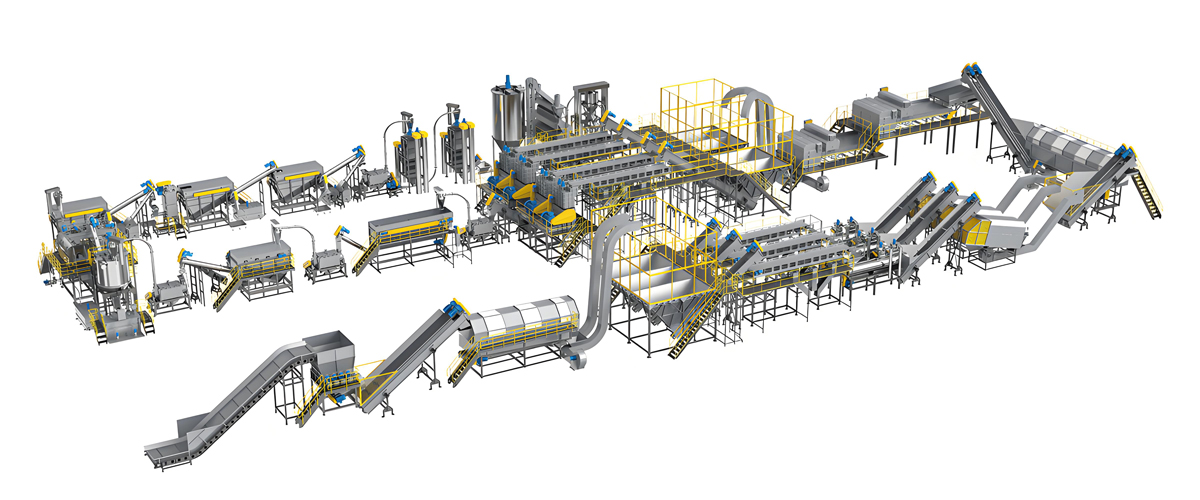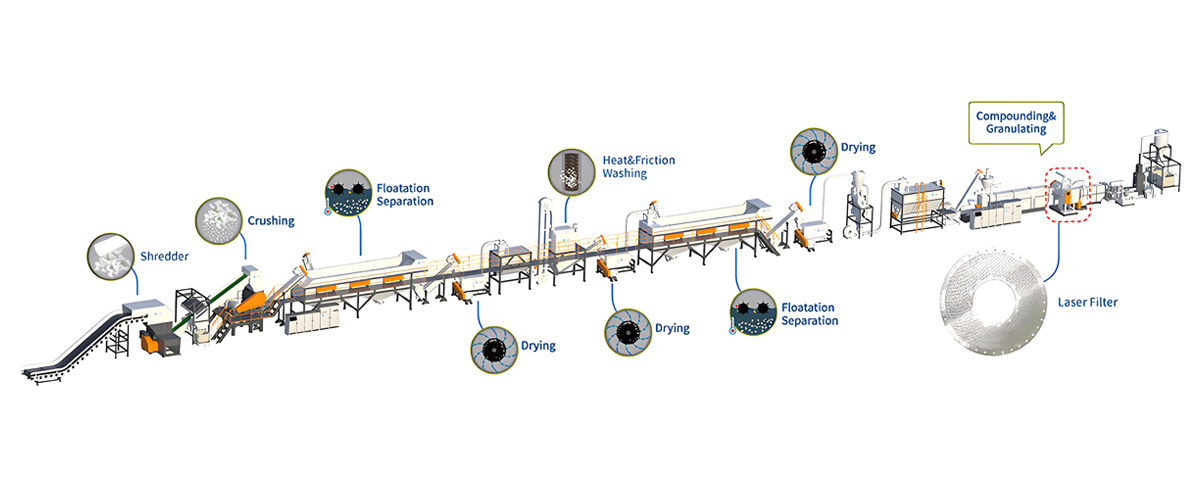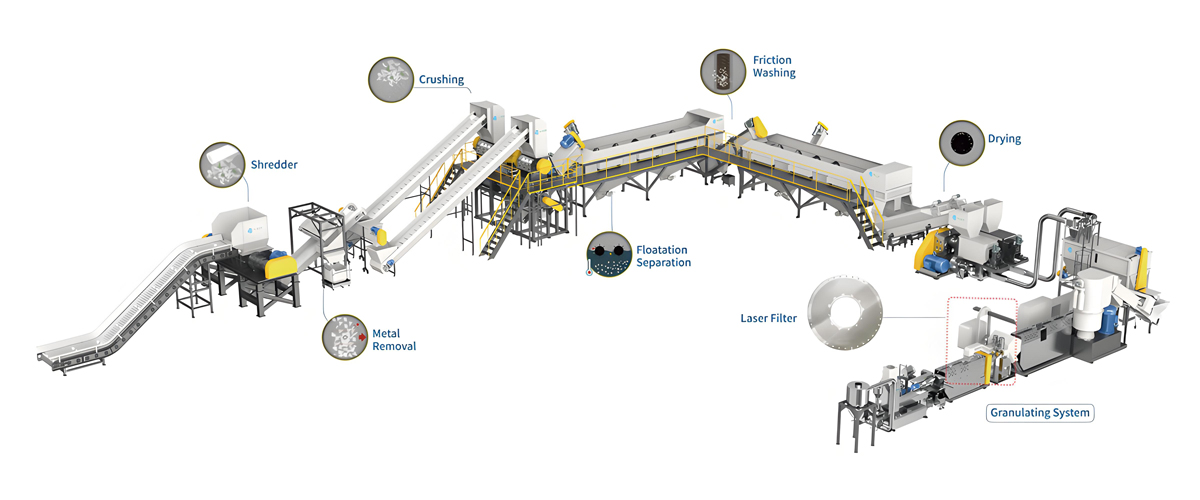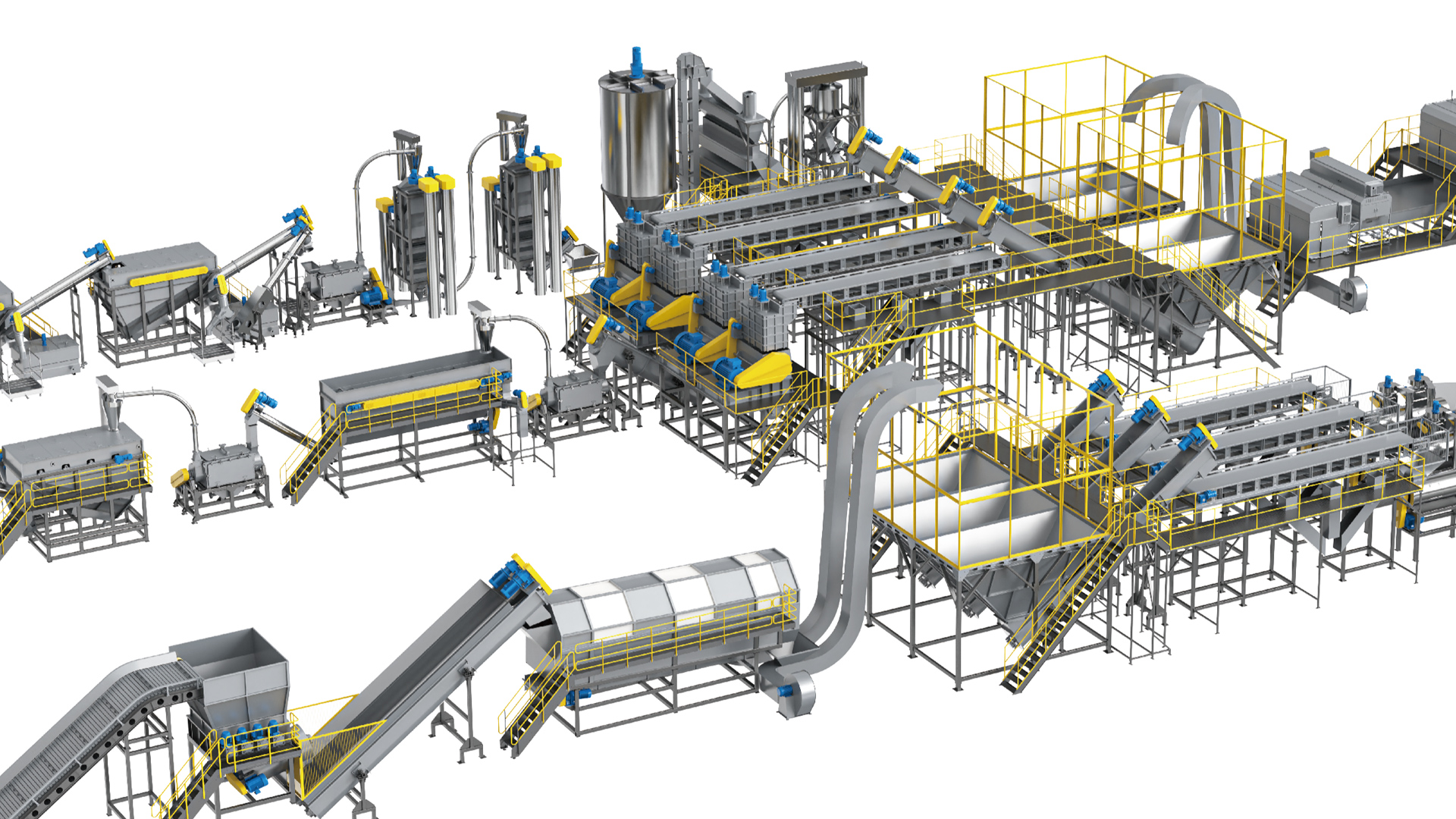
The global plastic recycling industry is undergoing comprehensive technological upgrading, driven by strict environmental regulations, growing demand for high-purity recycled plastic materials, and the booming circular economy market. Traditional plastic recycling washing lines often suffer from incomplete impurity removal, low material utilization rate, high water and energy consumption, and unstable recycled material quality due to backward auxiliary equipment and outdated process design. Austrian plastic recycling technology has long been recognized worldwide for its high precision, high efficiency, energy-saving performance, and stable industrial-grade operation, becoming the benchmark for modern plastic recycling washing line configuration.
As a professional supplier of high-end plastic recycling equipment and complete washing line solutions, POLYRETEC integrates mature Austrian core technology into full-series recycling auxiliary equipment, focusing on solving common pain points of traditional washing lines such as residual contamination, excessive moisture, uneven material sorting, and high operating costs. The complete set of Austrian-technology auxiliary equipments optimizes every processing link of plastic washing, from raw material pretreatment, impurity separation, deep cleaning, dehydration drying to final material homogenization, realizing full-process intelligent and efficient recycling of waste plastic materials.
This article comprehensively elaborates on the technical advantages, core functions, parameter characteristics, price and cost budgets, selection standards, installation and operation specifications, and application benefits of POLYRETEC Austrian technology plastic recycling washing line auxiliary equipments. It covers all core auxiliary equipment types, analyzes the matching logic of each equipment in the washing line, and summarizes efficient configuration schemes for different waste plastic materials, providing systematic and practical technical references and investment guidance for plastic recycling factory transformation, new project construction, and production efficiency upgrading.
1. Overview of Tecnologia austríaca in Modern Plastic Linha de lavagem Recycling
1.1 Core Advantages of Austrian Plastic Recycling Technology
Austrian plastic recycling technology has occupied a leading position in the global high-end recycling field for decades, focusing on refined recycling, low-carbon energy saving, and stable industrial continuous production. Different from conventional ordinary recycling technology that only realizes simple cleaning and crushing, Austrian technology takes high-purity recycled material output and full-link cost control as the core goals, realizing precise separation of micro impurities, efficient removal of oil stains and ink residues, and low-loss material recycling. Its core technical advantages include precise structural design, standardized process logic, energy-saving transmission system, and intelligent parameter control, which completely solve the defects of low cleaning accuracy and high resource consumption of traditional washing lines.
In terms of industrial adaptation, Austrian technology is highly compatible with multi-type waste plastics, including PET bottles, PE/PP films, plastic woven bags, rigid plastic containers, and mixed plastic materials. It can meet the recycling and cleaning requirements of food-grade, industrial-grade, and daily-use-grade recycled plastics, with strong production stability and wide application range. For large-scale, long-term, and high-standard plastic recycling production lines, Austrian supporting auxiliary equipment is an indispensable core configuration to ensure product qualification rate and long-term profit stability.
1.2 Importance of Professional Equipamentos Auxiliares for Linha de lavagem
A complete plastic recycling washing line is composed of main crushing and cleaning equipment and a full set of supporting auxiliary equipments. The main equipment undertakes core crushing and primary cleaning work, while auxiliary equipments determine the final purity, dryness, uniformity, and comprehensive production cost of recycled materials. Many recycling factories only pay attention to the performance of main equipment and ignore the upgrading of auxiliary equipments, resulting in a large number of micro impurities, residual moisture, and mixed materials in finished recycled plastics, which directly reduces the market value of products and restricts sales profit space.
High-quality Austrian-technology auxiliary equipments can form a perfect process matching with the main washing line, realizing full-coverage fine processing of waste plastics from feeding to finished output. They effectively remove hidden impurities that cannot be eliminated by conventional equipment, reduce material waste and energy consumption, improve the overall automation level of the production line, and reduce manual operation costs. For modern standardized plastic recycling projects, professional supporting auxiliary equipments are the key to distinguish low-end simple recycling lines from high-end refined recycling lines, and also the core guarantee for enterprises to obtain high-value recycled products and stable profits.
1.3 POLYRETEC Technical Localization and Equipment Iteration
POLYRETEC has long focused on the introduction, digestion, and innovative iteration of Austrian advanced plastic recycling technology. On the basis of retaining the original Austrian high-precision process design and structural standards, the company optimizes the equipment according to the actual operating environment, material characteristics, and production scale of global recycling factories, realizing localized adaptation of high-end technology. All POLYRETEC washing line auxiliary equipments adopt Austrian standard production processes, core component configuration, and quality inspection standards, with performance completely reaching international high-end level, while having more cost-effective pricing and more convenient after-sales service than pure imported equipment.
At present, POLYRETEC’s full-series auxiliary equipments cover all supporting links of plastic washing lines, including feeding conveying equipment, sorting and separating equipment, deep cleaning auxiliary equipment, dehydration and drying equipment, dust and impurity removal equipment, and centralized control auxiliary system. The complete equipment combination can form a fully automatic, high-efficiency, and low-consumption closed-loop plastic recycling washing production line, helping users achieve refined recycling production.
2. Complete Classification and Core Functions of POLYRETEC Tecnologia austríaca Equipamentos Auxiliares
According to the process flow of the plastic recycling washing line, POLYRETEC Austrian technology auxiliary equipments are divided into six core categories: pretreatment feeding auxiliary equipment, precise sorting auxiliary equipment, deep cleaning supporting equipment, dehydration and drying auxiliary equipment, impurity removal and purification equipment, and intelligent control auxiliary equipment. Each type of equipment has independent functional positioning and process matching logic, forming a mutually supportive and complementary complete process system. The following is a detailed introduction to the parameters, functions, and application scenarios of each core equipment.
2.1 Pretreatment Feeding Auxiliary Equipment
Pretreatment feeding is the first link of the plastic washing line, which determines the uniformity of subsequent material processing and the stability of continuous production. POLYRETEC Austrian-standard feeding auxiliary equipments include variable-speed belt conveyors, forced uniform feeders, and raw material screening pre-separators, which solve the problems of uneven feeding, material accumulation, and mixed large impurities in traditional feeding links.
The variable-speed belt conveyor adopts Austrian optimized anti-slip and anti-blocking structural design, with adjustable conveying speed according to production load, realizing synchronous matching with the operating speed of the main washing line. The equipment is equipped with an anti-overload protection system, which can automatically stop feeding when the main equipment is blocked, effectively avoiding equipment failure and material accumulation. The fully enclosed structure prevents dust and small impurities from entering the production link, reducing subsequent cleaning pressure.
The forced uniform feeder is specially designed for light and fluffy materials such as plastic films and woven bags. It can evenly disperse stacked materials to avoid agglomeration and incomplete cleaning in subsequent processes. The raw material screening pre-separator can preliminarily screen large impurities such as stones, metal blocks, and wood chips mixed in waste plastics, reducing the wear of subsequent crushing equipment and improving the purity of raw materials.
In terms of cost and price, the FOB price of a single set of POLYRETEC standard feeding auxiliary equipment combination (conveyor + feeder + pre-screener) ranges from 5,800 to 8,500 US dollars. The equipment has a service life of more than 8 years, with low daily maintenance cost, and the average daily depreciation cost is only 2 to 3 US dollars. It is a low-investment and high-return basic supporting equipment for washing lines.
2.2 Precise Sorting and Separating Auxiliary Equipment
Material sorting is the core link to improve the purity of recycled plastics. Traditional washing lines rely on manual sorting, which has high error rate, high labor cost, and low efficiency. POLYRETEC Austrian technology precise sorting auxiliary equipments include density flotation separators, wind sorting machines, and metal detection separators, realizing fully automatic precise sorting of different plastics and hybrid impurities.
The density flotation separator applies Austrian precise density classification technology, using the density difference between different plastic materials and impurities to realize automatic separation of PET, PE, PP, and mixed miscellaneous plastics. It can effectively separate plastic materials with similar appearance but different density, with a sorting accuracy of over 98.5%, completely solving the problem of mixed materials in finished recycled plastics. The equipment adopts a water circulation filtration design, with low water consumption and no secondary pollution, meeting global environmental protection discharge standards.
The wind sorting machine is mainly used for removing light impurities such as dust, paper scraps, and foam residues in crushed plastics. It adopts adjustable high-precision air volume control, which can accurately separate light impurities without losing plastic materials, improving the cleanliness of raw materials. The metal detection separator can automatically identify and remove metal impurities mixed in plastics, protecting subsequent precision equipment from wear and damage.
The FOB price of POLYRETEC standard sorting auxiliary equipment combination is 12,000 to 16,800 US dollars. For large-scale high-purity recycling projects, the upgraded high-precision sorting unit is priced at 17,000 to 22,000 US dollars. The equipment can reduce manual sorting labor costs by more than 80% and greatly improve the qualification rate of finished products, with obvious long-term cost-saving benefits.
2.3 Deep Cleaning Supporting Auxiliary Equipment
Conventional washing line main equipment can only remove surface floating dust and large dirt, while stubborn impurities such as oil stains, ink residues, glue marks, and deep embedded dirt require professional auxiliary cleaning equipment for deep treatment. POLYRETEC Austrian technology deep cleaning auxiliary equipments include high-temperature circulating cleaning tanks, friction cleaning auxiliary machines, and chemical neutralization adjustment devices, forming a three-stage deep cleaning system.
The high-temperature circulating cleaning tank adopts Austrian constant-temperature heating and circulating filtration technology, which can maintain a stable cleaning temperature of 60 to 85 degrees Celsius, effectively decomposing and removing stubborn oil stains and aging glue on the surface of waste plastics. The circulating water filtration system can filter and clean the cleaning water in real time, realizing repeated water circulation use, reducing water consumption by more than 40% compared with traditional cleaning equipment.
The friction cleaning auxiliary machine cooperates with the main friction washing machine to strengthen the friction cleaning effect of plastic fragments, thoroughly peel off residual ink layers and fine dirt on the plastic surface, and improve the surface smoothness and purity of recycled materials. The chemical neutralization adjustment device can automatically adjust the pH value of cleaning water, neutralize residual alkaline cleaning agents, avoid material corrosion, and ensure the safety and stability of recycled plastic materials.
The FOB price of the deep cleaning auxiliary equipment combination is 9,500 to 13,200 US dollars. The equipment can increase the cleanliness of recycled plastics from the traditional 90% to more than 99.2%, greatly improving the market selling price of finished materials. The daily operating water and electricity cost is only 4 to 6 US dollars, with extremely low comprehensive operating cost and high cost performance.
2.4 Dehydration and Drying Auxiliary Equipment
Excessive moisture in cleaned plastic fragments will affect subsequent granulation and molding processing, resulting in defective products such as bubbles and cracks. POLYRETEC Austrian technology dehydration and drying auxiliary equipments include high-speed centrifugal dehydrators, hot air circulating dryers, and vibration homogenization drying racks, which realize efficient dehydration and uniform drying of plastic materials.
The high-speed centrifugal dehydrator adopts Austrian high-precision dynamic balance design, with a rotating speed of up to 1800r/min, which can quickly remove surface moisture of plastic fragments. The material moisture content after primary dehydration is controlled below 8%, avoiding excessive water carrying into the drying link. The equipment has a self-cleaning function, which can prevent material residue and blockage, ensuring long-term stable operation.
The hot air circulating dryer uses a closed hot air circulation system, with uniform heating and low energy consumption. It can dry plastic materials evenly in all directions, and the final moisture content of finished materials is stably controlled below 0.3%, fully meeting the production requirements of high-quality recycled plastic granules. The vibration homogenization drying rack can disperse stacked materials, avoid local uneven drying, and improve overall drying efficiency.
The FOB price of POLYRETEC dehydration and drying auxiliary equipment combination is 8,200 to 11,500 US dollars. The equipment can effectively reduce the defective rate of subsequent granulation products by more than 95%, reduce material waste, and improve the yield of finished products. The daily energy consumption cost is controlled within 5 US dollars, with low long-term operating costs and significant profit improvement effects.
2.5 Impurity Removal and Purification Auxiliary Equipment
Micro impurities such as fine dust, tiny fiber residues, and residual plastic scraps are the main factors affecting the high-end application of recycled plastics. POLYRETEC Austrian technology impurity removal and purification auxiliary equipments include high-efficiency dust collectors, fine scrap filters, and static impurity removers, realizing ultra-fine purification of recycled materials.
The high-efficiency dust collector adopts negative-pressure dust removal technology, which can completely absorb fine dust generated in the cleaning and drying process, ensuring clean and dust-free material surface. The fine scrap filter can screen out ultra-fine plastic scraps and impurity particles with a particle size of less than 0.1mm, improving the uniformity of finished materials. The static impurity remover eliminates static electricity on the plastic surface, avoiding dust adsorption again and maintaining long-term material cleanliness.
This set of auxiliary purification equipment is the key configuration for producing food-grade and medical-grade recycled plastics. The FOB price of the complete set of equipment is 6,500 to 9,000 US dollars. It can help enterprises produce high-purity recycled materials that meet international high-standard requirements, greatly improving product added value and market competitiveness.
2.6 Intelligent Control Auxiliary System
Austrian advanced recycling technology is reflected in intelligent and automated process control. POLYRETEC supporting intelligent control auxiliary system includes PLC centralized control cabinet, material induction sensor, and operation fault alarm device, realizing full-process automatic linkage control of the washing line auxiliary equipment.
The centralized control cabinet can uniformly adjust the operating parameters of all auxiliary equipments, realize synchronous start and stop and speed matching of each equipment, avoid equipment mismatch caused by manual operation errors, and improve the overall operation efficiency of the production line. The material induction sensor can automatically identify material quantity and operating status, adjust equipment operating parameters in real time according to production load, and realize energy-saving operation.
The fault alarm device can monitor the operating status of each auxiliary equipment in real time, automatically alarm and record data in case of blockage, overload, and parameter abnormality, facilitating timely maintenance and reducing production shutdown losses. The FOB price of the complete intelligent control auxiliary system is 4,800 to 7,200 US dollars, which effectively reduces manual operation intensity and human error loss, realizing unmanned efficient operation of the production line.
3. Overall Linha de lavagem Configuration Scheme and Investment Cost Analysis
3.1 Classification Configuration Scheme for Different Production Scales
According to different daily production capacity and material types of recycling factories, POLYRETEC provides targeted Austrian technology auxiliary equipment matching schemes, including small-scale standard configuration, medium-scale optimized configuration, and large-scale high-end refined configuration, to meet the investment needs of different customers.
The small-scale standard configuration is suitable for new factories with a daily output of 1 to 3 tons of recycled materials, matching basic feeding, sorting, cleaning, and dehydration auxiliary equipment. The total investment of auxiliary equipment is 30,000 to 38,000 US dollars, with low initial investment, simple operation, and stable performance, meeting the basic standardized recycling production requirements.
The medium-scale optimized configuration is suitable for mature factories with a daily output of 3 to 8 tons, adding deep cleaning and intelligent control auxiliary equipment on the basis of standard configuration. The total investment is 42,000 to 55,000 US dollars, which can significantly improve material purity and production efficiency, suitable for stable batch production and medium-end product sales.
The large-scale high-end refined configuration is suitable for large-scale recycling enterprises with a daily output of more than 8 tons and high-end material output requirements, equipped with full-set ultra-precision sorting, purification, and intelligent linkage auxiliary equipment. The total investment is 60,000 to 78,000 US dollars, which can produce food-grade high-purity recycled plastics, with high product added value and long-term high profit space.
3.2 Full-Link Operation Cost Budget Analysis
In addition to one-time equipment procurement costs, the daily operating costs of Austrian technology auxiliary equipments mainly include water and electricity energy consumption, equipment maintenance, and wearing parts replacement. Compared with ordinary auxiliary equipment, POLYRETEC Austrian standard equipment has significant energy-saving and consumption-reducing advantages, with lower long-term comprehensive operating costs.
In terms of energy consumption, the full-set auxiliary equipment of the medium-sized production line has a daily total power consumption cost of 18 to 25 US dollars. The circulating water system reduces daily water consumption cost to 3 to 5 US dollars, and the daily comprehensive energy consumption cost is controlled within 30 US dollars. In terms of maintenance, the equipment adopts wear-resistant and anti-corrosion Austrian standard materials, with low failure rate. The average daily maintenance and wearing parts amortization cost is only 2 to 4 US dollars.
After the overall auxiliary equipment is upgraded, the material waste rate of the washing line is reduced from the traditional 8% to 10% to below 2%, and the labor cost is reduced by more than 70%. The comprehensive daily cost saving of a single production line can reach 80 to 120 US dollars, and the equipment investment payback period is short, with extremely high long-term economic benefits.
3.3 Equipment Service Life and Depreciation Cost Accounting
All POLYRETEC Austrian technology auxiliary equipments are manufactured according to industrial-grade high-standard specifications, with strict quality control of core components and structural materials. The overall service life of conventional auxiliary equipment is 8 to 12 years, far exceeding the 3 to 5 years service life of ordinary low-end auxiliary equipment.
Calculated based on a 10-year average service life, the daily depreciation cost of the full-set medium-sized auxiliary equipment configuration is only 12 to 15 US dollars. Long-term stable operation without frequent equipment replacement and maintenance can save a lot of secondary investment costs for enterprises, further optimizing the comprehensive profit margin of the recycling project.
4. Core Technical Advantages of POLYRETEC Austrian Standard Equipamentos Auxiliares
4.1 High Precision and Low Impurity Residue
Different from ordinary auxiliary equipment with simple functional design, POLYRETEC Austrian technology auxiliary equipments focus on refined impurity removal and precise processing. Each equipment has independent precision parameter adjustment function, which can carry out targeted processing according to different waste plastic pollution degrees and material characteristics. The full-set auxiliary equipment linkage operation can reduce the total impurity residue of recycled materials to below 0.8%, reaching the international high-end recycled material standard, which is far better than the processing effect of traditional supporting equipment.
4.2 Energy-Saving and Environmental Protection Process Design
Austrian recycling technology always adheres to the low-carbon environmental protection design concept. All POLYRETEC auxiliary equipments adopt energy-saving motor configuration and optimized transmission structure, effectively reducing invalid energy consumption. The circulating water filtration system and closed dust removal system realize zero sewage discharge and zero dust overflow in the production process, meeting the strict environmental protection standards of various countries. While ensuring production efficiency, it reduces enterprise environmental protection assessment risks and energy consumption costs.
4.3 Strong Compatibility and Flexible Matching
POLYRETEC Austrian technology auxiliary equipments have strong universal compatibility, which can be perfectly matched with various brands of main washing line equipment on the market, without equipment adaptation barriers. Users can carry out step-by-step transformation and upgrading according to the existing production line situation, replacing old and inefficient auxiliary equipment in batches, avoiding the waste of overall equipment investment. The modular design of the equipment realizes flexible combination and free matching, adapting to different production scales and material processing requirements.
4.4 Stable Operation and Low Failure Rate
Through the introduction of Austrian mature industrial design and manufacturing process, POLYRETEC auxiliary equipments avoid the structural defects and unstable operation of ordinary equipment. The core components are made of high-strength wear-resistant and anti-corrosion materials, which can adapt to long-term continuous high-load industrial production. The equipment failure rate is lower than 0.5% in long-term operation, greatly reducing production shutdown losses and maintenance time costs, ensuring continuous and stable production of the washing line.
5. Application Effects and Industry Benefits of Auxiliary Equipment Upgrading
5.1 Improvement of Recycled Material Quality and Added Value
After adopting POLYRETEC Austrian technology auxiliary equipments, the cleanliness, dryness, and uniformity of recycled plastic materials are comprehensively improved. The finished recycled materials can meet the production standards of high-end products such as food packaging, medical supplies, and precision plastic parts, instead of only being used for low-end ordinary plastic products. The market unit price of high-purity recycled materials is 20% to 40% higher than that of ordinary recycled materials, greatly improving the product added value and profit margin of recycling enterprises.
5.2 Improvement of Production Line Automation and Efficiency
The full-automatic linkage operation of intelligent auxiliary equipment reduces manual intervention links, realizes automatic feeding, sorting, cleaning, drying, and discharging of the washing line, and improves the overall production efficiency by 30% to 50%. The standardized parameter operation avoids quality fluctuation caused by manual debugging, ensures batch consistency of finished materials, and improves enterprise production capacity and order delivery capacity.
5.3 Reduction of Comprehensive Production Costs
The high-precision processing capability of Austrian standard auxiliary equipments reduces material waste rate, defective product rate, and resource consumption. The intelligent energy-saving design reduces long-term water and electricity costs, and the low-failure operation reduces maintenance and replacement costs. The comprehensive cost of recycled plastic per ton can be reduced by 15 to 25 US dollars, forming a stable cost advantage for enterprises in market competition.
5.4 Enhancement of Enterprise Market Competitiveness
With the increasingly strict industry environmental protection standards and market quality requirements, backward simple recycling lines are gradually eliminated. Upgrading to Austrian technology high-standard auxiliary equipment enables enterprises to obtain high-quality recycled product qualifications, meet high-end customer procurement standards, expand high-value market channels, and establish long-term stable cooperative relations with brand manufacturers, effectively enhancing core market competitiveness.
6. Standard Installation, Operation and Maintenance Especificações
6.1 Professional Installation and Commissioning Standards
All POLYRETEC Austrian technology auxiliary equipments adopt standardized modular installation design, with unified installation standards and process specifications. After the equipment arrives at the factory, professional technical personnel complete line layout, equipment connection, circuit debugging, and parameter calibration according to Austrian process standards. After installation, full-load trial production and parameter optimization are carried out to ensure that all equipment reaches the optimal operating state and meets the design precision and efficiency standards.
6.2 Daily Standardized Operation Especificações
During daily production, operators only need to start the intelligent control system with one key, and each auxiliary equipment will automatically match the operating parameters of the main washing line. It is necessary to regularly check the material operating status, equipment operation sound, and water and electricity supply status every shift, timely clean the filter screen and dust removal impurities, and ensure the unobstructed operation of the equipment. Avoid overloaded operation and random parameter modification to maintain long-term stable processing accuracy of the equipment.
6.3 Regular Maintenance and Upgrading Mechanism
Establish a daily inspection, weekly maintenance, and monthly overhaul system for auxiliary equipment. Daily cleaning of residual materials and dust, weekly lubrication of transmission components and inspection of wearing parts, monthly calibration of precision parameters and detection of electrical systems. POLYRETEC provides long-term free technical guidance and preferential replacement of original parts, ensuring that the equipment maintains Austrian standard operating performance for a long time and extends the service life of the equipment.
7. Common Problems and Optimization Solutions of Traditional Linha de lavagem Auxiliary Equipment
7.1 Low Cleaning Purity and Excessive Residual Impurities
Most traditional washing line auxiliary equipments have single functions and low precision, unable to remove micro oil stains, ink residues, and fine dust, resulting in low purity of finished materials. The optimization solution is to replace with POLYRETEC Austrian deep cleaning and purification auxiliary equipment, form a multi-stage impurity removal system, and realize full coverage removal of large impurities and micro impurities, thoroughly solving the problem of insufficient cleaning purity.
7.2 High Energy Consumption and Serious Resource Waste
Ordinary auxiliary equipment has unreasonable structural design and low operation efficiency, with large water and electricity energy consumption and serious material waste. After upgrading to Austrian standard energy-saving auxiliary equipment, the circulating water system and energy-saving motor effectively reduce resource consumption, and precise processing reduces material loss, realizing energy-saving, environmental protection and low-consumption production.
7.3 Disordered Equipment Matching and Low Automation
The traditional washing line auxiliary equipment is randomly matched, with inconsistent operating parameters and no linkage control, resulting in low overall production efficiency and frequent equipment failures. POLYRETEC integrated supporting auxiliary equipment adopts unified Austrian process standards and intelligent linkage control, realizing synchronous operation of the whole line, orderly process connection, and greatly improving production automation and stability.
8. Conclusion
Auxiliary equipment is an indispensable core part of the plastic recycling washing line, which determines the comprehensive production efficiency, finished product quality, and long-term operating cost of the recycling project. Austrian advanced recycling technology, with its high precision, high efficiency, energy saving and stability, has become the mainstream standard for modern high-end plastic recycling line configuration. POLYRETEC, relying on mature Austrian technology localization innovation, provides full-series high-quality auxiliary equipments for plastic washing lines, covering all process links of pretreatment, sorting, deep cleaning, dehydration drying, purification and intelligent control.
Compared with traditional ordinary auxiliary equipment, POLYRETEC Austrian technology supporting equipment has obvious advantages in impurity removal accuracy, production efficiency, energy-saving effect, and operation stability, which can effectively solve various pain points of traditional washing line production. Reasonable configuration of targeted auxiliary equipment solutions according to production scale and material requirements can help recycling enterprises reduce comprehensive production costs, improve the added value and market competitiveness of recycled products, and realize stable profit growth and long-term sustainable development in the increasingly standardized plastic recycling industry.