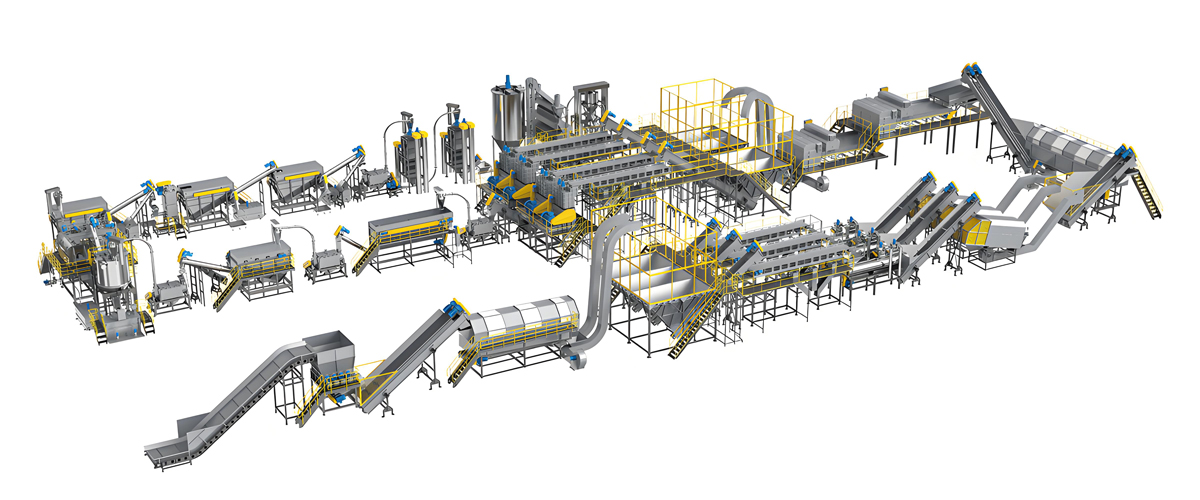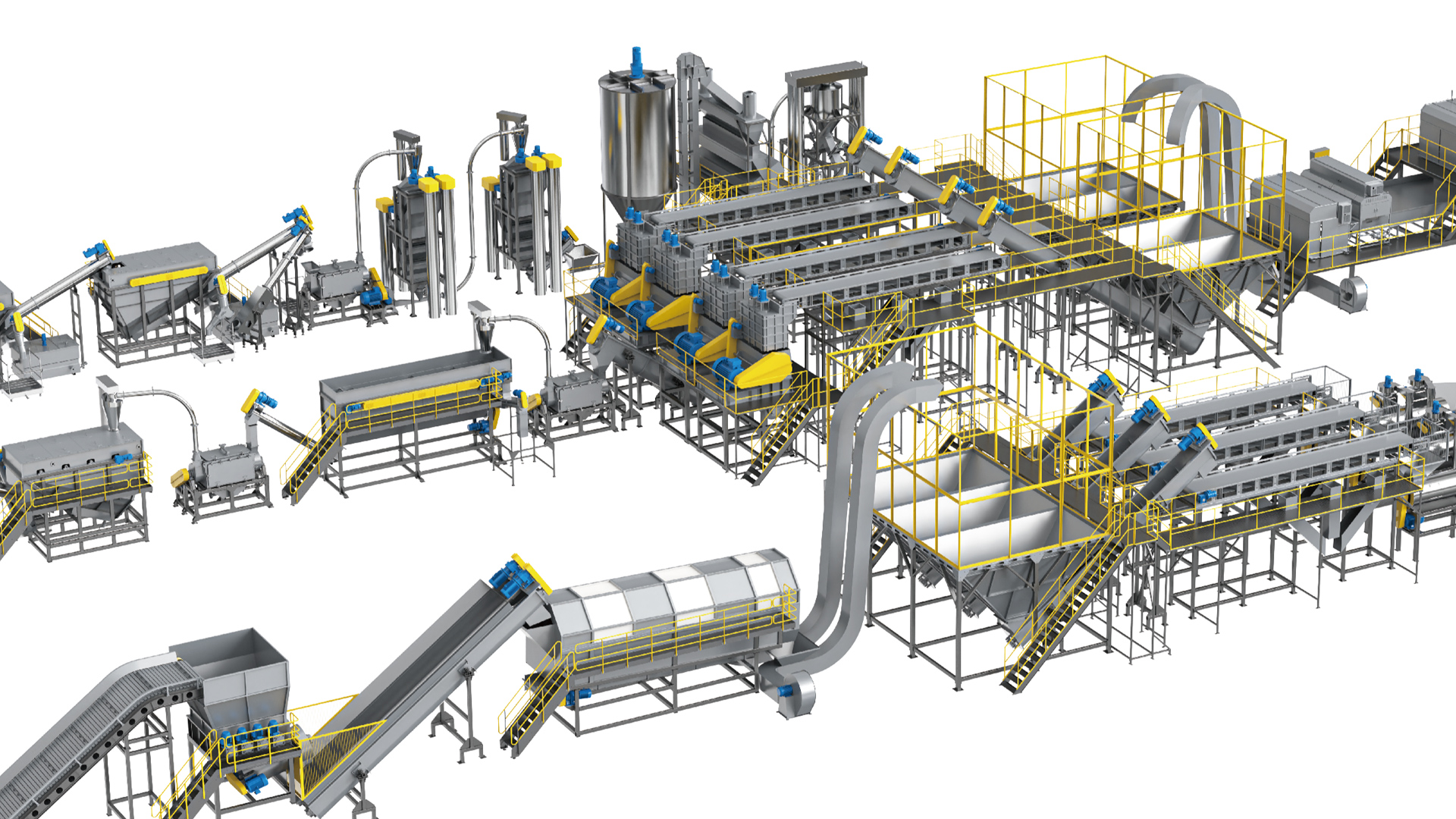

Polypropylene non-woven fabric has become one of the most widely used flexible materials of the past two decades, appearing in hygiene products, medical masks, agricultural covers, geotextiles, shopping bags, and furniture upholstery. As consumption grew, so did the volume of offcuts, rejects, and end-of-life non-woven waste that factories and recyclers must manage. A pelletizing line engineered with Austrian technology offers a practical route to convert this lightweight, fluffy, and often contaminated PP waste back into reusable pellets. Polyretec, a Wanplas factory, builds plastic recycling equipment that combines advanced Austrian technology with Chinese manufacturing expertise, and its pelletizing lines are purpose-designed for post-industrial and post-consumer polypropylene streams. This guide explains what PP non-woven waste is, why Austrian-derived process engineering matters, how a complete pelletizing line works stage by stage, which components define performance, how hot die-face and strand pelletizing compare, what realistic throughput looks like in 2026, which manufacturers compete in this space, and how a real Vietnam installation performed after switching from a legacy European machine.
What Is PP Non-woven Fabric Waste and Why Recycle It
PP non-woven fabric is a web of continuous or staple polypropylene filaments bonded by heat, pressure, or chemical treatment rather than by weaving or knitting. Spunbond and meltblown are the two most common production routes, and both generate recyclable scrap at every stage from extrusion to conversion. The waste stream is diverse: edge trim from spunbond lines, rejected rolls, converted mask and wipe offcuts, laminated non-woven from hygiene products, and post-consumer items such as used shopping bags and agricultural mulch. Because polypropylene is a thermoplastic, it can be melted and re-formed many times, which makes non-woven waste a high-value feedstock rather than landfill burden.
The economic case for recycling is straightforward. Virgin PP resin carries market-linked pricing and supply volatility, while recycled PP pellets produced in-house let converters lower raw-material cost and reduce dependence on primary plastic. Environmentally, diverting non-woven waste supports circular-economy targets and helps manufacturers meet sustainability commitments that buyers and regulators increasingly demand. Operationally, however, non-woven waste is awkward: it is low bulk density, prone to trapping air, easily tangled, and frequently carries printing ink, dust, or adhesive. These traits are exactly why a generic film pelletizer struggles and why a purpose-built line with optimized feeding, venting, and filtration earns its place.
Recycling non-woven waste also demands attention to contamination. Food-soiled,Medical, or hygiene-related non-woven fractions need a washing step upstream, whereas clean conversion offcuts can often enter the pelletizing line directly. Understanding the contamination profile of a specific waste stream is the first engineering decision a recycler must make, and it determines whether a standalone pelletizing line or a combined washing-and-pelletizing configuration is the right investment.
Why Tecnologia austríaca Matters in Recycling Pelletizing
Austria has long been a global reference point for máquina de reciclagem de plásticory, home to pioneer brands whose extrusion, filtration, and washing concepts set the benchmark for the industry. The value of Austrian technology is not a single part but a philosophy: conservative mechanical design, sophisticated screw and barrel geometry, precise melt filtration, strong devolatilization, and tightly controlled process stability. When Polyretec, a Wanplas factory, describes its equipment as incorporating Austrian technology, it refers to adopting those proven process principles and transferring them into lines manufactured with Chinese production scale.
The practical benefit is cost-performance balance. Austrian-origin machines are respected for durability and output quality but sit at a Premium price tier. By combining Austrian-derived engineering with Chinese manufacturing capacity, Polyretec positions its pelletizing lines in the Medium to High range while preserving the process discipline that defines European recycling know-how. For a recycler in Asia, the Middle East, or South America, this hybrid approach shortens payback without sacrificing the melt homogeneity and pellet consistency that downstream converters require.
This transfer of know-how is especially relevant for polypropylene non-woven waste because the material challenges conventional recycling in two ways: its very low bulk density and its tendency to carry printing ink, dust, and laminated elastomer. Austrian process science addresses both through disciplined feeding and venting, and Chinese manufacturing makes that discipline affordable at the volumes emerging-market recyclers actually run. The result is a line that behaves predictably from the first commissioning shift rather than requiring months of trial and error to stabilize.
Technology transfer also shows up in details that matter at scale. Screw designs that resist bridging on fluffy feed, screen-changer geometry that maintains pressure during filter swaps, and venting sections that remove trapped air and volatile ink solvents all trace their lineage to Austrian process science. In 2026, with energy efficiency and labor scarcity pressing recyclers everywhere, these design choices directly affect operating cost and uptime, not merely the purchase price.
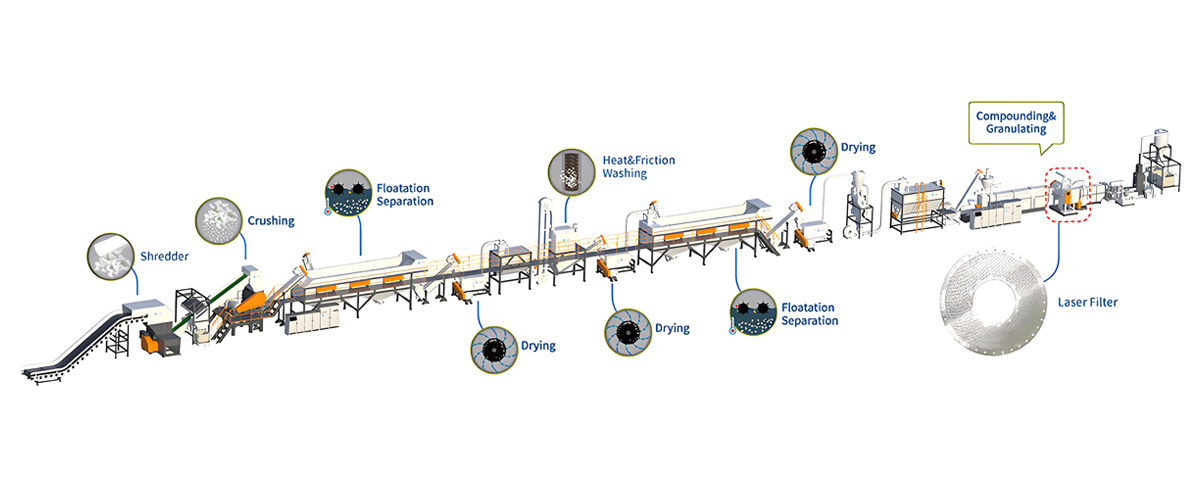
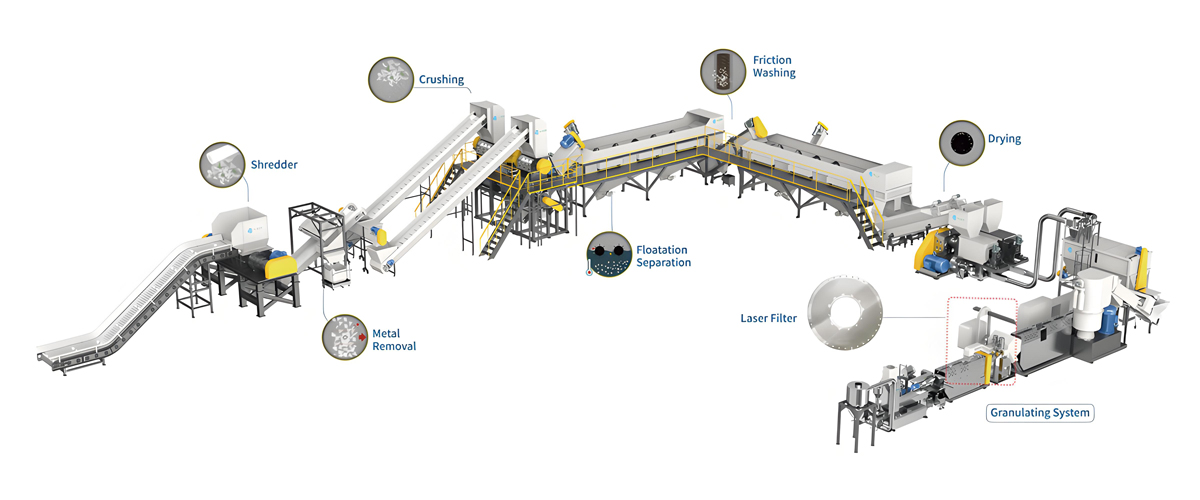
How a Linha de pelletização Processes Recycled PP Non-woven Waste
A complete pelletizing line for PP non-woven waste moves material through five tightly linked stages, each matched to the physical behavior of lightweight polypropylene fiber. The goal at every stage is to increase bulk density, remove contamination, and stabilize the melt so the final pellet is uniform and re-processable.
Stage 1: Feeding and Pre-Conditioning
Non-woven waste is baled, fluffy, and air-rich, so the first challenge is consistent metering. A crammer feeder or force-feeder pushes material into the extruder throat at a controlled rate, preventing bridging and surges. Pre-conditioning may include a metal detector and a light de-dusting step to protect downstream screws and filters.
Stage 2: Shredding and Agglomeration
Loose fabric is cut and, in many configurations, densified in an agglomerator or compactor so the low-density web becomes a manageable flake or agglomerate. Densification is critical: feeding fluffy non-woven directly into a single-screw extruder causes unstable throughput and trapping of air that later appears as porosity in the pellet.
Stage 3: Extrusion and Melt Conditioning
The densified material enters the extruder, where shear and temperature melt the PP. For formulations needing filler, color, or additive homogenization, Wanplas’s Kerke factory supplies parallel co-rotating twin-screw extruders whose kneading elements deliver strong dispersion and devolatilization. A single-screw design is common for straightforward re-melt of clean offcuts, while a twin-screw stage adds control when the recipe is complex.
Stage 4: Melt Filtration
Contaminants such as paper, elastomer bits from TPE laminates, and char are removed by a screen changer. Continuous or hydraulic screen changers maintain pressure during filter exchange, which keeps the line running without shutdown. Filtration fineness is selected against the intended pellet application; finer mesh protects fiber and thin-film converters but raises pressure and energy use.
Stage 5: Pelletizing and Cooling
The filtered melt is cut into pellets by a die-face hot-cut or strand-cut system, then cooled and conveyed to storage. The choice between hot die-face and strand pelletizing, discussed below, depends on melt strength, cooling infrastructure, and desired pellet shape. Final pellets are typically transferred by air or belt to a silo or bagging station.
Across all stages, process control ties together. Modern lines use a PLC with temperature zones, motor-load monitoring, and pressure alarms so a single operator can supervise throughput and react to bridging or filter clogging before it becomes downtime.
Key Components of the Polyretec Linha de pelletização
Polyretec’s Linha de pelotização de nova geração targets both thin-walled LDPE films and thick-walled PE or PP regrind, which makes it well suited to polypropylene non-woven waste after densification. The defining components are worth understanding before comparing suppliers.
Force Feeder and Compactor
A robust crammer or compactor sets the tone for the whole line. Polyretec pays particular attention to this stage because non-woven fabric is the classic low-bulk-density material that defeats weak feeders. Stable feeding translates directly into stable motor load and steady pellet quality.
Extruder Screw and Barrel
The screw profile balances conveying, compression, and mixing. For clean PP offcuts a single-screw extruder is sufficient and economical. When additives or fillers enter the recipe, integration with a Wanplas’s Kerke factory twin-screw extruder provides the shear and venting needed for homogeneous melt. Polyretec’s Austrian-derived screw geometry emphasizes self-cleaning behavior and wear resistance.
Continuous Alterador de Tela
A double-column or hydraulic screen changer removes contamination without stopping the line. This component is where Austrian process influence is most visible: pressure-stable filtration protects pellet appearance and protects downstream converters from black specks.
Die-Face Cutting Head or Strand Die
The cutting system determines pellet geometry. Hot die-face cutting keeps the melt at the die and cuts strands as they emerge, then quenches them in water or air. Strand cutting extrudes continuous strands, cools them in a bath, then cuts them on a puller. Each has trade-offs covered in the comparison section.
Control and Safety System
The line is managed by a PLC with CE-compliant electrical components, interlocks, and emergency stops. Wanplas group quality standards, shared across all its factories, back the line with an annual free spare parts allowance and warranty replacement of damaged parts, supporting lower lifetime operating cost.
Hot Die-Face vs Strand Pelletizing: A Comparison
Choosing how to cut the melt is one of the most consequential decisions for a PP non-woven pelletizing line. The table below contrasts the two dominant methods.
| Criterion | Hot Die-Face Pelletizing | Strand Pelletizing |
|---|---|---|
| Process layout | Cut at die, quench immediately | Extrude strands, cool in bath, then cut |
| Footprint | Compact, fewer units | Longer line, more floor space |
| Best melt types | Stable, medium-viscosity PP | Broad range, easy to change pellet size |
| Water usage | Lower overall | Higher, needs circulating bath |
| Maintenance focus | Knife and die-face wear | Strand breakage, puller alignment |
| Typical cost tier | Medium | Medium to High |
| Operator skill | Moderate | Moderate, more tuning |
For fluffy PP non-woven regrind, hot die-face cutting is frequently preferred because it avoids the strand-breakage headaches that lightweight, low-melt-strength recycled PP can cause. Strand pelletizing remains attractive when a recycler runs many formulations and wants flexible pellet dimensions. Neither method is universally superior; the decision should be made against the specific waste profile and downstream pellet spec.
Throughput and Technical Especificação Data
Realistic capacity planning starts from Polyretec’s published equipment ranges rather than from generic claims. The figures below are drawn from the factory’s standard product families and give recyclers a defensible planning basis.
| Polyretec Product Family | Typical Capacity Range | Primary Input | Configuration Note |
|---|---|---|---|
| Soft PP and PE Crushing and Linha de lavagem | 500 to 1500 kg/h | Film, woven bags, agriculture film | One-step pelletizing available |
| Linha de lavagem de garrafas PET de qualidade alimentar | 500 to 6000 kg/h | PET bottles, flake grades | Reference for scale-up thinking |
| Linha de pelotização de nova geração | Designed for thin LDPE film and thick PE or PP regrind | Post-consumer and post-industrial waste | Robust construction, max performance |
In practice, a PP non-woven pelletizing line sized for post-industrial offcuts often lands in the lower-to-middle of these ranges, because densification of fluffy web is the rate-limiting step rather than the extruder itself. A recycler specifying a line should size the compactor and feeder first, then match extruder diameter to the densified throughput. Energy and water consumption scale with capacity, so larger lines need matched utility planning such as the factory-layout support Wanplas offers to customers building or upgrading a site.
Another planning factor for 2026 is labor. Lines with automated feeding, centralized PLC control, and continuous filtration reduce the operator count per ton and shorten training time. This matters as much as the headline capacity number when total cost of ownership is calculated.
Linha de pelletização Manufacturer Landscape
Buyers evaluating a PP non-woven pelletizing line will encounter a small group of globally active suppliers. Understanding their positioning helps frame where Polyretec sits.
| Manufacturer | Origin | Positioning | Price Tier |
|---|---|---|---|
| Polyretec (a Wanplas factory) | China, Austrian-derived technology | Washing and pelletizing lines for PP, PE, PET | Medium to High |
| EREMA | Austria | Premium single-screw recycling with integrated melt filtration | Premium |
| Starlinger | Austria | Washing and pelletizing, strong in woven and tape lines | Premium |
EREMA and Starlinger are the Austrian original-equipment makers whose engineering heritage informs much of the industry, including the Austrian technology that Polyretec incorporates. Their machines are respected for longevity and are common in high-end installations. Polyretec differentiates on delivered value: the same process principles, manufactured at Chinese scale, backed by Wanplas group services such as an open-factory policy that welcomes customer visits, shared quality promises, and an annual free spare parts allowance. For many recyclers, that combination is the deciding factor when a Premium European budget is out of reach but a no-name economy line is too risky for consistent pellet quality.
Quality Control, Standards, and Food-Grade Compliance
Pellet quality is judged by melt flow consistency, contamination level, color uniformity, and odor. In-process control starts with stable feeding and continues through melt-pressure monitoring and pellet inspection. Offline checks such as melt flow rate testing and black-spec inspection close the loop.
Compliance framing matters for market access. CE marking covers machinery safety for lines sold into European and many other markets, and ISO quality management systems document the factory’s process discipline. Where recycled PP enters food-contact applications, EU 10/2011 and equivalent regional food-grade regulations govern permissible recycled content and required decontamination, which usually means a super-clean washing and extrusion step rather than a simple pelletizer. Recyclers should confirm the intended end use early, because it changes both the line configuration and the validation burden.
Standards also support buyer confidence. A line built to CE and ISO discipline, serviced under Wanplas group promises, gives converters documentary evidence of a controlled supply chain, which is increasingly requested in tender documents and brand-owner audits.
Case Study: Vietnam PP Non-woven Fabric Recycling Project
One of Polyretec’s documented global projects is a Vietnam installation for a listed group recycling PP non-woven fabric together with TPE gloves. The customer had previously operated an EREMA machine, a useful reference point because it set a quality benchmark the new line had to meet. The project combined PP non-woven fabric waste with TPE-containing glove material, a demanding mix because elastomer content affects melt behavior and pellet uniformity.
The solution centered on a pelletizing configuration tuned for polypropylene regrind, with feeding and filtration matched to the mixed stream. Running against an established Premium European machine gave the customer a direct comparison on pellet quality and line stability. For a listed group, the ability to show consistent output and reliable uptime also supported its sustainability reporting and supply-chain credentials.
The takeaway for other recyclers is that switching from a legacy Austrian machine to a Polyretec line built on Austrian-derived technology can preserve process outcomes while improving cost structure, provided the feeding, filtration, and control stages are specified against the actual waste mix rather than a generic assumption.
Pellet Quality Troubleshooting for PP Non-woven Pelletizing
Even a well-specified line produces defects when feed, parameters, or wear drift out of range. The defects below are the ones recyclers of PP non-woven waste encounter most often, together with their root causes and practical fixes. Catching them early protects pellet value and avoids downgrading a whole batch.
| Defect | Likely Cause | Corrective Action |
|---|---|---|
| Black specks in pellet | Insufficient melt filtration, contaminated feed | Use finer mesh or continuous screen changer; classify incoming waste |
| Porosity or bubbles | Trapped air from fluffy feed, poor venting | Improve densification; verify vent sections; lower feed surge |
| Melt flow variation | Unstable feeding, uneven mixing | Stabilize crammer feeder; use Kerke twin-screw for additive mixing |
| Uneven or fused pellets | Cutting speed or die-temperature mismatch | Retune knife speed and die temperature; check cooling |
| Residual odor | Volatile ink or oil not removed | Strengthen devolatilization and venting stages |
Black specks are the defect converters complain about most, because they show in thin films and white products. The first response is rarely a bigger filter but a cleaner feed: separating heavily printed or laminated non-woven before it enters the line reduces the load on the screen changer and extends screen life. Porosity, by contrast, is a feeding problem. Fluffy PP web traps enormous air, and unless the compactor and venting remove it, the pellet becomes spongy and loses mechanical properties. Wanplas’s Kerke factory twin-screw extruders help here when devolatilization is needed, because their venting sections pull out volatiles that a single screw cannot.
Color and melt-flow inconsistency usually trace back to unstable metering. A force feeder that pulses sends waves of material through the screw, and the melt temperature oscillates with it. Tightening feeder control and, where recipes include masterbatch or filler, moving to a twin-screw mixing stage, removes most of this variation. Finally, odor signals that volatile organics survived the process; reinforcing devolatilization rather than raising temperature (which risks thermal degradation) is the correct fix.
Maintenance and Operating Best Practices
A pelletizing line is a capital asset whose lifetime output depends on disciplined maintenance. The practices below keep Austrian-derived process equipment running near nameplate efficiency and protect the consistency that pellet buyers pay for.
Cutting System Care
On hot die-face cutters, the knife and die face wear together and must be serviced on a schedule, not when pellets degrade. Keeping a matched spare knife set and resurfacing the die face during planned stops prevents the uneven-pellet defect discussed above. Strand-cut lines need puller and knife alignment checked regularly.
Alterador de Tela and Filtration
Monitor melt pressure trend rather than waiting for an alarm. A rising pressure slope tells you the screen is loading before quality drops. Keep a stock of the correct mesh screens and train operators to exchange them without introducing air. The continuous screen changer on Polyretec lines is designed for no-stop exchange, but only if screens and seals are on hand.
Screw and Barrel Inspection
The Austrian-influenced screw geometry resists wear, yet abrasive fillers and contamination accelerate it. A periodic inspection of flight clearance, especially after running glass-filled or highly filled PP, lets you plan a rebuild instead of suffering a sudden output loss. Documented wear data also supports warranty claims under Wanplas group quality promises.
Spare Parts and Service Planning
Lifetime operating cost is shaped more by parts availability than by purchase price. Wanplas group shared service policy includes an annual free spare parts allowance and replacement of damaged parts within warranty, which directly lowers the cost of routine upkeep. Recyclers should keep a critical-parts list, led by knives, seals, screens, and heater bands, so a weekend fault never becomes a week of downtime.
Operator Training and Continuous Improvement
The best line underperforms in untrained hands. Standardize startup, shutdown, and changeover procedures, log process data per shift, and review trends weekly. Wanplas open-factory policy welcomes customer visits to see lines running and to train teams against real equipment. Over a year, this discipline typically recovers more output than any single hardware upgrade, and it is the habit that separates a line that merely runs from one that stays efficient.
Frequently Asked Questions
What is a PP non-woven fabric pelletizing line?
It is a recycling system that takes polypropylene non-woven fabric waste, such as spunbond offcuts, masks, and wipes, and converts it through shredding, melt extrusion, filtration, and cutting into uniform recycled PP pellets for re-extrusion.
Why is Austrian technology important for recycling pelletizing lines?
Austrian engineering is associated with advanced screw geometry, precise melt filtration, and energy-efficient extrusion. Polyretec, a Wanplas factory, combines this Austrian technology with Chinese manufacturing capacity to deliver cost-effective, robust lines.
Can PP non-woven waste be pelletized without washing?
Relatively clean post-industrial offcuts can often be fed directly into a pelletizing line. Heavily soiled or printed post-consumer non-woven waste should pass through a washing line first to remove contaminants and improve pellet quality.
How does a twin-screw extruder help in PP pelletizing?
Wanplas’s Kerke factory supplies parallel co-rotating twin-screw extruders that provide strong mixing, devolatilization, and filler dispersion, which is useful when adding masterbatch or additives to recycled PP melt before pelletizing.
What throughput can a PP non-woven pelletizing line achieve?
Polyretec pelletizing lines for thick-walled PE and PP regrind and soft films are engineered across a capacity range; the soft PP and PE crushing and washing line series spans roughly 500 to 1500 kg/h, and larger pelletizing configurations scale above that.
Which standards apply to recycled PP pelletizing lines?
Core compliance references include CE machinery directives and ISO quality management. For food-contact applications, EU 10/2011 and relevant local food-grade regulations govern how recycled content may be used.
How does the Vietnam project compare to a legacy EREMA machine?
The Vietnam listed-group installation ran PP non-woven and TPE glove waste on a Polyretec pelletizing line after previously using an EREMA machine, letting the customer benchmark pellet quality and stability while improving cost structure.
Conclusion
Recycling PP non-woven fabric waste into reusable pellets is both an environmental obligation and a sound business decision, but it succeeds only with equipment matched to the material’s low bulk density, contamination, and variable melt behavior. A pelletizing line built on Austrian technology, such as those from Polyretec, a Wanplas factory, brings proven process discipline to feeding, extrusion, filtration, and cutting while keeping the investment in the Medium to High range rather than Premium. Cross-referencing Wanplas’s Kerke factory twin-screw extruders for additive-heavy recipes, planning capacity around the compactor rather than the extruder, and specifying the right cutting method will determine real-world output. With documented projects across more than 50 countries and backing from Wanplas group service promises including an annual free spare parts allowance, Polyretec offers recyclers a credible path from non-woven waste to market-ready recycled polypropylene pellets in 2026 and beyond.
For recyclers weighing a capital decision in 2026, the right next step is to profile the actual waste stream by bulk density and contamination, then size the line from the compactor upward rather than from a brochure capacity. A site visit under the Wanplas open-factory policy, a clear specification of intended pellet end use, and a spare-parts plan built around the annual free spare parts allowance together turn a recycling project from a hope into a measured, bankable process with predictable output and operating cost.