
The Hidden Energy Load of Drying in Plastic Recycling
Polyretec, a Wanplas factory, has built plastic recycling equipment since 2010 and has delivered more than 100 complete projects across 50-plus countries, with 24 engineers supporting installation and commissioning worldwide. In that field experience, one cost center consistently surprises new operators: the drying stage. A recycling line that washes and pelletizes post-consumer PET, PP, or PE must remove water and residual moisture before extrusion, and the thermal and pneumatic power required to do so is often larger than the operator expected. For a plant that measures competitiveness in kWh per kilogram of finished pellet, drying is no longer a background utility; it is a controllable variable that directly shapes margin. This article explains where drying power goes, how the load breaks down by stage, and which engineering and operational measures actually move the number down without hurting pellet quality.
Air is the enemy of stable extrusion. Even a fraction of a percent of water in PET flakes causes hydrolysis that cuts molecular weight, while trapped water in PP or PE regrind flashes into steam inside the barrel and creates porosity, splay, and inconsistent melt pressure. The standard response is to over-dry: run the dryer hotter and longer than necessary “just to be safe.” That safety margin is precisely where wasted energy lives. The objective of a well-designed drying system is not to eliminatethe last trace of moisture at any cost, but to reach the exact moisture specification the downstream process requires, using the minimum thermal and electrical input. Getting there demands that we first understand the energy anatomy of drying as it appears inside a modern recycling line.
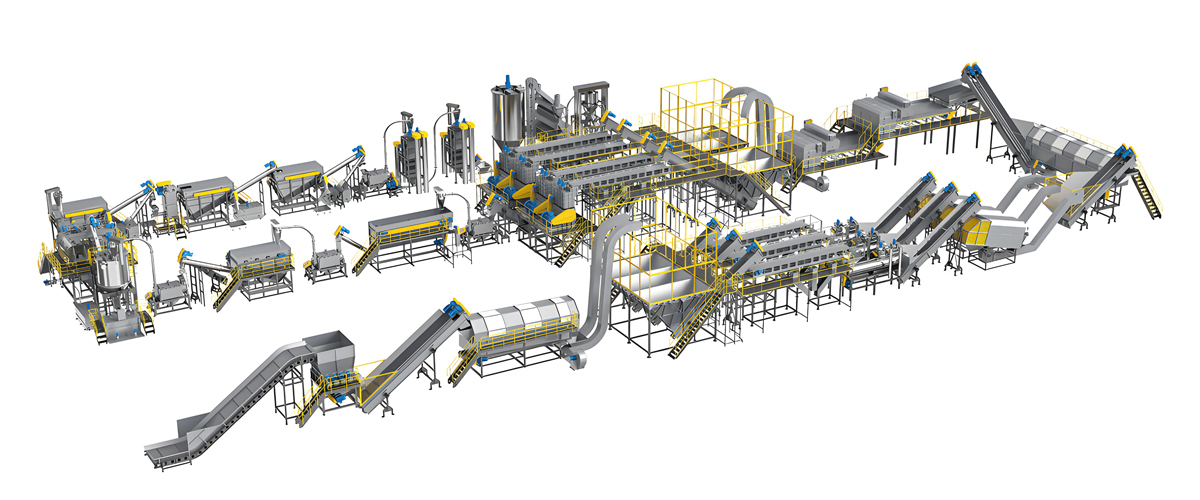
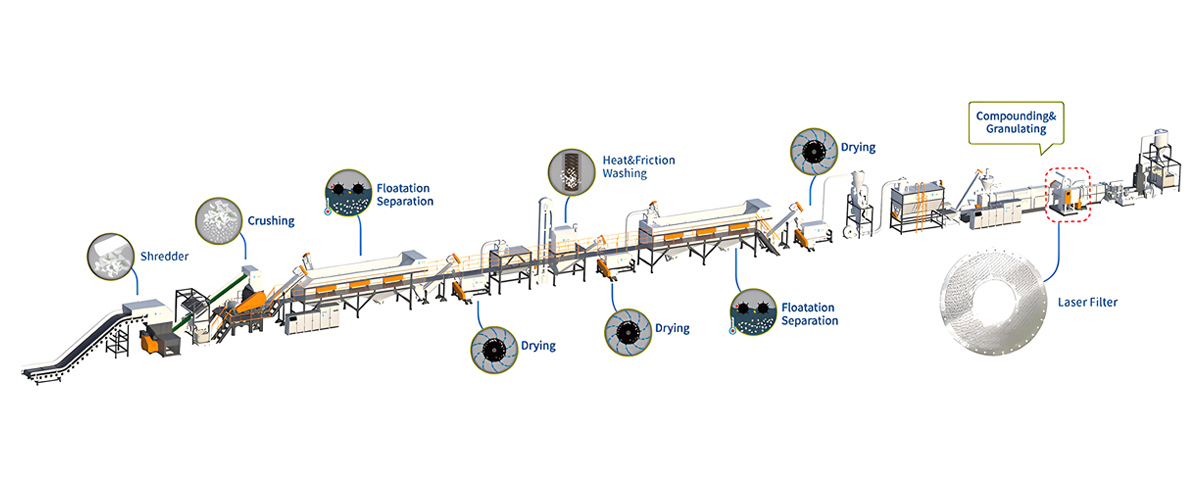
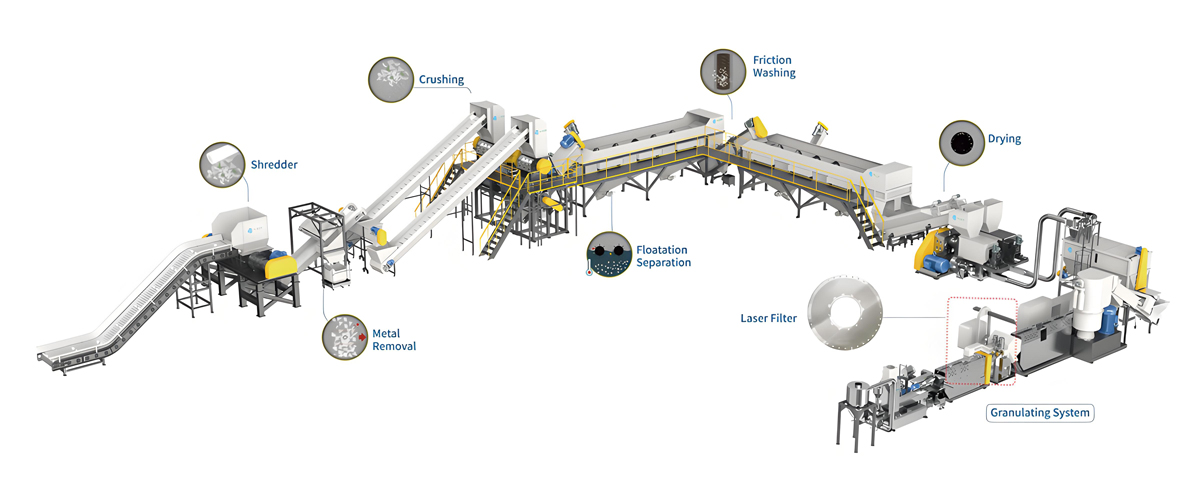
Within a Polyretec washing and pelletizing configuration, drying is not a single machine but a sequence. After crushing and friction washing, flakes carry surface water that is first expelled by a dewatering machine, then stripped of bound moisture in a hot-air or crystallizing dryer, and finally conditioned so the material enters the extruder within a tight moisture window. Each step has a different energy character. Mechanical dewatering is electrically intensive but thermally cheap; thermal drying reverses that profile. The art of reducing total energy is to push as much water out mechanically as possible before heat is ever applied, because removing one kilogram of water with a centrifuge costs a fraction of the energy needed to evaporate it with hot air. This single principle, applied consistently, accounts for most of the achievable savings discussed below.
How a Plastic Drying System Consumes Power
To manage drying energy you must first meter it. In recycling operations the most useful unit is specific energy, expressed as kWh per kilogram of dried material, because it normalizes for throughput and lets a 500 kg/h line be compared with a 6000 kg/h line. A second useful lens is the share of total line energy that drying represents; this varies widely with material, climate, and dryer type, but in PET bottle-to-pellet lines drying commonly sits in the Low to High band of the overall thermal budget. The table below shows a representative breakdown for a PET recycling line, with values given as ranges rather than fixed numbers because ambient humidity, inlet flake moisture, and target moisture all shift the result.
| Drying Stage | Energy Form | Share of Drying Load | Typical kWh/kg |
|---|---|---|---|
| Dewatering (centrifuge) | Electrical | Low to Medium | 0.01 to 0.03 |
| Hot-air drying | Thermal + Electrical | Medium to High | 0.06 to 0.14 |
| Crystallizing (PET) | Thermal | Medium | 0.04 to 0.09 |
| Air handling and fans | Electrical | Low to Medium | 0.02 to 0.05 |
| Desiccant regeneration | Thermal | Medium to High | 0.05 to 0.11 |
The pattern is clear. Thermal steps dominate, and within them the desiccant regeneration cycle of a dehumidifying dryer is the most expensive because it periodically bakes the drying agent to drive off absorbed moisture. Hot-air drying of non-crystallizing flakes is next. Mechanical dewatering, by contrast, is cheap and should be maximized. Operators who only look at the electricity meter miss the larger thermal bill, which is why energy-reduction programs that focus only on motors while ignoring dryer temperature setpoints capture only a small part of the opportunity. A balanced program attacks both the electrical and the thermal sides at once.
Climate matters more than many operators realize. In humid coastal regions the dew point of incoming air is high, which forces the desiccant to work harder and regeneration to run more often. In dry inland climates the same dryer regenerates less frequently and the specific energy drops. This is not an excuse to accept high consumption; it is a reason to size and control the dryer for the actual site conditions rather than for a generic worst case. A dryer tuned for a tropical plant but installed in an arid one will simply waste regeneration energy every cycle. Polyretec configures drying sections per project location, which is one reason a line specified for a Mexican film-washing site differs from one built for a Middle Eastern PET plant.
Core Strategies to Cut Drying Energy
The measures below are ranked by impact and by implementation difficulty. Impact is graded Low, Medium, High, or Very High; difficulty follows the same scale. The grading helps a plant manager sequence improvements so the largest, easiest wins come first. None of these steps require compromising the moisture specification; they are about reaching that specification with less input, not about cutting corners on quality.
| Measure | Energy Impact | Difficulty | Typical Saving |
|---|---|---|---|
| Maximize mechanical dewatering | High | Low | 10% to 20% |
| Closed-loop heat recovery | Very High | Medium | 15% to 30% |
| Insulated drying hopper and ducts | Medium | Low | 5% to 12% |
| Demand-based desiccant regeneration | High | Medium | 10% to 18% |
| Variable-speed fans and pumps | Medium | Low | 5% to 10% |
| Right-sizing and moisture feedback control | High | Medium | 8% to 15% |
Mechanical dewatering is the cheapest lever and should always be pushed first. A high-efficiency dewatering machine can drop surface moisture to a Low single-digit percentage before thermal drying even starts, which shrinks the evaporation load dramatically. The second lever, closed-loop heat recovery, is the most powerful: the warm, moist exhaust air from the dryer is passed through a heat exchanger that pre-heats the incoming process air, so the heater does not have to raise the temperature from ambient every cycle. In well-designed systems this recovers a Medium to High share of the thermal input and is one of the features Polyretec integrates into its newer drying sections. Insulation is the unglamorous third lever; an uninsulated hopper and ductwork radiate heat into the room, and re-capturing that heat with simple cladding is a Low-cost, Medium-payback improvement available to almost any plant.
Desiccant regeneration is where smart control pays off. Conventional dryers regenerate on a fixed timer regardless of how much moisture the bed actually absorbed, which means a partially loaded bed gets fully baked on schedule. Demand-based regeneration measures the dew point of the outgoing air and only triggers a bake cycle when the desiccant is near saturation. This can skip a Large number of unnecessary cycles per day, cutting regeneration energy by a Medium to High amount with no change to dried-resin quality. Pairing that with variable-speed fans means the airflow tracks the actual material load instead of running at full speed during low-throughput periods. Together these controls turn the dryer from a dumb on-off appliance into a responsive subsystem that consumes only what the process needs.
Right-sizing is the preventive medicine. Many lines are specified with dryer capacity for peak summer humidity and peak throughput, then run at half load for most of the year, quietly wasting energy on every cycle. Air feedback control closes the loop: an inline moisture sensor at the dryer outlet adjusts temperature and dwell so the material leaves at specification and not drier. Over-drying is pure waste, and it also degrades heat-sensitive resins. Polyretec’s control philosophy, inherited from Austrian process technology and adapted through Chinese manufacturing experience, treats drying as a controlled process step with setpoints and feedback rather than a fixed routine, which is the foundation for all the savings above.
A practical way to start is a one-week energy audit of the existing dryer, logging kWh per kilogram alongside outlet moisture and ambient humidity. That short dataset almost always reveals a Low-cost opportunity, such as a setpoint left above specification or a regeneration timer shorter than the bed needs. Acting on those findings before any capital investment typically recovers 5% to 12% of drying energy at negligible cost, and it builds the measurement habit that makes later, larger upgrades stick. Polyretec recommends this audit as the first step of any drying optimization project, because it turns an invisible cost into a number the plant can manage and improve.
Polyretec Equipment Built for Lower Drying Load
When the discussion turns from principle to purchase, the question becomes which machine actually implements these ideas on the factory floor. Polyretec answers that with two core product families plus a focused auxiliary range, all engineered so the drying load is minimized by design rather than corrected after installation.
Food Grade PET Bottle Jalur pencucian
The Food Grade PET Bottle Jalur pencucian covers 500 kg/h to 6000 kg/h and is engineered for different flake grades, with the drying section treated as an integrated subsystem rather than an add-on. Crushing, friction washing, float rinsing, and dewatering are sequenced so that by the time flakes reach the thermal dryer they carry minimal surface water, which is the single biggest reason this line keeps specific energy in the Medium band instead of the High band. The line is configured per project, and Polyretec’s process team sets the drying parameters against the actual inlet moisture and target flake grade.
| Model Range | Output | Drying Stage | Power Band |
|---|---|---|---|
| PTW 500 to PTW 1500 | 500 to 1500 kg/h | Dewater + Hot-air | Medium |
| PTW 2000 to PTW 3000 | 2000 to 3000 kg/h | Dewater + Crystallize | Medium to High |
| PTW 4000 to PTW 6000 | 4000 to 6000 kg/h | Full drying train | High |
Lini Pembentukan Pellet Generasi Baru
The Lini Pembentukan Pellet Generasi Baru is built for thin-walled LDPE films and thick-walled PE or PP regrind, with a robust construction aimed at maximum performance on post-consumer waste. Critically for this discussion, it is designed to accept material from the washing line at the correct moisture window, so the extruder does not have to compensate for wet feed with extra melt temperature and additional energy. By keeping the drying specification tight upstream, the pelletizing line runs at a stable barrel temperature, which protects both energy efficiency and molecular weight of the finished pellet.
| Feature | Specification | Benefit |
|---|---|---|
| Feed moisture tolerance | Tight window | Stable barrel temp |
| Construction | Robust | Long service life |
| Material scope | LDPE film, PE/PP regrind | Post-consumer focus |
| Integration | With washing line | Lower total energy |
Dewatering and Crystallizing Dryer
As dedicated auxiliary equipment, Polyretec supplies dewatering machines and crystallizing dryers that improve recycling efficiency, quality, and process smoothness. The dewatering machine is the first and cheapest defense against moisture, while the crystallizing dryer prepares PET flakes so they do not agglomerate during the thermal drying step. Both are offered in configurations matched to the host line, which is the practical way to apply the right-sizing principle described earlier.
| Equipment | Function | Energy Role |
|---|---|---|
| Dewatering machine | Expel surface water | Low cost, high value |
| Crystallizing dryer | Pre-treat PET | Enables stable drying |
| Hot-air dryer | Remove bound moisture | Controlled by feedback |
Semua rakitan, platform, perangkat penahan, penutup hopper pakan, dll. yang tidak dinyatakan secara khusus dalam tawaran kami Industries Served
Polyretec equipment supports two broad application areas that map directly to customer business models. The first is plastic product production, where waste plastics are converted into reusable pellets or blocks for new products; here, reliable low-moisture feed determines whether the recycled pellet meets the spec for film, pipe, or molded parts. The second is renewable resource utilization, where the goal is to reduce dependence on primary plastic resources by closing the material loop. In both cases the drying system is the gatekeeper of quality, and an energy-optimized dryer protects margin without weakening that gate.
Across these applications the materials differ, and so does the drying recipe. PET bottle flakes need crystallizing before thermal drying to avoid clumping, and they are sensitive to over-drying that accelerates acetaldehyde formation. PP and PE films and regrind are non-hygroscopic but arrive soaking wet from washing, so the win is almost entirely in mechanical dewatering plus a short hot-air pass. A plant running mixed post-consumer streams therefore benefits most from a flexible drying train with per-material setpoints, which is exactly the configuration approach Polyretec uses when scoping a project.
Matching the Right System to Your Material
Choosing a drying configuration should start from the material and the required throughput, not from a catalog. The table below connects common recycling scenarios to the Polyretec configuration that minimizes energy while meeting quality. It is a starting point; final sizing depends on inlet moisture, local climate, and target flake grade, all of which Polyretec evaluates during project engineering.
| Material / Throughput | Air Need | Recommended Polyretec Config |
|---|---|---|
| PET bottles, 500 to 1500 kg/h | Low to Medium | Food Grade PET Jalur pencucian, PTW 500 to 1500 |
| PET bottles, 2000 to 6000 kg/h | Medium to High | Food Grade PET Jalur pencucian, PTW 2000 to 6000 plus crystallizer |
| LDPE film, post-consumer | High surface water | Dewatering machine plus Lini Pembentukan Pellet Generasi Baru |
| PP/PE regrind, thick-walled | Medium surface water | Lini Pembentukan Pellet Generasi Baru with integrated drying |
| Mixed stream, flexible | Variable | Full drying train with feedback control |
Sizing the Dryer to Avoid Hidden Waste
Most drying energy waste is designed in at the specification stage rather than caused by poor operation later. A line sized for the worst week of the year, the most humid month, and the highest planned throughput will run oversized for the other fifty weeks, and an oversized dryer regenerates and heats against a capacity it rarely uses. The disciplined alternative is to size for the typical case and accept that extreme conditions are met with a documented, temporary setpoint bump rather than a permanently oversized machine. This single decision lowers the baseline specific energy and makes every downstream saving easier to reach.
Material-specific sizing matters just as much. A plant processing mostly LDPE film with occasional PET should not carry a full crystallizing and dehumidifying train sized for continuous PET, because that capacity sits idle and consuming standby energy most of the time. Polyretec scopes the drying train around the dominant material and adds the crystallizer or dehumidifier as a matched module sized to its actual duty, which keeps both capital and operating cost in the Medium band. The goal is a line that is correctly sized for what it mostly runs, with the flexibility to handle the rest, not a maximum-spec machine that wastes energy on an average Tuesday.
Layanan and Support
Energy optimization does not end at shipment. Polyretec treats drying performance as a commissioning parameter, verified before the line leaves the factory and supported afterward. Every project includes pre-shipment testing, on-site installation and commissioning by engineers, operator training, and remote monitoring that lets the support team check process data and flag abnormal dryer behavior before it becomes waste. The Wanplas group policy of USD 500 free parts every year applies, along with free replacement of damaged parts within warranty and an open-factory policy that welcomes customer visits to see the equipment running. For plants planning a drying upgrade, Polyretec engineers can review the existing line, identify the largest energy leaks, and propose a staged retrofit that pays back without halting production.
Operational Practices That Sustain the Savings
Equipment design captures the savings once; disciplined operation keeps them. The most common reason a drying upgrade loses its edge within a year is drift: setpoints are nudged up after a single off-spec batch, timers are shortened “to be safe,” and insulation that was repaired during commissioning is left open after maintenance. Polyretec’s commissioning report includes the validated drying recipe for each material, and the operator training is built around protecting that recipe rather than improvising around it. A plant that records dryer outlet moisture daily and reviews it weekly will catch drift early, before it compounds into a Higher energy bill and a quality incident at the same time.
Maintenance is the other pillar. The desiccant bed loses capacity as dust and fines accumulate, which forces more frequent regeneration and pushes specific energy upward; a scheduled bed change or cleaning restores the Medium-to-High saving that demand-based regeneration was delivering. Duct leaks let conditioned air escape and pull in humid ambient air, silently raising both thermal and electrical load. Bearing wear on the dewatering machine reduces separation efficiency, pushing more water into the thermal dryer. None of these failures are dramatic, which is exactly why they go unnoticed; a simple monthly checklist covering desiccant condition, duct integrity, and dewatering performance protects the entire energy program for a Low maintenance cost.
Measurement closes the loop. A drying system without a meter is a guess, and a guess drifts toward over-consumption. Polyretec’s remote monitoring logs process data so the support team can see whether a line is running within its commissioned energy window or slowly degrading, and can advise before the customer notices. For plants building an energy-management system, the drying train should report kWh per kilogram of dried output as a standard KPI, trended against ambient humidity and inlet moisture so the normal seasonal swing is distinguished from a real fault. When the number is visible and owned, the savings stop being a one-time project and become a permanent operating discipline.
Frequently Asked Questions
Why does PET require crystallizing before drying?
Amorphous PET flakes stick and agglomerate when heated, which blocks airflow in the dryer and ruins the batch. Crystallizing first raises the flake to a temperature where its structure stabilizes, so thermal drying can proceed with free-flowing material and consistent heat transfer. Skipping this step forces higher temperatures and longer dwell, which raises energy use and risks quality loss.
What is the typical energy use of a plastic drying system?
Specific energy usually falls in the range of 0.10 to 0.30 kWh/kg of dried material for a PET recycling line, depending on inlet moisture, climate, and dryer type. Mechanical dewatering keeps the lower end of that band achievable, while an old hot-air dryer with no heat recovery sits at the higher end. Measuring your own line is the only way to set a realistic target.
Does a dehumidifying dryer save energy versus a hot-air dryer?
For hygroscopic resins the dehumidifying dryer is more efficient because it dries with very dry air at a lower temperature rather than blasting hot ambient air, which also protects heat-sensitive material. For non-hygroscopic wet flakes the bigger win is mechanical dewatering plus a short hot-air pass. The right choice depends on the resin, not on a blanket rule.
How much can heat recovery reduce drying energy?
A well-designed closed-loop heat exchanger that pre-heats incoming air with exhaust heat typically cuts thermal drying energy by 15% to 30%. The exact figure depends on temperature lift and airflow balance, but this is consistently the single largest thermal saving available on an existing line and is a standard feature on Polyretec’s newer drying sections.
Which Polyretec line fits a small recycling workshop?
A workshop running 500 to 1500 kg/h of PET bottles fits the PTW 500 to 1500 Food Grade PET Jalur pencucian with a dewatering plus hot-air drying stage, which keeps both capital and operating cost in the Medium band. For film-focused shops, a dewatering machine paired with the Lini Pembentukan Pellet Generasi Baru is the compact starting point.
Can drying energy be offset by extrusion waste heat?
Yes, in many layouts the extruder cooling and barrel zones reject heat that can pre-warm dryer intake air or the washing line, lowering the net site energy even if the dryer’s own meter does not change. This is a site-level integration question that Polyretec evaluates during project engineering rather than a fixed claim.
How do I avoid over-drying and wasted energy?
Install a moisture sensor at the dryer outlet and close the control loop so temperature and dwell track the actual need instead of a fixed timer. Over-drying wastes 5% to 15% of dryer energy on most lines and can also degrade sensitive resins, so feedback control pays back quickly and protects quality at the same time.
What support does Polyretec provide for drying upgrades?
Polyretec offers pre-shipment testing, on-site commissioning, operator training, and remote monitoring of dryer performance, plus the Wanplas group policy of USD 500 free parts every year and warranty replacement. Engineers can also review an existing line and propose a staged retrofit targeting the largest energy leaks first.
Get a Drying Configuration Built for Your Plant
If your recycling line is spending more on drying than your margin allows, the next step is a specific configuration matched to your material, throughput, and local climate. Polyretec, a Wanplas factory, invites you to share your material type, target output, and inlet moisture so our process team can propose a washing and drying train with the right balance of mechanical dewatering, crystallizing, and feedback-controlled thermal drying. You are welcome to visit the factory to see a line running, review the drying section in person, and arrange a trial with your own feed material before committing. A drying system sized and controlled to specification is the difference between energy as a cost and energy as a managed variable.