
Polyretec, a Wanplas factory, has built plastic recycling systems since 2010 and now runs more than 100 delivered projects across over 50 countries, pairing a mature European-origin recycling process route with Chinese manufacturing scale to turn post-consumer bottles and film into high-purity flake. This article explains how a washing line is engineered for flake purity, where each stage removes a specific contaminant, and which Polyretec configuration fits a given feedstock and output target. Whether the goal is food-grade PET flake for bottle-to-bottle reuse or clean PP/PE regrind for film and pipe, the economics of recycling are decided long before pelletizing: they are decided by how thoroughly the flake is washed, separated, and dried. A line that controls contaminant levels in the parts-per-million range is what separates a saleable recycled resin from a low-value mixed regrind that buyers reject at the gate.
Why Flake Purity Decides Recycling Profitability
The value of recycled plastic is almost entirely a function of how clean and how uniform the flake is. A buyer of recycled PET for food-contact sheet will pay a strong premium for flake that consistently clears sub-50-ppm thresholds on PVC, metal, and glue, while the same material with intermittent contamination is downgraded to fiber or strapping use, or rejected outright. Purity is not a single measurement but a stack of independent contaminant controls: organic residues from drink and oil, inorganic fillers from labels and caps, polymer cross-contamination from HDPE and PP floaters, and metals introduced during collection and transport. Each contaminant demands a different physical or chemical mechanism, which is why a high-purity line is a sequence of purpose-built stages rather than one machine. The engineering discipline is to remove each contaminant at the point where doing so is cheapest and most complete, and to avoid carrying it forward into later stages where it would be harder and more expensive to extract.
Throughput scales the difficulty. At 500 kg/h a small operator can tolerate more manual sorting and more open water loops, but at 4000 to 6000 kg/h the same process must run with continuous automation, closed water recovery, and inline inspection because manual intervention no longer keeps pace with the material flow. This is where process route maturity matters more than any single component. A mature European-origin recycling process know-how encodes decades of field learning about where contamination hides, how flake size distribution affects sink-float separation, and why a slightly longer hot-wash residence time removes more glue than a more aggressive caustic dose that later has to be neutralized and rinsed away. Polyretec applies that accumulated process knowledge on top of Chinese manufacturing capacity, so the resulting line carries the engineering logic of a proven route while remaining cost-effective to build, ship, and service across global markets.
Polyretec Process Architecture for High Purity Flakes
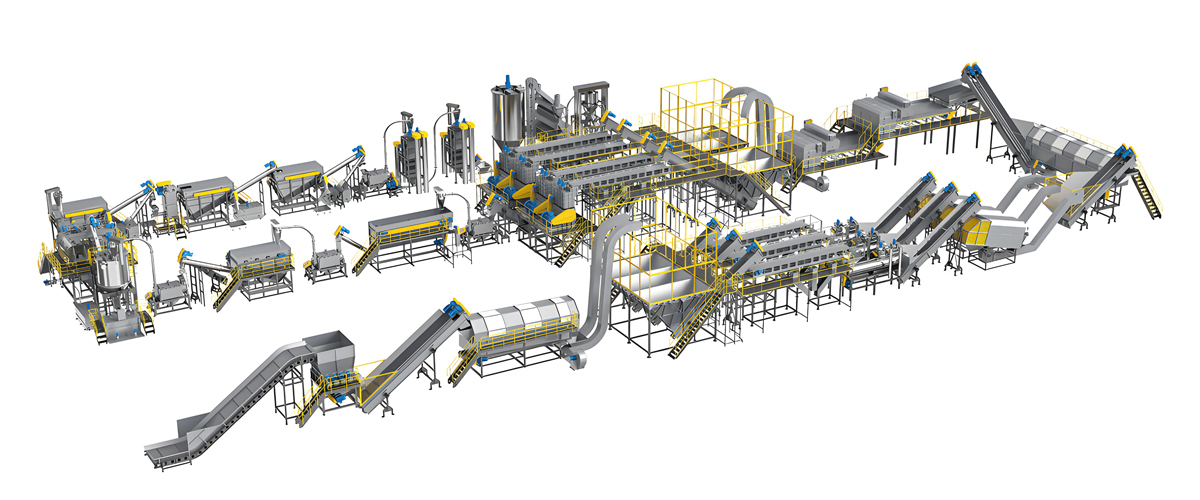
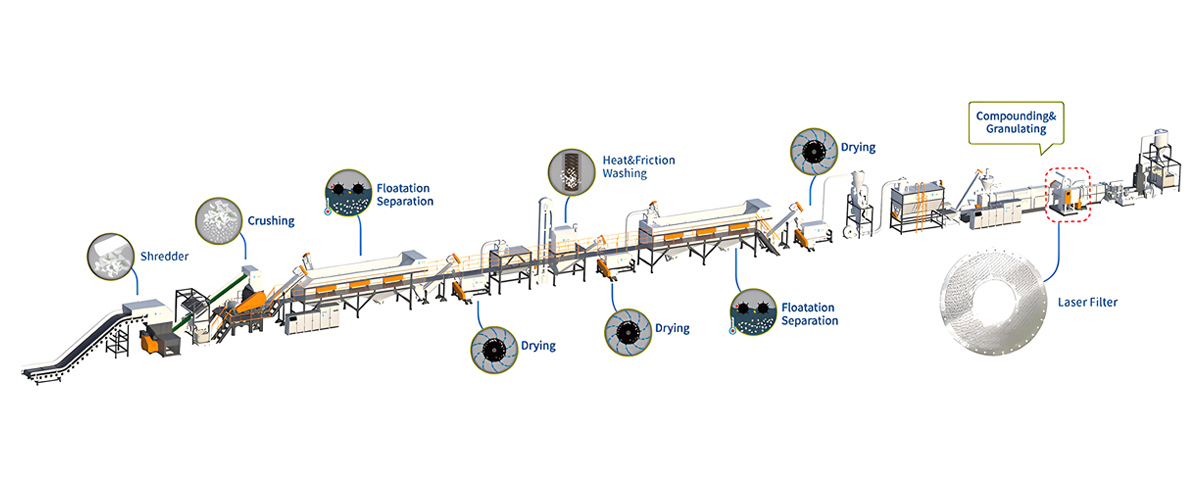
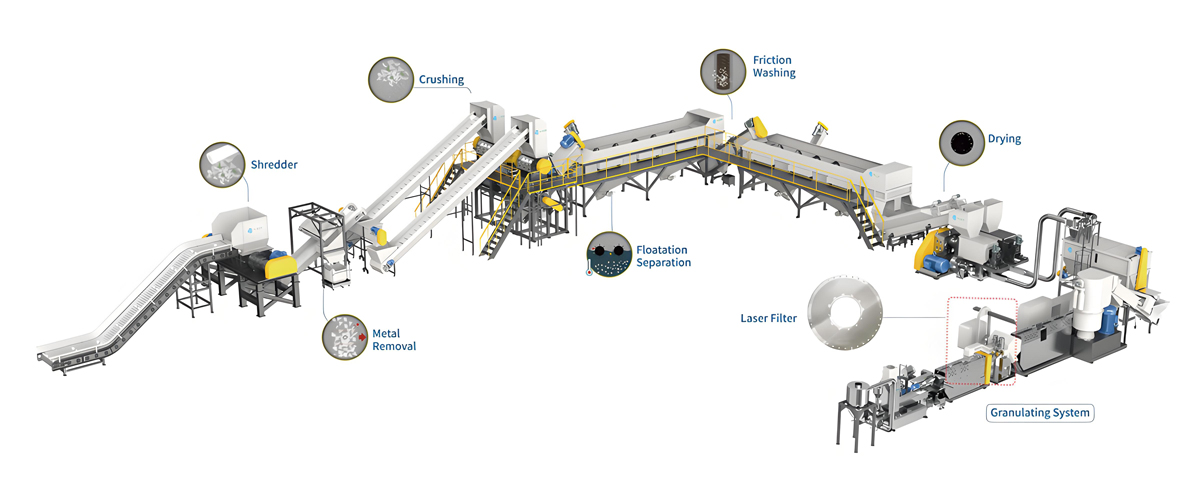
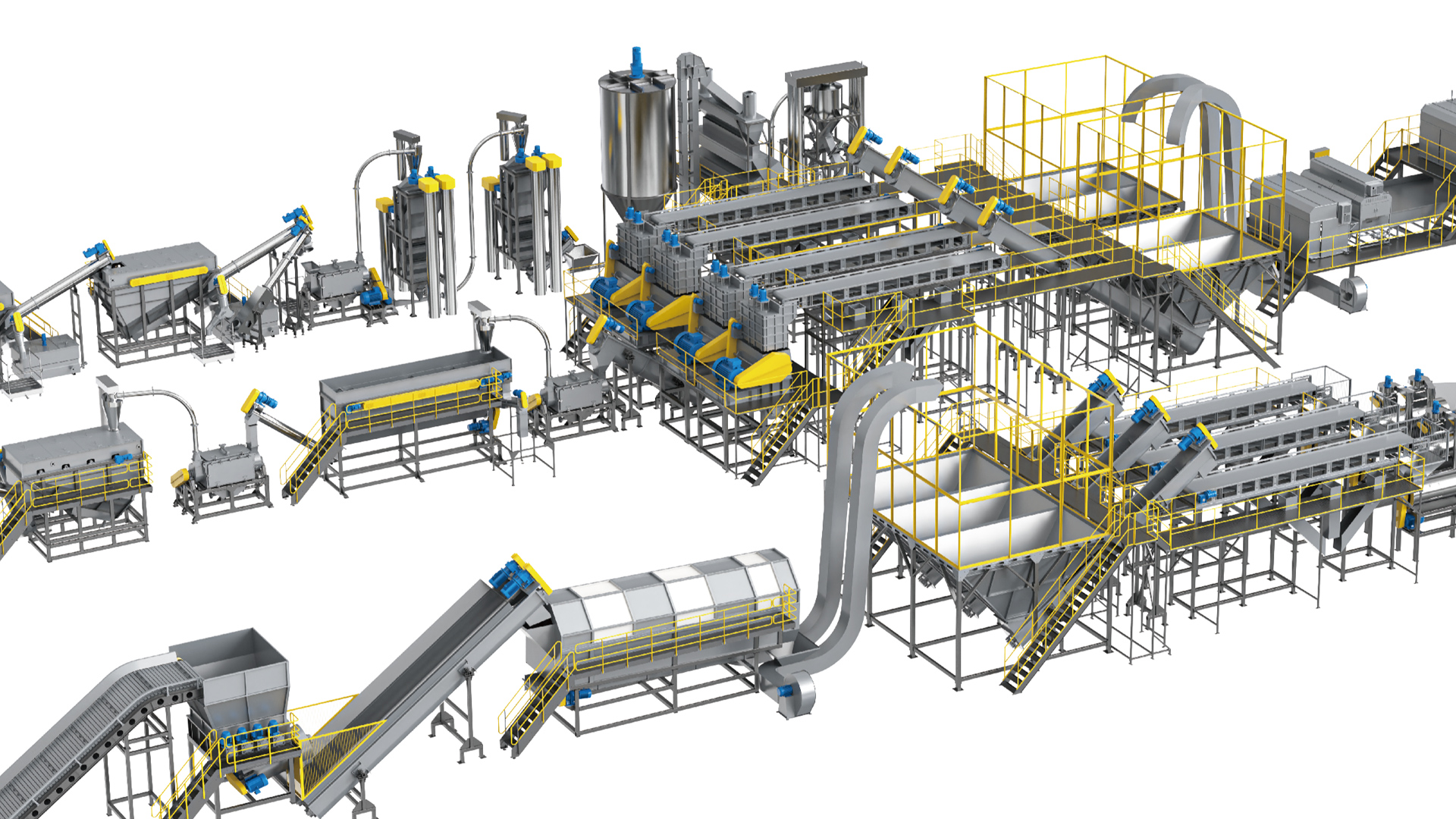
A complete Polyretec washing line is organized as a wet, multi-stage train in which each unit answers one contamination problem. Bale-breaking and dry label removal come first to drop the bulk of paper and glue before water is used. Coarse shredding converts whole bottles into flake so that subsequent washing acts on exposed surface rather than on sealed containers. Cold pre-wash and friction washing strip loose dirt and residual liquid. Hot caustic washing attacks the persistent glues and organic films that cold water cannot move. Float-sink separation splits PET, which sinks, from the polyolefin floaters that must not remain in the PET fraction. Rinsing and neutralization prepare the flake for dewatering and thermal drying. Optical sorting and metal separation provide the final purity gate. Pelletizing, where specified, converts the dry clean flake into uniform recycled pellet. The order is deliberate: remove the cheap, easy contaminants early, and reserve the expensive, precise operations for last so they act on the smallest possible mass.
The architecture is modular so that a customer can start with washing only and add pelletizing later, or size each stage to a target output without overbuilding. Feedstock variation is handled by configuring the front end: rigid bottles, soft film, and woven bags each need a different shredding and pre-wash approach, but they share the same downstream logic of separation, rinsing, drying, and sorting. Polyretec treats the line as one integrated process rather than a row of unrelated machines, which is why the control system can balance residence times and water flows stage to stage instead of leaving each operator to tune a single machine by feel. That integration is the practical meaning of a mature process route: the stages are tuned to each other, not merely placed in a row.
Pre-Washing and Coarse Shredding Stage
Post-consumer bales arrive dirty, compressed, and mixed with paper, sand, and residual liquid. The first action is mechanical opening and a dry or lightly wetted label knock-off that strips self-adhesive and sleeve labels before they are wetted and smeared across flake surfaces. Whole bottles then enter a coarse shredder or granulator that cuts them to a controlled flake size, typically 10 to 14 mm for PET bottle stock, because uniform flake size is what makes later separation predictable. If bottles are fed whole into a washer, water cannot reach interior surfaces and the result is pocket contamination that no later stage fully corrects. Shredding also liberates caps and base cups so that float-sink separation can remove them. The shredder must run with consistent screen size and speed control so the flake distribution stays inside the window the separation stage expects; a line that produces both fines and oversized pieces forces the float tank to compromise and loses purity at the boundary.
Pre-wash right after shredding uses a cold, low-chemical bath to remove the bulk of loose soil and the remaining drink residue while the material is still easy to handle. This stage protects the expensive hot-wash chemicals downstream by lowering the organic load they must attack, and it keeps the first wash water far dirtier than the last so that the final rinse can be genuinely clean. Polyretec sizes the pre-wash and shredder together, matching rotor speed and screen aperture to the target flake grade, because the two machines jointly set the particle-size distribution that every later stage depends on. Getting this stage right is the quiet prerequisite for the whole line: most purity failures that appear at the sort station were actually baked in at the shredder.
Friction Washing and Float-Sink Separation
After pre-wash the flake still carries pressed-in dirt and fine paper that only mechanical shear will dislodge. A friction washer uses high-speed rotation and counter-current water to rub flake against flake and against the drum wall, scouring surfaces without grinding the PET into fines. The discharged slurry then flows to a float-sink tank where density does the sorting: PET at about 1.30 to 1.40 g/cm3 sinks, while the unwanted polyolefins such as HDPE caps, PP labels, and LDPE film float and are skimmed off. This single physical step removes the largest mass of polymer cross-contamination, and it is the reason PVC and other dense impurities must instead be caught later by sorting rather than by flotation. Air flow, tank geometry, and residence time are tuned so that even thin flakes and small caps separate cleanly; poor tuning leaves a tail of floaters in the sink stream and a tail of PET in the float stream, both of which cost yield or purity.
Float-sink is repeated, sometimes in two passes, because a single pass trades some PET loss for some floater removal and the optimum balance shifts with feedstock. Polyretec configures the separation loop with adjustable weirs and flow so the operator can bias toward purity or toward recovery depending on market demand that month. Crucially, the separated polyolefin stream is itself a saleable product when washed, so the line is designed to recover it rather than discard it, improving the project economics. The density separation is purely physical and needs no chemicals, which keeps operating cost low and makes it the workhorse of the train; the more selective operations, such as optical and metal sorting, act only on the already-dense PET stream and therefore on a smaller, cleaner mass.
Hot Wash and Caustic Treatment for Label and Lemak Removal
The glues that hold labels and sleeves to bottles survive cold washing because they are designed to stay bonded through refrigerator and warehouse conditions. A hot wash, typically in the 80 to 95 degrees Celsius range with a controlled caustic dose, swells and hydrolyzes these adhesives so they release from the flake and are carried away in the wash water. Hot wash also attacks organic films, oils, and residual sugars that cold water leaves behind, and it helps soften any remaining paper fiber so it can be rinsed out. The engineering judgment is in the dose and residence time: too little leaves glue on the flake, too much wastes chemical, raises neutralization load, and can haze the PET surface. A mature process route sets these parameters from feedstock history rather than from a fixed recipe, because beverage bottles, dairy bottles, and edible-oil containers each carry different organic loads.
Polyretec runs the hot wash as a pressurized or atmospheric tunnel with managed retention so every flake sees the same thermal and chemical exposure, avoiding the hot and cold spots that cause uneven cleaning. After hot wash the flake passes a neutralization and rinse sequence that strips residual alkali, because leftover caustic would later corrode equipment and discolor the pellet. The wash water is filtered and, on larger lines, partly recovered through a closed loop to cut fresh-water demand and effluent volume. This stage is where the line earns its food-grade potential: the difference between a flake that merely looks clean and one that passes an organoleptic and contaminant spec is almost always decided by how thoroughly the hot wash and the rinses that follow it are executed.
Rinsing, Dewatering and Drying
Following neutralization the flake must be brought to a moisture content low enough for stable storage and for clean pelletizing. Rinse stages remove the last traces of alkali and suspended solids using progressively cleaner water, with the final rinse often fed by recovered or fresh water so the exit flake meets spec. Dewatering is first done mechanically in a centrifuge or dewatering screw that drops surface moisture to a few percent, then thermal drying in a hot-air or crystallizing dryer brings the flake to below roughly 1 percent moisture. Drying matters because water carried into the extruder flashes to steam, causes fish-eyes and splay in the pellet, and accelerates hydrolysis that drops molecular weight. For PET, which is moisture-sensitive, the drying step also begins the crystallizing that prevents clumping and bridging in the pelletizing hopper.
Polyretec matches the dewatering and drying capacity to the line throughput so that the back end never becomes the bottleneck that forces the front end to slow down. Dried flake is conveyed through a cooled zone before storage or pelletizing so it does not re-absorb humidity from warm plant air, and bulk density is checked because it predicts how the material will feed downstream. The entire wet section is built around water management: the cleaner the separation of dirty first-stage water from clean final-stage water, the less chemical and fresh water the line consumes per ton of flake. On a 5000 kg/h line the difference between a careless and a well-closed water loop is a large daily operating cost, which is why the loop design is part of the process route rather than an afterthought.
Optical Sorting and Logam Removal
Even after washing, the PET fraction can contain off-spec color, PVC, and metals that density separation cannot catch, because PVC is close enough in density to PET to ride along in the sink stream. Color sorters using near-infrared and visible-light detection identify and eject PVC, different-colored PET, and non-PET fragments at high line speed, while magnetic separators pull ferrous metal and eddy-current units reject non-ferrous metal introduced during collection. These units are the final purity gate and the reason a Polyretec line can claim food-grade potential rather than only industrial-grade output. The sorters are tuned to the customer’s spec: a bottle-to-bottle line demands aggressive PVC and color rejection, while a fiber line can accept broader tolerance and higher yield. Because sorting acts only on the already-clean, already-dense stream, the rejected mass is small and the value retained is high.
Logam removal is non-negotiable for equipment protection as well as product quality, since a missed bolt or bottle-cap remnant can damage the pelletizing extruder screw and screen changer. Polyretec places metal separation both before and after the sorter so that the pelletizing feed is doubly protected, and logs reject rates so the operator can see when a feedstock batch is unusually dirty. The combination of density separation, optical sorting, and metal separation is what converts washed flake into a specification product with documented impurity levels, and documentation is exactly what food-contact buyers require. A line that cannot show where and how each contaminant was removed will struggle to certify, regardless of how clean the flake happens to look in the pail.
Polyretec PET Bottle Jalur pencucian Series
The Polyretec Food Grade PET Bottle Jalur pencucian is built to convert post-consumer PET bottles into clean, dry flake graded for food-contact reuse, with output configurable from pilot scale to full plant throughput. Each tier shares the same staged architecture described above but scales the shredder, washer, and sorter widths to the target mass flow. The line is offered as a turnkey train with centralized PLC control, recipe management for different bottle mixes, and remote monitoring so the Wanplas engineering team can review operating data and support tuning from a distance. Because the design follows a mature European-origin recycling process route, the staging order and the separation logic are proven rather than experimental, which shortens commissioning and lowers the risk of a line that washes but does not pass spec.
The table below shows representative configuration tiers for the PET bottle washing line. Values are typical engineering ranges for the stated throughput and will be confirmed against the customer’s actual feedstock and target flake grade during project engineering; they are not fixed model numbers but capacity classes within the Polyretec washing program.
| Produksi (kg/h) | Feedstock | Flake Size (mm) | Power (kW) | Air (m3/h) |
|---|---|---|---|---|
| 500 to 1500 | Post-consumer PET bottles | 10 to 14 | about 180 | about 2.5 |
| 2000 to 3000 | Post-consumer PET bottles | 10 to 14 | about 310 | about 4.0 |
| 4000 to 6000 | Post-consumer PET bottles | 10 to 14 | about 520 | about 7.0 |
PP/PE Soft Film Jalur pencucian
Soft films, woven bags, and agricultural film follow a different front-end logic because they bridge, tangle, and float rather than sink, and they carry printing ink and agricultural dirt that need stronger pretreatment. The Polyretec PP/PE Kulit plastik yang lunak and Jalur pencucian starts with a heavy-duty shredder suited to tangled film, then uses friction and wash tanks to strip ink and soil, and can be paired with one-step pelletizing so the washed material goes straight to pellet without a separate densification step. Throughput is lower than for rigid bottles because film is bulky and low-density, so the line is engineered around volume handling and anti-tangling conveyance rather than around dense flake separation. For printed bags the wash must address ink, which is why the hot-wash and friction stages are emphasized relative to a clean film line.
The table below shows representative tiers for the soft film washing line. As with the PET line, the figures are typical engineering ranges for the stated capacity class and are finalized during project engineering against the customer’s actual material mix.
| Produksi (kg/h) | Feedstock | Power (kW) | Note |
|---|---|---|---|
| 500 to 800 | LDPE film, agriculture film | about 150 | one-step pelletizing available |
| 1000 to 1500 | woven bags, printed film | about 240 | heavy-duty shredder, agitator wash |
Lini Pembentukan Pellet Generasi Baru
Where the project calls for pellet rather than flake, the Polyretec Lini Pembentukan Pellet Generasi Baru receives the dried, sorted flake and converts it to uniform recycled pellet through controlled melt filtration and cutting. The extruder is a robust single-screw design chosen for post-consumer feed with variable bulk density, equipped with a continuous screen changer that removes gels and residual solids without stopping the line, and with degassing to strip residual moisture and volatiles so the pellet is low in voids and stable in molecular weight. Cutting is by underwater or strand pelletizing matched to the material, and the pellet is cooled, dewatered, and screened to a tight size distribution. The line is built for maximum performance on post-consumer waste, handling both thin-walled LDPE film regrind and thick-walled PE/PP regrind within its operating window.
The table below lists representative screw configurations for the pelletizing line. Screw diameter and L/D are selected from the Polyretec program to match throughput and melt load; the values are typical and confirmed during engineering.
| Screw Diameter (mm) | L/D | Produksi (kg/h) | Drive (kW) | Cutting |
|---|---|---|---|---|
| 130 | 32:1 | 300 to 500 | 110 | strand or underwater |
| 160 | 33:1 | 600 to 900 | 185 | underwater |
| 200 | 34:1 | 1000 to 1500 | 315 | underwater |
Semua rakitan, platform, perangkat penahan, penutup hopper pakan, dll. yang tidak dinyatakan secara khusus dalam tawaran kami Industries and End Markets
High-purity recycled flake and pellet from a Polyretec line feed a wide set of end markets, and the required purity level shapes which stages the line emphasizes. Bottled water and beverage producers close the loop with bottle-to-bottle rPET when the flake clears food-contact spec, while food packaging converters use rPET sheet for thermoformed trays. The textile sector consumes rPET fiber for polyester staple used in apparel and non-woven products, a large and steady outlet that tolerates broader color but still demands low metal and low organic load. Automotive and appliance makers use rPP and rPE compounds for interior and structural non-visible parts, and the construction sector uses rPE for pipe and profile where mechanical consistency matters more than color. Each market is reachable from the same washing logic by adjusting the sort aggressiveness and the pelletizing recipe.
Pemanfaatan sumber daya yang dapat diperbarui is the strategic frame: every ton of bottle or film returned to production displaces primary resin and its associated feedstock and energy cost, and a line that achieves high recovery rate multiplies that saving across its lifetime. Polyretec positions the equipment not as a single machine but as the front end of a customer’s sustainability program, which is why the Wanplas group supports adjacent capabilities such as matched pelletizing and compounding systems that integrate with the washing output. For rigid containers beyond film and bottle, Wanplas also offers rigid flake recycling and pelletizing routes, so a customer with mixed post-industrial scrap can standardize on one supplier relationship rather than stitching together unrelated vendors.
| Sector | Output Form | Typical Use | Purity Driver |
|---|---|---|---|
| Beverage | PET flake, rPET pellet | bottle-to-bottle | food-contact spec |
| Food packaging | rPET sheet | thermoformed trays | low organics, low metal |
| Textile | rPET fiber | polyester staple | low metal, broad color ok |
| Automotive | rPP or rPE compound | interior parts | consistent mechanicals |
| Construction | rPE pipe, profile | drainage, conduit | uniform pellet size |
Selection Guide: Matching Throughput to Your Feedstock
Choosing a line starts from feedstock type and target output, not from a preferred machine. A customer with post-consumer PET bottles aiming at food grade should specify the PET bottle washing line sized to the required kg/h and, if pellet is the sales form, pair it with the new generation pelletizing line at matching capacity. A customer with LDPE film, agricultural film, or woven bags should specify the soft film washing line, where one-step pelletizing can remove a handling step. Mixed rigid PP/PE from industrial scrap is handled by the rigid flake recycling and pelletizing route offered through Wanplas. The table below maps common feedstock situations to a recommended Polyretec configuration so the conversation with the engineering team starts from the right capacity class rather than from a generic quote.
| Feedstock | Target | Recommended Line |
|---|---|---|
| Post-consumer PET bottles | 500 to 6000 kg/h food-grade flake | Polyretec Food Grade PET Bottle Jalur pencucian |
| PET bottles to pellet | matched flake and pellet | PET Jalur pencucian plus Lini Pembentukan Pellet Generasi Baru |
| LDPE or PP film, woven bags | 500 to 1500 kg/h | Polyretec PP/PE Kulit plastik yang lunak and Jalur pencucian |
| Rigid PP or HDPE containers | regrind to pellet | Rigid flake recycling and pelletizing route via Wanplas |
Quality Metrics for Food-Grade Flake
A food-grade PET flake specification is a set of contaminant ceilings, not a single number, and the washing line must be validated against each. PVC content is the hardest to control because PVC is density-close to PET and must be removed by sorting; typical food-grade targets put PVC well below 50 ppm. Logam is removed by magnetic and eddy-current separation and targeted below 50 ppm. Lemak and organic residue are judged by visual and analytical checks after hot wash and rinse, and moisture is held below about 1 percent to protect pelletizing. Bulk density and flake-size distribution are reported because they predict feeding behavior. The table below lists representative ceilings used in food-grade programs; the exact accepted values are set by the end buyer and the relevant food-contact framework, and Polyretec tunes the line to meet the customer’s stated spec rather than a generic one.
| Parameter | Typical Food-Grade Ceiling | Control Stage |
|---|---|---|
| PVC content | below 50 ppm | optical sorting |
| Logam content | below 50 ppm | magnetic and eddy-current |
| PE or PP floaters | below 100 ppm | float-sink separation |
| Lemak and organics | visually clean | hot wash and rinse |
| Air | below 1 percent | dewatering and drying |
Service, Commissioning and After-Sales Support
Delivering a recycling line is only the first half of the engagement. Polyretec, as a Wanplas factory, provides installation and commissioning by engineers who set the line to the customer’s actual feedstock and run trial production before handover, because a line tuned to a generic bottle mix will not automatically hit spec on a specific local waste stream. The Wanplas shared service promise includes USD 500 free spare parts every year and warranty replacement of damaged parts, so routine wear items do not become a budget shock. Remote monitoring lets the engineering team read PLC data and advise on tuning without a site visit for many issues, which shortens downtime when a parameter drifts. Training covers operation, cleaning, and basic maintenance so the customer’s team can run the line confidently rather than depending on the supplier for every adjustment.
The Wanplas open-factory policy welcomes customers to visit and verify build quality before shipment, and the group’s experience across more than 100 delivered recycling projects means commissioning draws on a deep pool of field cases rather than on a single engineer’s memory. Spare-parts stocking is planned around the wear map of each stage, with shredder blades, screen packs, and sorter lamps identified as the items to keep on hand. For customers expanding later, the modular architecture means a second washing or pelletizing stage can be added without rebuilding the first, protecting the original investment. Across all of this the relationship is with Polyretec and the Wanplas group, so a customer who later adds complementary extrusion or molding capacity stays inside one supplier ecosystem with one service standard.
Frequently Asked Questions
What flake purity is needed for food-grade rPET?
Food-grade rPET flake is usually specified with PVC below 50 ppm, metal below 50 ppm, and polyolefin floaters below about 100 ppm, plus visually clean surfaces and moisture below 1 percent. The exact ceilings are set by the end buyer and the food-contact framework they follow, so the washing line is tuned to the customer’s stated spec. Optical sorting plus metal separation after washing is what delivers these parts-per-million levels rather than merely good-looking flake.
How much water does a PET washing line use?
Air demand scales with throughput, from about 2.5 cubic meters per hour at 500 to 1500 kg/h to about 7 cubic meters per hour at 4000 to 6000 kg/h for a typical Polyretec line. A well-designed closed loop filters and recovers wash water so fresh-water draw and effluent are lower than the raw figures suggest, and larger lines justify the more elaborate recovery because the daily volume is high.
Can the same line process PP or PE film?
Not the rigid-bottle line unchanged, because film tangles, floats, and carries ink that needs different pretreatment, so Polyretec offers a dedicated PP/PE soft film washing line with a heavy-duty shredder and stronger friction and wash stages. The soft film line can be paired with one-step pelletizing so washed material goes straight to pellet, and it covers LDPE film, agricultural film, and woven bags in the 500 to 1500 kg/h range.
What recovery rate can a washing line achieve?
Recovery depends on feedstock cleanliness and how aggressively the line sorts, but a well-run PET bottle line typically recovers most of the input PET as saleable flake, with the balance lost as fines, floaters, and rejects. The operator can bias the float-sink and sort settings toward yield or toward purity month to month; the Polyretec control system makes that trade visible so it is a managed choice rather than an accident.
How long does installation and commissioning take?
Commissioning time depends on line size, site readiness, and utility connection, and is planned during project engineering rather than assumed. Polyretec engineers install, tune the line to the actual feedstock, and run trial production before handover, and remote monitoring supports later tuning. A site with power, water, and drainage prepared in advance commissions far faster than one still building infrastructure during delivery.
Does Polyretec provide spare parts and remote support?
Yes. As a Wanplas factory, Polyretec applies the shared service promise of USD 500 free spare parts every year and warranty replacement of damaged parts, with remote monitoring that lets engineers read PLC data and advise on tuning from a distance. Spare-parts planning centers on wear items such as shredder blades, screen packs, and sorter lamps so downtime is predictable and short.
What feedstock preparation is needed before washing?
The line expects baled or loose post-consumer material free of obvious non-plastic bulk such as stones and large metal, which should be removed at intake. Bale breaking, dry label knock-off, and coarse shredding are part of the line, but heavily contaminated or unusually mixed feedstock is best discussed during selection so the front end is configured correctly rather than overloaded after delivery.
How is PVC contamination removed from PET flake?
PVC is close in density to PET, so float-sink separation cannot catch it; instead it rides in the sink stream and is ejected by optical sorting using near-infrared and visible-light detection that distinguishes PVC and off-color PET from clear PET. Tuning the sorter aggressively raises PVC rejection at some yield cost, which is why the setting is matched to whether the flake is bound for food-grade or lower-grade use.
If you are planning a recycling project and want flake that clears a real food-grade or high-value spec rather than a line that merely runs, share your feedstock type, target output, and intended end market with Polyretec, a Wanplas factory, and the engineering team will propose a configured washing and pelletizing train sized to your material. You are welcome to visit the factory to verify build quality, watch a trial run on a sample of your own scrap, and review the commissioning and spare-parts plan before you commit, so the line you receive is tuned to your stream and backed by the Wanplas service standard from day one.